6/30/2006

"Recriminations on architecture"

Sometimes you see a headline that calls out from the Civil War era and you stop and stare in amazement. The Congressional newspaper The Hill had one today. I noticed it in the district this morning (the story is not online however). The head: Recriminations on Architecture of the Capitol...

William Franklin replaced Montgomery Meigs as the engineer in charge of the doming of the Capitol and building the Capitol extension late in the Buchanan administration. However the politically savvy Meigs rigged Franklin's ouster and his own return to the project through the good offices of a new Secretary of War (and future Stanton hatchet man), Judge Holt.

Franklin's biography by Mark Snell, From First to Last, has this wonderful background information on Meigs' removal. I thought of it on seeing The Hill:
[Meigs] had been at odds with the Capitol architect, Thomas U. Walter. Much of the disagreement stemmed from Meigs' attempt to usurp Walter's authority as the architect. By 1859, matters were almost out of control, and problems between the two men caused work on the Capitol to be greatly retarded. Mr. Walter confided to a friend that "I have been in open war for more than a year contending for the dignity of our Profession against the assumptions and despotism of a military upstart who happens to have the power to annoy."
That phrase needs to come out of retirement: an "upstart who happens to have the power to annoy."

p.s. Meigs, the engineer, eventually practiced architecture designing a "lodge" for habitation by cemetery superintendents (as shown, here).

6/29/2006

The Haig Principle

I see from Jay Luvass's Military Legacy of the Civil War that onetime cavalry officer Douglas Haig considered Nathan Bedford Forrest "one of the greatest" cavalry officers in history.

What to make of that?

Given the cult of Lee, Jackson, and Grant in today's army a lesson is suggested. Any general's stated affinity for an historical figure may be a counterindication of his own tendencies.

Confederate AWOLs: the glass is half full

Reader Will Keene writes:
When I have had discussions in the past about strength reductions due to straggling in the Army of Northern Virginia during the 1862 Maryland campaign, one of the responses I have received is that the Army of the Potomac did not suffer the level of reductions that I (and Lee) claimed that the Army of Northern Virginia experienced. This argument is used to cast doubt on the information about the Army of Northern Virginia. But really it is the perception of cohesiveness in the Army of the Potomac that should be questioned.
I agree: I have been baffled by that perception myself. Even Joe Harsh has said that Lee suffered more from straggling.

Let's try to apply some general common sense to the limited data we have. I'll put up some arguments in the next day or two about this.

6/28/2006

Meet the Beatles

That sound you hear in the background is me shrieking like a teenage girl.

From the particular:

Mark (Neely): ... it is worth recovering the Democratic viewpoint on military strategy in the summer of 1864, for it reveals the fallacy of thinking of the Civil War as "modern," of thinking of the press as modernizing in its effect, and of thinking of the Republicans as modernizers.

Don (Connelly): In Missouri in the spring of 1861, Lieutenant John M. Schofield, in aligning himself with Captain Nathaniel Lyon and Congressman Frank Blair Jr., became a supporting player in the extralegal mustering of federal troops, the arrest of the lawful state militia, the ouster of the military department commander, and the overthrow of the elected governor of Missouri.

To the universal:

Joe (Harsh): When historians pretend to the status of "know-it-all," they are heirs to the armchair generalship of the editors [Robert E.] Lee lampooned. Historical participants knew many things that can never be learned after the fact.

Russ (Beatie): ... the best insights into the military questions [of the ACW] came then and come now from the amateurs who abound in the field.

Is The Man listening?

6/27/2006

Progress 2006

We're getting to the point in new books where authors are writing my blog for me:

Too many writers, unfortunately, treat both the civil and military sectors as relatively distinct and monolithic entities. They presume that the military and political spheres can be readily delineated ... (John M. Schofield and the Politics of Generalship)
This is not just an excellent new biography, as Steve Woodworth blurbs it, it is a new model biography for Civil War historians. Its attention to the cloud of politics enshrouding every general of Schofield's rank is precedent setting.

Are you a victim of "the false belief that in matters of military policy and strategy that there are purely 'political' and purely 'military' decisions"? Then this book is for you.

Author Donald Connelly takes the working proposition at the center of Brooks Simpson's Let Us Have Peace - Grant's canny management of the politics surrounding his jobs - and distills that into a biographical paradigm.

This book goes far beyond Schofield, needless to say. Explore the politics of the ACW with this strong medicine.

6/26/2006

The McClellan / Lincoln manpower dialogue: duly noted by Neely

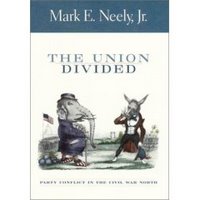
One of the many pleasant surprises in Mark Neely's The Union Divided is the fuss he makes on discovering the sub rosa manpower dialogue between Lincoln and McClellan.

The incidents I've collected on this for my own use complement rather than duplicate Neely's - a situation that tempts me to push this topic towards an article-length project. Needless to say, Union Divided appeared before this blog started and so I tender my complements to the author who "broke the story" to the fleas-across-the-barnyard crowd.

You have yoursleves, as readers, caught a glimpse of this exchange whenever pop historians trot out the Lincoln quote about sending men to McClellan being like shoveling fleas across a barnyard. It's a cute bit of imagery that plays into the wise-but-humorous Lincoln stereotype and it's generally deployed in a rundown of McClellan's peninsula manpower demands.

It makes no sense in that context, however, which caught my attention the first time I saw it. The imagery is about diminishing strength not increasing strength. Lincoln generally being someone who expressed himself as intended, it has to be taken at its meaning. It helps to know that this is one bit from an extended "offline" conversation in which the general presents the president with the horrifying reality of strength on the field.

Given the historian's love of utterly round numbers based on ludicrous muster roll figures, it may be another generation before our writers catch up to the core of the Lincoln / McClellan exchange on this. I'll quote an earlier post:
In speaking to some ladies after Antietam, Lincoln told them that McClellan lost 30,000 men to straggling within two hours of the start of the battle.

At the end of the battle on the Antietam, Mac had George Meade, then commanding Hooker's Corps, prepare a secret memo for Lincoln's visit telling how many men Hooker had brought into battle versus what the returns said he brought to bear. Here is Meade:

I prepared a statement showing that Hooker's corps on paper was thirty-one thousand five hundred strong; that of this number there were present for duty only twelve thousand, and of these, a numerical list, made on the day of battle after we came out of action, showed only seven thousand. Hence, while the United States were *paying* and the authorities at Washington were *relying* and basing their orders and plans on the belief that we had thirty-one thousand five hundred men, facts showed that we had in reality, on the field fighting, only nine thousand. As to the seven thousand that came out of the fight, we should add some two thousand killed and wounded in it. (Geo Meade, letter to his wife, 10/5/62)
Neely characterizes Lincoln as "obsessed" with the disparity in AOP muster roll numbers and boots on the ground and I think a case can be made for "obsession." Neely may err, however, by focusing this in the timeframe of the Maryland Campaign and McClellan's second Richmond drive when it can be found in summer correspondence.

On to Neely's incident collection.

First, he notes that Lincoln was soliciting strength numbers directly from McClellan's subordinates. This was very typical of Lincoln's unpleasant management style but it is untypical in its being systematic and topically focused.

Neely does not say this, so let me emphasize a point of my own. There is a point where Lincoln validates what McClellan has been telling him. He satisfies himself that McClellan's need for men arises from the very low AOP "participation levels" (my term). The low level of Union participation in combat dictates the need for a higher count of muster roll strength - and that is not something that can be openly discussed. And so Lincoln and McClellan carry on this quiet exchange about it.

McClellan was (predictably) much more discreet about this embarassment than Lincoln and so much of the evidence of their interactions on this comes from Lincolnian materials. Neely cites a letter in which Lincoln writes
The Army is constantly depleted by company officers who give their men leave of absence in the very face of the enemy , and on the eve of an engagement, which is almost as bad as desertion. At this very moment there are between seventy and one hundred thousand men absent on fulough from the Army of the Potomac.
Now, having internalized McClellan's dilemma, Lincoln needs an explanation for it. He rationalizes in this letter that the men are demoralized by McClellan's reliance on strategy - that hard fighting would keep them by the colors. All in all a rather startling demonstration of the distorting strength of Republican war fighting ideology on the mind of an ace lawyer, I would say.

But I may not have done his point justice. In a meeting with members of the Sanitary Commission, Lincoln begins a diatribe against McClellan on the same Radical lines. However in this particular rant, he suggests that absenteeism is so high because soldiers feel the war will be won by strategy and that therefore their suffering is not entirely necessary. In other words, McClellan can do it without their individual sacrifices. He again refers to the machinery of absenteeism as being the company furlough. (Elected officers in the army's overwhelmingly Republican regiments knew how to stay elected, indeed they did.)

In December, the month after McClellan's relief, Neely notes a Lincoln letter to Orville Browning which returns to the problem of absence with leave. Lincoln tells Browning that the absolute highest ratio of AOP strength that could be brought on to the field was 60%. He tells Browning that the combined armies before Antietam showed a muster roll strength of over 180,000 but that only 93,000 were present for duty.

Note that it is from the present for duty numbers that you begin to deduct for details, detachments, illness, and battlefield skulking and that Lincoln's 93,000 would include the capital defense forces not taken to the field against Lee.

Chilling stuff: an impossible manpower dilemma; an irrational boss who hates strategy and blames his leading general for absenteeism; a hardened veteran enemy with high morale and unified leadership.

That's my Civil War. Thank you, Mark Neely, for noticing it.

6/23/2006

Pop go the professionals

When the journalist-turned-history-writer Allan Nevins founded his own history society it had two major aims: popularize what he called "dry as dust" history and begin publishing a pop history magazine for a mass audience.

The magazine he founded, American Heritage, was very successful during the Civil War Centennial. Its success has been an albatross around the necks of deep Civil War readers for almost 50 years.

Nevins' stable of editors and writers, Catton and Sears among them, developed what non-journalists would call "a winning formula for success." Within journalism it's called "a successful editorial policy."

What brings people back to serials, issue after issue, is the experience of pleasurable sameness mixed with the odd surprise. That is the magic of good "editorial policy." You maintain that policy by soliciting and cultivating writers with compatible views and by acting with surgical coldness against the others. In the case of a history magazine, there is a dangerous side effect. Editorial policy can easily resolve itself into a set of historical doctrines dogmatically enforced by editors. At AH, the policy needed to do good business became Civil War historical doctrine.

As a naive mass audience gobbled up AH, it unknowingly ingested a highly specific and ahistorical view of the war ... an view heavily laden with recycled Republican newspaper analysis developed after 1860.

But the public couldn't get enough of it. They not only bought AH-issued books about the ACW, they followed the AH article writers into their own book projects - projects that carried the AH editorial policies outside Nevins' editorial conference rooms and into trade publishing.

AH constituted a de facto network of pop authors and writers helping each other get deals, endorsing books, sitting on prize committees. To the publishing industry, these people represented publishing success and a certain level "normalcy." The doctrines they opposed were marginalized and viewed, within trade publishing, as odd and risky.

A generation of young Civil War buffs who read widely in the 1960s, has come to the fore under the profound influence of Nevins' editorial policy. Many of them are now professors sitting on two stools, doing whatever serious research is required by academic norms and lusting in their hearts to write the next blockbuster nonfiction Oprah offering. They don't fit well into the universities and the universities tend to distrust them.

James McPherson has provided a certain amount of "cover" for these Centennial-influenced academics. A Centennialist himself, he represents a certain amount of academic legitimacy in the same way that a successful business represents legitimacy.

As an obscure young race relations historian during the Centennial years, McPherson absorbed the editorial policy of American Heritage and internalized it. When the time came to write a one-volume history of the war, McPherson mined Nevins' network's published output to recapitulate the war as AH saw it. The popularity of Battle Cry of Freedom has revived Nevins' editorial choices and carried them into a new century.

Which brings me (finally) toward the point of this post. The military professionals running the armed services today have an immense appetite for nonfiction beach reading. They command organizations that until a decade or two ago published excellent, highly technical historical monographs. It is baffling to see my generation of generals endorse reading lists made up of bus station newsrack literature.

Is it nostalgia for AH? Or have they, in the course of their advance degrees, come under the influence of a certain generation of historians occupying academic chairs?

Case in point - the Air Force - a technical branch of the services. The chief of staff's new additions to *his* reading list are 80% easy reading. Do jet engine mechanics rely on easy reading to learn their craft? How about the strategic missile command - are they getting their know-how doled out in grand generalizations?

I am very nervous about "professionals" with access to nuclear stockpiles considering Battle Cry of Freedom as professional development material. Makes me wonder how far down "professional" has been dumbed.

For a deeper chill, click on any of these links and read the incompetent review behind each Air Force book recommendation.

If you want to be taken seriously, mon general, show some seriousness.

(Photo, above right: the chief of staff's reading list depicted as a military aircraft.)

6/22/2006

Historical in(ter)vention

Construction workers building a McDonalds in Fairfax, VA, dug up six skeletons in 1995.

After a lot of red tape, the skeletons have just now been buried with military honors in Massachusetts as members of the Bay State's 1st USV regiment ... without identifying any of the bodies. That is weirdness going well beyond remarkable. For this to have happened, history (or rather the magic of "HISTORY!") must have bewitched the public.

Another example of this witchcraft: middle schoolers re-enating the battle of Antietam. The point being what, exactly?

No point to activity = "posessed" behavior.

Folks, we are getting very strange side effects ingesting the commodity retail version of HISTORY!

6/21/2006

Tourism: concentration and dispersion

The facts of life of Civil War tourism, as previously mentioned here, are that the big attractions concentrate visitors and the lesser attractions struggle to attract those few Americans who may have heard of them. There is the Gettysburg tier. Below that lies Antietam (maybe Shiloh, Chickamauga, Fredericksburg, and Vicksburg are on the same plane as Antietam). Below that yawns the void that eats dollars invested to attract visits.

There are two schools of thought among economic planners. The first is that concentration is essential and that smaller attractions are harmful to the main attraction(s). The second school of thought is that "trails" should either ladle out the abundance of tourists from the main site or create a significant attraction through a composite effect of lesser destinations.

Right now, in the battle of heritage tourism, the dispersionists have whipped the concentrationists.

Meanwhile, bucking the trend, two towns have opted out of a Maryland Civil War trails type of program, to the consternation of many. These towns are Brunswick (formerly "Berlin") and Walkersville. The naysayers there soberly suggest that costs will outweigh benefits. The ayesayers are baffled by that idea, particularly since they seem oblivious to hidden costs. They seem also to believe that there is an unlimited supply of outsiders ready to visit and spend their money in local establishments.

A particularly odd display of the tourism prosperity syndrome comes out of Burkittsville, near Crampton's Gap: " 'I encouraged my council to approve it [trails membership],' said Heidi Campbell-Shoaf, Burkittsville mayor and the curator of the Historical Society of Frederick County." Why? Maybe that's the historian in her speaking rather than the promoter of local commerce.

I have, on the way to the Gap, looked around Burkittsville in a quest to spend my outsider money and thereby enrich the locals. Resident Tim Reese told me there was a store where I could have (IIRC) bought a broom, if I had been paying attention. I have missed this broom outlet on the last two or three visits. I am Heidi's tourist. I was carrying those coveted tourism dollars. How many failed broom transactions will the trail bring to Burkittsville and at what cost?

Meanwhile, what a remarkable piece of mass psychology this heritage tourism is.

Locals may look at at their local ACW site as Gettysburg scaled down. But Gettysburg doesn't scale - the fall off in tourist interest is exponential. And somehow, lost on everyone, is that further reality of Gettysburg debating casinos because so many tourists skip visiting the town.

(By the way, have you looked at the commercial "district" of Sharpsburg lately? Is that something to aspire to?)

May I finally point out that the effect of Gettyburg - as place - is overwhelming, in part because of the scale, in part because of the incredible number of monuments, and in part because of the place it holds in the national imagination. This generates word of mouth, regardless of whether the visitor is ACW savvy or not. The effect can't be repeated by driving through a number of weedy crossroads marked by rusting signs. Nor will it be generated in a pep talk on the role of Berlin in the Civil War.

If you want to be like Gettysburg, you need stories about turning points, an immense amount of funerary architecture, hundreds of acres of tidy green, and serious amenities and commercial infrastructure. You need lots of books published about your place plus a few movies. You need to have heard about the place in grammar school.

When you pass that threshhold, you become eligible to fruitlessly debate new ways to try to get people into the shopping districts downtown. The wiser heads in Brunswick and Walkersville understand that and sensibly voted themselves off the trail. Which would have cost them money sooner or later.

There's a bumpersticker for you: GET OFF THE TRAIL!

Brief story here.
Long story here (requires sign-up).

The correct way to preserve

CWPT is doing it exactly right in the case of the Slaughter Pen Farm. Why not encourage them with a donation?

"Can nation's parks survive the pressure?"

Gloom aplenty. But define "survive."

6/20/2006

Glaciers and icepicks

Just read the 2005 paperback edition of Mark Neely's 2002 The Union Divided and figured out how to earn a big fat Amazon sales rank of "#1,468,736 in Books." (Is that the lowest Amazon rank ever awarded?)

Here's how: buck the tide of Centennial happyfaces fresh from their Ken Burns DVDs. Ergo:


(1) Argue that the two party system hindered the Union war effort.

(2) Use the writings of James McPherson as examples of getting-it-wrong.*

(3) Point out that it is very hard to connect the president or the Republican Congress with anything remotely resembling "modern war." Underscore that the Republican concept of war was a throwback.


(4) Note that the press had a detrimental effect on the public's understanding of military affairs and events througout the war, particularly the Republican press.


(5) Observe that the Civil War years politically represented a regression to the early republic when
political opposition was equated with sedition.

(6) Deplore that the political history of the war has been "sadly neglected."


Here are some quotes to designed to reap trouble:
... the Republican political victory in 1864 buried for a century the military lessons of the Civil War.
Oh dear. The Republican interpretation of the war, civil and military, is all we have had for 140+ years. More trouble ahead:
To survey what historians of northern politics have said on the subject [of two Union parties] over the last generation is to discover a glacial unanimity that has virtually frozen scholarship and fresh investigation of the subject.
I think I know that glacier.

And if you think that a generation of glacial unanimity surgically froze out your own new thinking on party politics during the war you are making the same error that Steve Newton made when he decided that the Centennial accounting of the war in the east was correct except for its treatment of Joe Johnston.


Look beyond your single issues to behold the wholeness of that ice sheet my friends. Then grab your icepicks.


More on this book later in the week.


***


(* A Pulitzer winner using McPherson's stuff as an example of nonsense - see p. 180 - indeed, the times, they are a changin!)

6/19/2006

“Livin' on jack and queens” - thrilling conclusion

We now test the Maverick screenwriters' (episode, "Gun Shy") possible need for Civil War consultants, as promised. Research has been supplied by the Civil War historical consulting firm of Hasty & Slovenly.

Issue #1: The matter of John Brown doing a mass killing in Kansas as opposed to Missouri.

Hasty & Slovenly: "Brown and seven of his followers ... brutally murdered and mutilated five pro-slavery men near Dutch Henry's Crossing on Pottawatomie Creek in Franklin County[Kansas]." (Link)

Issue # 2: Union military operations against Rebels in Kansas in 1863.

Hasty & Slovenly: Pursuit of Quantrill, after the sack of Lawrence of course.

Issue # 3: Were any rebel units permanently or temporarily based in KS?

Hasty & Slovenly: Probably not, though more research needs to be done.

Issue # 4: Did Confederates back any of their paper with redemption promises against gold?

Hasty & Slovenly: Occasionally. We found a redemption pledge similar to the one in the episode: "Redeemable in Gold within Six Months after the Raising of the Blockade of our Coast."

Gentlemen, your conclusion?

Hasty & Slovenly: Maverick's scriptwriters did not need Civil War history consultants.

6/18/2006

What we need more of...

Electronic book sites. Here's Tim Reese's.

In the early 1980s, I founded a publishing company starting with an electronic newsletter (available via TELEX, and some old online non-Internet services). For reasons not known to me, Mid-East Business Digest is still being downloaded and I still receive royalty checks for material written in 1983. Some of my distributors have made my ancient writings available on pay web sites. I am not suggesting this as a business model but draw your attention to the fact that information and analysis are extremely durable and (to someone, somewhere) useful.

I wanted to get into book publishing in 1982, however I knew that the book sales cycle was inordinatey long, which meant that the information feedback cycle would be painfully extended. To learn book publishing quickly, I entered the music business in which the manufacture / sales / returns / payment cycle was identical but highly compressed. In book publishing one project might disclose its secrets in 18 months. In music I got project feedback much faster and learned the wholesale and retail distribution on the QT.

This experiment took on a life of its own when my company's first releases more than paid for themselves; the temptation to continue here was thwarted, however, once "the industry" decided that the dual record and cassette release format needed a third format, the CD. (We indies viewed the introduction of CDs as economic warfare.)

I say all this to make a simple observation. Considering the amount of hassle shouldered by some of my fellow record company owners in the mid-eighties in issuing every release in no fewer than three formats - not counting singles - I am completely baffled as to why book publishers cannot create and maintain an e-edition of every hardcopy book they release.

What the hell? Every manuscript is submitted as an electronic file and it makes its way through the book publishing process as an electronic file!

What is the problem that keeps good work from staying in print (via e-editions)? We have actually gone through controverisies in publishing with contractual e-rights between author and publisher. Have they not been settled?

The best outcome right now seems to be one in which rights to out-of-print editions revert to authors, and authors republish e-editions.

Tip of that hat to Tim Reese for blazing this path.

[p.s. If you have not read his work on the Maryland Campaign, I am reasonably sure you do not understand it. I say that having been humbled reading Tim's books.]

6/15/2006

“Livin' on jack and queens” - without consultants

Watching an episode of Maverick on DVD I became overwhelmed by the curious details of its Civil War subplot.

Postwar treasure hunters are looking for family members who co-founded “Elwood, Kansas” (Dodge City, KS per the later part of this post). They want to ask about the family’s former land holdings.

They are told the family in question was massacred by John Brown, who achieved a 100% efficiency rating in this transaction. (“Memory, speak: Did John Brown conduct any massacres in Kansas?”)

The locals refer to the family as “Copperheads.” (Anachronism alert! Then I think, “It’s okay, the postwar locals are logically applying a sensible description based on later events.”)

In this story, a certain Confederate guerilla leader, a transplanted Louisianan, was operating around his new Kansas neighborhood during the Civil War. (“Memory speak: Were there Rebel partisan bands based in Kansas?”)

He is forced by military necessity in 1863 to try to get his operating funds out of Kansas but is compelled to bury them there on “Copperhead” land as Union forces close in on his organization. (“Memory: List the Union military operation in Kansas in 1863.”)

Spoiler alert: his operating funds are characterized as gold, which is what misleads postwar treasure hunters. They are actually notes promising to pay the bearer a certain amount of gold after the Confederate government achieves victory and independence. (“Memory: Did the Rebels issue any redeemable paper whatsoever aside from Cotton Bonds in Europe?”)

With the memory banks overheating, it was a little hard to absorb the main lines of the episode, which were truly excellent. Warner Brothers essentially filmed a complete faux episode of Gunsmoke, based in Dodge City, complete with Matt, Doc, Chester, and Miss Kitty and then dropped James Garner’s Maverick character into the Gunsmoke episode as the villain, providing the core joke (based on Maverick’s hilariously non-villainous nature). The climactic gunfight between Matt Dillon and Maverick was a deliciously cruel piece of satire. Excellently post-modern for 1958. If you remember these two shows, the DVD is a must-see.

Nowadays, producers hire consultants to help keep their facts straight. I’m not sure the consultants are doing a great job – they might potentially have reduced my brain strain in this old TV episode, but they would have done so by pigeonholing: John Brown would kill Missourians; a Quantrill-type guerilla would cross borders not base himself in Kansas; a famous military operation (instead of a generic one) would force Rebels treasure to be buried posthaste.

I’ll match the fuzzy possibilities envisioned by Maverick’s scriptwriters vis a vis the historical record in another post to test the potential value added of history consultants to this episode

6/14/2006

Military metaphors

I was reading the second edition of the book Death March ("The #1 guide to identifying and surviving death marches...") when it occurred to me how rich the Civil War reader is in business metaphors.

Death March, as the title suggests, is a business book about projects and the author says that anytime he uses the term in a business setting people know exactly what he means.

I started picturing dialogs between ACW readers in the workplace.

Q: Hey, how's your project going?
A: We're advancing on Corinth, only slower than Halleck.

Q: Hey what's this new assignment you've got?
A: Commander of all Quaker cannons.

Q: Hey, how's business?
A: If the competition is Earl Van Dorn, we're Holly Springs.

Q: You finished that project yet?
A: We keep riding around McClellan's army without much result.

Q: Workin' hard or hardly workin'?
A: I'm waiting for my pontoon bridges.

Got any?

6/13/2006

Outnumbered

The Klan at Antietam: reinforced by American Nazis to a total strength of 30.
 
Anti-Klan demonstrators: 30.
 
Police: 200.
 

6/11/2006

Popper, Hobsbawm, Voegelin, Valee and the Lost Cause - 3

The great French UFOlogist Jacques Vallee (right) noted in the middle/late 1960s that the saucer phenomena provided us as a society with the unique chance to document myth in formation – in real time, in modern times - and that we lacked the tools and strategies necessary to accurately record (for social science) this profound anthropological display. He felt we had lost an immense opportunity.

The situation was the same when those articles and writings emerged over a century ago that we tag “Lost Cause” thinking. They still exist: we can study them even now as emergent myth or as emergent tradition, but we are not yet ready for that level of analysis. Vallee observed a predicament that has not changed in forty years. The situation has deteriorated, if anything. Still being ill-equipped to observe or measure the emergence of myth or tradition, “Lost Cause” criticism is necessarily primitive and unsatisfying.

There are, as I said, available to letter readers and newspaper skimmers certain wartime Southern memes that take the form of insights or truths about the larger issues. Contemporary writers are interpreting great events and people’s relation to those events. The white Southerner is in crisis and the crisis is cosmic, touching every aspect of life: contracts, friendships, family relations, the meaning of loyalty, of nation, of justice, of personal self-respect, familial survival, and much more of course. And even now, we hear the old memes in these write-ups echoed in modern conversations with descendants of combatants.

Eric Voegelin (photo, right) writes that “symbolizations arise from a people’s experience of order” - this is a partial answer to Popper’s question of where traditions originate. Nowhere does “experience of order” bear down harder on a people than in a desperate war of independence – or a war of rebellion.

Voegelin said, that for Aristotle, “Society was a cosmion of meaning, illuminated from within by its own self-interpretation,” and this is certainly true of Southern society of the Rebellion period. Our task is to unpack that self-interpretation. Voegelin seems to be talking directly to Centennialists like Gallagher and Nolan and their attack on “Lost Cause” history when he says [emphasis added],
The symbols in which a society interprets the meaning of its existence are meant to be true [as opposed to a conspiratorial Hobsbawmian manipulation – DR]; if the theorist arrives at a different interpretation, he arrives at a different truth concerning the meaning of human existence in society. And then one would have to inquire: What is this truth that is represented by the theorist, this truth that furnishes him with standards by which he can measure the truth represented by society? What is the source of this truth that apparently is developed in critical opposition to society?
Wartime white Southern society, one might add. And this is the rub: critics of what could be called Lost Cause memes understand that criticism of “Lost Cause historiography” involves proclamations of “truth … developed in critical opposition to [Southern] society.” They use historiography to assume the role of critics of that society and its descendants. They are not studying and interpreting, they are proclaiming.

Oddly enough, the people least equipped to manage any sort of historiography whatsoever – the Centennialists – seem the most interested in “Lost Cause” historiography. But to the extent that they are focused on “correcting” various “errors” they never actually engage historiography at a “real” level, at the level of philosophy of history.

“Lost Cause” is a polemical construct, make no mistake. It’s an ism assembled from bits of analysis – Lost Causism. It in no way connects with the representational truth embedded in the self-interpretation of a society in crisis; it in no way attempts to connect with the cosmion of white Rebellion and its social and psychological ramifications. It’s a series of external criticisms. Voegelin again [my emphasis]:
More than once in a discussion of a political topic it has happened that a student … would ask me how I defined fascism, or socialism, or some other ism of that order. And more than once I had to surprise the questioner – who apparently as part of a college education picked up the idea that science was a warehouse of dictionary definitions – by my assurance that I did not feel obliged to indulge in such definitions, because movements of the suggested type, together with their symbolisms, were part of reality, that only concepts could be defined but not reality, and that it was highly doubtful whether the language symbols in question could be critically clarified to such a point that they were of any cognitive use in science.
This is the core dilemma of “Lost Cause” criticism. The Centennial Unionist, who rarely operates as an historian per se, has entered into yet another very personal, very emotional argument with the past.

6/09/2006

It's here, it's there, it's everywhere

"The psychological effects of what Poussaint and Alexander call post-traumatic slavery syndrome that blacks have managed to hold at bay for so long may finally be catching up to us in 2000, 135 years after slavery's end."

"Leary's concept [for post traumatic slavery syndrome] is based on the theory of Post-Traumatic Stress Disorder (PTSD), which is firmly accepted by the psychiatric establishment.... As Leary also pointed out, PTSD is not a new disorder; there are written accounts of similar symptoms going back to ancient times. During the Civil War, there was documentation of a PTSD-like disorder known as Da Costa's Syndrome."

Da Costa's syndrome - "A disorder combining effort fatigue, dyspnea, a sighing respiration, palpitation, sweating, tremor, an aching sensation in the left praecordium, utter fatigue, an exaggeration of symptoms upon efforts, and occasionally complete syncope [fainting]. Symptoms and signs of this syndrome closely resemble those of emotion and fear, rather that those of «effort» in normal subject, and depend on central stimulation. The disorder is most commonly seen in soldiers during time of stress, especially when an element of fear is involved. It was frequently observed in the American Civil War and World War I soldiers. It may also occur in young males or females who have suffered disruption in their emotional life.The syndrome was first described by Arthur Bowen Richards Myers (1838-1921) in 1870. Da Costa’s publications in 1871 gave an account of observations made during the Civil War."

"A Portland lawyer says suffering by African Americans at the hands of slave owners is to blame in the death of a 2-year-old Beaverton boy. Randall Vogt is offering the untested theory, called post traumatic slave syndrome, in his defense of Isaac Cortez Bynum..."

"James C. Garrett, a fringe candidate for mayor of Seattle, argued at an administrative hearing yesterday that his name should appear on the primary-election ballot despite a felony conviction for assaulting then-Mayor Paul Schell with a bullhorn four years ago. At yesterday's hearing, Garrett, 59, offered a rambling challenge to the authority of the U.S. government and said he suffered from post-traumatic slavery syndrome."

6/07/2006

More Lost Cause on Friday

Extensive travel tommorrow. See you soon.