11/30/2012
From my forthcoming book...
Suppressed Lincoln Photographs with Notes and Commentary. You can see why this one was suppressed. The UFO-shaped lights are not imagery artifacts. See my other book, Lincoln and the UFOs.


11/29/2012
Foner strikes again
Eric Foner returns to his criticism of Lincoln (the film) in a letter to the editor of the New York Times.
The letter below his, by a Williams College student is also worth a look.
Meanwhile, you'll be delighted to know Harold Holzer ("Lincoln scholar"!) is preparing a "companion book" to the film.
The letter below his, by a Williams College student is also worth a look.
Meanwhile, you'll be delighted to know Harold Holzer ("Lincoln scholar"!) is preparing a "companion book" to the film.
11/28/2012
Hey scholars! Get off Spielberg's back!
So says Kevin Levin in the Atlantic.
Nice to see a blogger make good but he must now use his superpowers to battle evil. That's the deal, IIRC.
If scholars are on Spielberg's back, it's to get a better bum kissing angle.
Nice to see a blogger make good but he must now use his superpowers to battle evil. That's the deal, IIRC.
If scholars are on Spielberg's back, it's to get a better bum kissing angle.
11/27/2012
Guelzo's "joy" over Spielberg's Lincoln
We have come to expect from Lincoln scholars a slobbering, insensate endorsement of every piece of craptastic pop culture touching upon AL.
As I have noted before, these people are trapped in a Gommorah Syndrome where they argue as if with God that the [whatever] be spared [our criticism] if even one little child is eventually led to a future enjoyment of [what they imagine to be] history.
Now, Allen Guelzo has written a movie review that is a study in equivocation that allows him to conclude his review with a reaction of [qualified] "joy."
Perhaps Lincoln scholars are so used to patting each other on the back that they lack the chops to lower the boom on bad product.
Take a look at this, by Guelzo, and again, compare it to Foner's succinct criticism of the project.
And while you're at it, amuse yourselves with this.
In publishing Guelzo's review, the Daily Beast only had to get two facts right: his name and his occupation. But somehow, they made him out to be a "Civil War historian."
Please don't compare Lincoln scholars to Civil War historians. They don't rate nearly that high. As blighted as our little corner of the nonfiction world may be...
p.s. After you tire of Guelzo's studied ambiguity, may I recommend a Nation of Islam review of the movie?
Spielberg is the master of American propaganda, and there is no one since the notorious director D.W. Griffith who has more successfully exported to the world a utopian vision of America as a Caucasian paradise.The baristas call that "robusto."
11/26/2012
McClellan at Antietam - a vigorous defense
Gene Thorp, cartographer, defends McClellan on all points on an NPR talk show. The callers are what you would expect, however.
He was apparently invited on based on this WaPo piece.
He was apparently invited on based on this WaPo piece.
11/22/2012
Huffpo can't find its quote marks
Lynn Parramore is a "cultural theorist" and writer for the Huffington Post. She recently wrote an article about Lincoln being a railroad lawyer.
The first red flag was highlighting as history a famously fakelore quote attributed to Lincoln and naively publicized by Al Gore (who had been taken in by the hoax). This is "I see in the near future a crisis approaching ..." - "a bold, unblushing forgery..."
The rest of the article contains the occasional quote mark, which is proof that Parramore is familiar with these exotic markings. It also includes the footnote, "For more on Lincoln’s railroad advocacy, see James W. Ely Jr.’s 'Abraham Lincoln as a Railroad Attorney.'" Ely is also mentioned in the body of the article.
To show what happens next, I will now link to Ely, which Huffpo neglected to do.
The Parramore text given below does not appear in quote marks, nor is it indented or boxed or otherwise set apart from her exposition.
Ely:
p.s. A real "cultural theorist" would over-use quote marks if anything, don't you think?
The first red flag was highlighting as history a famously fakelore quote attributed to Lincoln and naively publicized by Al Gore (who had been taken in by the hoax). This is "I see in the near future a crisis approaching ..." - "a bold, unblushing forgery..."
The rest of the article contains the occasional quote mark, which is proof that Parramore is familiar with these exotic markings. It also includes the footnote, "For more on Lincoln’s railroad advocacy, see James W. Ely Jr.’s 'Abraham Lincoln as a Railroad Attorney.'" Ely is also mentioned in the body of the article.
To show what happens next, I will now link to Ely, which Huffpo neglected to do.
The Parramore text given below does not appear in quote marks, nor is it indented or boxed or otherwise set apart from her exposition.
Ely:
During the late 1850s Lincoln received more in fees from that carrier than from any other single client, and he was closely associated with the Illinois Central until his election to the presidency.Parramore:
During the late 1850s, Lincoln collected more fees from Illinois Central Railroad than from any other single client, and he was closely associated with Illinois Central until his election to the presidency.Ely:
Lincoln first appeared for the Illinois Central Railroad, probably the largest business corporation in the state in May 1853.Parramore:
Lincoln first appeared for the Illinois Central Railroad, probably the largest business corporation in the state, in May 1853.Ely:
In 1851, in his first major railroad case, Lincoln represented the Alton & Sangamon Railroad before the Illinois Supreme Court in a case against a defaulting stock subscriber.Parramore:
In 1851, Lincoln tried his first major railroad case, representing the Alton & Sangamon Railroad before the Illinois Supreme Court.Memo to HuffPo: if the author mentions a source, go look at it. Compare and contrast. Take an interest in whatever it is you're publishing. Some of your readers might and that could prove embarassing.
p.s. A real "cultural theorist" would over-use quote marks if anything, don't you think?
11/21/2012
After Foner, the usual suspects
Eric Foner used the 15-30 seconds given him by CNN to substantively criticize the basis of the film "Lincoln" and to identify its central historical error. He made a compelling and interesting point in under a minute.
Meanwhile, a blogger at WaPo has collected other comments from authors attending the Lincoln Forum.
Harold Holzer: "I loved it."
Meanwhile, a blogger at WaPo has collected other comments from authors attending the Lincoln Forum.
Harold Holzer: "I loved it."
However, he said, the way the vote for the 13th Amendment was depicted in the House of Representatives was wrong. The roll call was, and is, always done alphabetically and not by state.Catherine Clinton: "... completely mesmerized by the film’s ability to capture Mary’s complexity."
She pointed to one inaccuracy in the movie, the scene where Lincoln slapped his son Robert. It never happened, she said.John Marszalek:
“[Grant] wasn’t that tall,” the forum speaker said. “His hair was too red and he wasn’t that aggressive. He was also too talkative. He would never have talked that much.” However, he still thought the movie excellent and said he planned to see it again.Speaks volumes, doesn't it?
11/19/2012
Foner vs. Spielberg & Co.
I have to tip my hat to Eric Foner for again stepping up to shoot down pop culture Lincoln artifacts. (Guelzo has bestirred himself once or twice but the rest of the Lincoln authors seem utterly useless.)
In a short CNN segment, Foner forcefully lays out the central historical error that invalidates the story arc in Lincoln-the-movie by Kushner/Spielberg/Goodwin. Kushner's rebuttal is hollow (as he hides behind Goodwin's skirts).*
Have a look. Link fixed 11/20.
(H/T to Simpson)
* Now that it's promo time, the utility of Goodwin in advancing this film seems worth the money Spielberg paid for the rights. She's everywhere.
11/18/2012
Petraeus called "phony hero" (O/T)
Truscott IV is lashing out blindly, I think, but I like this part very much:
One does get the distinct impression from Tell Me How This Ends that Petraeus was overwhelmed and unequal to the tasks he set himself in Iraq.
Rebuttal here.
More interesting is two seniormost officers going to a Tampa socialite for help suppressing free speech on a shock jock's radio show. Time weighs heavily on the hands of any four star, for sure.
Those colonels McClellan purged from the Army with special boards? They're running the show nowadays. In fact, they're running riot with stars on their shoulders.
I spent part of the fall of 2003 with General Petraeus and the 101st Airborne Division in and around Mosul, Iraq. One of the first questions I asked him was what his orders had been. Was he ordered to “take Mosul,” I asked. No answer. How about “Find Mosul and report back”? No answer. Finally I asked him if his orders were something along the lines of “Go to Mosul!” He gave me an almost imperceptible nod. It must have been the first time an American combat infantry division had been ordered into battle so casually.IIRC Petraeus himself noted he had no orders whatsoever. But that is modern generalship, of which Petraeus is but a small part.
One does get the distinct impression from Tell Me How This Ends that Petraeus was overwhelmed and unequal to the tasks he set himself in Iraq.
Rebuttal here.
More interesting is two seniormost officers going to a Tampa socialite for help suppressing free speech on a shock jock's radio show. Time weighs heavily on the hands of any four star, for sure.
Those colonels McClellan purged from the Army with special boards? They're running the show nowadays. In fact, they're running riot with stars on their shoulders.
11/16/2012
Lincoln reviews
Reviews are in.
Montreal Gazette: Six score and 12 minutes ago, we went into the movie theatre to see Lincoln, a biography of the 16th president of the United States that was conceived in reverence and dedicated to the proposition that Steven Spielberg should get another Oscar, and Daniel Day-Lewis along with him.
NY1: It's a bit long, close to two-and-a-half-hours, there's a hokey contrived scene early on, and if you don't like history, you might find it a bit tedious.
St. Louis Today: While some people might find 1800s legislative sausage-making to be drier than a C-SPAN marathon, for me it only grounds Lincoln firmer in reality.
Las Vegas CityLife: The early excessive exposition is necessary to set up the rest of the film, as well as for Spielberg to fully impart his appreciation for Lincoln’s dilemma.
Box Office Prophets: This take on Lincoln is undoubtedly an entertainment, rather than a history; while that will not impress those in search of the facts, it is ultimately to the film’s credit.
East Valley (AZ) Tribune: If you have no interest in how our laws were created or the people who made them, then you will probably be bored silly by this movie, because the bulk of this dialogue heavy picture is spent on the strategery ... behind getting the 13th amendment passed.
Salt Lake Tribune: The legislative thriller is a genre that’s seldom seen in the age of C-Span, but Spielberg creates one as riveting as the classic of the form, Otto Preminger’s "Advise and Consent."
WorthPlaying: If you've been turned off by the trailer, please ignore it and watch "Lincoln" anyway.
Lincoln's filmmakers speak

We didn't want it to be a movie of Abraham Lincoln's greatest hits ... what Lincoln and the lobbyists did to get this passed was not illegal. It was murky. To make a movie about a squeaky clean person whose moral principles hold them beyond mortal man or woman would not be interesting to me.I wonder how the legion of Lincoln authors will respond to that.
Meanwhile, I speculated a break between filmmakers and the infamous Doris Kearns Goodwin and I was wrong. Screewriter Kushner consulted her much:
I had known Doris' work. I'd read everything else she'd written and I've always thought she's an extraordinary writer and shaper of narrative..."Shaper of narrative!" I'll be using that.
“Doris' sense of who Lincoln was and how he did what he did became really the guiding spirit for the film,” the screenwriter said. I think it's the Kearns Goodwinian Lincoln that we follow. I talked to Doris two or three times a month, the whole time I was working on the script, and with great joy.The many Lincolns of Abraham Lincoln seems to work against the whole point of history, doesn't it? BTW, is this kiss kiss makeup w/DKG? FYI.
The cost of a modern major general (O/T)
... appears to be $400,000 apiece.
But Mr. Coburn said the problems went beyond bad program funding choices.We seem to have 698 of these types knocking around, doing a little physical training, giving each other briefings, signing new orders. When not sending voluminous emails to female admirers, some of them clearly do not have enough to do:
He said the military now has more generals and admirals per troop than it did at the height of the Cold War. He recommended cutting 200 generals and admirals, which he said would also cut 800 support personnel, for a savings of $800 million over the next decade.
On Jan. 16, two days after a killer earthquake hit Haiti, a team of senior military officers from the U.S. Central Command (responsible for overseeing American security interests in the Middle East), arrived at the Pentagon to brief Joint Chiefs of Staff Chairman Adm. Michael Mullen on the Israeli-Palestinian conflict. The team had been dispatched by CENTCOM commander Gen. David Petraeus to underline his growing worries at the lack of progress in resolving the issue.Good to see elements of Congress interested in oversight. If you haven't served, you haven't experienced the depth of this problem and will tend to give the benefit of the doubt. Feel free to doubt and doubt big.
[...]
The January Mullen briefing was unprecedented. No previous CENTCOM commander had ever expressed himself on what is essentially a political issue; which is why the briefers were careful to tell Mullen that their conclusions followed from a December 2009 tour of the region where, on Petraeus's instructions, they spoke to senior Arab leaders. "Everywhere they went, the message was pretty humbling," a Pentagon officer familiar with the briefing says. "America was not only viewed as weak, but its military posture in the region was eroding." But Petraeus wasn't finished: two days after the Mullen briefing, Petraeus sent a paper to the White House requesting that the West Bank and Gaza (which, with Israel, is a part of the European Command -- or EUCOM), be made a part of his area of operations.
11/14/2012
Listen to Drew
On Beatie's Army of the Potomac, Drew says it well. I too am eager for the next volume. It's been way too long.
As for the glut of Gettysburg books in preparation, I'd save two fingers, not one. Simpson's volume will be interesting and Petruzzi's authoritative.
As for the glut of Gettysburg books in preparation, I'd save two fingers, not one. Simpson's volume will be interesting and Petruzzi's authoritative.
11/13/2012
Memorable history
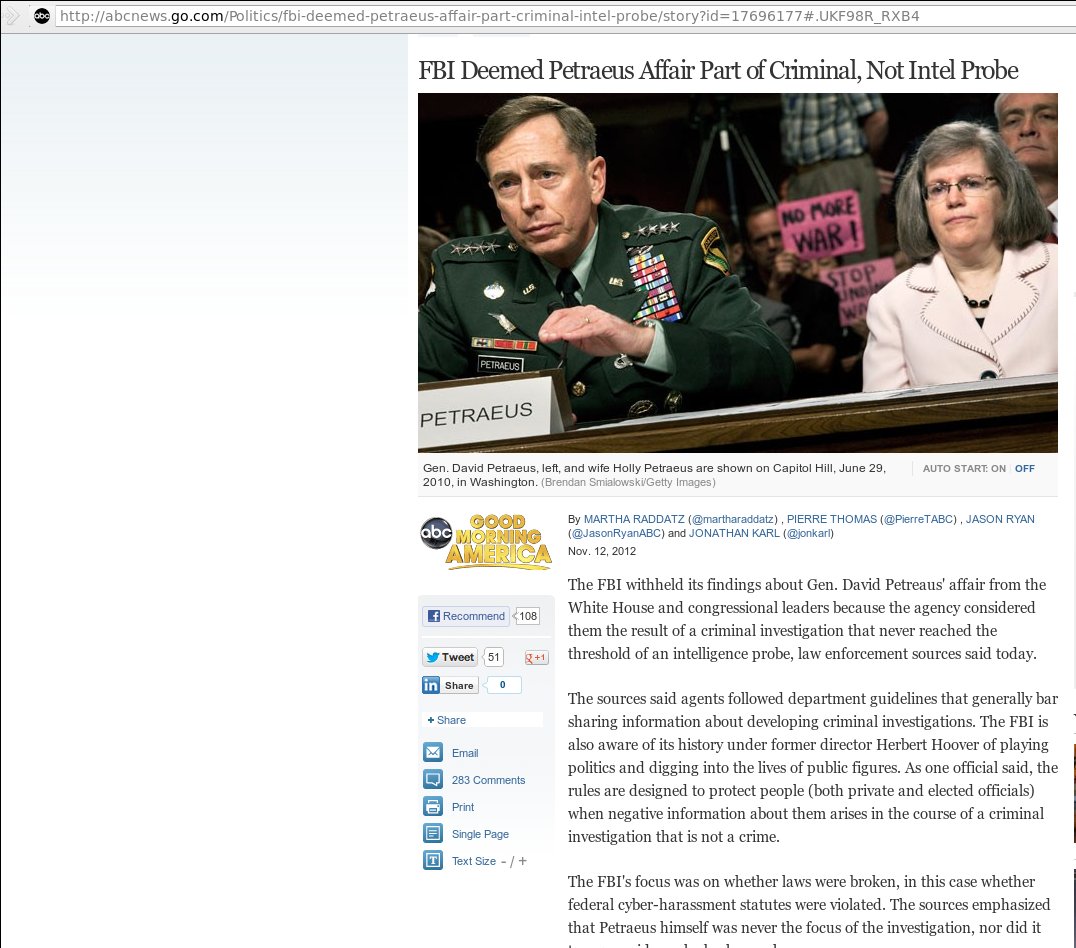
ABC News reminds its audience about the days when Herbert Hoover ran the FBI. See line 3, paragraph 2.
Meanwhile, IIRC, wasn't J. Edgar Hoover president when the stock market crashed in '29? Or was that FDR?
You make mistakes like this when history is not memorable. The authors of 1066 And All That well understood this principle:
Meanwhile, IIRC, wasn't J. Edgar Hoover president when the stock market crashed in '29? Or was that FDR?
You make mistakes like this when history is not memorable. The authors of 1066 And All That well understood this principle:
During the Wars of the Roses the Kings became less and less memorable (sometimes even getting in the wrong order) until at last one of them was nothing but some little princes smothered in the Tower, and another, finding that his name was Clarence, had himself drowned in a spot of Malmsey wine; while the last of all even attempted to give his Kingdom to a horse. It was therefore decided, since the Stuarts were not ready yet, to have some Welsh Kings called Tudors ... who, it was hoped, would be more memorable.Now, that's memorable history.
11/12/2012
The ACW wants you!

“If a [secession] petition gets enough support, White House staff will review it, ensure it’s sent to the appropriate policy experts, and issue an official response,” explains the [White House] website.Big priority! And then some genius put the petition signature requirement at 25,000.
If you want to get a trash collection measure on your state ballot, do you think the threshold will be set at a mere 25,000 signatures? Is this Buchanansism or Machiavellianism? Perhaps the "policy experts" receiving the petitions work at DHS and the FBI?
White House website + do-it-yourself secession instructions = here we are in 2012. Modern nullifiers might be pleased.
The ACW remains pervasive. Let's modify Trotsky's famous saying. Tell your friends: You may not be interest in the American Civil War, but the American Civil War is very interested in you.
---
Update: petitions from 47 states have been filed at this point.
Seward by Stahr - quick notes
Stopped at Bridge Street Books in Georgetown at lunch. Found newly translated novels by Celine and Cendrars there, which made me very happy, magnifying the effect of our Indian summer warmth and sunshine.
There was also present a large new biography of Seward, something I’ve been waiting for over a long time. I picked it up and noticed the dust jacket blurbed by all the wrong people: two plagiarists (Goodwin and McPherson) and a dialectical materialist (Foner). As if further red flags were needed, the praise was about readability – as if the previous works on Seward are unusable because they are unreadable. (The dust jacket could not hold all the praise craptastic authors had for this book, so check out Amazon if you want to see storytellers and recapitulators lavishly praise one of their own.)
I put the index through my McClellan test. There were a grand total of 13 references to GBM in 717 pages. They were appallingly ignorant. In addition to relying on the usual, imaginary “letters to his wife,” author Walter Stahr showed no inkling that Lincoln had been McClellan’s employee pre-war. In discussing the Scott-McClellan relationship, he shows no awareness of the McClellan-Scott family connections described by Rafuse, nor does he have any inkling of the Scott-Seward-McClellan patronage ecology, described in part by Gideon Welles in his diary. Stahr paints McClellan and Scott one-dimensionally as enemies. He does the same with McClellan-Seward, relying on a few snippets from Sears. Seward’s early patronage takeover (from Chase) of GBM is missing, as much as it annoyed Chase, and Seward’s other military clients are also missing from this book, if my quick skim can be relied on.
It’s likely I could find a few interesting points of departure for further research in these pages, but a biographer this tone-deaf and blinkered appears more of a menace than a help to readers.
You could hitch up your pants, grit your teeth, clothespin your nose shut and start reading, but what kind of fun would that be?
11/11/2012
"A lack of critical analysis"
A friend writes about Brands' Grant book:
BTW, Sears needs new authors to stress that special something that validates Grant and invalidates his predecessors or his storylines fall apart. The complexity-relationship comment, meanwhile, is a nod to Brooks Simpson.
A lack of critical analysis? Hallmark of pop history.
Don’t want to beat a dead horse, but I’m sensing a theme.Civil War book reviews are rare - it's unusual to get three high profile such. When they do appear, as in this case, they can end up addressing a book of no merit.
Bonds, WSJ: “. . . the book provides little analysis of Grant’s generalship. Battles are described but not dissected, and Mr. Brands presents no new sources or revelations.”
Foner, WaPo: “What Brands does not do, however, is present new interpretive insights on questions that have engaged generations of historians. . . .”
Sears(!), MHQ: “There is . . . a lack of critical analysis, especially in Grant's often complex relationship with the Lincoln administration, and little explication of just what Grant possessed that was so lacking in other Civil War generals.”
BTW, Sears needs new authors to stress that special something that validates Grant and invalidates his predecessors or his storylines fall apart. The complexity-relationship comment, meanwhile, is a nod to Brooks Simpson.
A lack of critical analysis? Hallmark of pop history.
Web weirdness (O/T)
In one day (Friday), 1300 hits from Googlers searching for Petraeus. Is the web so lacking in Petraeus data that searchers have to come here?
Dear searchers: refine your searches.
Thank you!
Dear searchers: refine your searches.
Thank you!
11/10/2012
Generals who faint (cont.)

* Rear Adm. Charles M. Gaouette ("inappropriate leadership judgment") mid-east carrier strike force.
* Carter Ham, commander AFRICOM, who proposed to defy SecDef (10/18/12?).
* The general who faints, David Petraeus. Rumors are flying. Was he pro-intervention? (11/09/12)
The first two seem to be victims of Panetta's growing Stantonism.
It amazes me that Panetta could hold a press conference after Benghazi, tell everyone publicly that he ordered the military not to respond to the attack and there still is confusion over what happened.
(1) Attack is underway, DoD tells soldiers no go.
(2) Attack is underway, CIA mounts confused, delayed, inadequate response.
The Civil War reader revels in civilian control of the military and hisses theatrically, like a vaudeville theatre-goer, at the mere hint of a Harrison Bar letter. And here we are.
Civil War controversies keep repeating. It will continue so until we stop shrouding the controversies in narrative and engage them as living issues of principle.
p.s. CIA chiefs with undeclared girlfriends - as big deals go, they don't get any bigger.
Subscribe to:
Posts (Atom)