By producing highly centralized structures ... by remorselessly condensing down functions and models, we are transforming all the rest into waste, residue, useless relics.How much Civil War history has been transformed into "waste, residue" by the prevailing narratives and the huckster authors who haunt this corner of the nonfiction world?
5/14/2014
The "Maleficent Ecology" of Civil War history
From Baudrillard's essay "Maleficent Ecology":


5/06/2014
Copperhead, the film

Woods: Do we not today use "The North"* as a foil** against "the South"*?
Kaufmann: The greatest anachronism in an historical film is to have a character reflect 21st Century ideas and values.
Woods: The Liberty Party received 2% of the vote before the Civil War. But if you talk to people today, that's not a radical party because we're all behind the Liberty Party now.
These are summaries and paraphrases, I repeat, and the context of their discussion is modern political Libertarianism in places. Unfortunately, the scant treatment of these kinds of insights spotlights the limits of radio-podcast-video discussions.
(Note: I'm not sure the audio link will stay active beyond a few more days)
--
* as a construct
** in the sense of thesis/antithesis
5/01/2014
You know you want a Lincoln bobblehead

The big question around Lincoln bobbleheads is always **which** Lincoln bobblehead to buy.

Maybe a Memorial bobblehead is the thing.
What is it about Lincoln that affects people such that his image must be tamed, mocked, lampooned, and generally made "user friendly"?
4/28/2014
The Ryan plagiarism scandal: an historian to the rescue
Someone with a good grasp of the material noticed that Professor Vanessa Ryan's Thinking Without Thinking in the Victorian Novel contained copied passages (see the table here).
The perp says she did a mea culpa,
(1) Ryan acted with integrity by stepping forward after being exposed as a plagiarist
(2) She accidentally "mixed her words with others" (the table shows no mixing and the sources did not even get a biblio entry)
(3) Any of us could accidentally become plagiarists at any moment (tragically!)
(3) She should not pay "more than people usually" pay for this action, whatever that means.
It's disturbing that a history professor would make such a defense. Given her attitude toward sources and "accidents," one would hope another anonymous tipster would now go through Flint's books with an eye towards attribution.
Ryan was exonerated by an investigative troika brimming with collegiality. They let her off with rationalizations. The Brown student newspaper:
In reading any mix of my writing and the writings of others, I can recognize others' passages. I may not be able to place the source, but I know when I see others' material. Either Ryan did not read the proofs or perhaps the book was assembled by helpers in a process too embarrassing to explain.
The perp says she did a mea culpa,
Ryan said she took immediate action, notifying her publisher, her department chair, other colleagues and the scholars improperly cited in her book.This "immediate action" came in August 2013 after an anonymous tipster turned her in to the university. Having been discovered, she became terribly sorry. Nevertheless,
Kate Flint, a Victorianist who is familiar with Ryan’s work, and who is chair of the department of art history at the University of Southern California, said that Ryan’s response to the allegations demonstrates her academic integrity.Now, if you will take a few minutes to read the table linked in the first paragraph, you can map your own impressions against these defenses of Ryan's actions (this again from Flint):
...the case demonstrated how easy it could be – even for the brightest young scholars – to accidentally mix their words with others’ after hours, days, and even years spent in libraries covering vast amounts of material. In time, she said, Ryan’s case might even be used a “lesson” for up-and-coming graduate students.Flint's defense, in a nutshell is that
“Any of us could do this,” she said. “It’s a really, really unfortunate, even tragic case of somebody who has done something unwittingly they should not have done being made to pay far more than people usually are.”
(1) Ryan acted with integrity by stepping forward after being exposed as a plagiarist
(2) She accidentally "mixed her words with others" (the table shows no mixing and the sources did not even get a biblio entry)
(3) Any of us could accidentally become plagiarists at any moment (tragically!)
(3) She should not pay "more than people usually" pay for this action, whatever that means.
It's disturbing that a history professor would make such a defense. Given her attitude toward sources and "accidents," one would hope another anonymous tipster would now go through Flint's books with an eye towards attribution.
Ryan was exonerated by an investigative troika brimming with collegiality. They let her off with rationalizations. The Brown student newspaper:
The committee’s final report, delivered ... and approved ... in November, stated that though Ryan’s book contains plagiarized material from other sources, the plagiarism in question “does not rise to the level of misconduct.” “While, as a result of these mistakes, my book uses words from other scholars’ writings without attribution, the substance of the ideas in the book is my own,” Ryan wrote to The [Brown Daily] Herald.Keach and 12 other faculty signed a letter protesting the investigation's outcome.
“Everyone I talked to in the English department understood that document [the troika's report] to be saying that research misconduct included plagiarism, that plagiarism is a form of research misconduct,” [Professor William] Keach said. “Therefore any judgment that a faculty member’s work contained errors that were plagiarism but not research misconduct was a kind of category mistake. It was contrary to the logic of the University rules.”"Category mistake"? Or rank immorality?
In reading any mix of my writing and the writings of others, I can recognize others' passages. I may not be able to place the source, but I know when I see others' material. Either Ryan did not read the proofs or perhaps the book was assembled by helpers in a process too embarrassing to explain.
4/03/2014
Guest Post: Closing remarks on McClellan's telegram from Maurice D’Aoust
Closing
remarks from Maurice D’Aoust:
I couldn’t
help but notice that Mr. Sears has failed to respond to the evidence presented
in my last rebuttal surrounding the phantom “idnight” in McClellan’s September
11th message to Halleck. I
must, therefore conclude that he concedes no “idnight” exists either on the
microfilm copy or on Mr. Thorp’s digital rendering of the message. I was also gratified to see Mr. Thorp's
comment in this regard. Mr. Thorp has
conducted some extensive research surrounding McClellan’s September 13, 1862
telegram to Lincoln and I would encourage him to share his findings at this
time.
Throughout
our debate, Mr. Sears has stated his case in support of the 12M version of
McClellan’s September 13, 1862 telegram and I have stated mine in favor of the
12 Midnight document. I will not
re-hash things in these, my closing remarks. Any who wish to know Mr. Sears’s or my views have now simply to go back
and read our various exchanges on this site.
As for McClellan’s sent copy, I’m certain that, if ever found, the
document will be time-marked 12 Midnight.
The evidence is simply too overwhelming for it to have not been so
marked. I would suggest to Mr. Sears that a jury of our peers has already begun
delivering its verdict and I am referring to Dr. Tom Clemens’s and Mr. Scott
Hartwig's respective works in which both of these prominent historians support
the 12 Midnight scenario. In closing,
I’d like to thank Mr. Sears for the opportunity of publicly debating this very
controversial matter. I would also like
to express my sincere gratitude to Dimitri Rotov for hosting the debate on
Civil War Bookshelf.
-- Maurice
D’Aoust
Guest Post: Gene Thorp offers "A brief clarification for Mr. Sears"
I would like to state clearly that I did not and do not agree with Mr. Sears that finding McClellan's original Sept. 13 Trophies telegram is theonly certain way to settle the time-stamp issue. If it can be conclusively shown that McClellan did not receive the Lost Order before noon, then it would also mean that he could not have reported it to Lincoln at noon.
The misrepresentations from Mr. Sears below about what I have and have not written on this subject are truly astounding. They are generally as accurate as his claim that the word "Midnight" on the Sept. 11 telegram is somehow written under the Official Records stamp.
The misrepresentations from Mr. Sears below about what I have and have not written on this subject are truly astounding. They are generally as accurate as his claim that the word "Midnight" on the Sept. 11 telegram is somehow written under the Official Records stamp.
Sincerely,
Gene Thorp
Washington Post Cartographer
Guest Post: Stephen Sears' second postscript on the McClellan telegram
Stephen
Sears offers this Postscript II on the McClellan telegram and the Lost Order:
In a phone
conversation with Gene Thorpe some time since, he and I agreed that the only certain way to settle the question of
the sending time of McClellan’s telegram to Lincoln on Sept. 13 was to have
McClellan’s original sending copy. Did he time-mark it 12 M (noon) or 12
Midnight? For my Papers of McClellan book (1989) I searched for
this elusive sending copy, and I know Mr. Thorpe has too. No luck so far.
The whole
matter therefore comes down to what happened starting at 2:35 a.m. on Sept. 14
at the War Dept. telegraph office in Washington. In the absence of McClellan’s
sending copy, the primary copy of the Lincoln telegram is the operator’s
received copy. I maintain he did his job capably. That is, he correctly copied
McClellan’s 12 M time mark on the file and carbon copies and on the copy for
Lincoln. Someone added “idnight” to Lincoln’s copy. As explained earlier, by
the logic of the case I believe it was the president himself. I further
believe, knowing George McClellan as I do and knowing the situation on Sept. 13,
he would never have sent his exuberant Lincoln telegram at midnight, an hour
after his dark and gloomy 11 p.m. telegram to Halleck.
Mr. D’Aoust
claims the War Dept. operator did not
do his job—for some inexplicable reason (and not for the first time) he changed
McClellan’s 12 Midnight time-mark to 12 M on the file and carbon copy and the
Lincoln copy. Then an unidentified someone added “idnight” to the Lincoln copy,
but not to the file and carbon copies. Then between 11 and 12 o’clock that
night, a very worried McClellan abruptly became exuberant and composed the
Lincoln telegram.
None of
this—the dolt operator, a hyper General McClellan—makes sense to me. Despite
being accused as a fabricator of facts, I think the facts supporting a noon
telegram are correct and relevant. And that’s
really all I have to say on the subject. If there is a jury out there, I’d like
to hear their verdict.
-- Stephen Sears
4/02/2014
Guest Post: The McClellan telegram, a response from Maurice D’Aoust
Maurice D’Aoust submitted the
following in response to Stephen Sears's March 30th post. "Once again, for ease of reference I have addressed each of Mr. Sears’s points individually."
SEARS:
To argue that
McClellan’s Sept. 13 telegram to Lincoln, announcing the finding of the Lost Order,
was sent at midnight rather than noon, Mr. D’Aoust offers two supposed proofs
demonstrating that the Lost Order did not reach McClellan in time for him to
telegraph Lincoln at noon. A third supposed proof, by Gene Thorp and laid out
in an appendix to the post, attempts to show how a telegram sent at midnight
was erroneously labeled noon in the records, and what lesson is to be drawn
from that.
D'AOUST: How
can Mr. Sears possibly refer to two primary source accounts confirming the 27th
Indiana's 12 noon arrival as "supposed" proof? The first of these proofs is from a Battles
and Leaders article, (vol. 2, p. 603) in which Silas Colgrove writes "The
Twelfth Army Corps arrived at Frederick, Maryland, about noon on the 13th of September,
1862. The 27th Indiana Volunteers, of which I was colonel at that date,
belonged to the Third Brigade, First Division, of that corps." The second primary source is from Antietam
chronicler Ezra A. Carman when he writes, "Williams Corps arrived near
Frederick and halted about noon, very early noon, and this agrees with the
recollections and papers of this author."
See Thomas G. Clemens, The Maryland Campaign of September 1862, Vol. 1:
South Mountain, p. 280 in this regard. Then there is the evidence contained within the message itself
surrounding the taking of Catoctin.
I'll reserve my comments regarding Mr. Thorp's evidence until later in
this response.
SEARS:
The heart of
the matter is this: Just because no sending copy of the Sept. 13 telegram in
McClellan’s handwriting has been found—and I have looked long and hard, far and
wide—Messrs. D’Aoust and Thorp and their advocates say the dispatch was
tampered with or messed with in the telegraphic process. I say the telegraphic
process worked just fine (except for unavoidable delay) and exactly as it was
supposed to.
D'AOUST: Absolutely
no one suggested Lincoln's copy was "tampered with" or "messed
with." These are entirely Mr.
Sears's words. As I've already stated,
the time stamp was amended by someone in order to correct the
telegrapher's "12M" error. The
evidence confirms that whoever amended the document was absolutely correct in
doing so.
SEARS:
To begin with,
I find no factual, confirmable evidence disproving the telegram was sent at
noon, so, obviously, the Lost Order reached McClellan before noon. But Mr.
D’Aoust persists, and his evidence deserves a hearing. He claims the 27th
Indiana did not get to where the Order was found in time for Corp. Mitchell to
do the finding before noon. But Charles B. Dew, writing in the Journal of
Southern History, used the Samuel Pittman papers to show that Silas Colgrove,
the 27th’s colonel, carried the Lost Order to Twelfth Corps headquarters, last
stop before it went to McClellan, before noon. Pittman was General Alpheus
Williams’s aide, identified the Order’s handwriting as authentic, and is a
sound witness. Ezra Carman heard from the courier (urged by Pittman to ride
fast) who delivered the Order, saying he left for army headquarters about 9:30
a.m. (No reliance can be placed on Jones’s regimental history of the 27th
Indiana. It is riddled with errors, such as the canard that Mitchell was
illiterate.)
D'AOUST: The
"confirmable evidence" that disproves the telegram was sent at noon
has been there all along for Mr. Sears
to find. He has simply chosen to ignore
it. The evidence confirming the 27
Indiana did not reach Frederick until noon is comprised of two primary source
accounts from two participants who were there when these events took
place. As for Charles B. Dew's article,
I assume Mr. Sears is referring to Dew's "How Samuel Pittman validated
Lee's 'Lost Order' Prior to Antietam: A Historical Note" in which, as one
reviewer puts it, "Dew uses Stephen
Sears and James B. McPherson's books to synthesize a description of the
event." Is this the article Mr.
Sears is referring to? Ezra Carman,
considered to be the foremost expert on the Battle of Antietam and who was also
present when these events took place, had this to say about Pittman's account: "[i]n this he was evidently mistaken, accounts generally agree that Williams
Corps arrived near Frederick and halted about noon, very early noon, and this
agrees with the recollections and papers of this author." Have either Messrs. Sears or Dew bothered to
investigate Carman's conclusion on this matter or have they simply chosen to
deem Carman a liar? For that matter, why
do they also completely discount Colgrove's Battles and Leaders 12 noon
account? Finally, should two sources
(Carman's and Colgrove's) not trump one (Pittman's)? Tom Clemens, editor of a three volume work on
Caman's papers, has confirmed to me that Carman received no such correspondence
from anyone purporting to be the courier.
In fact, it does not appear anyone truly knows who the courier was, there
being several theories. I must now make
a point of obtaining a copy of Jones's "error riddled" book and wish
to thank Mr. Sears for that heads up.
SEARS:
Next, Mr.
D’Aoust claims that McClellan’s telegram, saying the Catoctin range was in
Union hands, could not have been sent at noon since that feat was not
accomplished until 2 p.m. There is, however, cavalryman Pleasonton’s 11 a.m.
dispatch to McClellan (McClellan Papers) saying he is “4 miles west of
Frederick” at the Catoctins. That was good enough for McClellan to add that
extra bit of good news to his noon telegram to Lincoln.
D'AOUST: Fact: Catoctin pass was not taken until 2 p.m.
Fact: In his 12 Midnight
telegram, McClellan correctly informs the President that he has possession of
the Catoctin pass being that, by then, he truly was in possession of it. Not so at noon. Mr. Sears suggestion that Pleasonton's 11
a.m. dispatch was "good enough for McClellan to add that extra bit of good
news" to a supposed 12 noon telegram to Lincoln is an entirely
unsubstantiated, if not preposterous, fabrication on his part and is
undeserving of even the slightest consideration.
SEARS:
To repeat, if
there is demonstrable proof—as I contend there is—that the telegram was sent at
noon, all arguments that the Lost Order could not have gotten there “in time”
are nulled.
D'AOUST: And
what demonstrable proof does Mr. Sears offer? 1. An Official Records stamp on
the 12M War Department copy. The same stamp as is found on the clearly erroneous
September 11th telegram to Halleck. 2. A
preposterous and entirely unsubstantiated fabrication with which to counter the
Catoctin reference. 3. One account (Pittman's) with which to contradict two
others (Colgrove and Carman) regarding the time of the 27th Indiana's
arrival. Mr. Sears must know that
postulation and fabrication do not cut it as far as "demonstrable
proof" is concerned. Hard, primary
source evidence is what is required and this I have provided as support for the
12 Midnight telegram.
SEARS:
Finally,
Messrs. D’Aoust and Thorp appear willing to rest their case on . . . well,
quicksand. That is, McClellan’s Lincoln telegram was sent at midnight; that the
belief it was sent at noon is due entirely to a
Washington War Dept. telegraph operator who was a dolt, who made
repeated blunders that have muddied the historical waters ever since. I, on the
other hand, find the man entirely capable. He did his job exactly as he was
supposed to do and expected to do.
Mr. Thorp
displays a McClellan-Halleck telegram sent Sept. 11—two days before the Lost
Order telegram—that he claims is time-marked by McClellan 12 midnight. But that
dolt of a War Dept. operator marked it 12 M instead of 12 Midnight as he was
supposed to do and required to do. Now, that’s not just one major mistake,
that’s two major mistakes, perhaps three: 1) Not writing down the time-mark as
sent; 2) writing 12 M, the flat-out wrong abbreviation for midnight; or 3)
somehow misreading midnight as meridian or as noon and therefore rendering it
12 M, telegraphese for noon. The Official Records compilers saw 12 M and for
emphasis rendered it 12 noon in OR 19.2:252.
D'AOUST: Apparently,
Mr. Sears has had a change of heart since writing those last words and I am
referring to his "A Mystery Solved" postscript in which he now
suggests that the telegram to Halleck was, in fact, time marked "12
Midnight" (something Mr. Sears previously

While at the
National Archives Mr. Thorp, was, under the watchful eye of two National
Archives staff members, given the opportunity to view and actually hold
Halleck's received copy of the September 11th telegram and there is even a
picture of him holding the document for all to see. And what time-stamp did the
"competent" telegrapher specify on Halleck's copy? . . . "12M"!
So much for Mr. Sears's "A
Mystery Solved" theory. So where
does that leave us? With a
"sent" copy clearly marked 12 Midnight and a received copy
clearly marked 12M. Conclusion, the
telegrapher failed to faithfully copy the sender's time-mark and did so again
two days later.
SEARS:
To stay with
the Sept. 11 telegram, it’s in a dispatch book in the McClellan Papers. (The
McClellan-Lincoln telegram, not an official message, is not recorded in a
dispatch book.) This telegram is not in
McClellan’s handwriting; he did not break telegraphic protocol by writing 12
Midnight on it. It was dictated (it’s a routine message), and McClellan cannot
have read it or he would have seen it corrected from 12 Midnight to standard 12
or 12 p.m. on the copy. (It’s in the proper chronological order in the dispatch
book.) As noted in my earlier post, McClellan was careful about telegraphic
protocol.
D'AOUST: As
mentioned above, Mr. Sears in his "A Mystery Solved" postscript, has
now changed his mind regarding McClellan not breaking "telegraphic
protocol by writing 12 Midnight on it [the September 11th telegram to
Halleck.]"
SEARS:
Next, Mr.
Thorp would have us believe this same dolt of an operator two days later did exactly
the same stupid thing! That is, on Sept. 13 he deciphered a second 12 midnight
telegram from McClellan, made the same series of blunders for whatever reasons
of his own, and turned it into a 12 M telegram. Then “somebody” at the
telegraph office “corrected” the operator’s 12 M copy made for Mr. Lincoln by
adding “idnight” . . . but for whatever reasons of his own did not similarly
correct the office file copy and carbon.
D'AOUST: Well,
yes, that is exactly what Mr. Thorp would have us believe and in this he is
absolutely correct. Halleck's received
copy proves conclusively that the telegrapher did precisely that on September
11th. As for the September 13th 12
Midnight telegram, the evidence is overwhelming in proving that the telegram
could not possibly have been written at 12M and therefore, that the telegrapher
did make "the same series of blunders" and turned that message into a
12 M telegram. Thankfully someone
caught the error in time and added the "idnight" on Lincoln's copy.
SEARS:
I cannot find
a single confirmable fact in this scenario. It’s pure speculation, and I have
to say, simply beyond bizarre.
D'AOUST: It
is a confirmable fact that the September 11th telegram was time-marked 12
Midnight as evidenced by the sent copy.
It is also a confimable fact that Halleck's copy has been erroneously
time-marked 12M and again I refer to the image of Thorp holding that very
document. That there is no writing
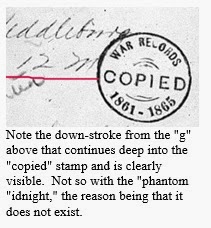
whatsoever behind the "copied" stamp on the erroneously deciphered
War Dept. copy of the September 11th message to Halleck which is also a confirmable
fact. Anyone who looks carefully will
see nothing after the "M." It
is also a confirmable fact that Lincoln's copy of the September 13 message is
time-marked 12 Midnight. The evidence
supporting the 12 Midnight time-mark are also confirmable facts. What am I
missing, I ask Mr. Sears?
SEARS:
What actually,
factually happened at noon at Frederick was this: McClellan was handed the Lost
Order, delivered by a courier from General Williams and Lieutenant Pittman at
Twelfth Corps headquarters, confirmed as authentic by Williams’s covering note.
It was a Eureka! moment for McClellan. The scales fell from his eyes. He
finally knew what to do. He had before him a telegram from the president, sent at
4:10 the previous afternoon (McClellan Papers), reading “How does it look now?”
He promptly replied, time-marking his telegram 12 M, for meridian or noon.
D'AOUST: Close
but no cigar. What actually, factually
happened shortly before 3 p.m., at Frederick was this: McClellan was
handed the Lost Order, delivered by a courier from General Williams and
Lieutenant Pittman at Twelfth Corps headquarters, confirmed as authentic by
Williams’s covering note. It was a Eureka! moment for McClellan. The scales fell
from his eyes. He finally knew what to do. He had before him a telegram from
the president, sent at 4:10 the previous afternoon (McClellan Papers), reading
“How does it look now?” McClellan being
too busy with critical military matters waited until late that night, at
Midnight, to be precise, before responding to Lincoln's inquiry. For all we know, the telegraph was still down
that afternoon and evening thus preventing McClellan from writing earlier. Then again, McClellan was in the habit of
writing such messages late in the night. In any event, he replied to Lincoln's message at Midnight, hence why the
message was time-marked 12 Midnight.
SEARS:
What actually,
factually happened in the early morning hours of Sept. 14 in the War Department
telegraph office was this: A perfectly
competent operator routinely took down McClellan’s Sept. 13 12 M telegram to Lincoln, labeled it received at
2:35 a.m. [14th], made one copy and carbon marked 12 M for the office, and one
marked 12 M for the president. When Lincoln was handed the telegram and saw the
2:35 a.m. received time, he figured two and a half hours about right for a
telegram to reach him (not knowing of the telegraphic delays), and altered 12 M
into 12 Midnight, no doubt for clarity in understanding events. It’s an
essentially simple story. It meets McClellan’s telegraphic protocol, meets the
professionalism of the War Dept. telegraph office. And most of all, it meets
the confirmable facts.
D'AOUST: What actually, factually happened in
the early morning hours of Sept. 14 in the War Department telegraph office was
this: A not so competent operator took
down McClellan’s Sept. 13 12 Midnight
telegram to Lincoln, labeled it received at 2:35 a.m. [14th] and
arranged to have it delivered to the President.
Someone, we will never know who, having realized that the time
designation was wrong, added the "idnight." As part of the clerical function, a War
Department copy and carbon copies were subsequently made, all erroneously
marked 12M. It’s an essentially simple
story. It meets all logic and most of all, it meets the confirmable facts (the
two accounts re the 27th Indiana's arrival time and the Catoctin aspect and
finally, Messrs. Thorp's and Clemens's discovery re the September 11th message
to Halleck.)
SEARS:
(And no, Mr.
D’Aoust, I did not “suppress,” as you accusingly put it, the Lincoln Copy when
I saw it some thirty years ago. I left it right where it is, in the Lincoln
Papers and microfilm, for all to see and ponder.)
D'AOUST: One
definition of the word suppress includes " To keep from being revealed,
published, or circulated." I'd say
that pretty well fits the circumstances.
That is not to suggest that Mr. Sears is in any way guilty of any
malicious act but having said that, he, at the very least, owed it to his
readers and to history to immediately reveal the existence of the Lincoln
copy. It was simply too controversial of
an issue for it to have been left "right
where it is." I know this, most who
read this exchange will know it, and even Mr. Sears must know it.
SEARS:
Here is a
transcription of the McClellan-Lincoln Sept. 13 telegram. It needs to be
considered in this context. On Sept. 12 McClellan writes his wife he can’t
figure out where the enemy is or what he is doing. Then just before noon on the
13th (after a warm welcome by the ladies of Frederick), he is handed the Lost
Order. Immediately, in obvious excitement, he telegraphs the president. For
George McClellan, this is positively giddy. Then compare this with McClellan’s
11 p.m. telegram to Halleck, (OR 19.2:281-82, too long to transcribe here). It
is a very sober document. He is facing 120,000 Rebels led by Lee in person,
aiming for Pennsylvania. He expects a “severe general engagement tomorrow. . .
. I have the mass of their troops to contend with & they outnumber me when
united.”
D'AOUST: The
McClellan-Lincoln Sept. 13 telegram needs to be considered in this context. On
Sept. 12 McClellan writes his wife he can’t figure out where the enemy is or
what he is doing. Then just before 3 p.m. on the 13th he is handed the
Lost Order. Almost immediately, he sends a copy to Pleasonton with instructions
to confirm its contents. Pleasonton
returns one and a half to three hours later with a quasi confirmation. By 6:20 McClellan has formulated his plan and
issued his orders to Franklin. I've
already commented on how Mr. Sears is reading too much into the variances
between McClellan's messages to Halleck and Lincoln that night.
I submit that
it is beyond imagining that McClellan could have sent the September 13, 1862
telegram to Abraham Lincoln at 12M and that it is time to permanently dispel
that myth.
To the
President Hd Qrs Frederick
Sept 13th 12 Midnight
I have the whole Rebel force in
front of me but am confident and no time shall be lost. I have a difficult task
to perform but with Gods blessing will accomplish it. I think Lee has made a
gross mistake and that he will be severely punished for it. The Army is in
motion as rapidly as possible. I hope for a great success if the plans of the
Rebels remain unchanged. We have possession of Cotocktane. I have all the plans
of the Rebels and will catch them in their own trap if my men are equal to the
emergency. I now feel I can count on them as of old. All forces of Pennsylvania
should be placed to cooperate at Chambersburg. My respects to Mrs. Lincoln.
Received most enthusiastically by
the ladies. Will send you trophies. All well and with Gods blessing will
accomplish it.
Geo B. McClellan
3/30/2014
Guest Post: The McClellan telegram, A Postscript from Stephen Sears
Stephen Sears writes:
A mystery
solved.
In my 3/30
guest post I discussed Gene Thorp’s reporting of a McClellan to Halleck
telegram of Sept. 11 that bore a 12 Midnight time stamp (pictured in the
D’Aoust post of 3/26) but which appears on the War Dept. telegraph operator’s
copy as 12 M, i.e., noon. It is printed in the Official Records as 12 noon. This
operator’s blunder, according to Mr. Thorp, was then repeated on Sept. 13 in
the McClellan to Lincoln telegram, that is, changing McClellan’s supposed time
mark 12 Midnight to 12 M.
While I
pointed out the falsity of this theory in my last post, I can now add the final
proof of that falsity. To double check, I looked up on the National Archives microfilm the Washington operator’s copy of
the Sept. 11 telegram to Halleck. In fact the operator faithfully copied the
sender’s time-mark 12 Midnight. But postwar the Official Records compiler
placed his “Copied” stamp squarely over the “idnight” of that 12 Midnight time
mark. All that shows is 12 M. And since
12 M is standard for noon, in the printed Official Records (19.2:252) it runs
as 12 noon. This can be seen in Thorp’s illustration, and more clearly on the
microfilm.
In other
words, the War Dept. operator was entirely competent on Sept. 11. The error was
made by the Official Records’ stamp-wielder. Now that we know the operator was
doing his job on Sept. 11, it’s safe to say he was also doing his job on Sept.
13, when he rendered McClellan’s 12 M telegram 12 M on Mr. Lincoln’s copy and
the file copy and carbon.
-- Stephen Sears
Guest Post: A re-rebuttal from Stephen Sears on McClellan's telegram
Stephen Sears writes re: Maurice
D’Aoust’s guest post of 3/26/14.
To argue that
McClellan’s Sept. 13 telegram to Lincoln, announcing the finding of the Lost
Order, was sent at midnight rather than noon, Mr. D’Aoust offers two supposed
proofs demonstrating that the Lost Order did not reach McClellan in time for
him to telegraph Lincoln at noon. A third supposed proof, by Gene Thorpe and
laid out in an appendix to the post, attempts to show how a telegram sent at
midnight was erroneously labeled noon in the records, and what lesson is to be
drawn from that.
The heart of
the matter is this: Just because no sending copy of the Sept. 13 telegram in
McClellan’s handwriting has been found—and I have looked long and hard, far and
wide—Messrs. D’Aoust and Thorpe and their advocates say the dispatch was
tampered with or messed with in the telegraphic process. I say the telegraphic
process worked just fine (except for unavoidable delay) and exactly as it was
supposed to.
To begin
with, I find no factual, confirmable evidence disproving the telegram was sent
at noon, so, obviously, the Lost Order reached McClellan before noon. But Mr. D’Aoust persists, and his evidence deserves a
hearing.
He claims the
27th Indiana did not get to where the Order was found in time for Corp.
Mitchell to do the finding before noon. But Charles B. Dew, writing in the Journal of Southern History, used the
Samuel Pittman papers to show that Silas Colgrove, the 27th’s colonel, carried
the Lost Order to Twelfth Corps headquarters, last stop before it went to
McClellan, before noon. Pittman was General Alpheus Williams’s aide, identified
the Order’s handwriting as authentic, and is a sound witness. Ezra Carman heard
from the courier (urged by Pittman to ride fast) who delivered the Order,
saying he left for army headquarters about 9:30 a.m. (No reliance can be placed
on Jones’s regimental history of the 27th Indiana. It is riddled with errors,
such as the canard that Mitchell was illiterate.)
Next, Mr. D’Aoust
claims that McClellan’s telegram, saying the Catoctin range was in Union hands,
could not have been sent at noon since that feat was not accomplished until 2
p.m. There is, however, cavalryman Pleasonton’s 11 a.m. dispatch to McClellan
(McClellan Papers) saying he is “4 miles west of Frederick” at the Catoctins.
That was good enough for McClellan to add that extra bit of good news to his
noon telegram to Lincoln.
To repeat, if
there is demonstrable proof—as I contend there is—that the telegram was sent at
noon, all arguments that the Lost Order could not have gotten there “in time”
are nulled.
Finally,
Messrs. D’Aoust and Thorpe appear willing to rest their case on . . . well,
quicksand. That is, McClellan’s Lincoln telegram was sent at midnight; that the
belief it was sent at noon is due entirely to a Washington War Dept. telegraph
operator who was a dolt, who made repeated blunders that have muddied the
historical waters ever since. I, on the other hand, find the man entirely
capable. He did his job exactly as he was supposed to do and expected to do.
Mr.
Thorpe displays a McClellan-Halleck telegram sent Sept. 11—two days before the
Lost Order telegram—that he claims is time-marked by McClellan 12 midnight. But
that dolt of a War Dept. operator marked it 12 M instead of 12 Midnight as he
was supposed to do and required to do. Now, that’s not just one major mistake,
that’s two major mistakes, perhaps three: 1) Not writing down the time-mark as sent;
2) writing 12 M, the flat-out wrong abbreviation for midnight; or 3) somehow misreading
midnight as meridian or as noon and therefore rendering it 12 M, telegraphese
for noon. The Official Records
compilers saw 12 M and for emphasis rendered it 12 noon in OR 19.2:252.
To
stay with the Sept. 11 telegram, it’s in a dispatch book in the McClellan
Papers. (The McClellan-Lincoln telegram, not an official message, is not
recorded in a dispatch book.) This telegram
is not in McClellan’s handwriting; he did not break telegraphic protocol by writing
12 Midnight on it. It was dictated (it’s a routine message), and McClellan
cannot have read it or he would have seen it corrected from 12 Midnight to
standard 12 or 12 p.m. on the copy. (It’s in the proper chronological order in
the dispatch book.) As noted in my earlier post, McClellan was careful about
telegraphic protocol.
Next,
Mr. Thorpe would have us believe this same dolt of an operator two days later
did exactly the same stupid thing! That
is, on Sept. 13 he deciphered a second 12 midnight telegram from McClellan, made
the same series of blunders for whatever reasons of his own, and turned it into
a 12 M telegram. Then “somebody” at the telegraph office “corrected” the
operator’s 12 M copy made for Mr. Lincoln by adding “idnight” . . . but for
whatever reasons of his own did not
similarly correct the office file copy and carbon.
I
cannot find a single confirmable fact in this scenario. It’s pure speculation,
and I have to say, simply beyond bizarre.
What
actually, factually happened at noon at Frederick was this: McClellan was
handed the Lost Order, delivered by a courier from General Williams and Lieutenant
Pittman at Twelfth Corps headquarters, confirmed as authentic by Williams’s
covering note. It was a Eureka! moment for McClellan. The scales fell from his
eyes. He finally knew what to do. He had before him a telegram from the
president, sent at 4:10 the previous afternoon (McClellan Papers), reading “How
does it look now?” He promptly replied, time-marking his telegram 12 M, for
meridian or noon.
What
actually, factually happened in the early morning hours of Sept. 14 in the War
Department telegraph office was this: A
perfectly competent operator routinely took down McClellan’s Sept. 13 12 M telegram to Lincoln, labeled it received at
2:35 a.m. [14th], made one copy and carbon marked 12 M for the office, and one
marked 12 M for the president. When Lincoln was handed the telegram and saw the
2:35 a.m. received time, he figured two and a half hours about right for a
telegram to reach him (not knowing of the telegraphic delays), and altered 12 M
into 12 Midnight, no doubt for clarity in understanding events. It’s an
essentially simple story. It meets McClellan’s telegraphic protocol, meets the
professionalism of the War Dept. telegraph office. And most of all, it meets
the confirmable facts.
(And
no, Mr. D’Aoust, I did not “suppress,” as you accusingly put it, the Lincoln
Copy when I saw it some thirty years ago. I left it right where it is, in the
Lincoln Papers and microfilm, for all to see and ponder.)
Here
is a transcription of the McClellan-Lincoln Sept. 13 telegram. It needs to be
considered in this context. On Sept. 12 McClellan writes his wife he can’t
figure out where the enemy is or what he is doing. Then just before noon on the
13th (after a warm welcome by the ladies of Frederick), he is handed the Lost
Order. Immediately, in obvious excitement, he telegraphs the president. For
George McClellan, this is positively giddy. Then compare this with McClellan’s
11 p.m. telegram to Halleck, (OR 19.2:281-82, too long to transcribe here). It
is a very sober document. He is facing 120,000 Rebels led by Lee in person,
aiming for Pennsylvania. He expects a “severe general engagement tomorrow. . .
. I have the mass of their troops to contend with & they outnumber me when
united.”
I
submit it is beyond imagining that one hour later he sent off the following
Lincoln telegram.
2.35 AM
To
the President Hd Qrs Frederick Sept 13th 12 M
I have the whole Rebel force in
front of me but am confident and no time shall be lost. I have a difficult task
to perform but with Gods blessing will accomplish it. I think Lee has made a
gross mistake and that he will be severely punished for it. The Army is in
motion as rapidly as possible. I hope for a great success if the plans of the
Rebels remain unchanged. We have possession of Cotocktane. I have all the plans
of the Rebels and will catch them in their own trap if my men are equal to the
emergency. I now feel I can count on them as of old. All forces of Pennsylvania
should be placed to cooperate at Chambersburg. My respects to Mrs. Lincoln.
Received most enthusiastically by
the ladies. Will send you trophies. All well and with Gods blessing will
accomplish it.
Geo
B. McClellan
-- Stephen
Sears
3/26/2014
Guest Post: Maurice D’Aoust responds to Stephen Sears on McClellan's telegram
Maurice D’Aoust has written to respond to this guest post:
Before I address Mr. Sears's comments (guest post 3/25/2014,) I think it would be worthwhile pointing out a few facts. As I’ve previously mentioned, by itself, Lincoln’s 12 Midnight copy of McClellan’s telegram proved nothing other than the fact there were two versions of the September 13, 1862 communication. Hence why I sought out supporting evidence which I knew would be necessary if Lincoln’s copy was to have any hope of taking precedence over the War Department's (Official Records) 12M version.
Ultimately, three very strong pieces of evidence were uncovered that, in combination, went far in disproving the notion McClellan was (1) aware of the Lost Order just before noon that day or (2) that he could possibly have sent that telegram to Lincoln at "12M". First there were the two primary source accounts, one being furnished by Dr. Tom Clemens, confirming that Barton Mitchell, the Lost Order’s discoverer, did not even reach Frederick with his regiment until noon on the 13th. When considering all of the steps that would have had to take place after Mitchell broke ranks (making his way to the recently abandoned Rebel encampment, finding Lee’s Lost Order, the time it would have then taken for the document to make its way through the various headquarters etc., etc.) it becomes clear that it would have been impossible for the Lost Order to have reached McClellan anywhere near noon. It simply does not make any logical sense. The second piece of evidence negating the 12M or noon version of the telegram was contained within the message itself when McClellan states, “we have possession of Catoctin. By “Catoctin,” the General was referring to the mountain pass over the Catoctin range, west of Frederick. According to all accounts, that defile was not taken until 2 p.m. on the 13th, a full two hours past “12m” [noon]. At this point, it becomes quite clear that the time-stamp on the Official Records version is wrong.
The above evidence was presented in my “McClellan Did Not Dawdle” article (Civil War Times, October, 2012 issue.) Mr. Sears forwarded a rebuttal to Civil War Times and this together with my own response, were published in the December issue. Never, either in his Civil War Times response nor in this latest rebuttal, has Mr. Sears ever addressed or even acknowledged that evidence. This only leads me to conclude that he simply has no answer. In truth, there is no answer other than to concede that the Lost Order could not have reached McClellan before noon and neither could that message to Lincoln have been written at "12M [noon]."
Of course, all of this alters the timeline of events on September 13th. According to Sears, the clock had, by virtue of a supposed “12M” message, started ticking at noon. In light of the 12 Midnight document and the strong evidence supporting it, that starting time must now be shifted to 3 p.m., when McClellan makes his first written reference to the Lost Order in his communication to Alfred Pleasonton. On that note, if a supposed 12M reference was good enough for Sears and others to prove that the Lost Order was in McClellan’s hands shortly before noon, why should an alternate 3 p.m. reference not be sufficient in proving it must have reached him shortly before 3 p.m.? When viewed in that context it can no longer be argued that McClellan sat on the information for over six hours before acting on it. Quite to the contrary, it is now clear that he acted with due diligence by promptly sending his cavalry forward to confirm its contents. What time it was when Pleasonton returned is unknown. Some say six p.m. but it's safe to imagine that the reconnaissance would have taken anywhere between one and a half to three hours. By 6:20 p.m. McClellan had formulated his plan and issued his first formal orders to Franklin. Contrary to what Mr. Sears would have us believe, McClellan had not allowed those afternoon hours of September 13th to slip away. In fact, including preparations for the very crucial action on Catoctin Mountain, assessing the information on the Lost Order, ordering Pleasonton forward, devising his plan, drafting his orders to Franklin and a variety of other military concerns, McClellan had things well in hand that afternoon.
For ease of reference, I’ve addressed each of Mr. Sears’s points individually.
THE DEBATE
SEARS: The issue: Did McClellan send his telegram at noon or at midnight on Sept. 13?
D'AOUST: The evidence presented is overwhelming in proving it was sent at Midnight.
SEARS: The point of it all: How and when and in what form did McClellan respond to the remarkable discovery of Lee’s campaign plan?
D'AOUST: The point of my Civil War Times article was (1) to prove that McClellan's telegram to Lincoln was sent at Midnight (2) that it was nowhere near noon when McClellan came into possession of Lee's Lost Order and (3) that he did not allow any time, let alone some six-plus hours, to slip away that afternoon. As such, my comments in this debate will be restricted to those aspects only.
SEARS: Here are all the facts relating to this telegram that I have been able to verify.
(1) The sending copy, important enough to be certainly in McClellan’s hand, sent from Frederick, Md. to Lincoln in Washington on Sept. 13, is not on record.
D'AOUST: Acknowledged, but it appears we may now have the next best thing. See 7 below and Appendix A in this regard.
SEARS: (2) The primary copy of McClellan’s telegram is therefore the copy made by the operator at the War Department telegraph office. It is dated Sept. 13 and time-marked 12M. It is in the National Archives, Record Group 107, Microcopy 473, Roll 50. It bears the stamp of the Official Records compilers. Call it the Archives Copy.
D'AOUST: Mr. Sears chooses to believe that the War Department or Archives Copy was the primary or first transcription of the message after it was deciphered by the telegrapher. In fact, it makes considerably more sense that Lincoln’s copy would have been the first to be transcribed. After all, the communication was addressed to the President who was then anxiously awaiting news from McClellan and the telegrapher would certainly have been aware of the importance in getting the message to Lincoln post haste. For all we know, Lincoln was standing beside the telegrapher when the message came in, he being known to frequent the telegraph room into the late hours of the night in such high drama situations. In any event, it simply doesn’t make sense that the telegraph office employee would have delayed getting the message to an anxious Lincoln by first performing a clerical function such as making a copy for the War Department files. Finally, just because a document is in the National Archives does not mean it is factual. There are many examples of erroneous documents in the National Archives, McClellan’s September 11, 1862 "12M" telegram (yes, another one) to Henry W. Halleck being a prime case in point. Again, see 7 and Appendix A below in this regard.
SEARS: (3) The manifold, or carbon copy of the Archives Copy is in the Seward Papers, University of Rochester. It is of course identical to the Archives Copy (including the 12M time-mark) except no Official Records stamp. This carbon is important because it identifies which of the operator’s copies is the primary copy (above). Call it the Seward Copy.
D'AOUST: Clearly the Archives’ copy is erroneous, as are all other copies made from it, including Seward's. An “Official Records stamp” does nothing to alter the fact a document is invalid. Again, please refer to the McClellan/Halleck message in 7 and Appendix A below.
SEARS: (4) Having made an original and carbon, the War Department telegraph operator made a copy for Mr. Lincoln, the addressee. It is a fair copy, careful written, in a slightly different format. It is time-marked 12M in the telegrapher’s hand. In another hand, 12M is altered to 12 Midnight, i.e., 12M + idnight. (This alteration is clearly seen on the microfilm and clear enough on the digitized version.) This copy is in the Lincoln Papers, Library of Congress. Call it the Lincoln Copy.
D'AOUST: Again, why would the telegrapher have taken the time to perform a clerical function (making an "original and carbon" copy for the War Dept. files) before getting such an urgent message to Lincoln? It does not make any sense. As for the “idnight” aspect, I believe the more proper term would be “amended,” that is to say, "corrected to reflect the true facts of the matter."
SEARS: (5) The Sept. 13 telegram was first printed a year later, in 1863, in the Report of the Committee on the Conduct of the War, copied from the Archive Copy supplied by the War Department and marked 12M. It was published in the Official Records (19.2:281) in 1887, from the OR- stamped Archives Copy and marked 12M. It is published in my The Civil War Papers of George B. McClellan (1989) p. 453, transcribed from the Archives Copy and marked 12M.
D'AOUST: How does all of this, in any way, alter the fact the 12M "Archive Copy" as well as any reproductions or printings thereof are all incorrect? Do ten, twenty or one hundred “wrongs” make a right? Obviously, no one was aware of Lincoln’s copy and the fact it stipulated 12 Midnight. Until recently at least, only a few thought to question or look into the matter.
SEARS: (6) The Lincoln Copy of the telegram was sequestered for 95 years, in the president’s papers until 1865, then held by Robert Todd Lincoln and donated to the Library of Congress, and opened to the public in 1947. (I came upon the Lincoln Copy—surely not the first to do so—on Lincoln Papers microfilm about 30 years ago when researching my McClellan biography and McClellan Papers. It posed a puzzle. I applied to it the same tests I’ve outlined here and concluded it was an anomaly, not historically viable.)
D'AOUST: It’s that part about this whole issue that really bothers me. If Mr. Sears did come across the document some thirty years ago, what gave him the sole right to conclude it was “an anomaly not historically viable” and then suppress it? At the very least, he should have disclosed its existence if only to allow others to apply their own "tests" in determining the document’s validity. Had he done so, I’m certain someone would have solved this "puzzle" long ago.
SEARS: (7) 12M is the abbreviation for 12 Meridian, or noon, standard in Civil War telegraphy. 12M is not a standard abbreviation for midnight in Civil War telegraphy or anywhere else. (I have 22 examples of McClellan 12M telegrams, nearly all in his hand; 14 by content or received time are explicitly noon. The rest are neutral as to time; none implies midnight.) When McClellan meant noon on a telegram he marked it 12M. Always. McClellan never time-marked 12 Midnight on a telegram.
D'AOUST: And here is where Mr. Sears has made his greatest mistake. Gene Thorp of the Washington Post and Tom Clemens (Editor, Ezra Carman Papers,) recently uncovered a sent copy of a telegram from McClellan to Henry W. Halleck dated September 11, 1862 and time-marked 12 Midnight. So much for McClellan never time-marking 12 Midnight on a telegram. But things get considerably better. Thorp and Clemens then compared that sent copy to the National Archives’s “received” copy (yes, the “primary” War Department copy on which that “Official Records” stamp was affixed and yes, the same copy that we see today in the Official Records.) And what time-stamp does this Official Records copy stipulate? 12M! The details surrounding Thorp's and Clemens's amazing piece of historical research is described in Appendix A below.
SEARS: (8) Who altered 12M into 12 Midnight on the Lincoln Copy? (Somebody did!) I’ve concluded it had to be Mr. Lincoln himself. The handwriting is not inconsistent with Lincoln’s. This telegram, and others that day, were much delayed by wire-cutting Confederates in Maryland. It is marked received 2:35 a.m. Sept. 14, or 14:35 hours late. Seeing it early on Sept. 14 with that received time, unaware of the telegraphic delay, Lincoln decided it must have been sent at midnight and so marked it. There is no reason to think Lincoln was especially familiar with telegraphy protocols. We forget that generals (except McClellan) did not telegraph the president from the battlefield—they followed the rules and sent to the War Dept. or Army HQ.
D'AOUST: We can postulate all day long regarding who may have “amended” the time stamp but in the final analysis, whoever did add the “idnight” obviously did so because they knew that 12 Midnight was the correct time designation and the evidence proves that they were correct.
SEARS: (9) For this telegram to have been sent at midnight on Sept. 13 requires a scenario like this: a) McClellan time-marked the sending copy 12 Midnight, something he had never done on a telegram and knew better than to do. b) The War Department operator, instead of time-marking his copy (with carbon) 12 Midnight as he was supposed to do, instead wrote 12 M—which c) was the dead-wrong abbreviation for midnight. d) Then “somebody” else—who could it be?—“corrected” the copy for the president by adding “idnight,” but e) did not “correct” the file copy and carbon. Theater of the absurd.
D'AOUST: At this point I think it best to refer Mr. Sears to Gene Thorp's description of events in Appendix A below. The bottom line is, there are no theatrics involved here but rather sound reasoning supported by overwhelming evidence.
SEARS: (10) In sum, the documentation is unassailable for a noon telegram, non-existent for a midnight telegram. No effort to argue that somehow it was physically impossible for McClellan to write this telegram at noon meets evidentiary standards. The three documents in and of themselves trump any and all alternate theories. Mr. D’Aoust and compatriots start with this supposed midnight telegram, then bend and twist and warp trying to make it fit the documented facts. It doesn’t and can’t. They are left with an anomaly.
D'AOUST: By documentation, I'm assuming Mr. Sears is referring to the War Department copy on which that "Official Records" stamp has been affixed, the same stamp as was placed on the War Department copy of that September 11th message to Halleck, which we now know for certain to be incorrect. Or is he referring to the various carbon copies on which the error is repeated over and over again? Are these also the "documents" that supposedly trump all alternate theories? I don't mean to be flippant but the idea that some officious stamp would automatically render a document more valid than another truly is “theatre of the absurd.” As for "evidentiary standards," Mr. Sears seems bent on ignoring the conclusive evidence surrounding the 27th Indiana's arrival time and that surrounding the Catoctin aspect. Will he also ignore Thorp's and Clemens's corroborating, albeit circumstantial, evidence surrounding the September 11th message to Halleck? With all due respect to Mr. Sears, it is he who is warping the facts to fit with the clearly flawed "12M" telegram.
SEARS: (11) Finally, and as important as anything else, simply read McClellan’s exuberant, almost giddy noon telegram in the context of Sept. 13’s events. See especially his 11 p.m. telegram to Halleck (OR 19.2:281-82; McClellan Papers, 456-57). No exuberance now, much worry, he is outnumbered, etc. He would never have sent his Lincoln telegram an hour later; that’s a sequence that simply makes no sense. (In this 11 o’clock telegram McClellan says he was handed the Lost Order “this evening.” What he meant by that is that cavalryman Pleasonton, who was sent a copy of the Lost Order at 3:00 p.m. [OR 51.1:829], had that evening confirmed that the find was authentic.)
D'AOUST: As for the variance between Halleck's and Lincoln's telegrams, upon reading Halleck's communication in its entirety it becomes evident that McClellan's intent was to communicate the critical nature of the situation and thus prompt Halleck, his immediate superior, into releasing the two corps that were still sitting idle in the Washington area. McClellan likely surmised that Halleck would communicate this to Lincoln. Although less gloomy, McClellan's message to Lincoln still conveys the critical nature of things. Mr. Sears is reading way too much into these two communications and this to the extent of making himself appear to be grasping at straws which he does yet again in his "this evening" theory. In that regard, as pointed out in my opening commentary, having discounted the 12M version, McClellan's message to Pleasonton now becomes his first written allusion to the Lost Order thus implying that the order fell into his hands shortly before 3 p.m. As I pointed out to Mr. Sears in our Civil War Times exchange, Websters' Dictionary defines "evening" as "the entire late afternoon" or "the latter part of the afternoon and the earlier part of the night." It would seem McClellan considered the 3 p.m. as falling within Webster's definition and he wouldn't have been far off.
SEARS: Certainly, absolutely, there is room for discussion and debate as to McClellan and the Lost Order. What action did he take? When? What should/could/ought he have done? What could he not do? And so on. For General McClellan, the clock on all those matters began ticking at noon on Sept. 13. I would suggest that anyone interested in the topic start their own clock ticking at noon.
D'AOUST: I won't cloud the issue by entering into a discussion on would'a could'a or shoulda's. On the other hand, I do urge any who read this exchange to look at the evidence, both Mr. Sears's and mine, objectively in determining whether a) McClellan's telegram to Lincoln was sent at 12M [noon] or 12 Midnight b) whether it was anywhere near noon when McClellan came into possession of the Lost Order and c) whether McClellan allowed any time, let alone some six-plus hours, to slip away that afternoon. I'm confident that the majority will, after weighing the evidence, conclude that the telegram was sent at midnight, that McClellan did not learn of the Lost Order until well after noon, likely closer to 3 p.m. and that he wasted no time that afternoon.
***
Appendix A: The September 11, 1862, 12 Midnight telegram from McClellan to Halleck
[Editor's note: Italicized text by Gene Thorp: editorial text by Maurice D’Aoust. The first image is figure 1, the lower image is figure 2.]
Although Dr. Clemens deserves to share in the credit for the following discovery, he insists that Gene Thorp deserves the bulk of that credit, having conducted most of the groundwork. Here now are the details surrounding Gene Thorp’s and Tom Clemens’s discovery, as described by Thorp:
In short, when the Sept. 13 telegram came out of cipher at the War Department, an operator misinterpreted 12 Midnight as Noon. Although [we don’t] have McClellan's original Sept. 13 telegram, I can prove conclusively that this exact same mistake was made two days earlier (Sept. 11) by the exact same War Department operator.
Here's what happened.
 1. On Sept. 11, McClellan telegraphed [Henry W.] Halleck from his headquarters in Middleburg, MD at 12 Midnight. [See McClellan’s “sent” copy, figure 1, right. Click to enlarge.]
2. At the War Department, an operator deciphered the message, and in the process, misinterpreted the time-stamp writing 12M instead of 12 Midnight on the decipher worksheet. (The deciphered worksheet is not found.)
3. The same operator then made a copy from the worksheet, on War Department heading, and sent it to the recipient, Gen. Henry Halleck. This copy was incorrectly time-stamped 12M. [See Figure 2, below.]
4. Later an operator, or transcriber, used the misinterpreted decipher worksheet to make War Department file copies. One was in original handwriting, the rest were carbon copies. All of these copies were incorrectly time-stamped 12M.
 5. Years after the war, officials compiling the Official Records located one of these War Department file copy carbon copies. Not having access to McClellan's papers, the officials transcribed the information from the [incorrectly time-stamped] War Department file copy carbon copy. They then stamped it with the red "War Records copied" stamp and wrote in green pencil "Printed [that is, printed in the Official Records]."
6. The Official Records of the War of the Rebellion were printed and in every single instance, the time-stamp of 12 M was used even though the original message [McClellan’s sent copy] said "12 Midnight".
And so it remains incorrect today. Any historian consulting the Official Records without consulting McClellan's original Sept. 11 telegram first will inadvertently duplicate this error. They will write that McClellan sent the telegram at noon and it was received at the War Department 13:45 hours later, when if fact it was actually sent at midnight and received only 3:45 hours later.
This exact same sequence, with the exact same War Department operator, happened two days later on Sept 13. The only difference is that someone caught the mistake on Lincoln's received copy and corrected it, thus the odd handwriting for "idnight."
Rinse and repeat
1. At 12 Midnight on Sept. 13, after writing marching orders to all his different Corps for the next day and informing General-in-Chief Halleck of everything that had transpired, McClellan sent a telegram to Lincoln announcing he had possession of Lee's plans. McClellan was responding to a query from Lincoln earlier in the evening that had been sent via telegram to Point of Rocks and then transmitted by signal to his headquarters north of Frederick. (The Signal Corps OR report states this. Neither the Lincoln or McClellan original has yet been found.)
2. At the War Department, the same operator as two days before deciphered the message, and in the process, misinterpreted the time-stamp writing 12M instead of 12 Midnight on the decipher worksheet. (The deciphered worksheet is not found.)
3a. The same operator then made a copy from the worksheet, on War Department heading, and sent it to the recipient, President Lincoln. This copy was initially incorrectly time-stamped 12M. Note [that]the handwriting is of the same operator that wrote Halleck's recipient copy.
3b. Unlike Sept. 11, either the operator, his manager, or perhaps even Lincoln himself corrected the time-stamp to read "12 Midnight." The operator or his manager could have seen it was deciphered incorrectly or Lincoln may have known because he was waiting for a response to the telegram he had sent McClellan earlier in the evening as is recorded in the Official Records.
4. An operator or transcriber used the misinterpreted decipher worksheet to make War Department file copies. One was in original handwriting, the rest were carbon copies. All of these copies were incorrectly time-stamped 12M.
5. Years after the war, officials compiling the Official Records located one of these War Department file copies. Not having access to McClellan's papers or Lincoln's papers, the officials transcribed the information from the War Department file copy carbon copy. They then stamped it with the red "War Records copied" stamp and wrote in green pencil "Printed.”
6. The Official Records of the War of the Rebellion were printed. In every single instance, the incorrect time-stamp of 12 M was used.”
Since the discovery of Lincoln's 12 Midnight version of the telegram and the overwhelming evidence supporting it, historians such as Tim Reese, Tom Clemens and Scott Hartwig have, via their respective publications, been chipping away at the long standing myth wherein McClellan wasted six hours after coming into possession of Lee's Lost Order. It's hoped that Clemens's and Thorp’s amazing piece of historical research will encourage even more historians to join in and that eventually, the 12M myth will be completely dispelled.
Before I address Mr. Sears's comments (guest post 3/25/2014,) I think it would be worthwhile pointing out a few facts. As I’ve previously mentioned, by itself, Lincoln’s 12 Midnight copy of McClellan’s telegram proved nothing other than the fact there were two versions of the September 13, 1862 communication. Hence why I sought out supporting evidence which I knew would be necessary if Lincoln’s copy was to have any hope of taking precedence over the War Department's (Official Records) 12M version.
The above evidence was presented in my “McClellan Did Not Dawdle” article (Civil War Times, October, 2012 issue.) Mr. Sears forwarded a rebuttal to Civil War Times and this together with my own response, were published in the December issue. Never, either in his Civil War Times response nor in this latest rebuttal, has Mr. Sears ever addressed or even acknowledged that evidence. This only leads me to conclude that he simply has no answer. In truth, there is no answer other than to concede that the Lost Order could not have reached McClellan before noon and neither could that message to Lincoln have been written at "12M [noon]."
For ease of reference, I’ve addressed each of Mr. Sears’s points individually.
THE DEBATE
SEARS: The issue: Did McClellan send his telegram at noon or at midnight on Sept. 13?
D'AOUST: The evidence presented is overwhelming in proving it was sent at Midnight.
SEARS: The point of it all: How and when and in what form did McClellan respond to the remarkable discovery of Lee’s campaign plan?
D'AOUST: The point of my Civil War Times article was (1) to prove that McClellan's telegram to Lincoln was sent at Midnight (2) that it was nowhere near noon when McClellan came into possession of Lee's Lost Order and (3) that he did not allow any time, let alone some six-plus hours, to slip away that afternoon. As such, my comments in this debate will be restricted to those aspects only.
SEARS: Here are all the facts relating to this telegram that I have been able to verify.
(1) The sending copy, important enough to be certainly in McClellan’s hand, sent from Frederick, Md. to Lincoln in Washington on Sept. 13, is not on record.
D'AOUST: Acknowledged, but it appears we may now have the next best thing. See 7 below and Appendix A in this regard.
SEARS: (2) The primary copy of McClellan’s telegram is therefore the copy made by the operator at the War Department telegraph office. It is dated Sept. 13 and time-marked 12M. It is in the National Archives, Record Group 107, Microcopy 473, Roll 50. It bears the stamp of the Official Records compilers. Call it the Archives Copy.
D'AOUST: Mr. Sears chooses to believe that the War Department or Archives Copy was the primary or first transcription of the message after it was deciphered by the telegrapher. In fact, it makes considerably more sense that Lincoln’s copy would have been the first to be transcribed. After all, the communication was addressed to the President who was then anxiously awaiting news from McClellan and the telegrapher would certainly have been aware of the importance in getting the message to Lincoln post haste. For all we know, Lincoln was standing beside the telegrapher when the message came in, he being known to frequent the telegraph room into the late hours of the night in such high drama situations. In any event, it simply doesn’t make sense that the telegraph office employee would have delayed getting the message to an anxious Lincoln by first performing a clerical function such as making a copy for the War Department files. Finally, just because a document is in the National Archives does not mean it is factual. There are many examples of erroneous documents in the National Archives, McClellan’s September 11, 1862 "12M" telegram (yes, another one) to Henry W. Halleck being a prime case in point. Again, see 7 and Appendix A below in this regard.
SEARS: (3) The manifold, or carbon copy of the Archives Copy is in the Seward Papers, University of Rochester. It is of course identical to the Archives Copy (including the 12M time-mark) except no Official Records stamp. This carbon is important because it identifies which of the operator’s copies is the primary copy (above). Call it the Seward Copy.
D'AOUST: Clearly the Archives’ copy is erroneous, as are all other copies made from it, including Seward's. An “Official Records stamp” does nothing to alter the fact a document is invalid. Again, please refer to the McClellan/Halleck message in 7 and Appendix A below.
SEARS: (4) Having made an original and carbon, the War Department telegraph operator made a copy for Mr. Lincoln, the addressee. It is a fair copy, careful written, in a slightly different format. It is time-marked 12M in the telegrapher’s hand. In another hand, 12M is altered to 12 Midnight, i.e., 12M + idnight. (This alteration is clearly seen on the microfilm and clear enough on the digitized version.) This copy is in the Lincoln Papers, Library of Congress. Call it the Lincoln Copy.
D'AOUST: Again, why would the telegrapher have taken the time to perform a clerical function (making an "original and carbon" copy for the War Dept. files) before getting such an urgent message to Lincoln? It does not make any sense. As for the “idnight” aspect, I believe the more proper term would be “amended,” that is to say, "corrected to reflect the true facts of the matter."
SEARS: (5) The Sept. 13 telegram was first printed a year later, in 1863, in the Report of the Committee on the Conduct of the War, copied from the Archive Copy supplied by the War Department and marked 12M. It was published in the Official Records (19.2:281) in 1887, from the OR- stamped Archives Copy and marked 12M. It is published in my The Civil War Papers of George B. McClellan (1989) p. 453, transcribed from the Archives Copy and marked 12M.
D'AOUST: How does all of this, in any way, alter the fact the 12M "Archive Copy" as well as any reproductions or printings thereof are all incorrect? Do ten, twenty or one hundred “wrongs” make a right? Obviously, no one was aware of Lincoln’s copy and the fact it stipulated 12 Midnight. Until recently at least, only a few thought to question or look into the matter.
SEARS: (6) The Lincoln Copy of the telegram was sequestered for 95 years, in the president’s papers until 1865, then held by Robert Todd Lincoln and donated to the Library of Congress, and opened to the public in 1947. (I came upon the Lincoln Copy—surely not the first to do so—on Lincoln Papers microfilm about 30 years ago when researching my McClellan biography and McClellan Papers. It posed a puzzle. I applied to it the same tests I’ve outlined here and concluded it was an anomaly, not historically viable.)
D'AOUST: It’s that part about this whole issue that really bothers me. If Mr. Sears did come across the document some thirty years ago, what gave him the sole right to conclude it was “an anomaly not historically viable” and then suppress it? At the very least, he should have disclosed its existence if only to allow others to apply their own "tests" in determining the document’s validity. Had he done so, I’m certain someone would have solved this "puzzle" long ago.
SEARS: (7) 12M is the abbreviation for 12 Meridian, or noon, standard in Civil War telegraphy. 12M is not a standard abbreviation for midnight in Civil War telegraphy or anywhere else. (I have 22 examples of McClellan 12M telegrams, nearly all in his hand; 14 by content or received time are explicitly noon. The rest are neutral as to time; none implies midnight.) When McClellan meant noon on a telegram he marked it 12M. Always. McClellan never time-marked 12 Midnight on a telegram.
D'AOUST: And here is where Mr. Sears has made his greatest mistake. Gene Thorp of the Washington Post and Tom Clemens (Editor, Ezra Carman Papers,) recently uncovered a sent copy of a telegram from McClellan to Henry W. Halleck dated September 11, 1862 and time-marked 12 Midnight. So much for McClellan never time-marking 12 Midnight on a telegram. But things get considerably better. Thorp and Clemens then compared that sent copy to the National Archives’s “received” copy (yes, the “primary” War Department copy on which that “Official Records” stamp was affixed and yes, the same copy that we see today in the Official Records.) And what time-stamp does this Official Records copy stipulate? 12M! The details surrounding Thorp's and Clemens's amazing piece of historical research is described in Appendix A below.
SEARS: (8) Who altered 12M into 12 Midnight on the Lincoln Copy? (Somebody did!) I’ve concluded it had to be Mr. Lincoln himself. The handwriting is not inconsistent with Lincoln’s. This telegram, and others that day, were much delayed by wire-cutting Confederates in Maryland. It is marked received 2:35 a.m. Sept. 14, or 14:35 hours late. Seeing it early on Sept. 14 with that received time, unaware of the telegraphic delay, Lincoln decided it must have been sent at midnight and so marked it. There is no reason to think Lincoln was especially familiar with telegraphy protocols. We forget that generals (except McClellan) did not telegraph the president from the battlefield—they followed the rules and sent to the War Dept. or Army HQ.
D'AOUST: We can postulate all day long regarding who may have “amended” the time stamp but in the final analysis, whoever did add the “idnight” obviously did so because they knew that 12 Midnight was the correct time designation and the evidence proves that they were correct.
SEARS: (9) For this telegram to have been sent at midnight on Sept. 13 requires a scenario like this: a) McClellan time-marked the sending copy 12 Midnight, something he had never done on a telegram and knew better than to do. b) The War Department operator, instead of time-marking his copy (with carbon) 12 Midnight as he was supposed to do, instead wrote 12 M—which c) was the dead-wrong abbreviation for midnight. d) Then “somebody” else—who could it be?—“corrected” the copy for the president by adding “idnight,” but e) did not “correct” the file copy and carbon. Theater of the absurd.
D'AOUST: At this point I think it best to refer Mr. Sears to Gene Thorp's description of events in Appendix A below. The bottom line is, there are no theatrics involved here but rather sound reasoning supported by overwhelming evidence.
SEARS: (10) In sum, the documentation is unassailable for a noon telegram, non-existent for a midnight telegram. No effort to argue that somehow it was physically impossible for McClellan to write this telegram at noon meets evidentiary standards. The three documents in and of themselves trump any and all alternate theories. Mr. D’Aoust and compatriots start with this supposed midnight telegram, then bend and twist and warp trying to make it fit the documented facts. It doesn’t and can’t. They are left with an anomaly.
D'AOUST: By documentation, I'm assuming Mr. Sears is referring to the War Department copy on which that "Official Records" stamp has been affixed, the same stamp as was placed on the War Department copy of that September 11th message to Halleck, which we now know for certain to be incorrect. Or is he referring to the various carbon copies on which the error is repeated over and over again? Are these also the "documents" that supposedly trump all alternate theories? I don't mean to be flippant but the idea that some officious stamp would automatically render a document more valid than another truly is “theatre of the absurd.” As for "evidentiary standards," Mr. Sears seems bent on ignoring the conclusive evidence surrounding the 27th Indiana's arrival time and that surrounding the Catoctin aspect. Will he also ignore Thorp's and Clemens's corroborating, albeit circumstantial, evidence surrounding the September 11th message to Halleck? With all due respect to Mr. Sears, it is he who is warping the facts to fit with the clearly flawed "12M" telegram.
SEARS: (11) Finally, and as important as anything else, simply read McClellan’s exuberant, almost giddy noon telegram in the context of Sept. 13’s events. See especially his 11 p.m. telegram to Halleck (OR 19.2:281-82; McClellan Papers, 456-57). No exuberance now, much worry, he is outnumbered, etc. He would never have sent his Lincoln telegram an hour later; that’s a sequence that simply makes no sense. (In this 11 o’clock telegram McClellan says he was handed the Lost Order “this evening.” What he meant by that is that cavalryman Pleasonton, who was sent a copy of the Lost Order at 3:00 p.m. [OR 51.1:829], had that evening confirmed that the find was authentic.)
D'AOUST: As for the variance between Halleck's and Lincoln's telegrams, upon reading Halleck's communication in its entirety it becomes evident that McClellan's intent was to communicate the critical nature of the situation and thus prompt Halleck, his immediate superior, into releasing the two corps that were still sitting idle in the Washington area. McClellan likely surmised that Halleck would communicate this to Lincoln. Although less gloomy, McClellan's message to Lincoln still conveys the critical nature of things. Mr. Sears is reading way too much into these two communications and this to the extent of making himself appear to be grasping at straws which he does yet again in his "this evening" theory. In that regard, as pointed out in my opening commentary, having discounted the 12M version, McClellan's message to Pleasonton now becomes his first written allusion to the Lost Order thus implying that the order fell into his hands shortly before 3 p.m. As I pointed out to Mr. Sears in our Civil War Times exchange, Websters' Dictionary defines "evening" as "the entire late afternoon" or "the latter part of the afternoon and the earlier part of the night." It would seem McClellan considered the 3 p.m. as falling within Webster's definition and he wouldn't have been far off.
SEARS: Certainly, absolutely, there is room for discussion and debate as to McClellan and the Lost Order. What action did he take? When? What should/could/ought he have done? What could he not do? And so on. For General McClellan, the clock on all those matters began ticking at noon on Sept. 13. I would suggest that anyone interested in the topic start their own clock ticking at noon.
D'AOUST: I won't cloud the issue by entering into a discussion on would'a could'a or shoulda's. On the other hand, I do urge any who read this exchange to look at the evidence, both Mr. Sears's and mine, objectively in determining whether a) McClellan's telegram to Lincoln was sent at 12M [noon] or 12 Midnight b) whether it was anywhere near noon when McClellan came into possession of the Lost Order and c) whether McClellan allowed any time, let alone some six-plus hours, to slip away that afternoon. I'm confident that the majority will, after weighing the evidence, conclude that the telegram was sent at midnight, that McClellan did not learn of the Lost Order until well after noon, likely closer to 3 p.m. and that he wasted no time that afternoon.
***
Appendix A: The September 11, 1862, 12 Midnight telegram from McClellan to Halleck
[Editor's note: Italicized text by Gene Thorp: editorial text by Maurice D’Aoust. The first image is figure 1, the lower image is figure 2.]
Although Dr. Clemens deserves to share in the credit for the following discovery, he insists that Gene Thorp deserves the bulk of that credit, having conducted most of the groundwork. Here now are the details surrounding Gene Thorp’s and Tom Clemens’s discovery, as described by Thorp:
In short, when the Sept. 13 telegram came out of cipher at the War Department, an operator misinterpreted 12 Midnight as Noon. Although [we don’t] have McClellan's original Sept. 13 telegram, I can prove conclusively that this exact same mistake was made two days earlier (Sept. 11) by the exact same War Department operator.
Here's what happened.
2. At the War Department, an operator deciphered the message, and in the process, misinterpreted the time-stamp writing 12M instead of 12 Midnight on the decipher worksheet. (The deciphered worksheet is not found.)
3. The same operator then made a copy from the worksheet, on War Department heading, and sent it to the recipient, Gen. Henry Halleck. This copy was incorrectly time-stamped 12M. [See Figure 2, below.]
4. Later an operator, or transcriber, used the misinterpreted decipher worksheet to make War Department file copies. One was in original handwriting, the rest were carbon copies. All of these copies were incorrectly time-stamped 12M.
6. The Official Records of the War of the Rebellion were printed and in every single instance, the time-stamp of 12 M was used even though the original message [McClellan’s sent copy] said "12 Midnight".
And so it remains incorrect today. Any historian consulting the Official Records without consulting McClellan's original Sept. 11 telegram first will inadvertently duplicate this error. They will write that McClellan sent the telegram at noon and it was received at the War Department 13:45 hours later, when if fact it was actually sent at midnight and received only 3:45 hours later.
This exact same sequence, with the exact same War Department operator, happened two days later on Sept 13. The only difference is that someone caught the mistake on Lincoln's received copy and corrected it, thus the odd handwriting for "idnight."
Rinse and repeat
1. At 12 Midnight on Sept. 13, after writing marching orders to all his different Corps for the next day and informing General-in-Chief Halleck of everything that had transpired, McClellan sent a telegram to Lincoln announcing he had possession of Lee's plans. McClellan was responding to a query from Lincoln earlier in the evening that had been sent via telegram to Point of Rocks and then transmitted by signal to his headquarters north of Frederick. (The Signal Corps OR report states this. Neither the Lincoln or McClellan original has yet been found.)
2. At the War Department, the same operator as two days before deciphered the message, and in the process, misinterpreted the time-stamp writing 12M instead of 12 Midnight on the decipher worksheet. (The deciphered worksheet is not found.)
3a. The same operator then made a copy from the worksheet, on War Department heading, and sent it to the recipient, President Lincoln. This copy was initially incorrectly time-stamped 12M. Note [that]the handwriting is of the same operator that wrote Halleck's recipient copy.
3b. Unlike Sept. 11, either the operator, his manager, or perhaps even Lincoln himself corrected the time-stamp to read "12 Midnight." The operator or his manager could have seen it was deciphered incorrectly or Lincoln may have known because he was waiting for a response to the telegram he had sent McClellan earlier in the evening as is recorded in the Official Records.
4. An operator or transcriber used the misinterpreted decipher worksheet to make War Department file copies. One was in original handwriting, the rest were carbon copies. All of these copies were incorrectly time-stamped 12M.
5. Years after the war, officials compiling the Official Records located one of these War Department file copies. Not having access to McClellan's papers or Lincoln's papers, the officials transcribed the information from the War Department file copy carbon copy. They then stamped it with the red "War Records copied" stamp and wrote in green pencil "Printed.”
6. The Official Records of the War of the Rebellion were printed. In every single instance, the incorrect time-stamp of 12 M was used.”
Since the discovery of Lincoln's 12 Midnight version of the telegram and the overwhelming evidence supporting it, historians such as Tim Reese, Tom Clemens and Scott Hartwig have, via their respective publications, been chipping away at the long standing myth wherein McClellan wasted six hours after coming into possession of Lee's Lost Order. It's hoped that Clemens's and Thorp’s amazing piece of historical research will encourage even more historians to join in and that eventually, the 12M myth will be completely dispelled.
3/25/2014
Guest Post: McClellan’s famous telegram—Stephen Sears offers a rebuttal
I respectfully
beg to differ from Maurice D’Aoust’s interpretation (guest post 3/20/14) of
General McClellan’s Sept. 13, 1862 telegram to Lincoln announcing the finding
of the Lost Order.
The issue:
Did McClellan send his telegram at noon or at midnight on Sept. 13?
The point of
it all: How and when and in what form did McClellan respond to the remarkable
discovery of Lee’s campaign plan?
Here are all
the facts relating to this telegram that I have been able to verify.
1. The sending copy, important enough to be certainly
in McClellan’s hand, sent from Frederick, Md. to Lincoln in Washington on Sept.
13, is not on record.
2. The primary copy of McClellan’s telegram is
therefore the copy made by the operator at the War Department telegraph office.
It is dated Sept. 13 and time-marked 12M. It is in the National Archives,
Record Group 107, Microcopy 473, Roll 50. It bears the stamp of the Official
Records compilers. Call it the Archives Copy.
3. The manifold, or carbon copy of the Archives
Copy is in the Seward Papers, University of Rochester. It is of course
identical to the Archives Copy (including the 12M time-mark) except no Official
Records stamp. This carbon is important because it identifies which of the
operator’s copies is the primary copy (above). Call it the Seward Copy.
4. Having made an original and carbon, the War
Department telegraph operator made a copy for Mr. Lincoln, the addressee. It is
a fair copy, careful written, in a slightly different format. It is time-marked
12M in the telegrapher’s hand. In another hand, 12M is altered to 12 Midnight,
i.e., 12M + idnight. (This alteration is clearly seen on the microfilm and
clear enough on the digitized version.) This copy is in the Lincoln Papers,
Library of Congress. Call it the Lincoln Copy.
5. The Sept. 13 telegram was first printed a
year later, in 1863, in the Report of the
Committee on the Conduct of the War, copied from the Archive Copy supplied
by the War Department and marked 12M. It was published in the Official Records (19.2:281) in 1887,
from the OR- stamped Archives Copy and marked 12M. It is published in my The Civil War Papers of George B. McClellan
(1989) p. 453, transcribed from the Archives Copy and marked 12M.
6.
The Lincoln Copy of the telegram was sequestered for 95 years, in the
president’s papers until 1865, then held by Robert Todd Lincoln and donated to
the Library of Congress, and opened to the public in 1947. (I came upon the
Lincoln Copy—surely not the first to do so—on Lincoln Papers microfilm about 30
years ago when researching my McClellan biography and McClellan Papers. It posed a puzzle. I applied to it the same tests
I’ve outlined here and concluded it was an anomaly, not historically viable.)
7. 12M is the abbreviation for 12 Meridian, or
noon, standard in Civil War telegraphy. 12M is not a standard abbreviation for
midnight in Civil War telegraphy or anywhere else. (I have 22 examples of
McClellan 12M telegrams, nearly all in his hand; 14 by content or received time
are explicitly noon. The rest are neutral as to time; none implies midnight.)
When McClellan meant noon on a telegram he marked it 12M. Always. McClellan
never time-marked 12 Midnight on a telegram.
8. Who altered 12M into 12 Midnight on the
Lincoln Copy? (Somebody did!) I’ve
concluded it had to be Mr. Lincoln himself. The handwriting is not inconsistent
with Lincoln’s. This telegram, and others that day, were much delayed by
wire-cutting Confederates in Maryland. It is marked received 2:35 a.m. Sept.
14, or 14:35 hours late. Seeing it early on Sept. 14 with that received time,
unaware of the telegraphic delay, Lincoln decided it must have been sent at midnight
and so marked it. There is no reason to think Lincoln was especially familiar
with telegraphy protocols. We forget that generals (except McClellan) did not
telegraph the president from the battlefield—they followed the rules and sent
to the War Dept. or Army HQ.
9.
For this telegram to have been sent at midnight on Sept. 13 requires a scenario
like this: a) McClellan time-marked the
sending copy 12 Midnight, something he had never done on a telegram and knew
better than to do. b) The War Department operator, instead of time-marking his
copy (with carbon) 12 Midnight as he was supposed to do, instead wrote 12
M—which c) was the dead-wrong abbreviation for midnight. d) Then “somebody”
else—who could it be?—“corrected” the copy for the president by adding
“idnight,” but e) did not “correct” the file copy and carbon. Theater of the
absurd.
10.
In sum, the documentation is unassailable for a noon telegram, non-existent for a midnight telegram. No
effort to argue that somehow it was physically impossible for McClellan to
write this telegram at noon meets evidentiary standards. The three documents in
and of themselves trump any and all alternate theories. Mr. D’Aoust and
compatriots start with this supposed midnight telegram, then bend and twist and
warp trying to make it fit the documented facts. It doesn’t and can’t. They are
left with an anomaly.
11. Finally, and as important as anything else, simply
read McClellan’s exuberant, almost giddy noon telegram in the context of Sept.
13’s events. See especially his 11 p.m. telegram to Halleck (OR 19.2:281-82; McClellan Papers, 456-57). No exuberance
now, much worry, he is outnumbered, etc. He would never have sent his Lincoln
telegram an hour later; that’s a sequence that simply makes no sense. (In this
11 o’clock telegram McClellan says he was handed the Lost Order “this evening.”
What he meant by that is that cavalryman Pleasonton, who was sent a copy of the
Lost Order at 3:00 p.m. [OR 51.1:829], had that evening confirmed that the find
was authentic.)
Certainly,
absolutely, there is room for discussion and debate as to McClellan and the
Lost Order. What action did he take? When? What should/could/ought he have
done? What could he not do? And so on. For General McClellan, the clock on all
those matters began ticking at noon on Sept. 13. I would suggest that anyone
interested in the topic start their own clock ticking at noon.
Comments,
questions, puzzlements, objections? I don’t blog, and I don’t want to wear out Dimitri’s
welcome. But I do answer e-mails. swsears@aol.com.
- Stephen
Sears
3/24/2014
Recycling the Centennial
You never cease to wonder about people who enter a public forum in order to "educate" the public on Grant by truncating and recapping Catton material from 50 years ago. Here's a political magazine whose editors surrendered their judgement to an author blowing past every controversy in a rocky career, an author celebrating the sesquicentennial as if the last half century never happened.
Ambrose Bierce admired Grant but was able to inject a level of maturity and ambiguity into his appreciation:
Ambrose Bierce admired Grant but was able to inject a level of maturity and ambiguity into his appreciation:
The Death of Grant
FATHER! whose hard and cruel law
Is part of thy compassion’s plan,
Thy works presumptuously we scan
For what the prophets say they saw.
Unbidden still, the awful slope
Walling us in, we climb to gain
Assurance of the shining plain
That faith has certified to hope.
In vain: beyond the circling hill
The shadow and the cloud abide;
Subdue the doubt, our spirits guide
To trust the Record and be still;
To trust it loyally as he
Who, heedful of his high design,
Ne’er raised a seeking eye to thine,
But wrought thy will unconsciously,
Disputing not of chance or fate,
Nor questioning of cause or creed:
For anything but duty’s deed
Too simply wise, too humbly great.
The cannon syllabled his name;
His shadow shifted o’er the land,
Portentous, as at his command
Successive cities sprang to flame!
He fringed the continent with fire,
The rivers ran in lines of light!
Thy will be done on earth—if right
Or wrong he cared not to inquire.
His was the heavy hand, and his
The service of the despot blade;
His the soft answer that allayed
War’s giant animosities.
Let us have peace: our clouded eyes
Fill, Father, with another light,
That we may see with clearer sight
Thy servant’s soul in Paradise.
Subscribe to:
Posts (Atom)


