This post is to acknowledge some of the many review copies received here over the last year even though most fall outside of my competence and interest. I'll give the same comments you would receive if we were browsing in a bookstore.
Living Hell: The Dark Side of the Civil War is by Michael Adams whom you may know through his Our Masters the Rebels, a book I thought interesting and worthwhile but as a "speculation" (author's characterization) it seemed to me to go too far. This new work looks to be a corrective the general run of airbrushed history, compiling the miserable squalor of the soldier's daily grind with the plight of civilians and veterans. There are war crimes too: "Evidence exists that, as the war went on, Union authorities deliberately reduced the ration" allowed to CSA POWs. This is the kind of remark that demands a little more exploration. So too do many hit and run observations: Thomas's "preference for winning through superior deployment;" "Many officers also failed to register that defensive firepower had shifted the tactical advantage...;" "Billets remained unclean." There is a tendency to footnote generalizations instead of argue them.
The Civil War as Global Conflict: Transnational Meanings of the American Civil War is a collection of essays under a title that suggests more focus than the assembled content possesses. Here we have King Cotton, atrocities, immigration, Gone with the Wind, quite the grab bag. The essay that attracted my interest especially was "Nurse as Icon," examining Florence Nightingale's effect on the ACW entirely as a pop culture phenomenon. The leading American nurses appear in Jane Schultz's piece ever so briefly as failed celebrities. This is a remarkable and disturbing way to approach Civil War meanings.
Last to Join the Fight: The 66th Georgia Infantry follows the misadventures of this late-war regiment through the famous end-of-war Western campaigns. Generally, the author works his data into narrative but this book does offer one table and it is fascinating: it shows the individual and parental wealth of the regiment's officers. Of 25 officers listed, only one shows neither personal nor parental wealth; I notice $400,000 on the top end and these are US dollars based on previous census figures.
The 66th Georgia (speaking of which) rates no fewer than 13 citations in Robert Jenkins' The Battle of Peachtree Creek: Hood's First Sortie, an enormous study of 423 pages, not counting rosters, bibliography, notes, front matter, pictures, etc. Two complaints about the book posted to Amazon address the unit-by-unit storytelling approach and the emphasis given to Stewart's part of the battle. My own complaint is about discouragement. I dread starting a book this detailed on such a specific topic outside of my more familiar reading. It seems an invitation to enter into disputes about which I know nothing. In this case, the treatment of Hood is of a mainstream/neutral flavor and Hardee is found wanting. The author, at least, is not a polemicist, and follows a process of describing actions and results.
Challenges on the Emmaus Road: Episcopal Bishops Confront Slavery, Civil War, and Emancipation offers, as its title says, an Episcopalian view into the ACW. This does not, however, mean that this big book enjoys a single point of view. The material ranges across time and personalities and the effect is episodic. Our good friend Leonidas Polk figures here, as he ought to, but many others also appear briefly as specific issues come up. There is, for instance, the matter of John Pope's Indian executions, to which Minnesota's bishop objects. An interesting church history.
William Gilmore Sims's Selected Reviews on Literature and Civilization offers the views of a leading Southern critic in short pieces often on books or personalities known to us. Sims is regarded by some as the leading literary figure of that place and time but to those of us steeped in contemporary research, too much of this reads like ordinary newspaper fare. He becomes interesting when pushing outside that range of tone, for instance when savaging De Forest's ACW novel, Miss Ravenel's Conversion ("the embodiment of all the brutal malignity Northern writers have ever conceived..."). Occasionally, the editors' introductions run longer than the piece itself, as in the review of Carlyle's Latter Day Pamphlets, and sometimes, as in the case of Carlyle, the underlying review is worthless except as a brand-name touch-point for readers and an opportunity for Sims to take another swipe at the North.
The Devil's to Pay: John Buford at Gettysburg: A History and Walking Tour brings us new work by Eric Wittenberg. We know the author as a cavalry specialist, a Buford advocate and a deep researcher whose treatment of primary sources is exemplary. This volume includes material from new primary sources, with the walking tour following the narrative in an appendix. There are other appendices (among maps, notes and other goodies), including Eric's masterful debunking of "The Myth of the Spencers" in Appendix B. This "Myth" reveals Eric's deep powers as historian, historiographer, researcher, analyst, and critic. If future writers skip this tome, mistaking it for a tour guide only, they will lose a broader understanding the general battle.
On the general theme of tour books, Savas Beatie has released a series of what might be considered to be battlefield backgrounders. These are not guides or map books but rather short, heavily illustrated descriptive narratives. The series includes Simply Murder, the Battle of Fredericksburg; A Season of Slaughter, the Battle of Spotsylvania Court House May 8-21, 1864; That Furious Strugle: Chancellorsville and the High Tide of the Confederacy May 1-4, 1863; Hurricane from the Heavens: The Battle of Cold Harbor, May 26-June 5, 1864; and No Turning Back,: A Guide to the 1864 Overland Campaign from the Wilderness to Cold Harbor, May 4-June 13, 1964.
11/27/2014
11/20/2014
Election note from '58
On October 6, 1858, The Loudon Democratic Mirror newspaper reprinted an article from the Philadelphia Evening Bulletin about the elections occurring in the Kingdom of Piedmont-Sardinia:
A Sardinian ElectionInteresting!
[...]
The qualifications for a voter, though apparently reasonable to a "European mind," would be so many shackles to a freeborn American. In the first place, a voter is required actually to be born Piedmontais and to reside in the district where he votes.
[...]


11/18/2014
Virginia vintners promote Sesquicentennial
Sorry I did not mention this earlier... a tie in between battlefield tours and nearby wineries.
11/14/2014
Civil War beer

I thought of this today while reading the October 6, 1858 edition of the Loudon Democratic Mirror in a library near Ball's Bluff. There was a beer advertisement that opens a window into the popular tastes of that time. The ad was placed by Arny & Shin, bottlers out of Georgetown, and the units offered were 12-bottles per price shown. The list below is complete as posted. The numbers are dollars. The bottle shown top right is contemporary with the ad.
Kennett Ale ---------- 1.25
Burton Ale ----------- 1.00
Philadelphia Ale ----- 1.00
XX Ale --------------- 1.00
XXX Pale Ale --------- 1.00
India Pale Ale ------- 1.50
XX Family Porter ----- 1.00
Brown Stout ---------- 1.50
Crab Apple Cider ----- 1.50
Champagne Cider ------ 1.50
If you were going to be an 1858 Joe Sixpack, it would cost you no less than 50 cents per day in a land where $5/week was a decent income.
Interesting that Loudon's significant German population is not represented in these beer styles. Perhaps they were Moravians and therefore abstainers. These English beer styles would be supplanted from coast to coast by the all-pervasive Central European yellow lager after the war.
But what of these beer styles?
Kennett ale seems to have been a strong ale spiced with coriander and chili peppers.
Burton Ale seems to have been strong, dark and sweet and a precursor to today's Baltic porters.
Philadelphia ale is something I could not identify.
XX Ale is probably something we would recognize as similar to a Sam Adams Boston Ale, though as an XX, I assume weaker.
XXX Pale Ale is a style we know well. It's having quite a revival just now.
India Pale Ale, likewise. This extreme form of Pale Ale caters to hop heads and was devised in Burton-on-Trent to help offset the loss of sales in Burton Ale caused by Russian import duties.
XX Family Porter has the most intriguing name. "C'mon, kids! Drink up!" It seems to be an over-hopped porter with the added ingredients of licorice and molasses. This 19th Century recipe lets the fermentation run its course, so the molasses would increase the alcohol content rather than act as a sweetener. At the same time, it's just an XX, so we have unanswered questions here.
Brown Stout:
Here’s a quote from a book called ‘A General Dictionary of Commerce, Trade and Manufactures,’ published in 1810: ‘Porter may be divided into two classes, namely brown-stout and porter properly so called … Brown-stout is only a fuller-bodied kind of porter than that which serves for ordinary drinking. A great deal of this is exported to America and the West Indies.”Here's a discussion of an 18th Century recipe for brown stout.
Today's beer snobs would be very happy in Civil War times.
----
p.s. A note on the bottle shown here:
The true green bottles pictured [above] are very typical short, squat, mid-19th century beer (ale, porter, stout) bottles with fairly abrupt shoulders and comparatively tall, straight (non-bulging) necks. Mineral finishes are most commonly seen on this style, though occasionally other finishes are present like the blob or oil finish. This distinct shape was and is often referred to as a "porter" or "porter bottle" (von Mechow pers. comm. 2011) and was undoubtedly used very frequently for that early type of beer (and occasionally mineral water); bottles noting that they contained "Porter" or "Ale" via the embossing are frequently seen.
The early example pictured [displays] an overall crudity befitting its manufacturing date of about 1854 to 1856.
9/09/2014
An antidote to Easter Bunny history
On Sunday I spoke with a business owner who takes his employees on outings once or twice a year. He had no idea I was interested in Civil War history much less that I was an ACW contrarian.
On Friday, instead of a seminar "where people fall backwards and are caught," as he put it, he took his staff to the nearby Antietam battlefield for a staff ride conducted by the Army War College Foundation (apparently in exchange for a donation to that charity). He couldn't stop talking about it.
As I probed with questions about the tour, each answer surprised me. The guides had an interesting view of the causes of the war that they shared with their audiences. They had a fully developed economic perspective, and their political view of Lincoln was one that a mainstream reader would have found difficult. They offered something like 360 degree views of strategy and tactics deeply intertwined with personalities, political struggles, political economy, and skulduggery. It was an escape from the readymade world of easy answers. I could paraphrase the fascinating specifics but coming from me, it would be third hand stuff.
This War College tour was not the history you get through headphones, my informant told me. "I can't stand Santa Clause history," he said, adding (perhaps unfairly) he would never take a battlefield tour with battlefield park staff. Once you get into that consensus-driven mainstream, that "Easter Bunny" stuff, all the richness and detail is lost to future generations, he told me with great force.
This must be quite a program. In its effect it resembles evangelism for big H History.
9/08/2014
Confederate Tide Rising and Southern strategy
Steve Woodworth compiled some reviews of Joseph Harsh's Confederate Tide Rising that give glimpses of what might be a Confederate strategy. This may whet the appetite of those not familiar with this work. I have an alternate view which I will recap in a future post.
Meanwhile, as President Obama prepares for his big strategy speech on Wednesday, he might consider the wisdom of the 17th Century Book of Five Rings:
Meanwhile, as President Obama prepares for his big strategy speech on Wednesday, he might consider the wisdom of the 17th Century Book of Five Rings:
The primary thing when you take a sword in your hands is your intention to cut the enemy, whatever the means. Whenever you parry, hit, spring, strike or touch the enemy's cutting sword, you must cut the enemy in the same movement. It is essential to attain this. If you think only of hitting, springing, striking or touching the enemy, you will not be able actually to cut him.
9/05/2014
Confusion about strategy
When President Obama recently said "We don’t have a strategy yet," political reporters became obligated to define "strategy," which (predictably) they refused to do (in any story I've seen).
Leaving "strategy" to the imagination of the political class, it could mean "objectives," "tactics," "general intentions," political or military posture, or "frame of reference."
To the military history reader, strategy refers to an outcome based on overall goals, with intermediate objectives, timetables, possibly means, and pre-selected milestone events (as needed). Such a reader might imagine WWII in the west: North Africa landings, Sicily, Italy, France; likewise the island hopping in the Pacific culminating in a home islands invasion.
We cannot, however, reasonably expect any politician anywhere to ever adopt anything like what we would call strategy. This makes the idea that Obama was "speaking our language" absurd. Whatever the "gaffe" was in making his statement, we can assume it was not military or strategic because politicians do no strategy, politicians do contingency.
I have said it before:
- Any strategy is death to political control of the military. It puts the politician at the mercy of events, ends and means having been decided and posted to the court of public opinion.
- There is a long list of inhibitors that guarantee strategy cannot be formulated or adopted.
- "He means to win the war by strategy" - biggest laugh line of the Civil War.
What about Roosevelt's war strategy, unfolding as it did? North Africa, specifically Operation Torch, was the military's desperate, improvised reaction to Roosevelt's non-negotiable demand that the European Axis must be engaged by American troops in 1942. It was pick a front and go. After Torch, Sicily was clearly opportunistic and with the fall of Sicily, the second opportunity of Italy promised a political effect against Mussolini: this was low hanging fruit. The decision to invade of France was a political football that remained in play into early 1944. After accepting the conditional surrender of Vichy in Africa and Badoglio in Italy, unconditional surrender suddenly became unconditional - a policy that would govern strategy or the absence of strategy to war's end. Note to political pundits: policy is not strategy.
In the Pacific, the same pattern emerges. The Navy's war was haphazard and self-directed. The Army's war, under MacArthur, followed the general's strategy for returning to the Philippines (one new book showing how MacArthur obtained incremental buy-in from Roosevelt in the absence of a presidential strategy).
And of Korea, Vietnam, the post war in Iraq and Afghanistan, the less said the better.
Since WWII, the political control of the military has so deeply affected the military's culture, our generals and admirals are at a complete loss as to what strategy is. They cannot seem to transcend the political bubble. Here are the comments of the current chairman of the Joint Chiefs on "strategy" (emphasis added):
- Strategy is operational excellence
- Strategy is is perspective, position, plan, and pattern
- "Strategy is that which top management does that is of great importance to the organization"
And yet, Google's top-of-search gives all the presidents, policymen, and policy executors what they need: strategy is "a plan of action or policy designed to achieve a major or overall aim." This definition is surprisingly close to what military readers think of as strategy, not that we should raise our hopes that others will agree with us. Because strategy is clear and actionable and measurable and it succeeds or fails, this must be poison to politicians. President Obama will adopt no strategy. Neither did Lincoln or Davis.
Leaving "strategy" to the imagination of the political class, it could mean "objectives," "tactics," "general intentions," political or military posture, or "frame of reference."
To the military history reader, strategy refers to an outcome based on overall goals, with intermediate objectives, timetables, possibly means, and pre-selected milestone events (as needed). Such a reader might imagine WWII in the west: North Africa landings, Sicily, Italy, France; likewise the island hopping in the Pacific culminating in a home islands invasion.
We cannot, however, reasonably expect any politician anywhere to ever adopt anything like what we would call strategy. This makes the idea that Obama was "speaking our language" absurd. Whatever the "gaffe" was in making his statement, we can assume it was not military or strategic because politicians do no strategy, politicians do contingency.
I have said it before:
- Any strategy is death to political control of the military. It puts the politician at the mercy of events, ends and means having been decided and posted to the court of public opinion.
- There is a long list of inhibitors that guarantee strategy cannot be formulated or adopted.
- "He means to win the war by strategy" - biggest laugh line of the Civil War.
What about Roosevelt's war strategy, unfolding as it did? North Africa, specifically Operation Torch, was the military's desperate, improvised reaction to Roosevelt's non-negotiable demand that the European Axis must be engaged by American troops in 1942. It was pick a front and go. After Torch, Sicily was clearly opportunistic and with the fall of Sicily, the second opportunity of Italy promised a political effect against Mussolini: this was low hanging fruit. The decision to invade of France was a political football that remained in play into early 1944. After accepting the conditional surrender of Vichy in Africa and Badoglio in Italy, unconditional surrender suddenly became unconditional - a policy that would govern strategy or the absence of strategy to war's end. Note to political pundits: policy is not strategy.
In the Pacific, the same pattern emerges. The Navy's war was haphazard and self-directed. The Army's war, under MacArthur, followed the general's strategy for returning to the Philippines (one new book showing how MacArthur obtained incremental buy-in from Roosevelt in the absence of a presidential strategy).
And of Korea, Vietnam, the post war in Iraq and Afghanistan, the less said the better.
Since WWII, the political control of the military has so deeply affected the military's culture, our generals and admirals are at a complete loss as to what strategy is. They cannot seem to transcend the political bubble. Here are the comments of the current chairman of the Joint Chiefs on "strategy" (emphasis added):
Yeah, I will say up front that normally we talk about ends, ways and means mostly during the budget season, when the means become the prominent feature in strategic discussions.To understand how confused the general can be about strategy, consider these pop culture assertions:
The other way we talk about strategy throughout the year is choices and consequences. You know, we are blessed as a nation to have, you know – we have multiple options in how to deal with issues, in ways that some other countries – most other countries around the world have far, far fewer options.
[...]
And then the other interesting thing about strategy, to me, is whether it’s best to define an end state and then deliberately plot a series of actions to achieve that end state. That’s the traditional thinking, by the way. You identify the end state and then you back plan from that and you chart a course with milestones to decide whether you’ve got it right or not; or whether the world in which we live today actually is one where, kind of like the Heisenberg principle in physics, where you should touch it and see what happens.
- Strategy is operational excellence
- Strategy is is perspective, position, plan, and pattern
- "Strategy is that which top management does that is of great importance to the organization"
And yet, Google's top-of-search gives all the presidents, policymen, and policy executors what they need: strategy is "a plan of action or policy designed to achieve a major or overall aim." This definition is surprisingly close to what military readers think of as strategy, not that we should raise our hopes that others will agree with us. Because strategy is clear and actionable and measurable and it succeeds or fails, this must be poison to politicians. President Obama will adopt no strategy. Neither did Lincoln or Davis.
8/12/2014
Lincoln bric-a-brac: some ideas
It's the 40th anniversary of Hello Kitty and the various writings on the subject, from scholarly papers to marketing analyses, miss the really big point about this little emblem. Hello Kitty was and is a floating signifier. So,
 For the broad masses, Lincoln suggests no more than "good guy" or "president whatever." At the same time, the hat and beard are "branded." The Lincoln image offers manufacturers a royalty free, license free trademark.
Hello Kitty went through stages.
In summary, Lincoln imagery offers free branding. The buyer projects something from within onto the meaningless but "cute design" of Lincoln's image. A transaction results.
It has taken me a long time to work this one out.
Hello Kitty was and remains content free. This helps me understand why Lincoln's face adorns so much product.Hello Kitty doesn’t have a body of film work or comic strips that define her character in a meaningful sense such as Mickey Mouse and Snoopy. She is like a mirror, reflecting back any desires or feelings you project upon the character


Hello Kitty went through stages.
In 1962, Shintaro Tsuji, founder of Sanrio, began selling rubber sandals with flowers painted on them. Tsuji noted the profits gained by adding a cute design to the sandals and hired cartoonists to design cute characters for his merchandise.This early phase in Hello Kitty's development seems to be where things are with the Hello Abe franchise. Hello Abe has had much time to go beyond this point but remains in plastic sandals, as it were.
In summary, Lincoln imagery offers free branding. The buyer projects something from within onto the meaningless but "cute design" of Lincoln's image. A transaction results.
It has taken me a long time to work this one out.
8/10/2014
Wipe out

He had drafted a book about an event with controversy surrounding Lincoln's involvement. After exhaustive research and his typical just treatment of sources, our author decided he could not solve the controversy and ended the work with an open question.
He had asked a famous ACW author (again, known to us all) to comment on his final draft. Here was the frustration. The celebrity historian, an expert in selling his own books, told him that one could not end things on an open question, one absolutely had to take sides. It was imperative. Our author had weighed the evidence and found no clear answer but he was strongly urged to settle questions for the reader.
The story reminded me of an interview with another celebrity author, James McPherson, in which he said that it was the job of any history writer to tie up loose ends for the reader. He was referring to the loose ends of evidence, not doing more research. IIRC, McPherson made it the historian's core mission to order the chaos of incomplete and contradictory primary material.
We are not speaking here about an historian telling the reader what evidence he, the historian, finds most compelling and why. No, these two best-selling authors called for writers to develop conclusions that go beyond the evidence.
This is not small beer. It renders history a fable. A fable offers a moral. We pass from history to literature.
The second tier of pop history writers willingly draw morals from conclusions to which they are not entitled. These morals are then recycled into derivative works, to "juice" the narratives, sort the good guys from the bad, to stage manage "characters" who play their "roles" to narrative perfection.
Notice the business books that draw "lessons in leadership" from Civil War pop lit. These "lessons" purport to be drawn from history, but they are drawn from the morals of fables.
I was reminded of this by a recent mass mailing advertising a Gettysburg-based program that trains executives.**
Lessons drawn from fables: can history be more diluted? Yes.
A reader sent this quote from a new Sherman biography, Fierce Patriot:
Let me propose an admittedly unconventional but useful analogy--big-wave surfing. Not nearly so many die as in war, but it does happen. . . . So surfers have learned to cooperate, take turns, share the waves. This too is the way of war.More, via Amazon:
Streaking down the face of a monster breaker, attached to your board by nothing more than a coat of wax, agile feet, and an awesome sense of balance, and then leaning in at precisely the right instance at precisely the right angle that will send you rocketing out from under just before the whole thunderous mass comes crashing down - or being buried in the attempt - that is the essence, the whole point, of everything else. The parallel with military strategists shouldn't be missed.Literature here has moved beyond fables and morals. It can use these to build ever newer metaphors, one on top of the other, until all is so far abstracted from history that the record is completely wiped out.
We wind up with "product" that actually destroys history.
--
* As this was a private talk, I should not mention names.
** Note that the boss isn't flattering someone with a mandatory leadership course. You wonder about the people sent to these courses.
5/14/2014
The "Maleficent Ecology" of Civil War history
From Baudrillard's essay "Maleficent Ecology":
By producing highly centralized structures ... by remorselessly condensing down functions and models, we are transforming all the rest into waste, residue, useless relics.How much Civil War history has been transformed into "waste, residue" by the prevailing narratives and the huckster authors who haunt this corner of the nonfiction world?
5/06/2014
Copperhead, the film

Woods: Do we not today use "The North"* as a foil** against "the South"*?
Kaufmann: The greatest anachronism in an historical film is to have a character reflect 21st Century ideas and values.
Woods: The Liberty Party received 2% of the vote before the Civil War. But if you talk to people today, that's not a radical party because we're all behind the Liberty Party now.
These are summaries and paraphrases, I repeat, and the context of their discussion is modern political Libertarianism in places. Unfortunately, the scant treatment of these kinds of insights spotlights the limits of radio-podcast-video discussions.
(Note: I'm not sure the audio link will stay active beyond a few more days)
--
* as a construct
** in the sense of thesis/antithesis
5/01/2014
You know you want a Lincoln bobblehead

The big question around Lincoln bobbleheads is always **which** Lincoln bobblehead to buy.

Maybe a Memorial bobblehead is the thing.
What is it about Lincoln that affects people such that his image must be tamed, mocked, lampooned, and generally made "user friendly"?
4/28/2014
The Ryan plagiarism scandal: an historian to the rescue
Someone with a good grasp of the material noticed that Professor Vanessa Ryan's Thinking Without Thinking in the Victorian Novel contained copied passages (see the table here).
The perp says she did a mea culpa,
(1) Ryan acted with integrity by stepping forward after being exposed as a plagiarist
(2) She accidentally "mixed her words with others" (the table shows no mixing and the sources did not even get a biblio entry)
(3) Any of us could accidentally become plagiarists at any moment (tragically!)
(3) She should not pay "more than people usually" pay for this action, whatever that means.
It's disturbing that a history professor would make such a defense. Given her attitude toward sources and "accidents," one would hope another anonymous tipster would now go through Flint's books with an eye towards attribution.
Ryan was exonerated by an investigative troika brimming with collegiality. They let her off with rationalizations. The Brown student newspaper:
In reading any mix of my writing and the writings of others, I can recognize others' passages. I may not be able to place the source, but I know when I see others' material. Either Ryan did not read the proofs or perhaps the book was assembled by helpers in a process too embarrassing to explain.
The perp says she did a mea culpa,
Ryan said she took immediate action, notifying her publisher, her department chair, other colleagues and the scholars improperly cited in her book.This "immediate action" came in August 2013 after an anonymous tipster turned her in to the university. Having been discovered, she became terribly sorry. Nevertheless,
Kate Flint, a Victorianist who is familiar with Ryan’s work, and who is chair of the department of art history at the University of Southern California, said that Ryan’s response to the allegations demonstrates her academic integrity.Now, if you will take a few minutes to read the table linked in the first paragraph, you can map your own impressions against these defenses of Ryan's actions (this again from Flint):
...the case demonstrated how easy it could be – even for the brightest young scholars – to accidentally mix their words with others’ after hours, days, and even years spent in libraries covering vast amounts of material. In time, she said, Ryan’s case might even be used a “lesson” for up-and-coming graduate students.Flint's defense, in a nutshell is that
“Any of us could do this,” she said. “It’s a really, really unfortunate, even tragic case of somebody who has done something unwittingly they should not have done being made to pay far more than people usually are.”
(1) Ryan acted with integrity by stepping forward after being exposed as a plagiarist
(2) She accidentally "mixed her words with others" (the table shows no mixing and the sources did not even get a biblio entry)
(3) Any of us could accidentally become plagiarists at any moment (tragically!)
(3) She should not pay "more than people usually" pay for this action, whatever that means.
It's disturbing that a history professor would make such a defense. Given her attitude toward sources and "accidents," one would hope another anonymous tipster would now go through Flint's books with an eye towards attribution.
Ryan was exonerated by an investigative troika brimming with collegiality. They let her off with rationalizations. The Brown student newspaper:
The committee’s final report, delivered ... and approved ... in November, stated that though Ryan’s book contains plagiarized material from other sources, the plagiarism in question “does not rise to the level of misconduct.” “While, as a result of these mistakes, my book uses words from other scholars’ writings without attribution, the substance of the ideas in the book is my own,” Ryan wrote to The [Brown Daily] Herald.Keach and 12 other faculty signed a letter protesting the investigation's outcome.
“Everyone I talked to in the English department understood that document [the troika's report] to be saying that research misconduct included plagiarism, that plagiarism is a form of research misconduct,” [Professor William] Keach said. “Therefore any judgment that a faculty member’s work contained errors that were plagiarism but not research misconduct was a kind of category mistake. It was contrary to the logic of the University rules.”"Category mistake"? Or rank immorality?
In reading any mix of my writing and the writings of others, I can recognize others' passages. I may not be able to place the source, but I know when I see others' material. Either Ryan did not read the proofs or perhaps the book was assembled by helpers in a process too embarrassing to explain.
4/03/2014
Guest Post: Closing remarks on McClellan's telegram from Maurice D’Aoust
Closing
remarks from Maurice D’Aoust:
I couldn’t
help but notice that Mr. Sears has failed to respond to the evidence presented
in my last rebuttal surrounding the phantom “idnight” in McClellan’s September
11th message to Halleck. I
must, therefore conclude that he concedes no “idnight” exists either on the
microfilm copy or on Mr. Thorp’s digital rendering of the message. I was also gratified to see Mr. Thorp's
comment in this regard. Mr. Thorp has
conducted some extensive research surrounding McClellan’s September 13, 1862
telegram to Lincoln and I would encourage him to share his findings at this
time.
Throughout
our debate, Mr. Sears has stated his case in support of the 12M version of
McClellan’s September 13, 1862 telegram and I have stated mine in favor of the
12 Midnight document. I will not
re-hash things in these, my closing remarks. Any who wish to know Mr. Sears’s or my views have now simply to go back
and read our various exchanges on this site.
As for McClellan’s sent copy, I’m certain that, if ever found, the
document will be time-marked 12 Midnight.
The evidence is simply too overwhelming for it to have not been so
marked. I would suggest to Mr. Sears that a jury of our peers has already begun
delivering its verdict and I am referring to Dr. Tom Clemens’s and Mr. Scott
Hartwig's respective works in which both of these prominent historians support
the 12 Midnight scenario. In closing,
I’d like to thank Mr. Sears for the opportunity of publicly debating this very
controversial matter. I would also like
to express my sincere gratitude to Dimitri Rotov for hosting the debate on
Civil War Bookshelf.
-- Maurice
D’Aoust
Guest Post: Gene Thorp offers "A brief clarification for Mr. Sears"
I would like to state clearly that I did not and do not agree with Mr. Sears that finding McClellan's original Sept. 13 Trophies telegram is theonly certain way to settle the time-stamp issue. If it can be conclusively shown that McClellan did not receive the Lost Order before noon, then it would also mean that he could not have reported it to Lincoln at noon.
The misrepresentations from Mr. Sears below about what I have and have not written on this subject are truly astounding. They are generally as accurate as his claim that the word "Midnight" on the Sept. 11 telegram is somehow written under the Official Records stamp.
The misrepresentations from Mr. Sears below about what I have and have not written on this subject are truly astounding. They are generally as accurate as his claim that the word "Midnight" on the Sept. 11 telegram is somehow written under the Official Records stamp.
Sincerely,
Gene Thorp
Washington Post Cartographer
Guest Post: Stephen Sears' second postscript on the McClellan telegram
Stephen
Sears offers this Postscript II on the McClellan telegram and the Lost Order:
In a phone
conversation with Gene Thorpe some time since, he and I agreed that the only certain way to settle the question of
the sending time of McClellan’s telegram to Lincoln on Sept. 13 was to have
McClellan’s original sending copy. Did he time-mark it 12 M (noon) or 12
Midnight? For my Papers of McClellan book (1989) I searched for
this elusive sending copy, and I know Mr. Thorpe has too. No luck so far.
The whole
matter therefore comes down to what happened starting at 2:35 a.m. on Sept. 14
at the War Dept. telegraph office in Washington. In the absence of McClellan’s
sending copy, the primary copy of the Lincoln telegram is the operator’s
received copy. I maintain he did his job capably. That is, he correctly copied
McClellan’s 12 M time mark on the file and carbon copies and on the copy for
Lincoln. Someone added “idnight” to Lincoln’s copy. As explained earlier, by
the logic of the case I believe it was the president himself. I further
believe, knowing George McClellan as I do and knowing the situation on Sept. 13,
he would never have sent his exuberant Lincoln telegram at midnight, an hour
after his dark and gloomy 11 p.m. telegram to Halleck.
Mr. D’Aoust
claims the War Dept. operator did not
do his job—for some inexplicable reason (and not for the first time) he changed
McClellan’s 12 Midnight time-mark to 12 M on the file and carbon copy and the
Lincoln copy. Then an unidentified someone added “idnight” to the Lincoln copy,
but not to the file and carbon copies. Then between 11 and 12 o’clock that
night, a very worried McClellan abruptly became exuberant and composed the
Lincoln telegram.
None of
this—the dolt operator, a hyper General McClellan—makes sense to me. Despite
being accused as a fabricator of facts, I think the facts supporting a noon
telegram are correct and relevant. And that’s
really all I have to say on the subject. If there is a jury out there, I’d like
to hear their verdict.
-- Stephen Sears
4/02/2014
Guest Post: The McClellan telegram, a response from Maurice D’Aoust
Maurice D’Aoust submitted the
following in response to Stephen Sears's March 30th post. "Once again, for ease of reference I have addressed each of Mr. Sears’s points individually."
SEARS:
To argue that
McClellan’s Sept. 13 telegram to Lincoln, announcing the finding of the Lost Order,
was sent at midnight rather than noon, Mr. D’Aoust offers two supposed proofs
demonstrating that the Lost Order did not reach McClellan in time for him to
telegraph Lincoln at noon. A third supposed proof, by Gene Thorp and laid out
in an appendix to the post, attempts to show how a telegram sent at midnight
was erroneously labeled noon in the records, and what lesson is to be drawn
from that.
D'AOUST: How
can Mr. Sears possibly refer to two primary source accounts confirming the 27th
Indiana's 12 noon arrival as "supposed" proof? The first of these proofs is from a Battles
and Leaders article, (vol. 2, p. 603) in which Silas Colgrove writes "The
Twelfth Army Corps arrived at Frederick, Maryland, about noon on the 13th of September,
1862. The 27th Indiana Volunteers, of which I was colonel at that date,
belonged to the Third Brigade, First Division, of that corps." The second primary source is from Antietam
chronicler Ezra A. Carman when he writes, "Williams Corps arrived near
Frederick and halted about noon, very early noon, and this agrees with the
recollections and papers of this author."
See Thomas G. Clemens, The Maryland Campaign of September 1862, Vol. 1:
South Mountain, p. 280 in this regard. Then there is the evidence contained within the message itself
surrounding the taking of Catoctin.
I'll reserve my comments regarding Mr. Thorp's evidence until later in
this response.
SEARS:
The heart of
the matter is this: Just because no sending copy of the Sept. 13 telegram in
McClellan’s handwriting has been found—and I have looked long and hard, far and
wide—Messrs. D’Aoust and Thorp and their advocates say the dispatch was
tampered with or messed with in the telegraphic process. I say the telegraphic
process worked just fine (except for unavoidable delay) and exactly as it was
supposed to.
D'AOUST: Absolutely
no one suggested Lincoln's copy was "tampered with" or "messed
with." These are entirely Mr.
Sears's words. As I've already stated,
the time stamp was amended by someone in order to correct the
telegrapher's "12M" error. The
evidence confirms that whoever amended the document was absolutely correct in
doing so.
SEARS:
To begin with,
I find no factual, confirmable evidence disproving the telegram was sent at
noon, so, obviously, the Lost Order reached McClellan before noon. But Mr.
D’Aoust persists, and his evidence deserves a hearing. He claims the 27th
Indiana did not get to where the Order was found in time for Corp. Mitchell to
do the finding before noon. But Charles B. Dew, writing in the Journal of
Southern History, used the Samuel Pittman papers to show that Silas Colgrove,
the 27th’s colonel, carried the Lost Order to Twelfth Corps headquarters, last
stop before it went to McClellan, before noon. Pittman was General Alpheus
Williams’s aide, identified the Order’s handwriting as authentic, and is a
sound witness. Ezra Carman heard from the courier (urged by Pittman to ride
fast) who delivered the Order, saying he left for army headquarters about 9:30
a.m. (No reliance can be placed on Jones’s regimental history of the 27th
Indiana. It is riddled with errors, such as the canard that Mitchell was
illiterate.)
D'AOUST: The
"confirmable evidence" that disproves the telegram was sent at noon
has been there all along for Mr. Sears
to find. He has simply chosen to ignore
it. The evidence confirming the 27
Indiana did not reach Frederick until noon is comprised of two primary source
accounts from two participants who were there when these events took
place. As for Charles B. Dew's article,
I assume Mr. Sears is referring to Dew's "How Samuel Pittman validated
Lee's 'Lost Order' Prior to Antietam: A Historical Note" in which, as one
reviewer puts it, "Dew uses Stephen
Sears and James B. McPherson's books to synthesize a description of the
event." Is this the article Mr.
Sears is referring to? Ezra Carman,
considered to be the foremost expert on the Battle of Antietam and who was also
present when these events took place, had this to say about Pittman's account: "[i]n this he was evidently mistaken, accounts generally agree that Williams
Corps arrived near Frederick and halted about noon, very early noon, and this
agrees with the recollections and papers of this author." Have either Messrs. Sears or Dew bothered to
investigate Carman's conclusion on this matter or have they simply chosen to
deem Carman a liar? For that matter, why
do they also completely discount Colgrove's Battles and Leaders 12 noon
account? Finally, should two sources
(Carman's and Colgrove's) not trump one (Pittman's)? Tom Clemens, editor of a three volume work on
Caman's papers, has confirmed to me that Carman received no such correspondence
from anyone purporting to be the courier.
In fact, it does not appear anyone truly knows who the courier was, there
being several theories. I must now make
a point of obtaining a copy of Jones's "error riddled" book and wish
to thank Mr. Sears for that heads up.
SEARS:
Next, Mr.
D’Aoust claims that McClellan’s telegram, saying the Catoctin range was in
Union hands, could not have been sent at noon since that feat was not
accomplished until 2 p.m. There is, however, cavalryman Pleasonton’s 11 a.m.
dispatch to McClellan (McClellan Papers) saying he is “4 miles west of
Frederick” at the Catoctins. That was good enough for McClellan to add that
extra bit of good news to his noon telegram to Lincoln.
D'AOUST: Fact: Catoctin pass was not taken until 2 p.m.
Fact: In his 12 Midnight
telegram, McClellan correctly informs the President that he has possession of
the Catoctin pass being that, by then, he truly was in possession of it. Not so at noon. Mr. Sears suggestion that Pleasonton's 11
a.m. dispatch was "good enough for McClellan to add that extra bit of good
news" to a supposed 12 noon telegram to Lincoln is an entirely
unsubstantiated, if not preposterous, fabrication on his part and is
undeserving of even the slightest consideration.
SEARS:
To repeat, if
there is demonstrable proof—as I contend there is—that the telegram was sent at
noon, all arguments that the Lost Order could not have gotten there “in time”
are nulled.
D'AOUST: And
what demonstrable proof does Mr. Sears offer? 1. An Official Records stamp on
the 12M War Department copy. The same stamp as is found on the clearly erroneous
September 11th telegram to Halleck. 2. A
preposterous and entirely unsubstantiated fabrication with which to counter the
Catoctin reference. 3. One account (Pittman's) with which to contradict two
others (Colgrove and Carman) regarding the time of the 27th Indiana's
arrival. Mr. Sears must know that
postulation and fabrication do not cut it as far as "demonstrable
proof" is concerned. Hard, primary
source evidence is what is required and this I have provided as support for the
12 Midnight telegram.
SEARS:
Finally,
Messrs. D’Aoust and Thorp appear willing to rest their case on . . . well,
quicksand. That is, McClellan’s Lincoln telegram was sent at midnight; that the
belief it was sent at noon is due entirely to a
Washington War Dept. telegraph operator who was a dolt, who made
repeated blunders that have muddied the historical waters ever since. I, on the
other hand, find the man entirely capable. He did his job exactly as he was
supposed to do and expected to do.
Mr. Thorp
displays a McClellan-Halleck telegram sent Sept. 11—two days before the Lost
Order telegram—that he claims is time-marked by McClellan 12 midnight. But that
dolt of a War Dept. operator marked it 12 M instead of 12 Midnight as he was
supposed to do and required to do. Now, that’s not just one major mistake,
that’s two major mistakes, perhaps three: 1) Not writing down the time-mark as
sent; 2) writing 12 M, the flat-out wrong abbreviation for midnight; or 3)
somehow misreading midnight as meridian or as noon and therefore rendering it
12 M, telegraphese for noon. The Official Records compilers saw 12 M and for
emphasis rendered it 12 noon in OR 19.2:252.
D'AOUST: Apparently,
Mr. Sears has had a change of heart since writing those last words and I am
referring to his "A Mystery Solved" postscript in which he now
suggests that the telegram to Halleck was, in fact, time marked "12
Midnight" (something Mr. Sears previously

While at the
National Archives Mr. Thorp, was, under the watchful eye of two National
Archives staff members, given the opportunity to view and actually hold
Halleck's received copy of the September 11th telegram and there is even a
picture of him holding the document for all to see. And what time-stamp did the
"competent" telegrapher specify on Halleck's copy? . . . "12M"!
So much for Mr. Sears's "A
Mystery Solved" theory. So where
does that leave us? With a
"sent" copy clearly marked 12 Midnight and a received copy
clearly marked 12M. Conclusion, the
telegrapher failed to faithfully copy the sender's time-mark and did so again
two days later.
SEARS:
To stay with
the Sept. 11 telegram, it’s in a dispatch book in the McClellan Papers. (The
McClellan-Lincoln telegram, not an official message, is not recorded in a
dispatch book.) This telegram is not in
McClellan’s handwriting; he did not break telegraphic protocol by writing 12
Midnight on it. It was dictated (it’s a routine message), and McClellan cannot
have read it or he would have seen it corrected from 12 Midnight to standard 12
or 12 p.m. on the copy. (It’s in the proper chronological order in the dispatch
book.) As noted in my earlier post, McClellan was careful about telegraphic
protocol.
D'AOUST: As
mentioned above, Mr. Sears in his "A Mystery Solved" postscript, has
now changed his mind regarding McClellan not breaking "telegraphic
protocol by writing 12 Midnight on it [the September 11th telegram to
Halleck.]"
SEARS:
Next, Mr.
Thorp would have us believe this same dolt of an operator two days later did exactly
the same stupid thing! That is, on Sept. 13 he deciphered a second 12 midnight
telegram from McClellan, made the same series of blunders for whatever reasons
of his own, and turned it into a 12 M telegram. Then “somebody” at the
telegraph office “corrected” the operator’s 12 M copy made for Mr. Lincoln by
adding “idnight” . . . but for whatever reasons of his own did not similarly
correct the office file copy and carbon.
D'AOUST: Well,
yes, that is exactly what Mr. Thorp would have us believe and in this he is
absolutely correct. Halleck's received
copy proves conclusively that the telegrapher did precisely that on September
11th. As for the September 13th 12
Midnight telegram, the evidence is overwhelming in proving that the telegram
could not possibly have been written at 12M and therefore, that the telegrapher
did make "the same series of blunders" and turned that message into a
12 M telegram. Thankfully someone
caught the error in time and added the "idnight" on Lincoln's copy.
SEARS:
I cannot find
a single confirmable fact in this scenario. It’s pure speculation, and I have
to say, simply beyond bizarre.
D'AOUST: It
is a confirmable fact that the September 11th telegram was time-marked 12
Midnight as evidenced by the sent copy.
It is also a confimable fact that Halleck's copy has been erroneously
time-marked 12M and again I refer to the image of Thorp holding that very
document. That there is no writing
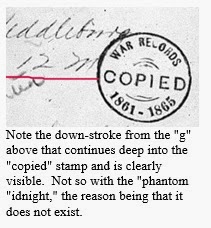
whatsoever behind the "copied" stamp on the erroneously deciphered
War Dept. copy of the September 11th message to Halleck which is also a confirmable
fact. Anyone who looks carefully will
see nothing after the "M." It
is also a confirmable fact that Lincoln's copy of the September 13 message is
time-marked 12 Midnight. The evidence
supporting the 12 Midnight time-mark are also confirmable facts. What am I
missing, I ask Mr. Sears?
SEARS:
What actually,
factually happened at noon at Frederick was this: McClellan was handed the Lost
Order, delivered by a courier from General Williams and Lieutenant Pittman at
Twelfth Corps headquarters, confirmed as authentic by Williams’s covering note.
It was a Eureka! moment for McClellan. The scales fell from his eyes. He
finally knew what to do. He had before him a telegram from the president, sent at
4:10 the previous afternoon (McClellan Papers), reading “How does it look now?”
He promptly replied, time-marking his telegram 12 M, for meridian or noon.
D'AOUST: Close
but no cigar. What actually, factually
happened shortly before 3 p.m., at Frederick was this: McClellan was
handed the Lost Order, delivered by a courier from General Williams and
Lieutenant Pittman at Twelfth Corps headquarters, confirmed as authentic by
Williams’s covering note. It was a Eureka! moment for McClellan. The scales fell
from his eyes. He finally knew what to do. He had before him a telegram from
the president, sent at 4:10 the previous afternoon (McClellan Papers), reading
“How does it look now?” McClellan being
too busy with critical military matters waited until late that night, at
Midnight, to be precise, before responding to Lincoln's inquiry. For all we know, the telegraph was still down
that afternoon and evening thus preventing McClellan from writing earlier. Then again, McClellan was in the habit of
writing such messages late in the night. In any event, he replied to Lincoln's message at Midnight, hence why the
message was time-marked 12 Midnight.
SEARS:
What actually,
factually happened in the early morning hours of Sept. 14 in the War Department
telegraph office was this: A perfectly
competent operator routinely took down McClellan’s Sept. 13 12 M telegram to Lincoln, labeled it received at
2:35 a.m. [14th], made one copy and carbon marked 12 M for the office, and one
marked 12 M for the president. When Lincoln was handed the telegram and saw the
2:35 a.m. received time, he figured two and a half hours about right for a
telegram to reach him (not knowing of the telegraphic delays), and altered 12 M
into 12 Midnight, no doubt for clarity in understanding events. It’s an
essentially simple story. It meets McClellan’s telegraphic protocol, meets the
professionalism of the War Dept. telegraph office. And most of all, it meets
the confirmable facts.
D'AOUST: What actually, factually happened in
the early morning hours of Sept. 14 in the War Department telegraph office was
this: A not so competent operator took
down McClellan’s Sept. 13 12 Midnight
telegram to Lincoln, labeled it received at 2:35 a.m. [14th] and
arranged to have it delivered to the President.
Someone, we will never know who, having realized that the time
designation was wrong, added the "idnight." As part of the clerical function, a War
Department copy and carbon copies were subsequently made, all erroneously
marked 12M. It’s an essentially simple
story. It meets all logic and most of all, it meets the confirmable facts (the
two accounts re the 27th Indiana's arrival time and the Catoctin aspect and
finally, Messrs. Thorp's and Clemens's discovery re the September 11th message
to Halleck.)
SEARS:
(And no, Mr.
D’Aoust, I did not “suppress,” as you accusingly put it, the Lincoln Copy when
I saw it some thirty years ago. I left it right where it is, in the Lincoln
Papers and microfilm, for all to see and ponder.)
D'AOUST: One
definition of the word suppress includes " To keep from being revealed,
published, or circulated." I'd say
that pretty well fits the circumstances.
That is not to suggest that Mr. Sears is in any way guilty of any
malicious act but having said that, he, at the very least, owed it to his
readers and to history to immediately reveal the existence of the Lincoln
copy. It was simply too controversial of
an issue for it to have been left "right
where it is." I know this, most who
read this exchange will know it, and even Mr. Sears must know it.
SEARS:
Here is a
transcription of the McClellan-Lincoln Sept. 13 telegram. It needs to be
considered in this context. On Sept. 12 McClellan writes his wife he can’t
figure out where the enemy is or what he is doing. Then just before noon on the
13th (after a warm welcome by the ladies of Frederick), he is handed the Lost
Order. Immediately, in obvious excitement, he telegraphs the president. For
George McClellan, this is positively giddy. Then compare this with McClellan’s
11 p.m. telegram to Halleck, (OR 19.2:281-82, too long to transcribe here). It
is a very sober document. He is facing 120,000 Rebels led by Lee in person,
aiming for Pennsylvania. He expects a “severe general engagement tomorrow. . .
. I have the mass of their troops to contend with & they outnumber me when
united.”
D'AOUST: The
McClellan-Lincoln Sept. 13 telegram needs to be considered in this context. On
Sept. 12 McClellan writes his wife he can’t figure out where the enemy is or
what he is doing. Then just before 3 p.m. on the 13th he is handed the
Lost Order. Almost immediately, he sends a copy to Pleasonton with instructions
to confirm its contents. Pleasonton
returns one and a half to three hours later with a quasi confirmation. By 6:20 McClellan has formulated his plan and
issued his orders to Franklin. I've
already commented on how Mr. Sears is reading too much into the variances
between McClellan's messages to Halleck and Lincoln that night.
I submit that
it is beyond imagining that McClellan could have sent the September 13, 1862
telegram to Abraham Lincoln at 12M and that it is time to permanently dispel
that myth.
To the
President Hd Qrs Frederick
Sept 13th 12 Midnight
I have the whole Rebel force in
front of me but am confident and no time shall be lost. I have a difficult task
to perform but with Gods blessing will accomplish it. I think Lee has made a
gross mistake and that he will be severely punished for it. The Army is in
motion as rapidly as possible. I hope for a great success if the plans of the
Rebels remain unchanged. We have possession of Cotocktane. I have all the plans
of the Rebels and will catch them in their own trap if my men are equal to the
emergency. I now feel I can count on them as of old. All forces of Pennsylvania
should be placed to cooperate at Chambersburg. My respects to Mrs. Lincoln.
Received most enthusiastically by
the ladies. Will send you trophies. All well and with Gods blessing will
accomplish it.
Geo B. McClellan
3/30/2014
Guest Post: The McClellan telegram, A Postscript from Stephen Sears
Stephen Sears writes:
A mystery
solved.
In my 3/30
guest post I discussed Gene Thorp’s reporting of a McClellan to Halleck
telegram of Sept. 11 that bore a 12 Midnight time stamp (pictured in the
D’Aoust post of 3/26) but which appears on the War Dept. telegraph operator’s
copy as 12 M, i.e., noon. It is printed in the Official Records as 12 noon. This
operator’s blunder, according to Mr. Thorp, was then repeated on Sept. 13 in
the McClellan to Lincoln telegram, that is, changing McClellan’s supposed time
mark 12 Midnight to 12 M.
While I
pointed out the falsity of this theory in my last post, I can now add the final
proof of that falsity. To double check, I looked up on the National Archives microfilm the Washington operator’s copy of
the Sept. 11 telegram to Halleck. In fact the operator faithfully copied the
sender’s time-mark 12 Midnight. But postwar the Official Records compiler
placed his “Copied” stamp squarely over the “idnight” of that 12 Midnight time
mark. All that shows is 12 M. And since
12 M is standard for noon, in the printed Official Records (19.2:252) it runs
as 12 noon. This can be seen in Thorp’s illustration, and more clearly on the
microfilm.
In other
words, the War Dept. operator was entirely competent on Sept. 11. The error was
made by the Official Records’ stamp-wielder. Now that we know the operator was
doing his job on Sept. 11, it’s safe to say he was also doing his job on Sept.
13, when he rendered McClellan’s 12 M telegram 12 M on Mr. Lincoln’s copy and
the file copy and carbon.
-- Stephen Sears
Subscribe to:
Posts (Atom)


