By the end of the Civil War, the Union had purged its high command of non-Academy generals. There were exceptions, like Logan and Blair functioning in field commands as major generals, but those wholly self-taught were crowded out of the center.
There is no study of this event, nor do we have a handy source for contemporary back and forth on the issue. Here's a try at listing the positions of the two camps.
Anti-professional
(1) Academy training does not prepare officers for war.
(2) The professionals will always consist of a stale, parochial talent pool organized by date of rank, not merit.
(3) Professionals will fall prey to their own class interests, putting these above the country's need.
(4) Professional officers lack the vision, energy and life experience of successful Americans civil leaders.
(5) Talented men can learn on-the-job and by reading.
(6) Professionals become preoccupied with military punctillio and minutia to the detriment of the mission.
(7) Professionals cannot connect with a citizen army mobilized by intense political or patriotic sentiment (cannot bring out their best).
Professional
(1) Civilians in high positions reduce efficiency.
(2) Civilians pursue individual and political (non-military) agendas.
(3) Civilian appointees make technical errors that cost lives.
(4) Civilians often have divided interests (businesses left behind, political careers, etc.) and lose focus.
(5) Civilian appointees will discriminate against professionals within their commands.
(6) Civilians curry favor with the rank and file.
(7) Appointees will apply non-military considerations in making military decisions.
This little list will be our jumping off point for looking at some ideas in the modern military reform movement. More tomorrow.
5/13/2004
5/12/2004
Yes, we have changes
Here we are with a new look and there will be glitches, with things out of place, etc. The old posts will lack titles, for instance. Good luck to us all.


A few years ago, Edward H. Bonekemper III wrote a short book arguing that the audacity of Robert E. Lee imposed an impossible cost on the Confederate Army, dooming it in any prolonged contest. The volume was called How Robert E. Lee Lost the Civil War. I noted when it came out that,
He subscribes to the prevailing battlemindedness in CW historiography and takes it down to the next level of primitivism, which is statistical analysis. This makes for a a final stop at a place where Lee ranks far, far below Bragg in capability. Thus the "novelty" of this work, its special thrill, is that it applies the current wisdom against the leading beneficiary of the current wisdom, Mr. Robert E. Lee.
The simplistic metric of battles won or lost dominates ACW thinking and is key to saleability of personalities and events.
In his Lee book, Bonekemper did revive a useful analytic tool to try to measure one aspect of "quality" in generalship; that is "hit ratios." Considering hit ratios (damage taken versus damage inflicted), the results are astonishing when set beside current ACW wisdom. For example, in terms effective combat violence, there is no soldier in McClellan's league on either side of the Civil War except for Grant, and Grant arrives near McClellan's numbers only if you include surrendered troops as if they were direct combat casualties. (Please see the linked table for numbers.)
Bonekemper used hit ratios to help substantiate his view that Lee was a poor general well regarded by his president who enjoyed a popularity that insulated him from his mistakes.
Well, Bonekemper has written a new book about Grant's career: A Victor, Not a Butcher: Ulysses S. Grant's Overlooked Military Genius. I would have thought he would flip the coin and use numeric analysis to measure the higher quality of Grant's generalship. This review suggests, instead, that he abandoned analysis for storytelling:
Bonekemper's descriptions of Grant's Overland and Appomattox Campaigns are exceptionally reader friendly and easy to follow. As a military writer, the author has that gift of simplifying complex maneuvers and making them understandable.
That's marching backwards. But there's a little silver lining:
... not since Dr. Jeffery Hummel's seminal study, Freeing the Slaves and Enslaving Freemen, have I read a book so generous with its bibliography, notes, and appendices all of which are required by serious students of the war!
Hmmm. Have to find this book. Will report back promptly.
UPDATE | Visited the B&N here in Baltimore after writing this. They actually have Bonekemper's book in a special display. Down to brass tacks:
Citations: Overwhelmingly secondary sources, even including authors who write from secondary sources themselves (e.g. McPherson).
Strength figures: They play a large role in each chapter but are not cited. Lots of zeroes, very round numbers.
Casualty figures: An appendix carries tables comparing estimates made by pop historians for each engagement. Very interesting. The author gives his own "best estimate" but fails to comment on how each individual best estimate was calculated.
Storytelling: Omnipresent, but the author keeps each chapter short.
Bibliography: Nothing special.
Impulse buy rating: No sale. (Updated at 1:45 pm)
He subscribes to the prevailing battlemindedness in CW historiography and takes it down to the next level of primitivism, which is statistical analysis. This makes for a a final stop at a place where Lee ranks far, far below Bragg in capability. Thus the "novelty" of this work, its special thrill, is that it applies the current wisdom against the leading beneficiary of the current wisdom, Mr. Robert E. Lee.
The simplistic metric of battles won or lost dominates ACW thinking and is key to saleability of personalities and events.
In his Lee book, Bonekemper did revive a useful analytic tool to try to measure one aspect of "quality" in generalship; that is "hit ratios." Considering hit ratios (damage taken versus damage inflicted), the results are astonishing when set beside current ACW wisdom. For example, in terms effective combat violence, there is no soldier in McClellan's league on either side of the Civil War except for Grant, and Grant arrives near McClellan's numbers only if you include surrendered troops as if they were direct combat casualties. (Please see the linked table for numbers.)
Bonekemper used hit ratios to help substantiate his view that Lee was a poor general well regarded by his president who enjoyed a popularity that insulated him from his mistakes.
Well, Bonekemper has written a new book about Grant's career: A Victor, Not a Butcher: Ulysses S. Grant's Overlooked Military Genius. I would have thought he would flip the coin and use numeric analysis to measure the higher quality of Grant's generalship. This review suggests, instead, that he abandoned analysis for storytelling:
Bonekemper's descriptions of Grant's Overland and Appomattox Campaigns are exceptionally reader friendly and easy to follow. As a military writer, the author has that gift of simplifying complex maneuvers and making them understandable.
That's marching backwards. But there's a little silver lining:
... not since Dr. Jeffery Hummel's seminal study, Freeing the Slaves and Enslaving Freemen, have I read a book so generous with its bibliography, notes, and appendices all of which are required by serious students of the war!
Hmmm. Have to find this book. Will report back promptly.
UPDATE | Visited the B&N here in Baltimore after writing this. They actually have Bonekemper's book in a special display. Down to brass tacks:
Citations: Overwhelmingly secondary sources, even including authors who write from secondary sources themselves (e.g. McPherson).
Strength figures: They play a large role in each chapter but are not cited. Lots of zeroes, very round numbers.
Casualty figures: An appendix carries tables comparing estimates made by pop historians for each engagement. Very interesting. The author gives his own "best estimate" but fails to comment on how each individual best estimate was calculated.
Storytelling: Omnipresent, but the author keeps each chapter short.
Bibliography: Nothing special.
Impulse buy rating: No sale. (Updated at 1:45 pm)
5/11/2004
Have been poking around for a software solution to a research problem. Maybe that's a bad thing.
Nevertheless, to map the complex patterns of ACW political sponsorship of military careers, I would like to visualize the interaction between various generals on one side and various cabinet members and governors on the other side.
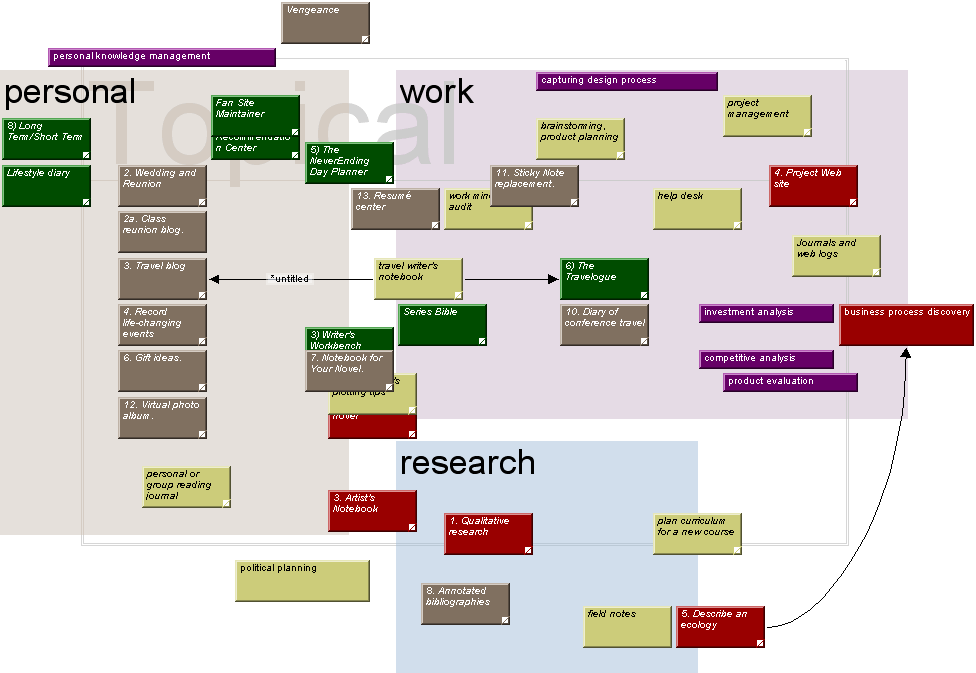
I started on this project looking at a simple hypertext authoring tool that could display information relationships graphically. Storyspace has this, but I'm afraid the volume I've collected would overload the display engine. Eastgate, which makes Storyscape, has a new product that may fit the bill, however: Tinderbox, which I need to look with care. However when they say, "Build relationships by arranging notes, organizing them with shape and color, linking them," it sounds like PowerPoint or Visio. And their graphic is does not speak well of organization, although I see possibilities in it.
Crime analysis and private intelligence analysis programs would be perfect, but they are geared for enterprises and government markets. Look at the wow factor here:
The software will troll through open databases, like D&B (DNB ) or LexisNexis, to look for connections between individuals and companies. Then it will illustrate the connections graphically, with lines connecting people and organizations.
This is Analyst's Notebook developed for intelligence work. You know you are entering deep waters when the website contains no hint of price.
Here's something interesting designed for crime-busters:
Watson provides clear and comprehensible charts that uncover patterns and relationships quickly and in detail. With Watson, information can be managed and presented with clarity and precision. Real-time analysis, intelligent querying and numerous temporal, associative or spatial charts ensure that information discovery is optimized and unlimited.
This is another interesting product lacking a price tag.
Back to the 3x5" cards for now.
Nevertheless, to map the complex patterns of ACW political sponsorship of military careers, I would like to visualize the interaction between various generals on one side and various cabinet members and governors on the other side.
I started on this project looking at a simple hypertext authoring tool that could display information relationships graphically. Storyspace has this, but I'm afraid the volume I've collected would overload the display engine. Eastgate, which makes Storyscape, has a new product that may fit the bill, however: Tinderbox, which I need to look with care. However when they say, "Build relationships by arranging notes, organizing them with shape and color, linking them," it sounds like PowerPoint or Visio. And their graphic is does not speak well of organization, although I see possibilities in it.
Crime analysis and private intelligence analysis programs would be perfect, but they are geared for enterprises and government markets. Look at the wow factor here:
The software will troll through open databases, like D&B (DNB ) or LexisNexis, to look for connections between individuals and companies. Then it will illustrate the connections graphically, with lines connecting people and organizations.
This is Analyst's Notebook developed for intelligence work. You know you are entering deep waters when the website contains no hint of price.
Here's something interesting designed for crime-busters:
Watson provides clear and comprehensible charts that uncover patterns and relationships quickly and in detail. With Watson, information can be managed and presented with clarity and precision. Real-time analysis, intelligent querying and numerous temporal, associative or spatial charts ensure that information discovery is optimized and unlimited.
This is another interesting product lacking a price tag.
Back to the 3x5" cards for now.
Grant biographer Brooks Simpson was at Chancellorsville recently and notes:
The problem with popular understandings of the battle -- and this is reinforced to some extent by the NPS treatment of the field -- is that people tend to abandon interest in the battle after May 2 [1862]. The Fredericksburg battlefield is set up to interpret 1862, not the 1863 action; Salem Church is overrun by development; although there is a Hazel Grove interpretive stop and walking tours of the final Union positions, people tend to go to the Chancellorsville VC to look at where Jackson was hit (not at the monuments, by the way).
Indeed: the configuration of the park - its amenities and attractions, the accident of which lands were acquired - affects the interpretation of the the battle. An obvious point that had not occurred to me, since I don't tour with guides. Another great reason to keep park services out of the interpretation business.
The problem with popular understandings of the battle -- and this is reinforced to some extent by the NPS treatment of the field -- is that people tend to abandon interest in the battle after May 2 [1862]. The Fredericksburg battlefield is set up to interpret 1862, not the 1863 action; Salem Church is overrun by development; although there is a Hazel Grove interpretive stop and walking tours of the final Union positions, people tend to go to the Chancellorsville VC to look at where Jackson was hit (not at the monuments, by the way).
Indeed: the configuration of the park - its amenities and attractions, the accident of which lands were acquired - affects the interpretation of the the battle. An obvious point that had not occurred to me, since I don't tour with guides. Another great reason to keep park services out of the interpretation business.
Battlefield preservation success stories from an organization local to the Shenandoah.
"Partnerships — both obvious and unlikely ones — lie at the root of each saved battlefield."
I'm open to argument on this, though I think partnerships will devour the precious time of a volunteer organization and enmesh people in useless politics. In this article at least they seem to be talking about civic partnerships that produce the desired results.
The desired result in battlefield conservation is always and only visitors on battlefield land.
The alternative concept in partnership is to team up with wildlife lovers and farmland conservators, the state, the county, the feds, and a myriad of other parties to encumber a piece of land through joint purchase of development rights. these partnerships keep people off battlefield land, but somehow allow groups to claim vistory for battlefield preservation.
We should keep an eye on these Shenandoah volunteers. The deep ditch of easement buying runs right next to the road they are travelling.
"Partnerships — both obvious and unlikely ones — lie at the root of each saved battlefield."
I'm open to argument on this, though I think partnerships will devour the precious time of a volunteer organization and enmesh people in useless politics. In this article at least they seem to be talking about civic partnerships that produce the desired results.
The desired result in battlefield conservation is always and only visitors on battlefield land.
The alternative concept in partnership is to team up with wildlife lovers and farmland conservators, the state, the county, the feds, and a myriad of other parties to encumber a piece of land through joint purchase of development rights. these partnerships keep people off battlefield land, but somehow allow groups to claim vistory for battlefield preservation.
We should keep an eye on these Shenandoah volunteers. The deep ditch of easement buying runs right next to the road they are travelling.
5/10/2004
U.S. Army officers study the art and deeds of Robert. E. Lee and Stonewall Jackson. If you ask military faculty why, they refer to our (USA + CSA) common military tradition.
I have always found this answer strange. No modern officer should be able to relate professionally on any level to Lee, Jackson, Bragg or their principal subordinates; at the same time, the histories of the Union high commanders resonate with material that speaks to every commander today.
The Jackson way, to take CSA stewardship in its most extreme form, offers a military fantasy.
The general leads an independent command. He has complete latitude in selecting objectives, designing campaigns, and executing operations. He is free from interference by the president, Congress, or other civilians. His authority is so broad that he can arrest his own general officers on trifles, and even humiliate them in front of their own troops. He is not obliged to share his plans with anyone. He is free to withhold strategy, objectives and even the details of orders from subordinates charged with executing them. This general is master of his own military justice system, with authority to shoot stragglers and deserters. He is not responsible for feeding or supplying his troops; the commissary and supply departments are. Consequently, he can force-march unfed barefoot troops day-after-day. Rain and cold but no tents? Someone else's problem. No clothes? Someone else's problem. No food? Maybe we can scrounge some today or tomorrow. Meanwhile – and the Vietnam-era officers dream of this – the public adores him.
All this is a recipe for 30 years in Leavenworth breaking rocks, should you try the Jackson way of war yourself today. If you bring this to the attention to the uniformed Jackson fantasists, as I did over 30 years ago, you are told that Jackson put the mission first. Well, he certainly did. Which reminds me of a related military fantasy at the Infantry School at the end of the Vietnam War. The old-timers from Korea and even WWII (we had a few of those on board then) would say, "All this BS goes away during war. Everybody gets down to business. The mission drives everything and the nonsense disappears." We would look at them, nod slightly and think, "Sorry, this BS is not going away." Nor has it. Nor, I suspect, was it ever banished.
The people who think you can force march parched, starving, shoeless troops in rags over hills and woods a distance of 25 miles or more per day, then fight battles (shooting stragglers en route) are probably the people who still think that when war comes, the trivia goes away. It did for Lee and Jackson; it does not go away in the U.S. Army, which means there is no common military tradition uniting USA and CSA.
Our modern military milieu was reflected in the federal forces of the Civil War era. Damned if you do or don't types of orders; political missions tacked on to military ones; letters from Congressmen to commanders demanding to know why someone was not promoted; the Secretary of War wanting to know why the troops were not getting enough fresh water or fresh vegetables; legislative junkets to your sector of the front; civilian interference in military justice; and commanders being responsible for soldiers' food, water, clothing, ammunition, even morale (!) despite the existence of commissary and supply bureaus.
The commanders of today, encumbered by regulations, oversight, micromanagement, multitasking, gross interference in their professional prerogatives, and with one eye on civilian management, another on career advancement have a home in the war fought for the Union … should they ever wish to leave Confederate fantasyland.
In the meantime, I will concede that you can get a lot out of unfed, unpaid, barefoot, ragged troops when they perceive no legal or other limits to your authority, no mercy in your justice, and no regard for your subordinates. Let's just agree not to model that too closely.
For some extreme Jackson fantasies, go here, and here.
I have always found this answer strange. No modern officer should be able to relate professionally on any level to Lee, Jackson, Bragg or their principal subordinates; at the same time, the histories of the Union high commanders resonate with material that speaks to every commander today.
The Jackson way, to take CSA stewardship in its most extreme form, offers a military fantasy.
The general leads an independent command. He has complete latitude in selecting objectives, designing campaigns, and executing operations. He is free from interference by the president, Congress, or other civilians. His authority is so broad that he can arrest his own general officers on trifles, and even humiliate them in front of their own troops. He is not obliged to share his plans with anyone. He is free to withhold strategy, objectives and even the details of orders from subordinates charged with executing them. This general is master of his own military justice system, with authority to shoot stragglers and deserters. He is not responsible for feeding or supplying his troops; the commissary and supply departments are. Consequently, he can force-march unfed barefoot troops day-after-day. Rain and cold but no tents? Someone else's problem. No clothes? Someone else's problem. No food? Maybe we can scrounge some today or tomorrow. Meanwhile – and the Vietnam-era officers dream of this – the public adores him.
All this is a recipe for 30 years in Leavenworth breaking rocks, should you try the Jackson way of war yourself today. If you bring this to the attention to the uniformed Jackson fantasists, as I did over 30 years ago, you are told that Jackson put the mission first. Well, he certainly did. Which reminds me of a related military fantasy at the Infantry School at the end of the Vietnam War. The old-timers from Korea and even WWII (we had a few of those on board then) would say, "All this BS goes away during war. Everybody gets down to business. The mission drives everything and the nonsense disappears." We would look at them, nod slightly and think, "Sorry, this BS is not going away." Nor has it. Nor, I suspect, was it ever banished.
The people who think you can force march parched, starving, shoeless troops in rags over hills and woods a distance of 25 miles or more per day, then fight battles (shooting stragglers en route) are probably the people who still think that when war comes, the trivia goes away. It did for Lee and Jackson; it does not go away in the U.S. Army, which means there is no common military tradition uniting USA and CSA.
Our modern military milieu was reflected in the federal forces of the Civil War era. Damned if you do or don't types of orders; political missions tacked on to military ones; letters from Congressmen to commanders demanding to know why someone was not promoted; the Secretary of War wanting to know why the troops were not getting enough fresh water or fresh vegetables; legislative junkets to your sector of the front; civilian interference in military justice; and commanders being responsible for soldiers' food, water, clothing, ammunition, even morale (!) despite the existence of commissary and supply bureaus.
The commanders of today, encumbered by regulations, oversight, micromanagement, multitasking, gross interference in their professional prerogatives, and with one eye on civilian management, another on career advancement have a home in the war fought for the Union … should they ever wish to leave Confederate fantasyland.
In the meantime, I will concede that you can get a lot out of unfed, unpaid, barefoot, ragged troops when they perceive no legal or other limits to your authority, no mercy in your justice, and no regard for your subordinates. Let's just agree not to model that too closely.
For some extreme Jackson fantasies, go here, and here.
5/08/2004
SATURDAY | Back to Malvern Hill on this McClellan Poetry Day, and to the writings of a best-selling author of the time, one Elizabeth Stuart Phelps Ward (1844-1911). Ward was a prolific New Englander who wrote on spiritual themes. I see from a net bio that she had over 56 books to her credit.
This is a poem you may need to read calmly, soberly, sitting down. It is laden with a sentimentality we would consider completely over the top; imagine Mac and Hooker and kittens and mother's cranberry pies all in one train of thought:
"Tell her"-but he wandered, slipping
Into tangled words and cries,
Something about Mac and Hooker,
Something dropping through the cries
About the kitten by the fire,
And mother's cranberry-pies;
The historic content is slight and I can't date the poem exactly, but the battle of Malvern Hill certainly inspired this work, so let's put on our Victorian spectales and have a look.
A MESSAGE
Was there ever message sweeter
Than that one from Malvern Hill,
From a grim old fellow,-you remember?
Dying in the dark at Malvern Hill.
With his rough face turned a little,
On, a heap of scarlet sand,
They found him, just within the thicket,
With a picture in his hand,
With a stained and crumpled picture
Of a woman's aged face;
Yet there seemed to leap a wild entreaty,
Young and living-tender-from the face
When they flashed the lantern on it,
Gilding all the purple shade,
And stooped to raise him softly,
That's my mother, sir," he said.
"Tell her"-but he wandered, slipping
Into tangled words and cries,
Something about Mac and Hooker,
Something dropping through the cries
About the kitten by the fire,
And mother's cranberry-pies; and there
The words fell, and an utter
Silence brooded in the air.
just as he was drifting from them,
Out into the dark, alone
(Poor old mother, waiting for your message,
Waiting with the kitten, all alone!),
Through the hush his voice broke, Tell her
Thank you, Doctor-when you can,
Tell her that I kissed her picture,
And wished I'd been a better man."
Ah, I wonder if the red feet
Of departed battle-hours
May not leave for us their searching
Message from those distant hours.
Sisters, daughters, mothers, think you,
Would your heroes now or then,
Dying, kiss your pictured faces,
Wishing they'd been better men?
This is a poem you may need to read calmly, soberly, sitting down. It is laden with a sentimentality we would consider completely over the top; imagine Mac and Hooker and kittens and mother's cranberry pies all in one train of thought:
"Tell her"-but he wandered, slipping
Into tangled words and cries,
Something about Mac and Hooker,
Something dropping through the cries
About the kitten by the fire,
And mother's cranberry-pies;
The historic content is slight and I can't date the poem exactly, but the battle of Malvern Hill certainly inspired this work, so let's put on our Victorian spectales and have a look.
A MESSAGE
Was there ever message sweeter
Than that one from Malvern Hill,
From a grim old fellow,-you remember?
Dying in the dark at Malvern Hill.
With his rough face turned a little,
On, a heap of scarlet sand,
They found him, just within the thicket,
With a picture in his hand,
With a stained and crumpled picture
Of a woman's aged face;
Yet there seemed to leap a wild entreaty,
Young and living-tender-from the face
When they flashed the lantern on it,
Gilding all the purple shade,
And stooped to raise him softly,
That's my mother, sir," he said.
"Tell her"-but he wandered, slipping
Into tangled words and cries,
Something about Mac and Hooker,
Something dropping through the cries
About the kitten by the fire,
And mother's cranberry-pies; and there
The words fell, and an utter
Silence brooded in the air.
just as he was drifting from them,
Out into the dark, alone
(Poor old mother, waiting for your message,
Waiting with the kitten, all alone!),
Through the hush his voice broke, Tell her
Thank you, Doctor-when you can,
Tell her that I kissed her picture,
And wished I'd been a better man."
Ah, I wonder if the red feet
Of departed battle-hours
May not leave for us their searching
Message from those distant hours.
Sisters, daughters, mothers, think you,
Would your heroes now or then,
Dying, kiss your pictured faces,
Wishing they'd been better men?
5/07/2004
I've mentioned a book previously that has a lot of new thinking in it: The War Within the Union High Command by Thomas J. Goss.
One of the points he makes succinctly (and too briefly, at the end of the book) is that the wartime public operated on a "tactical win/loss standard" of success and that this mapped to a simple political barometer. This is not a strange concept to those who have read Archer Jones or Herman Hattaway, or to those reading the gold market charts from that period, but it has a lager meaning in understanding the historiography of the high command. Let's work with this idea.
On one level, you had the McClellans, the Grants, the Shermans who could envision multi-theatre and even national strategy. Lincoln seemed strategy-averse; I think it was optimistic to imagine that a politician, living in the moment, swimming from one expediency to the next, would ever commit in advance to a train of events over a fairly extended period of time allowing for only little adjustment. Soldiers, a little deaf to politics, tried to get general strategies and policies adopted.
On the next level, you had Lincoln, who could simultaneously see the political and military needs of each situation, trying to operate inside the space of public opinion left to him by a "tactical win/loss standard" of success. Lincoln, a little deaf to strategy, tried to get political considerations accepted in military projects, occupation, and operations.
On the most basic level using the most primitive analysis available, much of the public and Congress measured success one battle at a time; never mind where the battle, or whether the battle was needed, or any other context: batlle won or battle lost represented political capital won or lost. Neither Lincoln nor the generals operated at this level of analysis and no one can make sense of the American Civil War using such a yardstick, though many a pop historian has tried.
Those adhering to the tactical win/loss standard of excellence were those who pushed for more political generals in the army. These generals "talked the talk" of immediate and unrelenting offensive action and they promised to "walk the walk." They were against professionalism on principle as limiting and parochial; they were in favor of genius manifested publicly in non-military areas of life being applied to the needs of war. They saw themselves as delivering streams of victories that would accumulate into one national victory. The idea that there was any need for strategy or that something could be won by strategy was openly mocked by the secretary of war himself on many occasions.
Goss aside, the primary sources are full of this stuff.
Now it is 2004 and we see senior military officers are reviving the framework of the natural genius argument. In my post here on Wednesday, I put up the writings of a colonel and a major recently appearing in Infantry magazine, a publication of the Army's very own Infantry School.
These gentlemen proposed two men for genius rank, Jackson and Patton, and the careful description of their virtues had nothing to do with training or preparation (yes, they read military history but so did the political generals of 1861). They were not held up as exemplars of training or devotion to professionalism: they were natural geniuses. The key point for our modern authors is that Jackson and Patton applied aspects of their personalities to each battle they fought. Look closely at the piece linked Wednesday: neither Patton nor Jackson can transcend the need of an individual battle. Their abilities are highly idiosyncratic in each case and can only be applied one battle at a time. Since military history has to be didactic when presented to military audiences, the authors have tacked on a little window dressing at the end, some tips on how you or I can be more like Jackson or Patton.
By the end of the Civil War all the "non-professional" generals had been run off the reservation. All of them. As Goss points out in his book, the school of "natural talent" and "natural genius" was completely defeated by the school of expert training and education. We are living in a world where the possibility of a Civil War type irruption of political celebrities into the pool of officer talent is impossible. Nor is it even possible that we will see the WWII scenario of accomplished civilian technocrats assuming generals' stars. The man of genius is dead as dead can be, as far as awarding commissions goes. The man of natural attainments and talents is locked out and the key has been thrown away. Those with training and military experience - the consistent ones, the dependable ones - hold sway completely.
Black Jack Logan returned to Congress after the war and fought Grant and the professionaliztion ethos. His vision for the Army was interesting; it is not taught. He lost, short term. But it's a symptom of the long-term failure of Grant and his associates that those arguments routinely used against professionalization could be the bread and butter assumptions of the same officer class his bureaucratic struggles made possible.
One of the points he makes succinctly (and too briefly, at the end of the book) is that the wartime public operated on a "tactical win/loss standard" of success and that this mapped to a simple political barometer. This is not a strange concept to those who have read Archer Jones or Herman Hattaway, or to those reading the gold market charts from that period, but it has a lager meaning in understanding the historiography of the high command. Let's work with this idea.
On one level, you had the McClellans, the Grants, the Shermans who could envision multi-theatre and even national strategy. Lincoln seemed strategy-averse; I think it was optimistic to imagine that a politician, living in the moment, swimming from one expediency to the next, would ever commit in advance to a train of events over a fairly extended period of time allowing for only little adjustment. Soldiers, a little deaf to politics, tried to get general strategies and policies adopted.
On the next level, you had Lincoln, who could simultaneously see the political and military needs of each situation, trying to operate inside the space of public opinion left to him by a "tactical win/loss standard" of success. Lincoln, a little deaf to strategy, tried to get political considerations accepted in military projects, occupation, and operations.
On the most basic level using the most primitive analysis available, much of the public and Congress measured success one battle at a time; never mind where the battle, or whether the battle was needed, or any other context: batlle won or battle lost represented political capital won or lost. Neither Lincoln nor the generals operated at this level of analysis and no one can make sense of the American Civil War using such a yardstick, though many a pop historian has tried.
Those adhering to the tactical win/loss standard of excellence were those who pushed for more political generals in the army. These generals "talked the talk" of immediate and unrelenting offensive action and they promised to "walk the walk." They were against professionalism on principle as limiting and parochial; they were in favor of genius manifested publicly in non-military areas of life being applied to the needs of war. They saw themselves as delivering streams of victories that would accumulate into one national victory. The idea that there was any need for strategy or that something could be won by strategy was openly mocked by the secretary of war himself on many occasions.
Goss aside, the primary sources are full of this stuff.
Now it is 2004 and we see senior military officers are reviving the framework of the natural genius argument. In my post here on Wednesday, I put up the writings of a colonel and a major recently appearing in Infantry magazine, a publication of the Army's very own Infantry School.
These gentlemen proposed two men for genius rank, Jackson and Patton, and the careful description of their virtues had nothing to do with training or preparation (yes, they read military history but so did the political generals of 1861). They were not held up as exemplars of training or devotion to professionalism: they were natural geniuses. The key point for our modern authors is that Jackson and Patton applied aspects of their personalities to each battle they fought. Look closely at the piece linked Wednesday: neither Patton nor Jackson can transcend the need of an individual battle. Their abilities are highly idiosyncratic in each case and can only be applied one battle at a time. Since military history has to be didactic when presented to military audiences, the authors have tacked on a little window dressing at the end, some tips on how you or I can be more like Jackson or Patton.
By the end of the Civil War all the "non-professional" generals had been run off the reservation. All of them. As Goss points out in his book, the school of "natural talent" and "natural genius" was completely defeated by the school of expert training and education. We are living in a world where the possibility of a Civil War type irruption of political celebrities into the pool of officer talent is impossible. Nor is it even possible that we will see the WWII scenario of accomplished civilian technocrats assuming generals' stars. The man of genius is dead as dead can be, as far as awarding commissions goes. The man of natural attainments and talents is locked out and the key has been thrown away. Those with training and military experience - the consistent ones, the dependable ones - hold sway completely.
Black Jack Logan returned to Congress after the war and fought Grant and the professionaliztion ethos. His vision for the Army was interesting; it is not taught. He lost, short term. But it's a symptom of the long-term failure of Grant and his associates that those arguments routinely used against professionalization could be the bread and butter assumptions of the same officer class his bureaucratic struggles made possible.
The local Fox affiliate morning TV news ran one segment after another on this weekend's Spotsylvania Court House re-enactment.
5/06/2004
The news is both hopeful and frightening:
New nonprofit pushes to preserve Franklin Battlefield.
We could begin with the question, who needs a new conservation group? That's a deep one we'll save for another time. Right now we can assume that the people who formed this organization did not feel any existing body could be sufficiently trusted to save Franklin battlefield.
Let me put down this bag of peanuts and shout some advice from the gallery.
(1) Buy land. Don't let anyone talk you out of buying land.
(2) If an officer of your new organization proposes buying easements or restrictive covenants, say "We buy land." Then fire that officer for suggesting you fritter away resources.
(3) If a member of your new organization proposes buying easements or restrictive covenants, say "We buy land." Then return the member's card and say goodbye.
(4) If a member of your board stands in the way of your buying land because of cost, remind that board member that you have only one purpose on earth: to buy land.
(5) If people tell you a landowner is asking too much for battlefield land, remind them that the amount asked is so cheap that a developer could pay full asking price and still make millions reselling the same property in parcels.
(6) If you do not have enough money to buy the land you want, act like the entrepreneur launching a startup ... spend your whole life, 18 hours per day, looking for money, for investors, for deep pockets. Borritt has his millionaires to fund the Lincoln Prize. Find your millionaires.
(7) If a developer gets the land before you do, buy lots in the development. Make one of the new houses a battlefield welcome center. Encourage tourist traffic to the development and weekend tours of the neighborhood. As more development property becomes available, buy it. Continue this process until you own the battlefield.
(8) Express your displeasure with developer-friendly officials; use lawsuits, elections, and press conferences rich with names named.
(9) When this or that organization comes to you offering to team up, or "help" or to "coordinate efforts," simply say to them, "What we need from you is money to buy battlefield land - and it must have no strings attached. Can you provide that?" If not, tell them goodbye.
(10) Structure your organization to prevent an internal coup by paid management. Management will try to hijack the organization in order to make a living out of it.
If you want to see how battlefields have been destroyed by preservationists and government entities look at this discussion thread, "Spinning Wheels on South Mountain." It could be the furture of Franklin battlefield if you repeat the mistakes made in Maryland.
New nonprofit pushes to preserve Franklin Battlefield.
We could begin with the question, who needs a new conservation group? That's a deep one we'll save for another time. Right now we can assume that the people who formed this organization did not feel any existing body could be sufficiently trusted to save Franklin battlefield.
Let me put down this bag of peanuts and shout some advice from the gallery.
(1) Buy land. Don't let anyone talk you out of buying land.
(2) If an officer of your new organization proposes buying easements or restrictive covenants, say "We buy land." Then fire that officer for suggesting you fritter away resources.
(3) If a member of your new organization proposes buying easements or restrictive covenants, say "We buy land." Then return the member's card and say goodbye.
(4) If a member of your board stands in the way of your buying land because of cost, remind that board member that you have only one purpose on earth: to buy land.
(5) If people tell you a landowner is asking too much for battlefield land, remind them that the amount asked is so cheap that a developer could pay full asking price and still make millions reselling the same property in parcels.
(6) If you do not have enough money to buy the land you want, act like the entrepreneur launching a startup ... spend your whole life, 18 hours per day, looking for money, for investors, for deep pockets. Borritt has his millionaires to fund the Lincoln Prize. Find your millionaires.
(7) If a developer gets the land before you do, buy lots in the development. Make one of the new houses a battlefield welcome center. Encourage tourist traffic to the development and weekend tours of the neighborhood. As more development property becomes available, buy it. Continue this process until you own the battlefield.
(8) Express your displeasure with developer-friendly officials; use lawsuits, elections, and press conferences rich with names named.
(9) When this or that organization comes to you offering to team up, or "help" or to "coordinate efforts," simply say to them, "What we need from you is money to buy battlefield land - and it must have no strings attached. Can you provide that?" If not, tell them goodbye.
(10) Structure your organization to prevent an internal coup by paid management. Management will try to hijack the organization in order to make a living out of it.
If you want to see how battlefields have been destroyed by preservationists and government entities look at this discussion thread, "Spinning Wheels on South Mountain." It could be the furture of Franklin battlefield if you repeat the mistakes made in Maryland.
Subscribe to:
Posts (Atom)