12/28/2006

More narrative strategies

Kevin Levin is not entirely satisfied by my post on narrative strategies.

Anyway, let me take the opportunity that a new post provides to suggest some writings from rhetoritician Andrew Cline. (These tie in more closely with Elektradig's issues than with Kevin's, however).

Cline has long been concerned with the narrative strategies of journalists, but his points apply just as well to nonfiction writers in general.

For instance, I think that this passage speaks to the difference between (h)istorian and the (H)istorian:
The story journalism tells is always the story of the context (the rhetorical situation) of journalism. As long as it constructs, structures, and mediates the stories of others, those others will always feel their contexts have been lost or ignored.
Those with historic sensibility (generally not pop historians) feel deeply for those others. Let me make this easier with a rephrasing:
The story that narrative history tells is always the story of the context (the rhetorical situation) of narrative history.
Thus, plot line; protagonist; character development arc; struggle; these imperatives structure the information conveyed transforming it out of the realm of history into the realm of literature. We are not reading the story of events per se but the story of narrative structure and linear, chronological presentation.

Note too that there are only a limited number of story structures that work for pop history, further distorting the mirror of events. We'll look at those soon.

History as a game

Military analyst Niall Ferguson writes, "Gaming history is not a crass attempt to make the subject relevant to today’s kids. Rather it’s an attempt to revitalize history with the kind of technology that kids have pioneered. And why not?"

I'll say why not. The game is entertainment structured around the designer's interpretation of historical events and/or his attempt to translate events into "playability." If you already know about the underlying events, you can experience the fun of dynamically working through someone's interpretation and evaluating it.

Games are also story machines reworking a known narrative in the way script doctors work on screenplays. Again, your starting point is the accepted narrative and timeline; if you don't know those going into the game, the game makes sense only on the level of sci-fi with no backstory.

The game, "as education," should logically follow as second step after reading at least one narrative history of the underlying events. But in that case, we're still doing stories, not doing history ... and we're seeing events without seeing consequences.

Ferguson seems to be using strategy games to develop his kids' interest in reading about the events played. What depresses one here is that through gaming he hopes to inveigle his boys into reading fast-paced, novelistic nonfiction tales with loads of dialog and drama.

Sort of like sending your kids to play with Big Bird toys to prepare them for Road Runner cartoons later in life. Better they learn some zoology this way than none at all?

12/27/2006

Narrative strategies

Friendly blogger Elektradig puzzles over my apparent anti-narrative stance - I should offer a word or two, since this has been an issue raised before.

There are two sides to narrative and analysis - as reader's choice and as writer's choice.

Reader's choice.
My strategy in reading narrative - like yours - is to find a framework in some topic I am not well versed in, ideally with as little work as possible. Hello easy reading! Thus, I read Jean Smith's Grant when it came out and enjoyed it - I am naive enough in things Western that his mistakes and failures of attribution did my entertainment no harm at all.

The next reading on the same topic, if it is a narrative, will be matched against what I read before; in other words, I will begin to develop my own analysis and to offset weaknesses in each storytelling by reading one narrative against the other. And so it goes, until I am ready for fully analytic work. Once there, I cannot, as a reader ever go back to reading narrative for enjoyment in a particular subject. I have (accidentally or on purpose) made myself into a critic of the literature. I believe this to be true for everyone.

The narrator has wired a large board and set all the switches of controversy to flow the storyline in a manageable direction. As a naive reader of Jean Smith, the switches were hidden from me and I went with the flow - with pleasure. But as a deep reader in other areas, say the early war in the East, I can recognize each choice the narrator makes to either highlight or suppress a controversy. I become judgemental: is the subject being done justice by the author?

The author is on trial. And yet, narrative as a form has served its (positive) purpose. It has taken me to a point where I can exercise my analytic faculty - also for enjoyment.

What would be weird (pathological?) is if I repeatedly sought out more books on the same subject and at the same level as Jean Smith's Grant. In other words, something very bad is happening if Grant is a gateway to years of more Grants.

People generally range various nonfiction fields topically, looking to recreate that nonfiction reading pleasure James McPherson delivered with his Civil War material by finding a similar work by a different author on another topic. In other words, readers do not repeat Grant endlessly when they can swim at their chosen depth across a wider sea; and they do, travelling from Leonardo's Italy to Mao's China and back again.

So let the wide-ranging reading of narratives continue. Let me not begrudge the entertainment a McPherson or Goodwin delivers to a naive reader. And let us remember that the pleasure fades as topical innocence is lost.

If this is true for the general public, it needs qualification for Civil War readers. The ACW is so broad, one could wade the same shallow depth from one war topic to the next. One could, in other words, start with Battle Cry, then seek out a similar reading experience in a campaign account, then in a tale of the Lincoln presidency, etc. One could arrest one's own development as a reader while assuming the (false) identity of a history reader. The publishing industry understands this and has built for us in Civil War nonfiction a huge wading pool.

Part of the maintenance of that pool involves praising entertainers as historians.

McPherson and Goodwin, then, represent less a gateway to the riches of history than a trapdoor into this nonfiction wading pool.

Writer's choice
When you get down in the trenches with bestselling nonfictioneers, say a Peter Maas, you notice a hopping from topic to topic. You find authors studying up for a next nonfiction book; they are only one or two steps ahead (informationally) of their naive readers. They are, in sum, naive readers packaging material for other naive readers. This is an excellent way to preserve freshness, the innocence, the view from 50,000 feet. But if Maas, for instance, had stayed with his first hit like many an ACW scribe has done, if he endlessly re-investigated, rewrote, and rethought Serpico (different aspects of the career, different cases within the career), he would have passed through an ever-evolving understanding of his topic, something he could apply to the deepest questions about life. He would be doing history.

This Maas dynamic, real or imagined, does not apply in the professional class of Civil War authors. We are confronted by writers who publish decade after decade without hopping or evolving.

Battle Cry has not been revised since it was compiled in 1988 (unless an illustrated edition is considered revision - and there we are told all the revisions involved cuts). On the other hand, Doris Goodwin had to study up to write Team of Rivals. Like Maas, Goodwin topic hops, establishing an alibi of innocence.

But the Centennial era material that McPherson aggregated in the late 1980s had already been made stale then by 10 to 15 years of research and new discoveries. It is now almost 20 years since this outdated-at-birth, never-revised nonfiction was released. The book, delivering its pleasure, sets up a pathology part of which is a standing invitation to immaturity.

Personal choices
J. David Petruzzi said something about being a writer that applies just as much to being a Civil War reader:

In my case, before even thinking about writing on a particular subject, I have a personal desire to know it inside and out. I gather all available sources - both primary and secondary - and sift through them over and over. I make comparisons and contrasts, and attempt to construct the story that I feel is accurate, placing the subject in context with surrounding events. By the time I’ve grown comfortable with the idea of beginning to write - the process can take weeks or even months - I feel that the story is now “mine.”
As readers, we make topics of interest "ours." Once that happens, the attraction of narrative fades, its entertainment value falls away, and the idea that this form could transcend entertainment to deliver History becomes improbable.

For all those who tell me, "I came into this by reading Battle Cry," let me suggest you are different. You escaped the pool, leaving many times your number wandering aimlessly through sludge.

Sentimental loyalty to an author in repayment for a good reading experience is misguided.

"History" and eggnog

To many, history seems worthless unless used as a raw ingredient in some sort of brew, usually political or military analysis. For such readers, Investor's Daily weighed in yesterday with a potent recipe for history nog.

To get your run-of-the-mill nonfiction reader good and drunk on punditry spiked with "history," first assemble your ingredients in a work area cleaned of messy detail.

Pour some strong spices in a bowl: "[Colin] Powell seems to be morphing into the McClellan of his time."

Break your eggs into the bowl; don't worry if they are rotten or sound: "He'd been sacked by Lincoln as commander of the Army of the Potomac for his reluctance to commit his troops to battle."

Mix in a little frothy cream: "Weary Union voters seemed willing to accept McClellan's plans to accept a stalemate..."

Add moonshine to taste: "Line up everything we've got and more, point it in the general direction of al-Sadr and the other jihadists, put a Sherman in command and shout Charge!"

Uh oh, this nog maker has tasted too much of his own brew.

12/26/2006

Viewshed: up for grabs?

Interesting how the authorities regard "viewshed" at Chattanooga. A wireless cell tower builder whose structure will be visible from the battlefield received green lights from the oddest sources:
Mr. Wells said he conferred with the National Park Service and other entities and there was no objection.
Also:
"We did not receive any objections and were approved by the State Historical Commission."
More here.

"Momentous"

Seen in print:
A momentous tribute to a local legend was observed at the Cook Center on the campus of Navarro College Thursday morning. Charles S. Pearce, arguably the biggest factor for the Pearce Civil War Museum and Western Art Collection’s success, was honored with a display case dedicated to his late wife Peggy Pearce.

Off with her head/off her head

Some people in Galena are unhappy with the Julia Dent Grant statue: "We've discussed sending it back to the foundry to have the head lopped off and redone..."

Meanwhile, Mary Lincoln features in a new musical.

12/22/2006

Planning a tour of eastern battlefields

Joshua Blair has started a blog detailing his adventures in planning what he calls a "Civil War Power Tour". He must know that Tim Reese should be his Maryland Campaign guide and that Manny is standing for Antietam specifically. James A. Morgan III does a great job with Ball's Bluff and should be reachable through his publisher Eric. Not sure whom to recommend for Gettysburg or Fredericksburg or the later stuff.

Joshua could keep it simple by booking James McPherson for seven days. Cost per person: $2,165.

Why not book him, then argue the whole time?

That would be a good vacation, except you'd still have to pay him.

James McPherson, children's author

Just in time for the holidays, James McPherson has released a picture book for children about the settling of the West. In this email interview run by the New York Times, McPherson lays out his credo better than I ever could:

I emphasize here the word story. If history is not presented in a narrative format it loses the drama and vividness that evokes interest — in adults as well as children. If history is taught — at any level, from elementary to college — as little more than facts and dates to memorize, or concepts to analyze, it becomes deadly.
On the contrary, the overwhelming experience of history begins at some point after the facts, dates, and (yes) storyline have been mastered. Fail to master those, and you cannot begin to engage this as hobby or discipline. The reading (and listening) experience called history rests on combinations of details that never stop surprising, delighting and challenging.

History taught as story cuts out the legs from under those who might eventually learn to love history - perhaps even study or write history - and converts them into readers of nonfiction genre narrative, usually second rate literature with appallingly low history content.

The question is how many of those nonfiction readers cross over to discerning history readers: direct mail specialists call this the "conversion rate" and I personally think it is miniscule. Consider Elektradig's formula,
I'm delighted when I see that someone under the age of, say, thirty, knows anything about American history. If Doris Kearns Goodwin inspires 100 or 1,000 people to become interested in the Civil War or Lincoln, I say she can have her award. Ditto for James McPherson and Ken Burns. In an age when teenagers have never heard of World War I and aren't sure when World War II took place (much less between whom), I say that popular history is better than no history at all.
Well, it is not history except that it uses historical materials more or less the way a novelist would use them. It is genre literature written to entertain - not in the way a crossword puzzle does, or even a detective novel, but in the same way a Western works - black hats, white hats, a struggle, a showdown, the end.

I am selfishly concerned that a generation of people with no historical sensibility to whom McPherson and Goodwin have been portrayed as "historians" is making my life miserable. If McPherson and Goodwin were represented to newbies as the starting point in a long journey, then I should keep quiet. But if held up as representatives of this discipline called history they merely encourage newbies to read more authors like DKG and McP. They become a gateway to more Goodwinism, not to history.

Like so many thoughtless nonfiction readers, the commentator Hugh Hewitt imagines history as raw material for his garden variety political analysis and that is what he uses Goodwin for (just as the NewsHour used her and Richard Norton Smith). Meanwhile the postings of history professors on HNN look like third-rate political punditry (scroll down here anytime) and the poses struck tell us these "historians" would much rather be policy makers or newspaper columnists but they've settled on their third choice of career.

This is all data my friends and it suggests that "historians" growing up in a McPherson/Goodwin world do not wind up as Historians - far from it, whatever their credentials, whatever their job title.

I am not irritated with writers of some story well told but at butchers of stories. I am not miffed at popularizers of history but with popularizers of anti-history.

Kevin Levin is waving McPherson's forthcoming (adult) book of essays at me by way of teasing. Actually, I encourage people to read that book and will do so myself. By adopting a topical format, McPherson abandons the master narrative structure and places himself at the mercy of the facts in each case. Which is to say, an enormous disadvantage.

A man who cannot understand (process) historical controversy and who then misrepresents the views of bona fide scholars is not going to fare well in a monograph setting.

If all our Goodwins, not just McPherson, could be lured into writing in depth topically, their pretenses would be exposed and the advanced readers could use this new digital media to supply them with the feedback they desperately need.

The Civil War for five-year-olds

You take them to the woods, march them around with muskets, and they regurgitate gibberish at the end of the day: “Wars don’t solve anything. The Civil War was about slavery, but others just make more wars, and they do not have any reason.” Brilliant.

For kids, I think I prefer this.

Heritage tourism now pays for tourists

Just when you think the rubber Lincoln brigade has run out of crazy ideas, they surprise you with a new level of audacity.

Recall that heritage tourism is a civic religion that believes the gods of tourism demand historical attractions - build these shrines, and hordes will come to spend their average per capita $37 on hot dogs and T-shirts.

We've long speculated here on what is an historical attraction, why should they come, and what if they stay away?

Rick Beard's library and museum has come up with the idea of paying them to come. You pay them. They come and spend your money.

Consider it roundabout wealth transfer from taxpayers and museum donors to trinket sellers. It's the only level on which this makes sense.

12/20/2006

"You're talking in cliches"

Anonymous literary agent Miss Snark takes down a Civil War submission before closing shop on her annual CRAPOMETER contest.

Civil War blog roundups

I don't have to do them because Joe Avalon is writing them weekly over at Civil War Interactive.

(Hat tip to Harry Smeltzer for the info.)

12/19/2006

Russel Beatie's Williamsburg

Civil War historians have, up until now, had major problems understanding Williamsburg. With self-control, I may be able to keep this list of their errors short.

(1) The battle is given a dozen pages or fewer in the general run of accounts of McClellan's first Richmond campaign. And yet the battle is complex and enormously illuminating. In his Army of the Potomac, Vol. III, Russel Beatie gives Williamsburg the space it deserves, about 112 pages, and he centers its "message" on the incapacity of Lincoln's hand-picked corps commanders. (Let the date-of-rank sticklers remember that Lincoln created those dates of rank with help from the various generals' friends in Congress.)

(2) Most Civil War history, obsessed with narrative, is dependent on contemporary sources to sustain the storytelling momentum: thus, that part of the battle offering the greatest number of eyewitness accounts and the greatest amount of derring-do gets the most retelling. At Williamsburg, this places attention on Hooker thereby annihilating understanding. The places where the least is happening (the Union center and the Union right) are the most important in assessing what was failing and what was succeeding. Beatie understands this and saves the reader from getting caught up analytically in the Hooker trap. The action on the Union left was a gaudy, gory, irrelevant circus - and yet exactly the kind of material writers love. Beatie innoculates his readers against the Hooker/Kearny notion that "It must be impotant - it's the part of the battle I am fighting." Nor does he promote the historian's worse mistake, "The point of commotion denotes the point of decision."

(3) Most historians treat McClellan's absence from the battlefield as a lapse in judgement or evidence of misplaced priorities. But McClellan was overseeing the knock-out blow to the Rebel retreat, loadings leading to landings in the skedaddlers' rear that would cut them off from Richmond. In modern parlance, Williamsburg, a meeting engagement, fixed the enemy where West Point landings would have f [inish] ed them. I am not clear whether Beatie agrees that McClellan needed to supervise these loadings, but he does not allow his readers to misinterpret GBM's absence.

(4) The ACW writer often regards Mac's appearance on the battlefield at the end of the day as irrelevant. Beatie correctly views it as decisive. The reader is long overdue an accurate account of GBM at Williamsburg: the essential data collection in failing daylight; the stream of on-the-money orders that followed; and his personal visit to what he decided was the point of decision, Hancock's do-it-yourself breach of Confederate fortifications (a breach invalidating all of Longstreet's dispositions). Hancock refused to be recalled by Sumner: in that alone he was magnificent. McClellan upheld Hancock's judgements and he stayed in Hancock's exposed position until reinforced by Smith, also magnificent. GBM won the battle by reinforcing the point of decision after rapid analysis. This was an exciting end of the day and Beatie handles it well indeed.

(5) Historians pass over the errors of Lincoln's corps commanders that day, excepting Sumner's errors. Beatie recounts them all in the flow of events and they are heartbreaking, standing out like drumbeats in the course of events. The corps commanders, being revealed for what they are, the reader sees a pall cast over the future of the campaign.

(6) Hooker's stand is burnished by many writers into a paradigm - the fighting general versus the strategy-minded McClellan. Beatie takes down Hooker the braggart but rather delicately, I think, allows Kearny only one (powerful) anti-Hooker quote, one in which PK observes the arrangement of dead in Hookers lines showed that Hooker did not know what he was doing nor what he wanted to do. I would have added material from Kearny's letters published by William Styple's Belle Grove Press. In at least two of these, Kearny says Hooker had lost it emotionally by the time he arrived; that Hooker was unstable generally; and that put under similar pressure, Hooker would collapse again.

There is much more to say about Beatie's excellent account of Williamsburg but I worry that my views and the author's are so strange to the common understanding that I had better first allow the book to come out, to be bought, and to be read before discussing the topic more deeply.

General Order 11

Law student Eric Muller is remembering the anniversary of Grant's orders expelling Jews from his department. Blogger Ed Cone says the effect of the order on his own East Tennessee family was to turn over the family store to "Union partisans". (Assume that means "Republican Party members.")

Brooks Simpson has suggested that this outburst was influenced by Grant's father's commercial experiences but no one other than he has spilled much ink on a subject so damaging to a hero's reputation.

Among the roadblocks threatening beloved storylines, this has always been a big one, larger even than Ewing's depopulation of Western Missouri. Where did the order come from? What did it mean? It takes a lot of very powerful literary equipment to push past an obstruction of this size to allow readers smooth, worry-free reading enjoyment.

Our lack of interest in General Order 11 is a tribute to the exceptionally straight roads built by Centennial historians.

12/18/2006

Rick Beard emerges

Shadowy master of all things Lincoln, Rick Beard, has just recently, been discovered working out of a a small office in the Lincoln Museum behind doors marked "emergency exit only." I would say he's shy.

His first take on the Lincoln Museum was reassuring: "If all you ever have to worry about is whether the holograms are working, then it's probably not the place..." [for a big-league docent].

But they began flattering him and waving money. He decided these inveiglers were people "without personal agendas, people he could work for and with." How lovely that someone could innocently mouth those words in this day and age. Does my heart good.

And he's a quick study too. He's cramming with Doris Kearns Goodwin's Team of Rivals: The Political Genius of Abraham Lincoln, no less. So he says. One can understand how he might add, "I'm more of a museum person than a library person..."

The reporter who uncovered Beard had enough sense to ask him about his other project "The Civil War 150: The Sesquicentennial Initiative," and Rick was good enough to answer that "He's also reading a few books about the Civil War."

Might come in handy. Has some Lincoln content as a bonus. Could give you an idea for a new hologram, even.

The Lincolns as Virginians

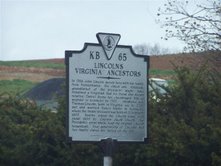
Harry Smeltzer sent me some snaps taken through the window of a bus. The key piece is a sign describing the the Lincolns as denizens of the Shenandoah Valley. I think the picture below shows Jacob Lincoln's house, while the sign is what supplied the transcript farther down.

Conclusions: some Lincolns became Virginians at the same time others chose to become Kentuckians (or something else). Were they war-torn during Secession?

Here's the text - my emphasis is at the end:
In 1768, John Lincoln moved here with his family from Pennsylvnia. His elder son, Abraham, grandfather of the president, might have remained a Virginian had his friend and distant relative, Daniel Boone, not encouraged him to migrate to Kentucky by 1782. Abraham's son, Thomas Lincoln, born in Virginia (circa 1778) met and married Nancy Hanks in Kentucky where the future president was born on 12 February 1809. Nearby stands the Lincoln house built about 1800 by Captain Jacob Lincoln, the president's great-uncle near the original Lincoln homestead. Five generations of Lincolns and two family slaves are buried on the [this?] hill.
Well, well - five generations, and from the looks of the surviving artifacts, not living too shabbily.

12/16/2006

Abraham Lincoln the Elder - Pennsylvanian

Will Keene wrote me to say that these Lincolns were not a family with Virginia roots .... that the Lincolns passed through Virginia en route from Pennsylvania to what would become Kentucky. He is correct.

That would make my comments about Mordecai observing Virginia social arrangements post-inheritance inoperative.

Abraham did achieve prosperity in Pennsy which he leveraged in Virginia and then maximized in what would become Kentucky.

Of the Berks County Lincolns in PA: "The Lincolns were prominent in Berks county. Thomas, brother of Mordecai, was sheriff of the county, and all owned land. Mordecai was a merchant in Berks county and a man of means. In 1791 he visited his son Benjamin, who prior to 1791 had gone to Fayette county, Pennsylvania. He liked the country so well that on June 29, 1791, he purchased of Isaac Pearce the tract of land called "Discord," containing three hundred and twenty acres. He finally settled in the county himself, and continued his residence until his death in 1812."

Of the Virginia stage of the family's situation: "John ("Virginia John") settled in Berks county, Pennsylvania, later in Virginia, His son, Abraham, carried on an extensive land transaction[s] in Augusta county, Virginia, and later in Kentucky, where he was killed in the spring of 1784 by an Indian, while at work in his field."

Thanks Will.

12/13/2006

Jim Lane's hair

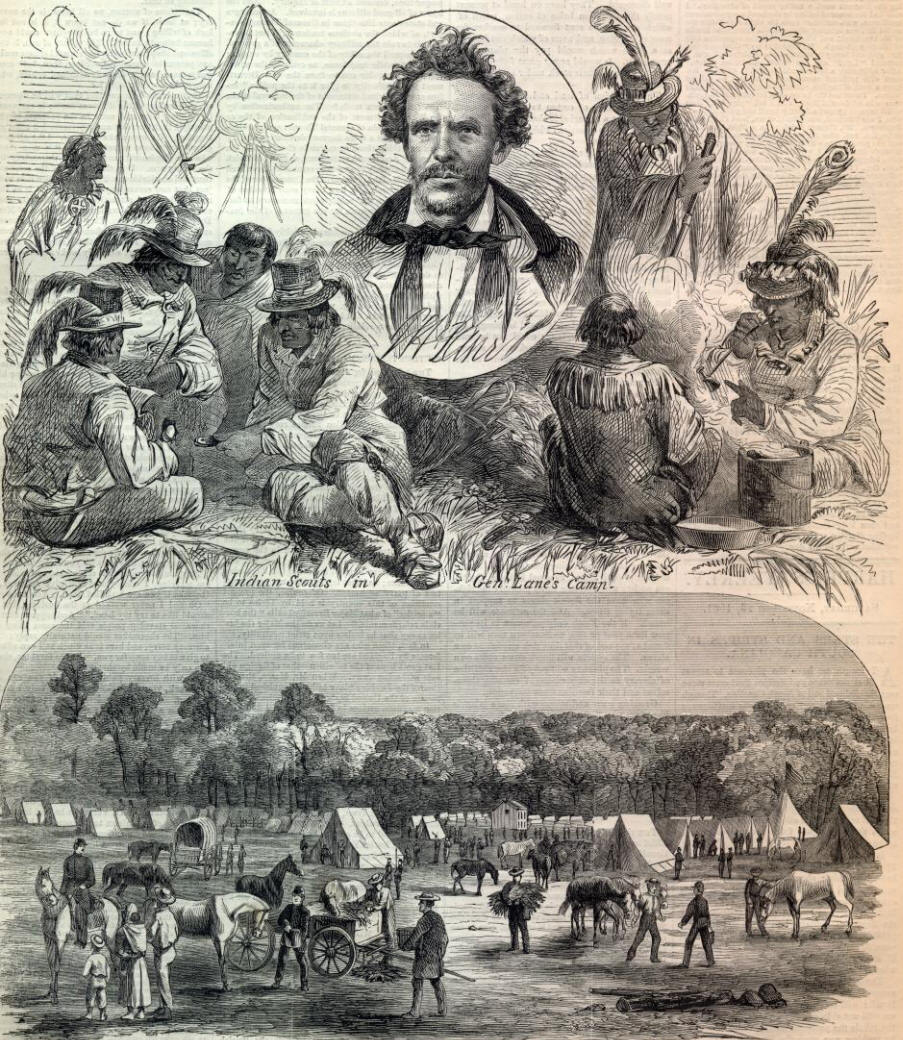
Harry asks what Jim Lane (right) was thinking when he sat for this portrait.

What were any of them thinking? Civil War hair reached heights we shall never again attain.

See Lane's hair here. See it again here.

These are not accidents, my friend. If Lane looks pleased at right, it is because he has achieved a personal best.