8/31/2005
Holiday schedule


8/30/2005
Lincoln's depression
Widow of the South - more reviews
New York Daily News: "Somewhere in The Widow of the South is a plot. It's buried, though, by the florid prose and straying story lines in a Civil War novel that offers more hysteria than history."
San Jose Mercury: "The Widow of the South doesn't have the imaginative depth and lyrical eloquence of Cold Mountain or the mythmaking epic sweep (or the sentimentality and racism) of Gone With the Wind. But what it does have is a shrewd author who knows and loves what he's writing about, and that helps give his book its narrative drive and emotional impact."
USA Today: "... the battle's carnage, as well as the poverty, hunger and terror experienced by a defeated South, takes a back seat to Hicks' pretentious meditations on maternal grief, God, love, death and morality. By the end, the reader is ready to holler, 'Scarlett, come home,' 'Inman, take me to Cold Mountain' or 'Ken Burns, load that DVD.'
Orlando Sentinel: "Though undeniably riveting in many respects, The Widow of the South is not without significant flaws. [...] Perhaps its greatest virtue, aside from bringing Carrie McGavock into the historical limelight and serving as a stirring elegy to the Blue and the Gray, is its indictment of war as our greatest inhumanity to man."
Man's inhumanity to man - I'm trying to remember which 1960s comedy show used that cliche as a running gag - but never mind. I think it's utterly charming that a reviewer could write that line "in this day and age."
Meanwhile, save a little pity for Hicks. Can you imagine your first novel getting this level of scrutiny? It's ranked 783 on B&N's sales chart and 652 on Amazon's.
Crying all the way to the bank, you say? Maybe.
8/29/2005
1 + 1 = ?
McPherson, exemplifying the ACW history consensus, believes that there is no new talent in Civil War publishing under the age of 40. He said so himself. Since he cannot see non-conforming history, or if he sees it he discounts it, the statement means that he cannot see any historians under 40 of his own ilk.
Perhaps the two statements (Sears' + McPherson's) together point to the end of consensus ACW history.
The Widow of the South - reviews begin
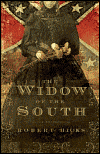 The first reviews are popping up for Robert Hicks' The Widow of the South - a first novel that has presold over 200,000 copies on Amazon.
The Detroit Free Press: "... the climax of the novel is a huge disappointment."
The Baltimore Sun: "... skips clumsily from perspective to perspective. It wallows in the pathos of war and death. [...] His accounts of the fighting leave no Civil War battle cliche unturned.
8/26/2005
Convergence in Franklin
 Kevin Worley (right), publicizing the new documentary "Battle of Franklin: Five Hours in the Valley of Death" was good enough to respond to a recent posting here by pointing to more information in a press release.
The release (issued by Wide Awake Films) points to a convergence of interest that might develop from the film complementing the as-yet unpublished bestseller Widow of the South, a Battle of Franklin centered novel. (In May, when we checked in on Amazon sales they were low. The preorders have since hit 200,000, according to Wide Awake. Widow is the author's first novel.)
Meanwhile, filmmakers and author have teamed up to help reclaim the battlefield from Franklin golfers.
(p.s. The Wide Awake site has a variety of ACW documentary clips to browse. Go here and notice the Demo Reels control panel at left, then scroll down within that panel to the Museum/Documentary section.)
Richard F. Miller has the goods
 Russel Beatie's website lost a lot when it took down his draft chapters of unreleased volumes. (Not, before I nabbed a few pieces of his unreleased Volume III of Army of the Potomac, however).
Richard Miller (right) has a book coming out next month called Harvard’s Civil War: The History of the Twentieth Massachusetts Volunteer Infantry and you can sample it (obliquely) by reading a couple of related article on his website: "The Trouble wtih Brahmins:, Class and Ethnic Tensions in Massachusetts' Harvard Regiment" and "Brahmin Janissaries:, John A. Andrew Mobilizes Massachusetts' Upper Class for the Civil War."
There are more articles on this regiment, all well worth reading.
Free samples - always a good thing.
Tennessee’s Radical Army
... the State Guard ... [offset] ... the Klan [which] terrorized large portions of the state. The State Guard was not deployed in 1868, and both the Republican party and freedmen suffered as a result."These reviewers note,
... the State Guard [was created] in order to enforce the law and protect the Reconstruction process along with a law giving the right to vote to male African Americans.Disbanded in 1868, it exists today outside of the National Guard system.
Those lovable canine thespians
 Here's a long feature about "Dog Jack," an independent Civil War movie.
The original Dog Jack was so highly regarded by the unit's soldiers that Confederate prisoners were exchanged for him when he was twice captured by the enemy. [Reenactor] Hoover was similarly taken with the canine actor that portrayed Jack, a female pit bull terrier named "Piglet."When did terriers become "pit bull terriers"? And how will makeup compensate for this player's anatomical unfitness for the role?
"You fell in love with her," Hoover said. "If she liked you, she'd jump right up on you." Hoover was amazed by Piglet's intelligence and her ability to work with owner and handler Tracy Doyle, even though the dog is deaf. Doyle directed the canine performer with hand signals. Piglet looks remarkably like the original Dog Jack, whose portrait hangs in Pittsburgh's Soldiers and Sailors Memorial Hall.A deaf dog starring in a heartwarming role. Somebody get me an "Oscar material" cliche.
Friday housekeeping
Blogger used to give a statistical summary in the profile section - number of posts published and number of words to date. It no longer does. When I last checked, months ago, the blog was approaching 250,000 words. Maybe a new War and Peace should have been written instead.
Nevertheless, if a keyword search has brought you to this site, chances are the topic has been covered before. Search the site itself as described in item one, below, and you probably won't be disappointed.
Some points of interest.
(1) You can search within this site by using the little box in the upper left hand corner of any page.
(2) You can link to any post directly by clicking on its datestamp (at the bottom). That causes the post to come up in its own window with its own unique URL.
(3) This is a consumer site concerned with "product" quality. It's also concerned with the product quality of "public history" in its various forms.
(4) There are plenty of clues around as to how to reach me if you wish to and I thank those who have taken that trouble.
(5) If my criticism is sometimes overdone, take it with a grain of salt. I regret any unnecessary harshness. A lot of bad history is produced by good people.
Thanks for visiting.
8/25/2005
And now for something completely different...
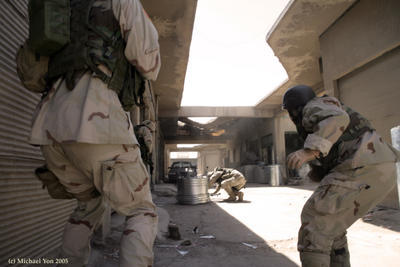 ... some serious combat blogging.
I try to keep the current war at arm's length, but this piece is exquisite.
The shirkers who will not do their duty as infantry to "close with and destroy the enemy" - yards away from an enemy trying to kill friendly wounded - overwhelmingly resonates with the American Civil War.
As does the battalion commander and his sergeant major acting as close combat spearheads in hand-to-hand combat. If only the new men would follow them... If only the new men would act their part... but they don't.
Shades of S.L.A. Marshall.
Many thanks to superblogger Michael Yon, with a hat tip to Instapundit. (Photo by Michael Yon.)
Fischer and McPherson
 Mark Grimsley has received a commission from David Hackett Fischer (right) and James McPherson and it's causing him to wonder about the significance of 1864. (He's got a lot of good ACW stuff up, by the way.)
Grimsley is well regarded in this blog, as you can tell.
However, the collaboration of Fischer and McPherson causes me to wonder if Fischer has relaxed his old professional standards and is prepared now to overlook incomplete historical rationalizations, reductive fallacies, the elimination of historic contradictions, not to mention causality compressed to the point of malfunction - which he once decried and any of which sins can be found in Battle Cry.
If Fischer (rightly) previously numbered David Donald among the ignoratii (his term!), what must he thinking of his new helpmate?
More vandalism
A young man was charged this week with desecrating a 142-year-old corpse, kicking in the door of the Civil War-era tomb, pulling apart the skeleton, and posing for pictures with the skull and other bones.
8/24/2005
"Wesley McClellan" rides again
 In the long-ago early days of this blog, there was a now-forgotten election in which much was made by many comparing George B. McClellan with a candidate named Wesley Clark (top right). I wouldn't expect readers of such enduring literature as blogs (esp. this blog) to get caught up in the passing ephemera of presidential elections, so let me link you to a painfully long post in which I then summarized all the Clark/McClellan comparisons being made.
One of the more deeper of these was based on the Centennial doctrine of Civil War history aggragated and synthesized by commentator Rush Limbaugh into an opinion piece called "Wesley McClellan."
If you saw Ken Burns' stuff or have ever read McPherson, Sears, Davis, Catton, Williams, Williams, or Nevins, you'll have been thoroughly prepared for "Wesley McClellan."
Contending with "Wesley McClellan," I wrote that "And as for Lincoln's opponent McClellan, none of the talk show hosts has any idea he was a war Democrat or a conservative. Karl Marx and Friederich Engels backed Lincoln over McClellan, which should be all a talk show host needs to know." (Chris Cross, a political blogger and occasional reader of these screeds, saw the post and linked to it, so I suspect that Marx-and-Engels-for-Lincoln has some novelty value.)
Author Richard F. Miller was good enough to alert me now to a new piece (transcript) in which Limbaugh has again revived the Centennialists' pantomime McClellan, this time to condemn politicians soft on the war. Miller notes how certain pop history themes leach into the common discourse. Limbaugh:
Let me give you a name. Remember George McClellan? General George McClellan. He never had enough troops; he never had enough equipment. No situation was ever the right situation to attack Lee in the Confederacy. He was always complaining. He didn't have what it took, so Lincoln finally said, "You're outta here, buddy." He canned him. That's what we have in these politicians today. They're all McClellans. None of them are Lincolns. [Link as posted in the original - click on it, it's representative of the quality of McClellan criticism.
]
"... I believe that [Limbaugh is] a bit over his head here," writes Miller. Indeed, as were the Centennialists who set the scene for this vaudeville McClellan character.
All of which reminds me of a story.
When Limbaugh's Wall Street Journal piece "Wesley McClellan" was reprised on the commentator's website, his webmaster chose for a time to illustrate the text with a book cover (right) linked to an Amazon shopping cart.
The book was Jim Ridgway's Little Mac: Demise of an American Hero. The subtitle gives it away: it was the one book in print carried by Amazon, aside from a kids' tome (George B. McClellan: the Disposable Patriot), that gave a full blooded defense of "our George."
Ridgway, a fellow member of the McClellan Society, couldn't believe his eyes when I pointed him to the web page and we speculated about a book sales boost ... after having a laugh about unintended consequences.
Good things can sometimes come from bad history.