1/29/2007

Team of Rivals has morphed...

... into "Lincoln," a film starring Liam Neeson and Marcia Gay Harden as Mary Lincoln.

Harden (photo, right) is not yet confirmed - maybe because she doesn't look the part. It will be hard enough to take Neeson scene after scene; together Harden and Neeson could drive watchability way down. I get the feeling this is a made-for-TV movie to air on the Lifetime channel.

For a good laugh have a look at the film's message board. The first question in the first section asks if Tom Hanks will play in this. In the last forum, about future films, fans speculate on what a great job director Spielberg could do with a movie version of Smurfs. Oh Hollywood, you kill me.

Meanwhile Neeson says he has read 22 Lincoln books so far and is still reading.

1/26/2007

Savas Beatie and sales

I mentioned Savas Beatie in a recent post and said that its prospects seemed good based on the titles whose sales I follow through the wholesaler Ingram.

Founder Theodore Savas was, as it happens, interviewed by a blogger earlier this month and said then that he tries to do the bulk of his selling outside of bookstore channels. That would be outside of my Ingram metric, my way of measuring success. Put another way, I inadvertently looked at the least part of his sales and pronounced them stronger than the main part of some trade titles' sales.

I'm not sure he is giving the whole recipe for his secret sauce in this interview, but the points that struck me were:

* Identify the lack first and then hunt up or commission the best ms
* Work only with hard-working authors
* Maintain a collaborative culture
* Insist on an author's website with fresh content
* Craft better books - in terms of total package - than competitors
* Leverage small networks
* Treat the bookstore as your venue of last resort
* Leave "remainders" out of your plans.

An aside: I have noticed that since Savas Beatie picked up the Army of the Potomac series, Da Capo, publisher of the first two titles in the series, has kept the series in stock in the major chains. When they first came out, it was hit or miss to find either volume. But in the last six months I have never been in a store where both are not on the shelf together. It takes attention, nagging, and muscle to keep books shelved in retail outlets and Da Capo seems to be working for a payoff riding sales strength to be provided by Savas Beatie when the third volume comes out next month.

Look at the interview. This Q&A was a multipart posting: part 1, part2, part3, part4.

1/25/2007

Idea for a monument

Dr. Seuss envisioned this in WWII. Let's build it now to honor nonfiction readers everywhere.

Speaking of publishing

I laughed myself silly at this post. Best bit: telling a prospective agent, "the book is a really rough edit so far. when i land the money deal i can move forward to make it complete."

These jokers remind me of a kind of author I tend to run into more and more - the non-reader author. "I was never much of a reader..." Hey, it shows don't you know?

Do non-drivers design automobiles?

ACW publishing in 2006: first impressions

These conclusions may be tested or examined in later posts, but in going through the numbers supplied by the wholesaler Ingram here is what I found. The context overall is reduced demand for ACW titles.

Observation: The sales debut of "new thinking" titles is soft, after which a fairly normal sales decay rate sets in - prohibiting these titles from achieving a viable mid-list status.
Comment: These titles may need to debut in economical softcover editions and then switch over to electronic or other formats to persist in midlist. Publishers, please know when you are handling new thinking and add some "viral marketing" approaches.

Observation: New Lincoln books were a washout. I refer to trade titles which failed on the trade scale of operations. This includes Goodwin's Rivals, Wills' Gettysburg reflections, and even John Brown, Abolitionist.
Comment: Team of Rivals sold especially poorly. Shipped and displayed everywhere, my numbers tell me it was returned to the publisher in large lots. I don't know whether to read cause and effect into this. Was DKG the victim of her own reputation, or a reduced level of interest in Abe, or did people not care for the book? Her weak leadership mirrored larger weaknesses in the genre, including an abnormal sales collapse in Tripp's gay Lincoln effort. (Some of my control data for historical nonfictions, e.g. the late S. Ambrose's sales, followed the same path.)

Observation: Gingrich and Forstchen's alternative Civil War novels have crashed into a sales cellar out of which they seem unlikely to climb back into midlist status.
Comment: They debuted with huge numbers under a science fiction marque and then went into an steep, accelerated sales decay pattern year-on-year. This is nothing like the situation with the Shaaras, whose sales are decaying in slow motion. If this pattern represents sci-fi niche normalcy, then we were dealing all along with sci-fi readers, not ACW nor even nonfiction readers.

Observation: McPherson's (non-illustrated) Battle Cry continues steady state with altogether insignificant sales variation year on year.
Comment: The year-on-year variations I see in other rock-solid mid- and backlist titles far exceed the variations in Battle Cry sales data. You'll give me a "DUH" for saying this, but I now feel comfortable suggesting that Battle Cry figures are overwhelmingly textbook sales-driven via assigned reading. The lack of significant variation says "no" to the possibility of a textbook-based core number plus commercial sales and "yes" to entirely textbook sales-based.

Observation: The springtime of U.S. Grant publishing has passed directly into winter.
Comment: It may be a long time before another Grant book comes out in a major publisher's catalog.

Observation: The prolific W. C. Davis and G. Gallagher are suffering normal sales decay rates on modest debuts across a wide number of titles.
Comment: Neither "old thinking" author is going to see viable midlist status for any of his work despite high name recognition. You can view these two as the victims of an AWOL readership or blame them as the cause for same.

Observation: Savas Beatie (in the case of the few titles of theirs I track) is doing better than many major houses and surely better than most academic presses .
Comment: This is a backhanded complement given the state of ACW sales. Sitting a thousand miles away from their accounting department, though, it looks like Civil War publishing, in the right hands, could be a viable enterprise.

1/24/2007

Civil War joke

Civil War jokes seem to be few and far between but I found one with which to test the Google joke meter. Here it is:
A soldier had lost his bayonet and whittled one from wood so he could stand inspection. He was hoping not to be discovered until the regiment had gone into battle where he could pick up one from a dead soldier. At an inspection, an officer asked to see his bayonet. The soldier stated " Sir, I promised my father I would never unsheathe my bayonet unless I intended to kill with it." The Officer insisted he hand over the bayonet. Taking it out, the Soldier looked skyward and declared " May the Lord change this bayonet to wood for breaking my vow."
Result:

Google laughs!!!

The joke's funniness percentage is: 50.7732%

The joke's popularity is: 2.589
(where 7=super popular, 1=not popular)

Shepherdstown = safe?

Civil War Preservation Trust seems to have saved some battlefield acreage at Shepherdstown but details are scarce. This is the only relevant press release I could find on their site and this is the only news story.

Meanwhile, the Missionary Ridge viewshed issues surrounding a proposed cell phone tower are going to get a public airing.

A fight over bronze Napoleons

Should they be in front of a veterans' hall or a medical facility? This Maine fight seems a waste of time and money. (More here.)

1/23/2007

Civil War flash cards

I was looking at the counterinsurgency bullet points in this posting by John Robb and mapping Civil War equivalents to each one, treating the Rebels as insurgents. Done sort of like flash cards - quick as you can - it's fun.

If you want to try it, click on the link above before reading any further, otherwise I may contaminate some of your own ideas.

Here's what I came up with on the QT:

"Attack critical nodes" - I thought of G-inC McClellan's Nov. 1861 strategy to advance on Southern rail lines both East and West, seizing, garrisoning, and holding rail junctions while moving downline to the next set. Kind of an internal Anaconda plan rarely analyzed in ACW histories and a foretaste of what was to come.

"Attack the insurgency's weakness in political cohesion by forcing it to respond to issues that are beyond its scope" - This correlates to emancipation or the gambit of making the war about slavery rather than independence.

"Reduce ... sources of funding" - Here I thought of the strategy of protracted war flattening the Southern economy and ruining the currency.

"Attack the ... technology infrastructure of the network" - Sherman's destruction of all war making property in Atlanta and beyond occurred to me; the blockade was intended to keep technology and war materiel out of the South, as well.

Even if you read these spoilers, have a go at it yourself.

And the point? One has to wonder if these four recommendations for fighting modern guerillas are drawn too broadly if they cover the case of the ACW.

Civil War magazines

I have always been against them; it's a stubborn prejudice. Today, I found a few phrases written by blogger Gagdad Bob that explain my thinking to a tee:
A magazine such as Psychology Today represents stupidity squared, because it mostly boils down the nonsense of academia for a semi-literate audience ...
Obviously, I like a lot of "nonsense of academia." The situation in Civil War publishing is a little different on other counts as well. My case might read as:
A magazine such as [Civil War whatever] represents stupidity squared, because it mostly boils down the nonsense of [pop history] to an even grosser level of simplification ...
Perhaps I am letting my feelings run wild. We all know some mags, like North and South, try to fill a gap in scholarly publishing. Nevertheless, I can't pick up one of these magazines without the irritation immediately outweighing any potential pleasure. So I no longer ever pick them up.

Apologies to our readers who enjoy these periodicals. If you get a moment, tell us why and how. I promise not to quibble.

1/22/2007

Resonance on the Nile (3/3)

Much of Garnet Wolseley's Civil War commentary appeared after his Khartoum campaign to relieve Charles "Chinese" Gordon. He wrote favorably of Lee, and like so many Lee (or Lincoln) adherents, fell into spurious McClellan criticism. After an 1863 piece in Blackwoods, this McClellan criticism became muted; he seemed impressed with the McClellan appearing in Battles and Leaders volumes in the 1880s. Perhaps personal experience and reflection also played a part.

Unlike other McClellan critics, the Wolseley of 1863 would occupy a series of positions to act on his analysis for the next 30 years. Some of Wolseley's combats sported that Jacksonian dash he admired - notice his campaign against Ahmed Arabi, leader of an Egyptian army revolting against its hated foreign officers (such as William Wing Loring). Other actions, less so.

Another point of interest in Wolseley's early McClellan criticism involves paradoxes. We see the strongest admirers of Lee or Jackson most often practicing the most conservative war possible - witness he modern U.S. Army, for example. Was Wolseley himself an example of this? On the other hand, the strongest admirers of McClellan's art were Lee and his generals, something we know because of Wolseley's care in recording their views while in their company. His knowledge of this appreciation fails to save him from the shallow schoolyard dichotomy of "Lee this" and "McClellan that."

I thought I would juxtapose some of Wolseley's ACW comments with comments made about his own conduct of the Khartoum relief (speaking of "compare and contrast").

Wolseley: "The federal generals hitherto have been either extremely rash, or extremely cautious and slow." (45)

Winston Churchill: "He [Wolseley] saw himself confronted with a task which was easy and safe if it were undertaken at leisure, and which was doubtful and perilous if begun in haste. All the fruits of a long and successful career were staked on the result, and it is scarcely wonderful that he declined to be swift and reckless." (Churchill, The River War)

Wolseley: "The much-admired M’Clellan is slowness and caution incarnate; vigour and promptness of action are undreamed of in his philosophy…"

Churchill: "… he [Wolseley] made his plans for a methodical and deliberate advance which would leave nothing to luck … He excluded the idea of a wild glorious rush which might result in astonishing success or terrible disaster." (Churchill, The River War)

Wolseley: "… the real power of an army rests on its ability in marching well …" (45)

Britannica: "After learning of two victories won by Wolseley's advancing forces, al-Mahdi's troops were on the verge of raising the siege; but the further unaccountable delay of the relief force encouraged them to make a final, successful assault at a gap in the ramparts caused by the falling of the Nile's waters. The city's garrison was butchered, Gordon with it." (Online encyclopedia entry)

Wolseley: "As the months of 1862 went by, the universal feeling was one of impatience and restlessness at what was deemed the waste of time and the useless delay which were taking place." (112)
Lytton Strachey: “The delay of the expedition was even more serious than Gordon had supposed. Lord Wolseley had made the most elaborate preparations. He had collected together a picked army of 10,000 of the finest British troops; he had arranged a system of river transports with infinite care. For it was his intention to take no risks; he would advance in force up the Nile; he had determined that the fate of Gordon should not depend upon the dangerous hazards of a small and hasty exploit.” (Strachey, Eminent Victorians)

Wolseley: "What most strikes the regular soldier … is the inefficient manner in which both he [Lee] and his opponents were often served by their subordinate commanders…" (64)

Churchill: "Sir Charles Wilson, [Wolseley’s subordinate] having collected his force, remained three days by the bank of the Nile before attempting any further advance on Khartoum. […] On the fourth day he embarked on two of Gordon's steamers. […] On the 27th of January the rescuers came in sight of Khartoum [two days after its storming]." (Churchill, The River War)

Wolseley: "… from a desire of leaving nothing to chance, he [McClellan] has not succeeded in anything." (46)

Edward M. Spiers: "Meanwhile British soldiers felt immensely frustrated about the outcome of the relief expedition. If they were less critical of Wolseley’s planning and staff system than some historians have been, many felt that their mission had begun too late, and that they had struggled up the Nile and defeated the Mahdi’s forces in several battles to little effect." (Spiers: The Victorian Soldier in Africa)

***

Charles Gordon: "It is, of course, on the cards that Khartoum is taken under the nose of the expeditionary force which will be just too late." (Siege journal)

(All Wolseley quotes from The American Civil War: An English View. Page numbers are in parens.)

Part 1 of this series
Part 2 of this series


Fixing history at Jamestown

Here's an inspirational story about a deep reader named William Kelso.
A graduate student at the nearby College of William and Mary when he first visited the island [Jamestown], he was unconvinced by the park ranger's spiel.
Excellent starting point: park rangers represent authorized opinion and in this case pointed towards a rotten consensus.

Kelso, seeing the site of Jamestown Civil War fort, tapping into the eternal logic of fort sitings, suspected that the received wisdom on the location of Jamestown fort (underwater) was incompetent. Good for him and us.

Let's take up our own convictions now and keep at it.

Civil War revenge movie

It stars two Irishmen in what appears to be a spaghetti Western knockoff.

1/20/2007

ACW publishing in 2006

I have been going through the sales numbers and have found some interesting developments, enough for a series next week.

Will wrap up Romney and Nile then as well.

1/18/2007

McPherson and the Atlantic

Kevin Levin seems disappointed in the new McPherson book, citing especially the quality of analysis. He has applied some care and thought to his review. Compare it to the usual senseless outpouring flowing from, for instance, the L.A. Times:
"In This Mighty Scourge — a riveting collection of 16 masterfully written essays — James M. McPherson again demonstrates that he is our greatest historian of the war."

Give him credit, the man attracts excess. Not just from me.

There was a story recently in the Atlantic magazine about the Oxford University Press history series into which McPherson's Battle Cry was plugged by his Johns Hopkins mentor, C. Vann Woodward (editor of the series). Did you know, for instance that "The author originally slated to write the volume on the Civil War, Willie Lee Rose, suffered a stroke in 1978."

Does the author of the Atlantic piece, in this "sweeping indictment against American historians" include McPherson when he says of the Oxford series, "not only are the Americans unconscionably tardy; their entries conspicuously lack the intellectual refinement, analytic sharpness, and stylistic verve" of the stuff published on the British history side? Mind you, this fellow is the literary editor of the magazine!

The article carries a measure of cynicism towards Woodward's editorship. "...nearly a half-century later, only five of a projected 11 volumes in the Oxford History of the United States have been completed." It dwells on the good work he rejected.

Gordon Wood is quoted as saying "The idea that you can sum up the scholarship of a previous generation in one volume just doesn't hold anymore." He means one narrative volume.

Wood is giving others' views here - mainly mine, though I can't imagine how he got them. (But let's be clear: in the case of Battle Cry, it is not the scholarship of the previous generation - it is the pop history of the previous generation being summarized.)

Anyway, read the piece.

1/17/2007

A bridge too far for Stonewall (2/3)

Jackson can always turn up a winner with a little writerly help:

Robert G. Tanner, Stonewall in the Valley:
"Yet Jackson was not entirely dissatisfied with his progress to date [1/5/62]. Communications between the Alleghenies and the Potomac were severed..."

Russel Beatie, Army of the Potomac Vol. 2:
"Murray then brought Ashby to Lander in the telegraph office [at Hancock, 1/5/62]. Concerned that Ashby might understand telegraphic signals, Lander moved the group to another room..." "Lander telegraphed for reinforcements [on 1/5/62] ..." "He pressed Banks [in the neighboring department by telegraph] to ask McClellan for permission to cross and engage [Jackson] ..."

Tanner:
"... and the Federals were probably misled as to the true Southern objective [Romney]."

Beatie:
"McClellan, Banks, and Lander all knew that Jackson did not mean to retreat. He intended to withdraw, turn west, cross the mountains, recapture Romney..." [Cites McC telegram alerting
Romney commander on 1/7/62.]

Hmmm. Communications not cut - not out of Hancock nor Romney. Federals not misled either. Thanks again, Russel Beatie.

1/16/2007

Madame, fix your kepi!

Or is this some sort of war-flavored stylization going on?
(Miss Olivia Rand, 186?)

"Romney Campaign" revised

I have revised the post "A bridge too far for Stonewall" for clarity and you can see the changes in brackets. This first part sets up two historiographical questions: why is Stonewall dominating accounts of this affair (my answer will not be what you expect); and why is this called the "Romney Campaign."

Robert Tanner and Russel Beatie will figure extensively in the answer to these questions.

It's raining new ACW blogs

Without making a systematic survey, I notice the following ACW-related blogs have sprouted:

The Battle of Franklin - This tends to be informational rather than analytical. The author is anonymous.

The Adjutant's Blog - Tony Zusman takes re-enacting online. I notice burnout is a recurrent theme here.

Southern Heritage News and Views - "In Defense of Southern Heritage & Faith!" The blogger is anonymous.

Not In Memoriam, But In Defense - Student "Sarah" explores "how is the radicalization and organizational shift that is occurring in the Sons of Confederate Veterans (SCV) altering the physical landscape of Richmond, Virginia."

The Tredegar Iron Works - This is Brett Schulte's new ACW gaming blog. This seems to be a supplement or "back office" to this site.

Battlefield Biker - By "bb." "Situated at the intersection of Motorcycle Touring and Military History and their relationships to Current Events." This is a topically segmented blog and the link given takes you to the ACW blog content.

1/15/2007

Resonance on the Nile (2/3)

Garnet Wolseley (lower right) was probably the British Empire’s most successful general, both on the battlefield and in career terms.

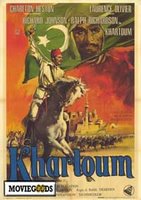
In the movie Khartoum, his personal relationship with Charles Gordon is obscured; a cabinet officer suggests Gordon be sent to the Sudan and the Prime Minister Gladstone character endorses the idea. The Gladstone character then meets Gordon at the train station for a send-off. Later, when a rescue decision is made, the film portrays Wolseley as operating under secret orders from Gladstone not to approach Khartoum/Gordon too quickly or too near.

Shades of that purported "Grand Conspiracy" to keep Mac out of Richmond!

In reality it was Wolseley himself who recruited his friend Gordon to go to Khartoum and sent him off. But Wolseley’s choice of route for his relief expedition was so strange that delay may have produced a conspiracy meme to understand his bizarre decisions. More on that next time when we match his actions as reliever against the ACW analyses he wrote.

What is interesting is that Wolseley placed Gordon on a pedestal sized to match the one he built for Robert E. Lee. In 1887, he wrote, “I have met but two men who realized my ideas of what a true hero should be: my friend Charles Gordon was one, General Lee was the other.”

Wolseley wrote a great deal about the American Civil War, first as an observer who spent time with Lee and McClellan (he was about McClellan’s age), and then as a commentator/reviewer on the Battles and Leaders series. I have isolated some of his views: direct quotes are in marks, otherwise I paraphrased. Note that his first-hand impressions ended in early ’63.

On Rebel cavalry
They attained first class status as irregular cavalry; there was no attempt to drill them or train them as anything else and they became the best of that type. The Union went wrong in pursuing a conventional cavalry path and thereby failed to achieve competence as irregular or regular cavalry. “… their puzzled [Yankee] enemy, clogged with all the routine of drill, without officers able to direct it, or soldiers sufficiently instructed to perform it, is trying in vain to discover their whereabouts.” (1863)

On efficiency
“What strikes the regular soldier in these campaigns of General Lee is the inefficient manner in which both he and his opponents were served by their subordinate commanders, and how badly the staff and outpost work was performed on both sides.” (1863)

On Civil War armies
“It is most difficult to move with any effective precision young armies constituted as these were during the war. The direction and movement of large bodies of newly raised troops, even when victorious, is never easy, is often impossible.” (1863).

On railroad delivery of men to battlefields
It is an error to believe such and is perpetrated by Beauregard’s account of Bull Run. For artillery and cavalry, this is impossible. For infantry, highly improbable because train order of movement and debarkation will produce a hodge-podge of forces. (1883)

On civilian (public) opinion
It was “… the true criminal.” “… he [public opinion] took into his ignorant hands the entire conduct of this part [1861] of the war.” (1883)

On the Lincoln/Stanton military policy
“Go straight at the enemy at the very point where he expects you… Let everyone know what you are going to do, so that we may announce it in the public press, and chuckle and crow over your coming victory. Scatter your forces in as many directions as possible, so that the enemy may always be able to bring superior forces against you. Arrange your force so that it is rigidly tied to one particular point, and that the enemy cannot doubt where you will be. Go ahead without preparation, forethought, or care; only let us hear that you are moving, so that the newspapers may brag.” (Date unknown, after 1883)

He records a friend’s reaction to reading Stanton’s orders to Pope: “… he literally ‘laughed until he cried,’ and never fully understood what the expression meant until doing so.” (After 1883)

On Lincoln’s lack of civil policies
“The safe retention of private property is made to depend upon the will and pleasure of some petty provost marshal of the neighborhood – a functionary who has also the power of consigning the owners, and perhaps their families” to prison. “Tyranny and illegal arrests have stricken them [under occupation] with terror.” “Every species of minor annoyance has been resorted to by federal authorities.” (1863)

Previous post here.