1/20/2006

Signs and markers

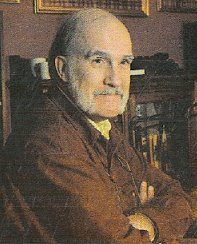
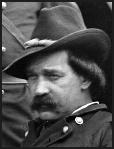
David Woodbury has a few comments on misguided Civil War markers and Richard Brautigan (right). Which reminds me.

I was at Ball's Bluff a few weeks ago following the walking trail and stopping to read the markers with two people generally oblivious to ACW history. You walked awhile, stopped, and read something about a specific regiment.

It was a pretty long walk and we all three assumed the "markers" "marked" unit positions, since so many were unit specific. It was hard to visualize things because Ball's Bluff battlefield is in a nature preserve and the trees have been allowed to grow everywhere.

Satisfied with our battlefield tour, we completed the trail and on the way back to the car I noticed a road indicating the way to a cemetery for the war dead. That's how the road was signed and it was off in a different direction.

Going there on a whim, we discovered the battlefield. The grave of Baker. Unknown soldiers buried near where they fell.

The grave markers told us where the battle was fought. The signs were all elsewhere. It was a spectacular display of custodial incompetence.

Which plays into a story about Richard Brautigan. He and a friend were running around town putting up posters for a poetry reading. They went into a bookstore.
“Do you have any of Richard Brautigan’s work?” said Richard.

“What does he write?” said the clerk.

“He writes novels and books of poetry.” Richard’s mouth was assuming an odd shape under his moustache.

“What kind of novels?” said the clerk.

“Famous ones, you know, like great literature,” said Richard without moving his mouth very much because his teeth were gritted.

“Our literary works are over there, and our poetry section is over there,” said the clerk, pointing first to a large part of the wall near us then to a tiny clump of books in the back of the store.

“Thank you,” gritted Richard. Soon we had scoured both sections and found one book, The Hawkline Monster, in the whole store, so the Captain returned to the clerk while I hung back. “I would like to give you a little lesson in capitalism,” said Richard.

“You would find that in our business section,” said the clerk.

“I am Richard Brautigan,” said Richard. “I write novels and books of poetry. People like them. When stores stock them, people buy them. You only have one of my books because people bought the rest of them. But you do not stock more of them. That is how book stores make money. People come to them to buy books, and in return, they give the book stores money. DON’T YOU F*****S WANT TO MAKE SOME F*****G MONEY!!!!!”

The clerk couldn’t think of anything to say back, so Richard just stared at him for a few seconds until I suggested that maybe we should find some other places to put the posters.
I have to wonder if the *!#%+ custodians of Ball's Bluff Battlefield want to attract tourists and make some !#&!*+# money.

Shepherdstown

The effort to recover the battlefield at Shepherdstown has begun in earnest. That's the good news.

The bad news is that the current rescue plan is more complex than a Rube Goldberg machine, involving highway funds, the CWPT, and buying various non-battlefield properties over time to physically link the killing ground with National Park Service holdings - in the hope that the NPS will take over the battlefield at the end of the process.

The battlefield is for sale. Got $3.6 million? End the pain.

Lee and Lincoln

As mentioned in my McLuhan "interview" this week, there is a point where the cliches of Centennial history become the actual environment itself - and thereby unexamined and invisible. These cliches then provide the foundation for new combinations of "insights" and generalizations based on the embedded skew, the effects eventually becoming wildly surrealistic - like something out of a Baudrillard essay on hyperreality. I want to share a particularly vicious example with you.

In the immediate postwar, historiographers noticed reconciliation-themed Civil War narratives becoming popular and gaining the predominant "mindshare." The assumption that "We're all Americans now" became pervasive and invisible and provided a foundation of sentiment available to Unionist Civil War authors in our own day writing what Ayers calls "nationalist" histories, e.g. McPherson, his imitators, and those authors McPherson compiles.

Say hello to "Lee the American," "Jackson, the American." Say good-bye to Lee or Jackson as oath-breaking traitors responsible for the loss of hundreds of thousands of loyalists, as the deluded military arm of a horrifying national holocaust.

The effects of "reconciliation history" pervade Centennial works. As these Centennial writings are more literary compositions than historical investigations, they require literary machinery and artifacts - heroes and villains, tensions and struggle, and a happy ending. If we are all Americans now, the doughty Lee and the spunky Jackson can be admirable, can fulfill protagonist roles - even in a history written by staunch Union men. This creates a moral imbalance that can be redressed in part through exaggerated displays of appreciation of Abraham Lincoln.

The villains in these books, then, become Unionists who let Lincoln down. Not let their country down, let Lincoln down. Honest patriots struggling with their own limitations in trying circumstances at the bottom of the red hot crucible of war are to be dressed in jester's costumes and showered with scorn: the Popes, the McClellans, the Buells, the political generals, the failures. You are invited to hiss at them.

The position of Jefferson Davis in this kind of writing tends to be ambiguous, a sure indication that you are reading a failed treatment. Davis is a shadowy supporting actor, subject to a few carping comments about micromanagement and cronyism, but immune to any suggestion of catastrophic moral failure - homicidal pride - or the possibility of evil.

Evil were the men who took arms against the rebellion and then failed to press the attack at the moment retrocatively identified as opportune.

Centennial history is a tale of the heroic Lincoln, Lee and Jackson collaborating in a wholesome drama, the retelling of which will bind us all together more strongly than ever. Lee and Lincoln, the "nothing personal" adversaries followed similar moral compasses all the while avoiding the traps and troubles set by selfish, immoral men.

These are some of the baroque effects generated from the Civil War cliches we are living now. So I am not surprised to see that Guelzo and Maxwell have become involved in a documentary called "Lincoln and Lee at Antietam."

Lincoln and Lee. Profiles in courage?

At first I thought it sad that McClellan had been demoted so far as to become a Soviet-style unperson. For you see, there is this persistent rumor that McClellan was at Antietam and that through some quirk in the command structure, might have been Lee's counterpart. There is also this idea of matching military with military, civil with civil. Lincoln and Davis. McClellan and Lee.

Then I realized that misguided though it may be, this documentary has promoted GBM. Instead of being an albatross hanging from Saint Abraham's neck, he has become ambiguously irrelevant - a benign status long enjoyed by Jefferson Davis in Centennial work.

Well, that's progress.
NEWS | Fitchburg Art Museum to exhibit rare Civil War artifacts, photographs * Gift of Civil War relics a treasure for Atlanta museum * Commemoration of Lee evolving

1/18/2006

The case of the phony letter

When wondering here whether soldiers' letters were being fabricated, I got an answer from Tim Reese. He had written about such an episode in a project called A Witch Came Knocking, a collection of pieces organized around the Blair Witch tourism torrent unleashed on his home in Burkittsville some years back. This excerpt runs long but is a great read - except for my blog-centric reparagraphing, it's all Tim's. Put up your feet, light up a Lucky and enjoy. (Note: I have excised one name that appears in the original ms.)

I recalled that the 1980 reenactment, in which I took part, was briefly delayed at its start because a ceremony was taking place within the [Burkittsville] Reformed church. As we idled in column on Main Street outside the church, an inquiry to one of our officers revealed that an original letter was being formally returned to descendants of the Confederate soldier who had written it while being treated for wounds here in town after the battle. We thought no more of it, the ceremony concluded, and we got on with our bang-bang to the delight of spectators who nearly engulfed the town.

In those days virtually everyone who came to town seeking historical wisdom was directed to Burkittsville’s unofficial historian and folklorist, the Rev. H A C, beloved pastor of Pleasant View Church of the Brethren outside town to the north side. C lived in Pleasant View’s rectory on West Main Street and was always amenable to fielding inquiries. I too was directed his way when I arrived.

Here I should mention that I also found that the local heritage society had fallen to moth balls in recent years and, with a handful of other sympathizers, made a naive and vain attempt to revitalize it as its last president before its name was changed, not realizing that the organization had always pursued social rather than academic activities.

My year of stewardship at least gave me access to the society’s rather disheveled files which furnished a fair record of all that had preceded me. Therein I found an old newspaper article descriptive of the presentation that had held up the 1980 parade. My mouth began to water. Here was a genuine vestige of the battle found in the town itself. Its text might very well shed light suitable for illuminating my [forthcoming book]. Unfortunately, my quest coincided with Reverend C’s relocation, after back surgery, to his daughter’s home not far away.

I was however twice able to telephone him to make inquiry. He was a delight to chat with, though getting a word in edgewise was difficult. A more bubbly, affable fellow you cannot imagine. His head seemed crammed to capacity with tidbits on houses, roads, battles, churches, grave sites, and you name it. Others informed me that his accumulated historical notes were legendary. Frankly I was overwhelmed at first.

In the society’s files was a copy of the news clipping heralding the famous letter’s “amazing discovery” including a complete verbatim transcript. After reading it my bubble burst.

The events and chronology described therein defied well-documented facets of the campaign, so I began to get suspicious—I'm only human. Following careful dissection I was alarmed to discover that the thing was a patent fraud, and so set out to publish an article picking it factually apart for the sake of those who trusted its authenticity. I assumed that Reverend C had been duped.

Sometime later I bumped into an old acquaintance, who just happened to be the de facto state historian, and asked him what he knew of the letter. He had seen my article and humorously related his reaction after reading it, he having gone so far as to show a photocopy of the letter to a mutual colleague at the U.S. National Archives who roared with laughter at first sight of such an amateurish fraud. It seemed this was old news.

Still, I had a mystery on my hands. Who had penned it and why? Would anyone accept my rebuttal so long after the letter’s appearance? And who in the historical community had fallen for it and then cited it in what context?

Some answers came sooner than others. I found that the hoax had appeared in at least three otherwise scholarly publications, and was told of still more I have never tracked down. Reaction to my article was subdued and at times belligerent. Many continued to believe that the letter had merit. Clearly I had unwittingly poked a stick into a hornets’ nest.

After a few dead ends I returned to the newspaper article to see to whom the letter had been returned and where they might be located. They were pictured receiving it in the church from Reverend C and were named as Mr. and Mrs. James Story of Georgia with their son, namesake of the deceased soldier. After telephoning nearly everyone in that state by the name of James Story, I connected with what turned out to be a relative who impatiently informed me that I was looking in the wrong state! Jim had long before moved to Charles County, Maryland (!), commuting to work in Washington.

From there it was a simple matter to contact him and arrange another visit to Burkittsville to discuss family history. He seemed eager to again visit Burkittsville and talk about it. What Jim revealed to me here in town was nothing less than stunning, and must be narrated in careful though elaborate context.

The letter, found by Reverend C in the back of an old hymnal at St. Paul’s Lutheran Church, recounts a Virginia cavalryman’s sojourn with a special detail, assigned to escort Gen. Robert E. Lee in an ambulance, to General Longstreet’s headquarters near Hagerstown due to both Lee’s hands having been injured at the battle of Chantilly, Virginia during a thunderstorm in which his faithful war-horse “Traveler” had shied at a thunderbolt while Lee still held the reins, a widely-known and documented occurrence.

He also tells of the destruction of Horsey’s distillery after Rebel troops ran amuck freely availing themselves, the incident prompting Gen. Lafayette McLaws to have it burned, held up as the ostensible cause of Confederate defeat at Crampton’s Gap.

This Virginian, signed as Benjamin Prather, somehow got mixed up in the battle here above town and was wounded in both right knee and hip. Brought down the mountain as a prisoner of war, he writes of prolonged treatment in St. Paul’s where he delights to record personally chatting with President Abraham Lincoln who visited the two churches to see the wounded during his four-day October tour of the battlefields to confer with General McClellan, also well-documented.

Prather succumbed to his wounds; the letter was never sent, hence its discovery. By fantastic coincidence, the soldier’s personal prayer book had also been discovered at St. Paul’s by Reverend C.

Before meeting Jim Story it was relatively easy to establish that Lee did not part company with Longstreet’s command as it marched to Frederick and beyond. Laying all this out in front of Jim Story very quickly became unnecessary.

Several years before the letter’s discovery Jim found time to consult his ancestor’s service records at the Archives while working in Washington. From these he learned of the soldier’s death in Burkittsville and one day ventured here to attempt finding the places where he had fought and died, perhaps even his place of burial, a pilgrimage common to folks with ancestors in that war. He too was directed to Reverend C who, try as he might, was unable to point out the exact location. However, C showed Jim the Prather-identified prayer book from St. Paul’s which was proof enough. Though Jim was allowed to reverently hold and thumb through the book, C was not about to part with it, descendant or not.

Reverend C occasionally corresponded with Jim for years, most notably when the “amazing” letter surfaced—after Jim’s visit. C also repeatedly insisted that the town’s name was correctly spelled and pronounced “Birkettsville,” accent on the second syllable, a habit he lured other residents into espousing (Are you spinning, [C]?).

Jim was then invited by C to attend dedication of a new monument at the town residence of former Governor and Mrs. Endicott Peabody in 1978, using the occasion to again pay homage to his lost ancestor and his comrades by saying a few words, all the while praying he could pry the prayer book from C’s grasp, without success.

Through persistent postal badgering by the family, added to insistent entreaties by Governor Peabody, C finally relented and agreed to return the prayer book. In time a ceremony was arranged to coincide with the 1980 reenactment at which the prayer book and letter, now attributed to the “Reverend Colonel Prather,” would at long last be delivered to the next of kin: Jim and Carolyn Story, and their son, Benjamin Felton Story, his first name given to perpetuate Prather’s memory. The story made the front page of the Brunswick Citizen. Jim’s heart sank when he got home, calmly compared the ancient epistle to C’s letters, and found that the handwriting matched.

When I had regained my composure I asked the obvious final question. How could he have gone through with the church charade, then kept his mouth shut about such a hurtful desecration of his great-grandfather’s memory? Here it behooves me to say, possibly to Jim’s embarrassment, that he is a quiet, dignified, god-fearing gentleman of the first order not given to histrionics. In replying he calmly stated that the prayer book and letter had become an inseparable pair, making Jim’s attendance mandatory to retrieve the former. He kept quiet about the farce to all but family members because he had concluded that no one was really interested in an obscure soldier who died in an obscure town, victim of an obscure battle. Like it or not, I had my answer.

For the record, Pvt. Benjamin Franklin Prather, Company K, 16th Georgia Infantry, a devout young man preparing for the ministry when distracted by war, was indeed wounded in the hip only, and died of acute dysentery 9 October, 1862, somewhere in Burkittsville. He likely lies buried with his comrades in unmarked graves at Washington Confederate Cemetery, Hagerstown, in dignified quietude where no one can again hurt him. The miraculous prayer book is in fact authentic, stumbled across by C and strongly indicative that Private Prather was indeed treated at the Lutheran church. So Jim’s original quest was in fact well-aimed and fulfilled despite prolonged, insensitive jerking around. The prayer book could only be reclaimed in tandem with the bogus “letter,” both of which remain in Jim’s possession where they rightly belong, he being the only living soul who truly understands both.

Now it was my turn to keep quiet. Keep in mind that it never has been, and still isn't, my intention to defame a man of the cloth. Nor was it my purpose to play investigative journalist, looking for someone to pillory. I merely had a book to write. Curiosity however demanded the truth now matter how upsetting or difficult to uncover it may have been. Continued research would reveal still more disappointment.
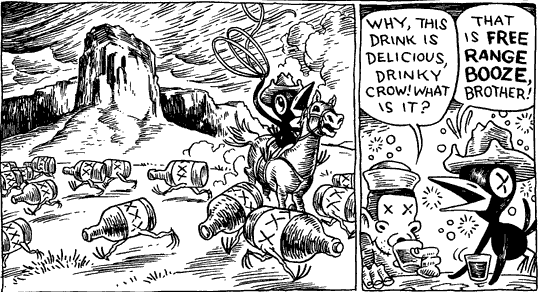
A scene from Remington

Sometimes we have to round up our own drinks.

But then they taste better in the end.

(Courtesy of Tony Millionaire)

Operating on Civil War readers

A dialog with Jean Baudrillard.

DR: I understand that a nonfiction book is an argument and I like argument. But there are Civil War histories that make me feel absolutely sleazy when I put them down - the author has tried to put the make on me, tried to recruit me into his little movement. Not directly but in an underhanded way - not through argument, which would be fine, but through literary tricks - attaching me to this one, alientating me from that one, manipulating my emotions.

JB: The point in advertising and propaganda is not to believe but to make people believe. "Participation" is not an active or spontaneous social form, because it is always induced by some sort of machinery or machination...

DR: Yes, I feel that much ACW reading is about getting me to participate viscerally in the controversies of the Civil War and involves authorial machinations that have nothing to do with reading or enjoying history.

JB: Everywhere the active verb has given way to the factitive, and actions themselves have less importance than the fact that they are produced, induced, solicited, media-ized, or technicized.

DR: Given that a manipulation like Civil War pop history is about driving emotional effects, the story lines become ridiculously broad, I think. They become sketchy like outlines or biblical archetypes. Lincoln finds a general, Yahweh finds a prophet. The content is in the emotion-producing material, not in historical matter...

JB: Violence is whitewashed, history is whitewashed, all as part of a vast enterprise of cosmetic surgery at whose completion nothing will be left ... We are under the sway of a surgical compulsion that seeks to excise negative characteristics and remodel things synthetically into ideal forms.

DR: But an ideal form can be inferred from historical detail or it can be crudely suggested by the author. Rich content poses a problem to pop authors - it can lead to unexpected conclusions. It can point to unexpected forms.

JB: In order for content to be conveyed as well and as quickly as possible, that content should come as close as possible to transparency and insignificance.

DR: Leaving space for identification games, induced sympathy, aroused antipathy. Operations.

JB: The thing that characterizes operation, as opposed to action, is precisely that operations are necessarily regulated in the way in which they occur - otherwise there would be no communication. Speaking - but no communication.

DR: Writing - but no communication.

JB: Communication is operational or it is nothing. Information is operational or it is nothing.

DR: Publishing success is operational or it is nothing.

JB: Thus good communication - the foundation, today, of a good society - implies the annihilation of its own content.

DR: Because content leaves entirely too much to the reader.

(From The Transparency of Evilby Baudrillard, New York, Verso, 1993. All JB quotes from the chapter "Operational Whitewash." Emphasis in the original.)

1/17/2006

New media and historical doctrines

A dialog with the late Marshall McLuhan.

DR: Civil War history from about 1960 on has been a slick product delivered to its public on a news broadcast model – “And that’s the way it is.” Its best-selling motifs became endlessly reworked, until motif gave way to clichés.

MM: The world of the cliché is itself environmental since nothing can become a cliché until it has pervaded some world or other. It is at the moment of pervasiveness that the cliché becomes invisible.

DR: Which causes that startled reaction from readers when the Civil War author leaves the certainties we all “know” behind. The newscast model has been remarkably robust despite sweeping changes in information technology…

MM: …they still have the illusion that the new developments are to be fitted into the old space or environment.

DR: You see that with LSU publishing a conventional book review magazine online; with authors blogging whole chapters of their print books; with the same logic of ink and paper costs limiting an online catalog as if it were a print catalog; with email being used as junk mail.

MM: Under electric conditions the content tends, however, toward becoming environmental itself.

DR: The great commonplace of the dotcom era was that it was all about content; the Internet was its content, not technology. But by publishing ACW content on the Internet, one also becomes highly aware of aspects to old style Civil War publishing.

MM: When an environment is new, we perceive the old one for the first time.

DR: And we can perceive it critically, from outside and above.

MM: An environment is naturally of low intensity or low definition. That is why it escapes observation. Anything that raises the environment to high intensity … turns the environment to an object of attention. When it becomes an object of attention, it assumes the character of an antienvironment or an art object.

DR: Subject to the criticism we would bestow on an art object.

MM: Art and education were presented to the public as consumer packages for their instruction and edification. The members of the mass audience are immediately involved in art and education as participants and co-creators rather than as consumers.

DR: Why distinguish between: the “public” of the Centennial era and the mass audience of electronic media times?

MM: The Mass does not consist of separate individuals, but of individuals profoundly involved in one another. This involvement is a function not of numbers but of speed. The age of the mass audience is thus far more individualistic than the preceding age of the public.

DR: And these engaged communities of interest, communicating frequently, at high speed, are colliding with a world still passively ingesting units of edification.

MM: The feedback loop plays all sorts of tricks to confound the single-plane and one-way direction of thought and action....

DR: ... but the loop plays tricks on us all. Imagine media interaction with a professor, student, archivist, or corporate publisher: this class of participant is self-censored and drags chains of bondage at the bottom of every email sent. The behaviour of such restricted classes of participants is going to transform any media environment they enter. The environment fogs over - its contours become vague.

MM: In an age of accelerated change, the need to perceive the environment becomes urgent.

(DR: From Essential McLuhan by McLuhan and Zingaro, Toronto, Anansi, 1995. All quotes from the chapter “The Emperor’s New Clothes.” Emphasis in the original.)

1/16/2006

Potpourri

* Fergus Bordewich has launched a blog to support his new book Bound for Canaan , but three postings in six months does not a blog make, my friend. And the postings are book excerpts, it seems.

* David Woodbury is posting weekly (or thereabouts) but is going for length and quality in any case. Hard to keep up blogging momentum on a weekly basis I think.

* CSPAN has actually had an ACW author on (this via Drew Wagenhoffer). That's rare.

* A new Bivouac Banner was posted last month and the newsletter is now carrying excerpts from future book releases. Good idea.

* Brett Schulte's guest poster Johnny Whitewater has taken the trouble to read Team of Rivals and is annoyed at the depiction of Lincoln as superhuman puppetmaster; he doesn't like the citational style either.

* SavasBeatie has its 2006 release list up and seems to have taken two 2005 titles into paper already. There's a new Eric Wittenberg title in the bullpen .

* Mark Grimsley has noticed that the Department of War Studies at King's College (London) has gone into the distance learning business. I have a funny Department of War Studies at King's College story, believe it or not. (Don't we all?)

My friend Delk O. and I were sitting around over a meal of Australian steak grill-fried in olive oil (lots of olive oil, the cooks were not steak eaters normally) in a contractor's mess in Riyadh back in 1979 or '80. Delk, an outspoken fellow, had just come back from London where he interviewed to study in the new War Studies department; at the end of his Saudi contract he would start his advanced degree work

"How did it go," I asked. "A little rough," he said. "After answering a lot of questions I asked my interviewer, 'So are you going to put your name on my research and then publish it?'" This was pure Delk. The interviewer, who would have become Delk's advisor answered, "Sir, this is not the United States. We do our own research here."

Bad interview technique but good answer.

Apologies to my academic friends. I do love that story. I don't think Delk got in.

New Year's Resolution

Stop teasing McPherson fans.

Hey, put that down

I'm getting beat up over at Kevin Levin's place. "We don't get what we expect, but we get what we deserve," as the people over at the Daily Reckoning like to say.

I see also that Kevin reports that Maxwell has passed a financial milestone (millstone) that may doom his third movie. And Kevin notes that the often tedious Philip Glass is planning a Civil War opera.

I would suggest he team up with Terry Gilliam for the libretto. If he can ever scare up another buck, I would also suggest Maxwell team up with Gilliam.

In his (fairly awful) Brothers Grimm, Gilliam returned with a vengeance to the explicit antimodernist motifs developed in detail in his Adventures of Baron Muenchausen. If you saw either of these films, you would know exactly what I mean. Gilliam would be perfect to represent to a mass (Northernized) audience the Southern view as developed by the Fugitives.

He's ready for his first ACW movie. Or opera.

New Lincoln statue

Given the abundance of Lincoln statues in Springfield, IL, you won't mind one more, will you? "A bronze, nine-foot statue of Abraham Lincoln, bracing himself against the wind, will [soon] adorn the southeast corner of Union Square Park across Sixth Street from the Abraham Lincoln Presidential Museum."
 
Nothing succeeds like excess.
 
"[Sculptor] McClarey, 70, said his sculpture reflects Lincoln's two most dominant leadership traits - his openness and toughness."
 
Those of us who think of AL as secretive and weak will have to wait. But at the rate statues are going up - something like the rate at which an infinite number of monkeys hit an infinite number of typewriter keys - it may not be long before the proper, Shakespearean depiction emerges.

1/15/2006

Morningside Books minus Bob Younger

Bob Younger has died. Morningside Bookshop seems poised to continue operations, looking at this staff roster.

His outfit has done Civil War readers a terrific service over the years and I myself have a few indispensable books reprinted by the shop. My hunch is that Mary Younger has been the practical half of this partnership. May she prosper.

The last fifty years of Civil War publishing have been, by and large, dreadful. Bob Younger, however, was there for us with important new work and essential reprints.

Interesting obit here by Eric Wittenberg. More here. My earlier posting about Morningside.

1/13/2006

Crampton's Gap is in the news

 
The headline writer seems a tad unfriendly, though.

"Distortion, lies and fakery"

 
It's a mistake to think this flap is simply about misleading readers with faked biographies (or fake details). The autobiographical excesses charted in this article have their counterparts in Civil War nonfiction, too. And they are rooted in the same source - authorial hubris.
 
It's not about a few ink-stained rogues - it's about standards in nonfiction editing.
 
Is anyone faking Civil War letters from start to finish? The particulars of this current crisis in trade publishing makes me wonder.

1/12/2006

Civil War authors of merit

... I think that success in life is largely a matter of luck. It has little correlation with merit, and in all fields of life there have always been many people of great merit who did not succeed. [...] The theory that art advances with the great artists in the van is not just a myth; it has led to the formation of cliques and pressure groups which, with their propaganda machines, almost resemble a political party or a church faction. - Karl Popper, Unended Quest
Substitute history/historians for art/artists and you will get another take on this quote.

It is 2006 and the day of the great Civil War historian has passed. "Great" in our field has only ever meant "great sales" and as the great sales fade, the claims of charlatans weaken. "The class of 1965" passes into memory - American Heritage struggles to survive - and that aggregator who decades later clumsily reiterated the historiography of '65 for cash and prizes now contends for store space with unlucky authors of real merit.

Popper: "... if I thought that there were no genuine philosophical problems, I would certainly not be a philiosopher..." We are crowding out the oafs who think there are no genuine problems in Civil War history, that all has been settled. They have become marginal.

And so I welcome the new year.

Refunds from Random House

Random House is refunding readers the cost of a nonfiction book bought directly from the publisher because the book contains exaggerations.
 
I like this - let it trend.

Welcome, Judge Alito

Mrs. Alito says about Mr. Alito: "He makes lists of novels that win the National Book Award, but at heart he's a history buff." " He's been reading Civil War stuff lately."
 
Hunch: If the National Book Award is your source for novel recommendations, your Civil War reading is likely to be dreadful, the kind of trash that wins prizes from committees of back-scratching plagiarist storytellers.
 
We all have to start somewhere, however. Welcome to the ranks of Civil War readership, your honor.

1/09/2006

Bullwinkle's bullets

A few years ago, a stranger stumbled into the Usenet discussion group to ask where people liked to prospect for spent ACW bullets. The uproar was memorable, even by Usenet standards.
 
Since moving to Virginia, I have actually met two fellows who occasionally search our property, near the Potomac, for fallen rounds. Can this be a better use of time than searching the surrounding streams for gold? (Gold was mined commercially farther downriver until about 1948. Weekend searchers still collect gold flakes hereabouts.)
 
Here's a searcher who sells ACW bullets for $12 or more in cases.
 
Here's another fellow who has found so many bullets, he can only stow them in buckets and give them away.
 
The dynamic between searchers one and two, above, reminds me of an episode of Rocky and Bullwinkle. Some sort of economic council met to deal with the problem of saved cereal boxtops. They worried that Bullwinkle's huge collection could flood the world economy all at once pre-empting all other forms of economic production. Firms would compete to book factories to make all the trinkets that would be needed to honor unredeemed boxtops.
 
Far-fetched? Look at unredeemed frequent flyer miles.
 
Searcher one had better hope searcher two loses those buckets. 

Funding fury over Richmond museum

The allocation of $1 million from a defense bill for a prospective Civil War museum in Richmond has  ignited anger.

Franklin and Mac at the gaps

Tim Reese has some newly posted thoughts on the battles for the gaps on his website.
 
In reading it, you may want to keep in mind McClellan's plan of having Franklin act as a flying column in Pleasant Valley interposing between Jackson and Longstreet.
 
"... had he broken into Pleasant Valley while ample daylight remained, he would have thus threatened Lee with isolation before the latter could safely disengage at Turner's under cover of darkness, further 'cutting the enemy in two,' allowing McClellan to 'beat him in detail.'"
 
I appreciate Mark Snell's undertaking a biography of Franklin, but the man remains baffling. Kearny's correspondence makes reference to Franklin often, repeatedly referring to his great talent (unique praise from Phil). Franklin impresses everyone, always. He begins the war as an adjunct member of the cabinet, acting with McDowell as the Executive's "workaround" for avoiding Gen. Scott. Grant is still seeking his services near the end of the war.
 
Franklin will always repay more analysis.

1/05/2006

Fiends and oligarchs

Interesting sidelight on Alexander Keith Jr., ex-Confederate from Halifax, Nova Scotia: this fellow (Ann Larabee's Dynamite Fiend) was well known in his home town - but never as a terrorist - thanks to a press blackout.

See here.

1/04/2006

Back Door to Richmond

Brett Schulte has posted on Robertson's Back Door to Richmond, on the Bermuda Hundred campaign.

I very much enjoyed the book, its analytical cast, and its revision of the Butler guilt trip laid on by those who thought he should have taken Petersburg; Robertson thought that Butler was a victim of diffuse guidance. He also made Butler look good compared to his corps commanders, Gillmore and Smith.

IIRC, in a series of Usenet posts some time ago, Grant biographer Brooks Simpson, however, took aim at Robertson's reconstructions of the Grant-Butler communications on mission/operations matters, arguing that Robertson had overreached his material. Butler should not have been confused.

Keep a close eye on Robertson's handling of the communications evidence. It may be a balancing act that fails but it will well repay careful reading with the pleasure only a compact historical problem can deliver.

Good cavalry and bad books

Eric Wittenberg is rethinking McClellan and his cavalry and has composed a nice post about it. It reminds me that I need to write a little on the subject too, starting with the McClellan/Johnston/Davis cavalry doctrine disputes after the return of the Delafield commission from the Crimean War.

Which also reminds me that Eric had written some time ago, in an email, that he was dissatisfied with some of the books of a small publisher I had praised, Pelican. He had suffered an especially bad experience with White Mane, too. Buyer beware he said. There are publishers with some rot on the rosters.

Now, I should warn all that I like the publishers of bad little books - and I like their bad little books too. Of course there are two kinds of bad books. The first kind, which I read avidly, has interesting sourced material mired in bad history of one kind or another. I try to skate past the bad stuff and pick up the good.

The second kind is just bad history through and through. That is a losing proposition but perhaps a price worth paying to keep a pipeline open for bad book type one.

I remember plowing through this terrible 1968 self-published bio of Gen. "Bull" Sumner by a distant relative. At the end of this wearying read lay a morsel: the author complained that people made too much of Bull Sumner being cousins with Senator Charles Sumner.

Where have you ever read that before? Something to be verified somehow, but quite the choice bit. And I only had to read one bad, obscure book to get at it.

Win-win, no?

1/03/2006

What Emerson meant

I was re-reading the lovely Voegelinian musings of Marion Montgomery in his Why Hawthorne was Melancholy when I stumbled over a question of What Emerson Meant.

In 1864, Emerson wrote to Sen. Charles Sumner about a proposed law to set up a National Academy of Literature and Art. He thought it could offer "a jury to set upon abnormal anomolous pretensions to genius, such as puzzle the public mind now and then."

I wondered if a concern with "abnormal anomolous pretensions to genius" was sparked by military headlines or by literary goings on.

Perhaps he was envisioning the future state of Civil War history and its abject cult of authorial genius. Or perhaps he was envisioning the blog phenomenon.

Thanks for this rich quote, Marion.

The point about Polk

This LA Times columnist makes some interesting points in comparing Polk to Bush, with a side glance at Lincoln.

As might be expected from a fan of Doris Kearns Goodwin, the Bush side of his analysis is based on pop stereotypes and the core comparison of Lincoln with Polk erroneously sets them up as contraries... to serve the purposes of a short essay, of course.

A deeper analysis would uncover a treasure trove of lessons Lincoln learned from Polk, especially in military organization and in the civilian management of professional soldiers.

Lincoln's Polkification of the Civil War (my term) had enormous consequences in losses and in efficiency trading off against gains in ardour and a certain broadening of participation.

The columnist is not far off in his assessment of Polk, however, and in the newspaper game one out of three ain't bad. Have a look.

The Dramatic Oil Company

Whiskey & Gunpowder (not the name of a a convenience store, a financial newsletter) has an interesting little piece on John Wilkes Booth's oil partnership, "The Dramatic Oil Company."

"You can find the remains and a marker of the Wilhelmina No. 1 today, on the Allegheny River Trail, just east of Titusville."

Booth's well can be visited.
NEWS | New Civil War exhibit offers in-depth look at Wade Hampton * Confederate journal turns editor into author * Hilton Head group tries to save freedmen's village site

1/02/2006

On keeping quiet

Dr. George McClellan, founder of Jefferson Medical College in Philadelphia, gave a valedictory address to his students at Jefferson Medical College in 1836.

I found this in a pamphlet among the papers of Max McClellan (the general's son) at Princeton University last week.

Some of his words in that address presage his son's refusal to engage his critics during and after the war:
If you have a low, crafty, and hostile competitor to deal with, let him alone and he will work out your reputaion for you. If you take the trouble to refute his calumnies too often, he will, in some measure, bring you down to his level in public estimation. ... A sensible author has somewhere observed that there are two ways of obtaining prosperity in the world - the first is by the praises of honest men, the other and surests is by the abuse of rogues.

Even the reviewers are noticing

A conventional ACW pop history retelling comes forth (Grant and Sherman, the Friendship that Won the Civil War) and even the book reviewer feels obliged to warn his readers, "the details of the famous relationship are familiar to event the most casual of buffs, and building his whole project on this framework sometimes feels slightly strained."

Why slightly strained?

At least this hackwork is being molested at the lowest-common-denominator of reviewing, the newspaper. I'll take that as an omen for 2006.
NEWS | Plans move forward on national ACW memorial * Emancipation jubilees mark Jan. 2 * Ft. Pulaski gets new chief * Civil War book collection on auction block

12/30/2005

Morris Island: Joe Riley bestirs himself

Marx envisioned a period after socialism when all needs would be met and the state would wither away. He called it post-scarcity anarchism.

The political psychosis that fogs the mind of your run-of-the mill newsroom and editorial board is something very like a psychology of post scarcity anarchism; local problems are trivial, technical matters; local corruption is a small bother the feds can take care of when they get around to it; vote rigging is something that happens in Central America; the really "important" stuff is chiliastic and national: global warming (whatever happened to acid rain?), international debt forgiveness, presidential elections, and massive financing for paradigmatically skewed pork barrel medical research.

The post-scarcity Carolinian anarchist will wrack his brain over an editorial about perfecting Egypt's political system while bulldozers are ferried to Morris Island. Gaze on this and despair.

My fellow Trentonians who were critics of Trenton's late Mayor Art Holland - cautious in development, respectful of historical treasures - viewed him as an obstructionist. His successor is an enabler. Give me the obstructionist.

Charleston's Mayor Joe Riley delivered a stirring eulogy for Holland in Trenton on the old mayor's death; among other stories, he told of their tug-of-war over posession of the Swamp Angel in Trenton's Cadwallader Park. Riley marched with us in the long procession to the Broad Street Cathedral where the memorial service was held. With Holland dead, he's one of a kind.

Riley has finally weighed in with an editorial against Morris Island development in Charleston Harbor. (I cannot access the editorial.) I don't know why he has to resort to an editorial - maybe it is preparatory to action. Maybe there are jurisdictional issues that prevent his intervention.

Thank heaven the Egyptian political experts let him have a forum on their pages.

Now, responding to Riley's call, the Trust for Public Land has stepped forward to offer its leadership in organizing resistance to the develpoment of Morris Island.

Now, this is a Civil War site. TPL should be on the sidelines and, if I can indulge my own post-scarcity fantasy, Civil War buffs would be working hard to exclude any naturalist participation in this preservation effort.

The gentleman making the offer on behalf of the TPL is (incidentally) a developer himself. Is that sweet?

Of course, given a Civil War preservation leadership scarcity, you thank heaven for the kindness of strangers, be they in sheep's clothing or not. Since we have an abundance of leadership scarcity we have an abundance of developmental anarchism, too.

Coming to a drain near you

Civil War cannon shell tops Roto-Rooter list of weirdest finds in America's drains.

(p.s. Is there an academy journalists could attend to learn the difference between shot and shell?)

12/28/2005

Not ostensible

"I am afraid you will think me ostensible," Emily Dickinson wrote to a gentleman friend,

(Was it Col. Shaw?)

I am not ostensible myself, not yet, and will be back tomorrow.

12/22/2005

Poisoned fruit

Mike Stevens, of the Central Virginia Battlefield Trust, has done Christmas proud in the pages of Fredericksburg's Free-Lance Star.

He has written a generous, humble, praiseful letter thanking certain parties for coming together to save Chancellorsville battlefield:
Anticipation arises out of seeing, once again, a coming together of developers, politicians, and preservationists, willing to balance self-interest with common purpose, willing to listen and learn from one another, willing to share a commitment to get the deal done. The folks of Toll Brothers, of the Spotsylvania Board of Supervisors, and of the Civil War Preservation Trust are meeting in a spirit of comity and compromise, and all of us who understand what this land means to our community and to our country can be hopeful that their efforts will bear fruit.
The lion lying down with the lamb is something that happens after the second coming of Christ, I think. Right now, we are in the period after the first coming of Christ and we need to note the lion's claws and mark our distance from the carnivore. What is happening between Toll Brothers, the county and CWPT can better be summarized in a news snippet:
Toll Brothers Inc. of Horsham, Pa., is poised to sell 75 acres of battleground on State Route 3 to the Civil War Preservation Trust. The sale hinges on the Spotsylvania County Board of Supervisors increasing the number of homes the company can build on about 500 adjacent acres.
Is this "a spirit of comity and compromise?" Or is this a rank business deal with a serious preservation downside?

One could reasonably say that there are no preservationists whatsoever involved in these discussions.

Avoid the Christmas punch, ladies and gents, and remember the true meaning of preservation this year.

Book review riots - let's stage one

There is a new book out on the NYC draft riots which, if I read the review correctly, aims to be definitive.

Can't be sure because the review wastes itself entirely by retelling the underlying events rather than conveying the worth of the tome.

What is wrong with this country's book review editors that they should allow retelling to pass as analysis week after week?
NEWS | Congressman discusses timber sales at Pea Ridge military park * Morris Island finds a buyer - a high-end developer * Davis friend's mansion is reinvented for lodging, dining

12/21/2005

Enough to make a grown man blog

I was reading a nature book and came across a quote by spy novelist John le Carré.

Wait, it gets more convoluted.

On reading it, I immediately thought, “This is about Civil War history.”
There was the boring similarity of technique; the grain of truth carefully reconstructed culled from newspaper reports and bazaar gossip; the follow-up, less carefully done, betraying the deceiver’s contempt for the deceived; and finally, the flight of fancy, the stroke of artistic impertinence which wantonly terminated a relationship already under sentence.
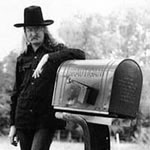
In the original context, le Carré (right) was talking about stories spread by the enemy in war. If we break it down, the tiny engine of pop history appears in all its parts.

There was the boring similarity of technique

… lineal storytelling on a strict timeline in a flat narrative style dolled up with a few old fashioned literary tricks from Jules Verne or Edgar Rice Burroughs.

the grain of truth carefully reconstructed, culled from newspaper reports and bazaar gossip

… some bit from the odd OR report and an anecdote or two that can advance the book's high concept.

the follow-up, less carefully done, betraying the deceiver’s contempt for the deceived

… the next instance of a trend, development, or characterization presented with even less evidence than the previous one.

and finally, the flight of fancy, the stroke of artistic impertinence which wantonly terminated a relationship already under sentence

… the resort to hyperbole in stretching an incompetent generalization beyond error to make it an outrage. Not even Napoleon himself … Never in military history unprecedented error … unique opportunity ….

The “deceiver’s contempt for the deceived” shuts me down early in most readings. I have to want to suffer to get to that flight of fancy that must terminate my relationship with a book.

What is comical is encountering so many people mouthing flights of fancy as though they were precious insights harvested from some “scholar’s” deepest wisdom.

I have felt the sting of the author's contempt for me, as a reader, so harshly as to want to start three websites in retaliation. And I have. But the sting remains.

12/16/2005

Bringing Civil War history up to date

I used to attend readings of Voegelin Society papers at the American Political Science Association's annual conventions whenever they were held in Washington D.C. In those days, the APSA was in the iron grip of a very grim outfit called The Society for Political Methodology. If not that exact society, its imitators and competitors.

(By the way, attendees would ask me, "What institution do you represent?" and I would answer, "The reading public." The looks were priceless.)

This sort of research flooded the halls of whatever hotel was hosting APSA:

* Practical Issues in Implementing and Understanding Bayesian Ideal Point Estimation *

A quote from that paper: "Item-response and ideal-point models are inherently applied to multilevel structures, with data nested within persons and test items, or judges and decisions, or legislators votes."

Should be "legislators' votes" but these are not wordsmiths, needless to say. And there aren't that many words in these papers anyway. APSA and friends have turned to formulae:

That was an expression of political analysis from a poli-sci paper.
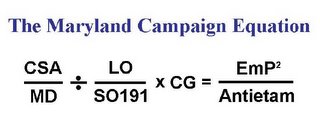
Tim Reese has generously agreed to help our dowdy field catch up with the poli-sci trailblazers. Here is his offering, which I trust you can decode without my help:

We're on our way to methodological excellence!
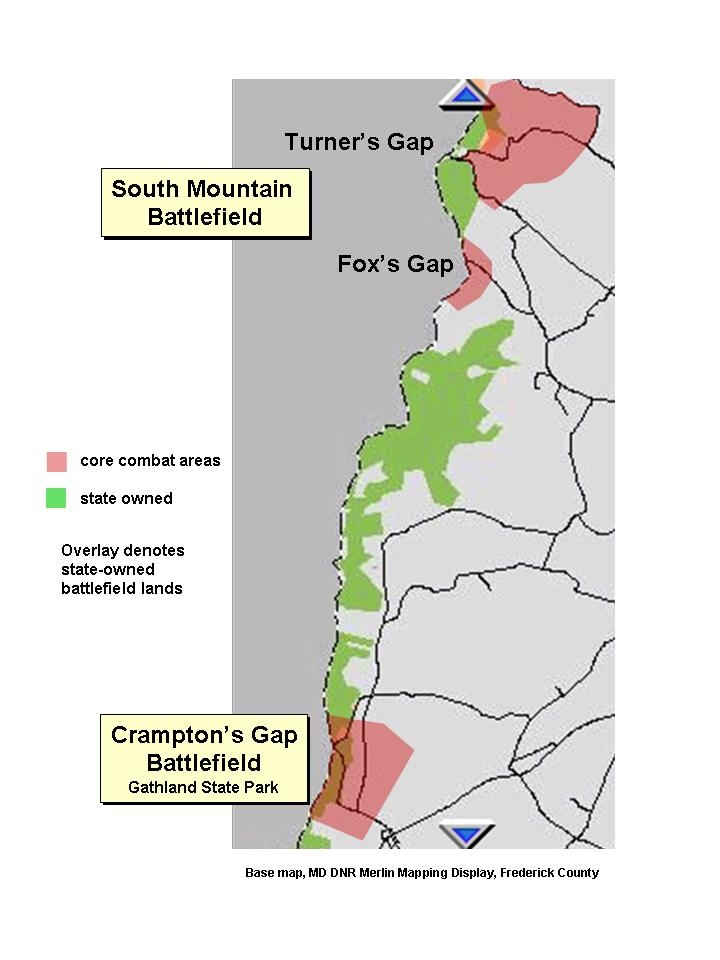
Well, there you have it

The entire preservation story of the Maryland Campaign's gaps is here told in one graphic. Click to enlarge.

If you don't want to click, then peer. Red indicates "core combat areas" and green shows land the state owns.

Thanks to Tim Reese for this.

p.s. The League - on which I posted yesterday - is broadening its focus beyond the Civil War and a number of ACW preservationists have left the group ... which adds a wrinkle to their battlefield land sale.

12/15/2005

The computer is a marvelous thing

I was looking at log files and saw that some searcher way out on the Internet had entered the keyword string "civil war major flaws" and Google brought him to this posting.
 
Wow.
 
This might have done as well, or this series ( 1, 2, 3, 4, 5).
 
You came to the right place. Thank your computer.

Pieces removed from Frankenstein park

The Frankentein-shaped hallucination that passes for South Mountain state battlefield park - a park no one can visit because it is patched together from easements and the odd, isolated fee simple holding - is shifting shape a little, according to a newsletter issued by the Central Maryland Heritage League.

The monster has a notional existence because locals drank the potion offered by some mad scientists who run a famous national preservation trust; they promise eternal life to land placed under easement.

You can reduce the cost of an easement - which already costs less than land - by applying for state highway funds (believe it or not) and/or teaming up with the local birdwatchers or farm conservationists to split the bill ... not the sort of partners you want to have, truth be told, but available and willing.

So, you swing the shiny watch and mutter, "stretch battlefield land budgets, buy several easements instead," and they drink the potion.

I think this is what's happening at the Central Maryland Heritage League:

We are negotiating with State and Federal agencies to see if it is feasible to sell parcels of land on or near South Mountain State Battlefield. Both are protected and their sale would again help us to acquire and protect more land.

This year we have seen battlefield land being "preserved" through sale to developers. We have seen developers called preservationists in the press. Now we have a preservation society selling battlefield land it owns in order to "acquire and protect more land". Will it sell to developers if they are called "preservationists"?

Strike "acquire" from their comments. They want to swap real ownership to buy some hallucinogenic easements. They drank the potion, I think.

However, Tim Reese wonders if the League may be getting off the mountain entirely. Certainly, it may be possible that this sale fixes a financial problem, and that "acquire and protect more land" is a fig leaf.

I wonder, also, if they have put easements on the property they own and want to sell. Since - hypnotized - they may believe easement equals protection, there may be no reason - in their befuddlement - why they should continue to own "protected land" and pay taxes on it. Yes, it is land no one can visit. Yes, it is land that may come under generations of "no trespassing signs" once relinquished.

But by Jove, it is "protected"!

If you think that way, if you believe the nonsense that swirls around Civil War preservation societies today, a perfectly reasonable game plan would be to buy land, put an easement on it, sell the land with the easement in place, buy another piece of land and continue indefinitely. Maybe the League is doing this.It takes a PhD in Kremlinology to understand what our battlefield protectors are saying and doing.

Preserving is developing, buying is paying owners not to sell, and saving something means getting rid of it.

Enjoy your "no trespassing" virtual battlefield, friends. And give generously to save our hallowed ground.

12/14/2005

Even more hats


I hope the code holding this post together does not blow up. I dread to think of how this will compile in your browser. Nevertheless, do send me your favorite hat pictures.

Here we have Scott in a chapeau most of us have seen him wear. He's got some spectacular attachments where Blunt's (see previous posts) is plainer. What do you call this thing?

Check out this variant on General Benham: pure Hornblower. "Hard a'starboard, you laggards!" Banks looks like cover art from a Hawthorne novel - there must be a cape to go with that outfit - and Ward is modeling a Trilby, no less. The locks underneath look fairly lustrous for extended field duty.

That helmet on Jackson's head has to be asynchronous (although we did run a picture in this blog of the Delafield Commission with a spiked helmet on the table nearby).

It's important to be able to spot your general on the field. Very important apparently.

General Mansfield ...

... I like your style.

Everybody in the army puts some spin on regulation headgear.

This interpretive statement takes the prize.

Fussy, continued

A reader writes to say that authors referring to Johnston's Army of the Potomac as the Army of Northern Virginia get his goat.
 
Drew Wagenhoffer also writes to say that "McClellan restored to command" does it for him, McClellan not having been removed from command. Sears, for one, takes a little care here, offering the formula, "McClellan's command was restored to him."
 
I have a different view of this. McClellan was assigned an entirely new command, the defenses of Washington. His adjunct mission, while commander of the defenses of Washington, was to organize a (**A**) field army to intercept Lee. The fact that a field army was organized and later received the old name "Army of the Potomac" is an accident of history ... especially given that it was John Pope who was named commander of this field army (by city defenses commander George McClellan) on September 5, 1862.
 
This is going to be surprising if you have digested the formula "Pope was removed from command and McClellan was restored." That statement is as (un)true for 1862 as is "McDowell was removed from command to be replaced by McClellan" for 1861.
 
You can reach a level of generalization in writing history, where it becomes sludgy.

12/12/2005

How fussy is fussy?

Is it terribly wrong to be irritated when an author refers to McDowell's forces at Bull Run as the Army of the Potomac? Repeatedly in one work?

Any number of authors do this and it freaks me out every time. I stop for awhile. Can't go on. It casts a shadow on all that follows.

Some of you are thinking, "There were no army designations apart from the department then." Partially right. Scott was against divisions and armies. And what was McDowell's department called? The Department of Northeast Virginia.

I see from Eicher and Eicher that McD is department commander from 27 May and that he picks up a title from July 8 on, commander of the Army of Northeast Virginia. I want to know more about that, not less, and calling the Army of Northeast Virginia by another name is giving me less.

Here's another eye-opener that may indicate all is not well in Civil War history. McDowell co-exists as army commander with McClellan when McClellan is called east. McDowell does not relinquish his army command until 15 August; Mansfield does not relinquish his department until August 18. There's a major essay lurking in that.

I know this sort of arcana (names of armies, limits of command) places a terrible burden on history writers but we readers like to know true from false. Humor us.

You don't have to call it "The Army of Northeast Virginia" if that's going to confuse your editors. But don't call it the Army of the Potomac. Please.

Civil War Book News has been updated

 
Hoping to get the rest of the year finished by January 1.
 
That would be cosmic.

"Corrupt Conqueror"

Stamp collectors love those upside-down images and I wonder if this is the ACW reader's equivalent.

The Blunt book I wrote about yesterday is titled General James G. Blunt: Tarnished Glory. I am looking at the cover as I write.

The photo of the cover run in yesterday's post shows a book titled General James G. Blunt: Corrupt Conqueror. Click on the image for a close-up. I got it from the publisher's own website.

Last minute title change or passive resistance from a Missourian in the art department?

12/11/2005

Western publishing

What's with the hat, commodore?

Is there a picture of any other ACW general, aside from Scott and Wool, wearing this headcover?

I picked this book up early in December, pleased to see a Blunt bio and happy that the small publisher, Pelican, had won major chain distribution of the title (I have seen it in three chain outlets so far this year).

This cute and curious passage is from the introduction. It is the very picture of Republican generalhood, I think:
As impressive as these achievements are, they can be overshadowed by Blunt's spectacular failures as a military administrator. He carried on a yearlong feud with one of his superiors. His relations with the first two governors of Kansas were notoriously poor. He did nothing to stem the rampant corruption in the military supply system. Indeed, Blunt took part in some of that corruption. And in one incident ... he bears some of the blame for allowing the massacre to occur.
Ah, Baxter Springs. Rode off leaving his command not just to be massacred but tortured then massacred or tortured while enduring massacre. Something more serious than failed to advance quickly or wrote his wife complaining about Stanton.

Pelican seems to specialize in Western titles; have a look. So does the Camp Pope bookshop, which like Morningside, is both a bookstore and a publisher.

They deserve our patronage.

12/10/2005

Surprises in libraries

There was a talk to be attended in a county branch library new to me today and after the event, I browsed the Civil War book section.

This is always a discouraging prospect and the trash here was heaped deeply on the shelves - I despaired of finding a single useful book when I noticed Richard F. Miller's new Harvard's Civil War mixed in with the dross.

A good sign, one that encouraged me to keep searching. I found a couple of diaries to check out in addition to the Miller book. Gregory Acken, connected with Philadelphia's Civil War Library and Museum, assembled some letters among the holdings in his care into a big tome, Inside the Army of the Potomac, the Civil War Experiences of Capt. Francis Adams Donaldson (of the 118th Penna. USV). McClellan commanding at Gettysburg (again) caught my eye. I also checked out Sears' On Campaign with the Army of the Potoma, the war diaries of LTC Theodore A. Dodge, whom I knew for his Chancellorsville history. Dodge had no McClellan at Gettysburg info.

Dodge and Donaldson were McClellan men through and through. As I started through Donaldson's letters copying out the McClellan material it became overwhelming, there was just so much of it. And it was so emotional.

The general literary and social style of the Civil War involves restraint and distance and understatement and irony. For grown men to wax emotional and poetic about their leader is outside the bounds of accepted personal style. When it happens army-wide, something astonishing is going on. Not astonishing enough to have ever merited a study, however.

Someone needs to collect such primary material - these manliness-be-damned outcries - into a big concentrated sheep dip that we can run historians through before they begin their carping, niggling little AoP annals.

Donaldson: I can say in conclusion that I never saw the army so full of enthusiasm as it now is, everyone anxious to meet the enemy and terminate the war by one grand battle. McClellan seems to have the final termination of the issue well in hand, and when we again meet Gen. Lee's army, they will suffer a defeat that will end their existence. We all feel confident of this, and should I be correct in this forecast of the future, McClellan will be, as he really is today, the greatest military chieftain of the age. (11/5/62)

Dodge: By the way, I may as well tell you how the Army feels about the conduct of this war. Everyone is longing for McClellan [emphasis in original]. "Let us go into action and a few get killed and then the rest retreat." This is just the feeling they have about Burnside, no confidence in his ability at all. But every heart is so turned toward McClellan that his being put in command of the U.S. Army would this moment more than double the force of the troops. They will go anywhere under him, but with reluctance under any other leader; and any day I believe McClellan could lead us up & take those Frederickburg batteries, considered now impregnable.(1/1/63)

And so it goes.

David Woodbury

Hat tip to Eric Wittenberg for pointing to David Woodbury's new Civil War blog. It's quite a feast: start with this post.

Woodbury is a writer who has paid his Civil War dues in a major way - as an editorial collaborator with Ted Savas bringing out innumerable specialist studies and as the patron saint of certain indispensable books, one of which I have failed to say enough about - Eicher and Eicher's Civil War High Commands.

Civil War High Commands originated in John Eicher's dissatisfaction with Civil War historians being unable to master even the most basic units of fact - e.g. who was promoted when and commanded what. As an ACW reader, he found himself keeping notes he could refer to and rely on in lieu of whatever book he might be reading at the time. (Sounds like my gateway into McClellanology.) The result is 1,040 pages of useful almanac-style data (and indirectly, 1,040 pages of commentary on the wretched state of previous ACW research). Shepherding this book through the publishing wilds must have been epic.

My admiration for Woodbury does not stop there. Civil War Regiments, which he co-edited, was an oasis of freethinking during one of the worst periods of consensus we have seen in Civil War publishing, the mid- to late1990s. His reasons for blogging resonate with me: "Let's be frank -- some of those authors didn't work as hard on their books as you did earning the money to buy them. And for that, they must be called out."

But I disagree - I think we're moving past the point where hack authors can still flood the market each publishing season with work struggling to retell the Catton story. New thinking has dominated each new release list for the last four or five seasons. My blog, with its cathartic vitriol, could better serve its readers turning attention to our dramatically new situation. I keep reminding myself, we've turned a corner. There's a new story to tell.

Then McPherson gives an interview and I'm called back to the hunt...

But we need expert readers like David Woodbury to help sort out the new scene. Crappy books will always be with us - it's the publishers' commitment to crap that is crumbling. It is a very talented cohort of writers that is taking advantage of the end of the Centennial ice ages.

Since his is a book blog, I hope Mr. Woodbury notices and takes the same pleasure I do in this new beginning for Civil War history.

12/07/2005

Rawley dies, Lincoln consensus hardens

Lincoln specialist James A. Rawley has died.

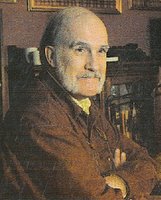
Rawley (to the left in photo at right) admired J.G. Randall, and like Randall upheld a view of the president as a conservative - in Rawley's case, an "organic nationalist" - who fought for Union straight through to 1865. This contrasts with Trefousse's view of Lincoln as a dissimulating Radical with emancipation in mind from day one (I may have gone too far with that characterization, but not by much); and with the prevailing Centennial idea that AL was a pragmatist who reached a point where he could no longer disentangle war aims - slavery from Union.

This article states his case nicely and awards Mark Neely and Gabor Boritt a few slaps to the sides of their heads. I find especially interesting his suggestion that writers have mixed up Lincoln the Whig with Lincoln the Republican.

It is also worth noting that a term count done by Rawley produces no Lincolnian references to the Declaration after 1862. There is Lincoln's ever-burgeoning rhetoric of Declaration that approaches crescendo and then is suddenly turned off in the second year of the war. Quite a bit to chew on there.

Rawley's reasonable, mainstream, scholarly view of Lincoln has been marginalized and he will soon have his name on some dirty doghouse as does Randall.

We seem to have a public that wants one single interpretation for anything; we have Lincoln salons competing to deliver these monochrome images; and we have publishers committed to flattening the landscape for the historically challenged. Poor Rawley and poor us.

Morbidly yours, (signed) The Editor

This fellow in Illinois decided to collect and publish a collection of "last letters" sent by ACW servicemen.

Some snap judgements: (1) This is entertainment - "rubber Lincoln" stuff. (2) The editor lacks any historical sensibility:

After getting 75 letters, along with permission to use them, he narrowed them down to 21. Why 21? "I just thought that a 21-gun salute is the highest honor you can give a military man," he said.


If emotional manipulation and sentimentality are pathways to historical understanding, the Pulitzer may not be enough of a prize for this guy.

C&E ACW buffs

A reader writes to tell me that James McPherson does not speak for free to civil war roundtables as suggested here, that he charges $1,000 (which is donated to Civil War Preservation Trust or another cause). He says, "The Chicago Civil War Round Table has been foolish enough to pony up," by which I assume he means they did not get $1,000 worth of value.
 
I believe he spoke for free to the Camp Olden Civil War Roundtable in 1999 or 2000. In any case, even if he charged $1,000 then, they raised $5,000 from the affair.
 
Which leads me to ask, in slangy terms, is there such a thing as a "Christmas and Easter" Civil War reader? Certain churchgoers are labeled "C&E" and I wonder if there is an ACW equivalent (one that would generate a $5,000 gate at a McPherson talk, for instance, then disappear).
NEWS | Man wants to sell Civil War style cannon he had made * Fort Wright museum to feature Civil War Christmas celebration * Police detonate Civil War-era cannonball * No cemetery under Texas school site

12/06/2005

Richard Norton Smith uncensored

Bureau reporters at the Chicago Tribune are sharing city memories and one, Ellen Warren, recalls the grand opening of the Lincoln Library in April, 2005 :
 
Museum executive director Richard Norton Smith clearly does NOT appreciate critics who have carped about the Museum's lifelike Lincoln statues. It's a "manufactured non-existent controversy," he told me.

"Real people don't talk about 'rubber Lincolns.' No one on the street talks about 'rubber Lincolns.' No one gives a shit  about 'rubber Lincolns.'"
 
Slick.
 
The controversy was about the tax-supported stewardship of public memory being placed in the hands of people who offer us fabricated 3-D Lincoln images in lieu of history - not about mannekins per se.
 
The idea that what the public wants equals history renders history nothing but putty in the hands of museum directors, governors, battlefield guides, filmmakers, market researchers, and nonfiction storytellers.
 
The reporter "gets" the Smith dynamic dispite his disclaimers:
 
... Norton was channeling his inner Brad Pitt, working the crowds like a movie star.

Citizens without tickets were lined up a dozen deep in some places and those near the front were asking Smith to sign their dedication programs. It's got to be one of the rare times in history when a scholar gets to play like it's Hollywood. Or Disneyland.
 
The scholar. What a scholar.

Clausewitz again

For those supposing, judging his actions, that Lincoln knew Clausewitz, a few points Lincoln may have overlooked:
 
[War] does not consist of a single instantaneous blow.
 
... much more strength of will is required to make an important decision in strategy than in tactics.
 
The defensive, according to our conception, is nothing but the stronger form of combat.
 
Every assailant in advancing diminishes his military strength by the advance ... This loss in the advance is increased if the enemy has not been beaten, but withdraws of his own accord with his forces intact...

The army in retreat has the means of collecting provisions everywhere, and he marches towards them, whilst the pursuer must have everything brought after him, which, as long as he is in motion, even with the shortest lines of communication, is difficult, and on that account begets scarcity from the very first.

The greater the masses are, the more severe are the exertions demanded from each individual for the daily duties required strategically and tactically. A hundred thousand men who have to march to and from the point of assembly every day, halted at one time, and then set in movement again, now called to arms, then cooking or receiving their rations—a hundred thousand who must not go into their bivouac until the necessary reports are delivered in from all quarters—these men, as a rule, require for all these exertions connected with the actual march, twice as much time as 50,000 would require, but there are only twenty-four hours in the day for both

12/02/2005

Clausewitz in the Civil War

A reader was good enough to send me a link to this essay, which concludes:
 
Nonetheless, Halleck's references, Schurz's knowledge, Jomini's comments on Clausewitz (especially as reported in the 1854 translation), the 1843 translation of Clausewitz's study of the Russian campaign, Wellington's "famous" response to Clausewitz's Campaign of 1815, the French translations and commentary, Mitchell's work in England, and the appearance of the 1835 article on Clausewitz in Britain and in the Military and Naval Magazine of the United States make untenable the assumption that Clausewitz's name and important aspects of his theories were inaccessible to American political and military figures in the Civil War era. Thus a Clausewitzian influence on Lincoln or on others in his circle remains a real possibility. In the absence of conclusive evidence one way or the other, the question must remain open. 
 
Good points.
 
My problem with the Clausewitz-in-America crowd is that they (a) do not understand Clausewitz deeply on his own terms and (b) do not understand the Civil War in its fundamental political aspects.
 
They operate in an abnormal milieu without recognizing it as such; it is the Centennial milieu in which military history completely dominates and is separated from political history. Lincoln is the apolitical, pragmatic leader, not a party-builder. The few bones of political consideration sprinklled in to your average ACW history, the few times that Centennialists allow that Lincoln may have made a political calculation are met by this species of Clausewitzian with delight - you see Lincoln understands that war is policy (or politics) carried on by other means! Breakthrough! Why else would he inject political considerations into military affairs, knowing how we readers feel about such stuff?
 
Clausewitz, in our day, has been boiled down to one formula a five-year-old can grasp = politics by other means. ACW history, meanwhile, has been had the political stuff boiled out of it such that the sight of superpolitician Abe Lincoln injecting politics (horrors) into a war decision is so disconcerting we need Clausewitz to explain it.
 
For if Clausewitz is a military thinker, then Lincoln's political intervention is informed by the highest military science available in that day; then he has made a military decision after all (and our ACW history remains uninfected by politics).
 
Bad Clausewitz meets bad Civil War for a perfect Union.

This week's obligatory McPherson post

A reader asked "Why the McPherson posts?" One may as well ask why celebrity journalism. Celebs are entertaining.

To the broad public, McPherson's work represents "our" highest aspiration as ACW readers and writers. He speaks on preservation issues, giving "our" consolidated opinion on saving battlefield land. To publishers, the success of Battle Cry represents "our" sales standard, the one we must meet to be successful as writers. When the Civil War leaks into current events, the press seeks McPherson for "our" aggregate opinion on this or that controversy.

McPherson has been made into "our" spokesman, representing the entire Civil War subculture - publishing, film, scholarship, re-enacting, television.

This is not just a political spokesman type of gig, however, it actually crosses into Hollywood's deepest colors of bathos.

Think of the juiciest Hollywood gossip story.

A diva who doesn't read music or sing well or act competently who was "made" by a hit single has not had a hit in a long while, but her entourage has never been bigger; the press cannot get enough of her; and she is on the cover of everything everywhere all the time giving all sorts of advice and comment. Sought for TV spots, her banal views are met with rapture. She is now branching out into Naval history - er, sorry, cosmetics and fashions.

The Hollywood gossip monger, understanding Greek dramatic form, awaits the correction to set in. The numbers from her next movie or record will tell part of the story; the insane levels of media saturation must cause a backlash some day. The hype surrounding each failed project must eventually scale back the outsized reputation. New actors will eventually stop fearing her and honestly comment on her achievments, what it's like to work with her, and what kind of person she seems to be.

The audience for this life drama expects the diva's downfall to be triggered by mistakes stemming from specific character flaws - flaws she was warned about, problems her hangers on kept her from confronting.

The gossip rags report these flaws - whatever they are - manifested however (tantrums, divorces, etc.) - and the subject denies them, creating a dissonance that begs resolution. That's entertainment.

The protagonist then heightens this dramatic tension by projecting her known but denied faults and errors into new shapes, larger forms, assuming ever greater risks, and meanwhile withholding signs of humility, shame, or fear.

And so we come to James McPherson.

I am reminded of an interview with Carl Sandburg or Robert Frost I read in the mid-sixties. The interviewer casually referred to his subject as a "poet," and the subject (Frost or Sandburg) stopped the interview immediately. The dialog went something like this:

Subject: Don't call me a poet, I am a writer.
Interviewer: Don't you write poetry?
Subject: "Poet" is a gift word bestowed by others - it is not for me to call myself a "poet" or to hear you or others call me that. Let "poet" be said outside my hearing.

And so "poet" was out of the record.

Now this may have been stagey buncombe but I think of that whenever Dr. McPherson presents his rear-end for lavish kissing by intervierwers who ask him what it's like to be the "greatest historian of his generation," or "the greatest Civil War scholar," or gush some other nonsense. He answers them without pause and without shame. So it seems.

His humility comes into question not only from a failure to correct the interviewer in such matters, but in his willingness to be used in the way a Hollywood celebrity is used. There are the celebrity endorsements (blurbs) that say essentially nothing but associate the McPherson "brand" with printed "product"; there are the tours, documented by the Washington Post, in which he takes groups of fans out to Gettysburg, then runs ahead of them - literally keeping his distance - barking comments over his shoulder. There are the assiduous public defenses made of fellow celebrities who get into ethical trouble with the law - think Goodwin. There is the rock-star hoopla associated with his public appearances.

Even the generous things he does, such as appear for free at roundtables to help raise money for them, have this component of egocentric self-indulgence, like a Hollywood benefit for (insert cause here).

Not that I'm not indulging myself here. But it's a private self-indulgence in front of fewer than 200 friends, like a drunk putting on a lampshade.

The press that interacts with McPherson are very like entertainment reporters. I have never read an interview with him in which the fawning questioner was anything more than the most casual ACW reader. In his routine attacks on academic history, I have never seen an interviewer challenge that; nor have I seen a writer who read McPherson and understood his historiographic context; nor gave I seen one who could do something as basic as discuss new trends in Civil War publishing with him.

McPherson wrote a a single-volume compendium of Civil War narrative recapitulated from popular secondary sources; that was his hit single. He has a virtual entourage of "hopefuls" - historians who know who and what he is but keep quiet imagining his good will can help them or his ill will may hurt. The ignorant interviewers keep coming. Local roundtables, benefitting from his appearances, promote his reputation to the skies. He deigns to speak by conference call nowadays.

McPherson imposed upon Gary Gallgher recently to give him license to write the history of the Civil War navies for the University of North Carolina Press because he thought he would like to do that. There was no major trade house asking for a project - he hunted this up. He's going to do it the way he does everything, by aggregating secondary sources. Watch.

McPherson's newest book, published this spring, was brought out by Kluwer, a Netherlands medical publisher, which has been building trade business stateside by buying specialist imprints like Da Capo. Kluwer issued his book through an obscure U.S. imprint.

This is not a hitmeister cranking it out. This is fadeout per "A Star is Born."

Speaking of which plotline, the only two McPherson students actively writing that we have been able to identify, Carhart and Clinton, each have books out this year issued by a major trade house. Clinton's was well received but is doing poorly; Carhart's has been poorly received but is selling decently. No stars here.

Meanwhile, "the greatest living Civil War historian of his generation" is reading royalty statements written in Dutch.

You wonder how this docudrama is going to end ... which is why the coverage will continue.

12/01/2005

Hand me that cliche, will you?

"On Dec. 7, from 6:30 to 9 p.m., the Pierce House in Lincoln will welcome the humble, slightly disheveled, yet ever so determined character of Gen. Ulysses S. Grant as he was in 1864..."
 
It would be nauseatingly sweet if he could meet "Honest Abe" and "Never Told A Lie" George Washington on the way.

Franklin Battlefield reclaimed

 
Franklin city has bought Pizza Hut as well as the golf course next door. Big ceremony to destroy the fast food structure.
 
God forbid they should now get state or federal park services to manage this land.
 
Find a private owner and keep it private if you want to avoid further desecration.

Re-enactors murdered

Here's a new mystery novel featuring dead re-enactors.
NEWS | Work continues at Black Jack park * Kenosha plans $15 mln ACW museum * Gen. Grant to visit Lincoln