Jim Campi, spokesman for Civil War Preservation Trust was good enough to entertain twenty questions from this blogger and I will be sharing my questions and his answers this week without edits or comment. Hat tip to Eric Wittenberg for facilitating this exchange.
DR: Are alliances with local ACW groups temporary or permanent?
JC: CWPT prefers its partnerships with local preservation groups to be long-lasting, not temporary. Because we are a small organization, we need local groups to be our “eyes and ears” in a community, keeping us informed of threats to a battlefield and potential land acquisition opportunities. Without a permanent relationship, too many preservation opportunities would fall between the cracks.
DR: Does CWPT take positions on state and federal battlefield management policies?
CWPT generally tries to shy away from battlefield management issues, primarily because they can impact our efforts to encourage further funding for battlefield preservation on Capitol Hill and elsewhere. But we have been known to take a position on occasion. For instance, just last year we came out in support of timber cutting to restore battlefields to their 1860s appearance.
DR: If CWPT had an unlimited budget, how would it spend the funds?
JC: If we had substantially more money that we do now, CWPT would almost certainly use it to buy up additional battlefield land in high-growth areas – such as central Virginia, middle Tennessee, and the Atlanta suburbs – before prices escalated even more. Right now, with our limited resources, CWPT and other preservation groups are fighting the clock to save significant parcels in regions such as these.
DR: Ideally, by whom or by what agency and at what level should battlefields be managed?
JC: Ultimately, CWPT’s goal is to own as little battlefield land as possible. We want to turn the our properties over to a responsible governmental entity so the money that is currently be used to maintain them can be used to purchase more land.
When it makes sense to do so (for instance, when we own land adjacent to a national battlefield), we try to turn over land to NPS to maintain. In other instances, it makes more sense to turn over the property to state or local governments, or sometimes to local groups (although this is rare). Before turning over any property, we always put restrictions on its use so it can never be developed.
DR: Is re-enactment an appropriate use of saved battlefield land?
In really depends on the scale of the reenactment. Small reenactments, or tacticals, can be very positive for preservation – because reenactors are often willing to donate money for the opportunity to reenact on a real battlefield. For instance, last year a small group of reenactors staged an event on our Payne’s Farm property on the Mine Run Battlefield in Orange County, Va. Thanks to an aggressive fundraising campaign, the participants were able to raise more than $10,000 for preservation.
However, CWPT tends not to support large reenactments on actual battlefield land, primarily because they can leave scars on a battlefield that last for years. If the ground is soft from rain, the large trucks that are often used to haul horses, cannons and gear can literally “turf” a battlefield. As stewards of battlefield land, we believe it is the organization’s mission to prevent such ill effects.
You can find earlier installments of this series here:
Part 1 * Part 2 * Part 3
3/23/2006
3/22/2006
Twenty questions for CWPT (3/4)
Jim Campi, spokesman for Civil War Preservation Trust was good enough to entertain twenty questions from this blogger and I will be sharing my questions and his answers this week without edits or comment. Hat tip to Eric Wittenberg for facilitating this exchange.
DR: Does CWPT endorse or oppose political candidates based on their preservation positions?
JC: As a 501(c)(3) nonprofit organization, we cannot endorse or oppose political candidates.
DR: Is Civil War tourism the rightful purpose for saving battlefields or is it secondary?
JC: CWPT sees tourism as a powerful tool for promoting battlefield protection. It provides preservationists with an economic argument for protecting hallowed ground, which is often more persuasive with local governments considering the development of historic land. Many understand that tourism to battlefields is a valuable commodity, because tourists (particularly heritage tourists) spend large amounts of money in neighboring communities, but put little or no demands on local services (such as schools, police and fire protection).
DR: What is CWPT's position on saving sites through eminent domain?
JC: We generally shy away from saving sites through eminent domain for two reasons:
(1) Use of eminent domain is a very polarizing issue. Once invoked it can make any other preservation in a region difficult, if not impossible. As one very respected preservationist once told me, you can use eminent domain once, then you will never have enough local goodwill and government support to save land in that area again.
(2) It is not cost effective. The legislative taking of the Stuart Hill Tract in the late 80s is a case in point. Although that parcel without question needed to be preserved, those 500 acres wound up costing taxpayers more than $120 million – more money than has been invested by the federal government in battlefield preservation in the last 7 years. Please note that the developer had bought the property only a few years before for $2 million.
DR: Why not buy land?
JC: I believe this was the question in which you were trying to differentiate between outright land acquisition (fee simple purchase) and conservation easements.
First, please be aware that – by far – most of our land deals are for the outright purchase of battlefield land. In this, we are just like you – we want to be able to walk on battlefield land, not view it from afar, or only with a landowner’s permission.
In general, CWPT only uses easements to protect property around core battlefield (for instance, at Antietam, where much of the viewshed is protected through conservation easements). The only exception is when we cannot get the seller to commit to an outright purchase, but he/she is willing to accept an easement. Then, at the very least, we do not have to worry about the property being sold for a subdivision. Later, we can perhaps buy it outright (for substantially lower cost, because we already hold an easement).
I recall you are not a fan of easements – particularly on South Mountain. I agree that easements don’t make sense in many preservation situations. However, CWPT believes easements can play an important role in protecting battlefields – but they have to be used judiciously, when public access is not an issue.
DR: Is saving viewshed like saving battlefields?
JC: I think we all agree that viewshed is important for maintaining the historic context of core battlefield land. As we discussed in the previous question, it makes sense to use easements to acquire view sheds, so that financial resources can be conserved for outright acquisition of core battlefield land. Easements tend to cost about half the fee-simple purchase price of a parcel.
DR: Does CWPT endorse or oppose political candidates based on their preservation positions?
JC: As a 501(c)(3) nonprofit organization, we cannot endorse or oppose political candidates.
DR: Is Civil War tourism the rightful purpose for saving battlefields or is it secondary?
JC: CWPT sees tourism as a powerful tool for promoting battlefield protection. It provides preservationists with an economic argument for protecting hallowed ground, which is often more persuasive with local governments considering the development of historic land. Many understand that tourism to battlefields is a valuable commodity, because tourists (particularly heritage tourists) spend large amounts of money in neighboring communities, but put little or no demands on local services (such as schools, police and fire protection).
DR: What is CWPT's position on saving sites through eminent domain?
JC: We generally shy away from saving sites through eminent domain for two reasons:
(1) Use of eminent domain is a very polarizing issue. Once invoked it can make any other preservation in a region difficult, if not impossible. As one very respected preservationist once told me, you can use eminent domain once, then you will never have enough local goodwill and government support to save land in that area again.
(2) It is not cost effective. The legislative taking of the Stuart Hill Tract in the late 80s is a case in point. Although that parcel without question needed to be preserved, those 500 acres wound up costing taxpayers more than $120 million – more money than has been invested by the federal government in battlefield preservation in the last 7 years. Please note that the developer had bought the property only a few years before for $2 million.
DR: Why not buy land?
JC: I believe this was the question in which you were trying to differentiate between outright land acquisition (fee simple purchase) and conservation easements.
First, please be aware that – by far – most of our land deals are for the outright purchase of battlefield land. In this, we are just like you – we want to be able to walk on battlefield land, not view it from afar, or only with a landowner’s permission.
In general, CWPT only uses easements to protect property around core battlefield (for instance, at Antietam, where much of the viewshed is protected through conservation easements). The only exception is when we cannot get the seller to commit to an outright purchase, but he/she is willing to accept an easement. Then, at the very least, we do not have to worry about the property being sold for a subdivision. Later, we can perhaps buy it outright (for substantially lower cost, because we already hold an easement).
I recall you are not a fan of easements – particularly on South Mountain. I agree that easements don’t make sense in many preservation situations. However, CWPT believes easements can play an important role in protecting battlefields – but they have to be used judiciously, when public access is not an issue.
DR: Is saving viewshed like saving battlefields?
JC: I think we all agree that viewshed is important for maintaining the historic context of core battlefield land. As we discussed in the previous question, it makes sense to use easements to acquire view sheds, so that financial resources can be conserved for outright acquisition of core battlefield land. Easements tend to cost about half the fee-simple purchase price of a parcel.


Lincoln and Lee at Antietam - warning, spoiler
I see this review and it's a long one that concludes: "a compelling portrait of an American hero [Lincoln], a man who located his own ethical center and remained steadfast and true to its focal point in some of his country’s most dire hours."
They gave away the surprise ending - Lincoln, a hero!
They gave away the surprise ending - Lincoln, a hero!
Breakthrough Civil War novel
Oh good, a new Civil War novel.
The reviewer says, "Historical novels don't shy away from blood and grime." The reviewer says that in this novel, "uplifting lessons are in short supply amid the gore and filth."
The author used "gore and filth" to attract his readers. He removes "uplifting lessons" to speed their reading.
How flattering to Civil War readers.
The reviewer says, "Historical novels don't shy away from blood and grime." The reviewer says that in this novel, "uplifting lessons are in short supply amid the gore and filth."
The author used "gore and filth" to attract his readers. He removes "uplifting lessons" to speed their reading.
How flattering to Civil War readers.
Memo to hertiage tourism planners
The two million tourists per year passing through Gettysburg battlefield don't much stop in town to spend money, according to this new Washington Post article. If Gettysburg can't get visitors into town, heritage tourism as a planning strategy needs a deep rethink.
3/21/2006
"New" Civil War blogs and what they mean
The pros get going
This is big news ... from January. Have been so wrapped up in my own affairs I failed to notice a group Civil War blog written by Mark Grimsley, Steven E. Woodworth, and Brooks Simpson.
With this particular roster of Civil War writers, "Civil Warriors" has the potential to become the diary of new thinking in Civil War history. Brooks Simpson, in fact, had been instrumental in recruiting Grimsley and Woodworth to write "new thinking" Civil War books for series he's edited since the late 1990s.
If the potential is great, there are some risks here. All three men are professors and may fall into shop talk occasionally. There's going to be collegial reticence displayed towards the work of hacks. Additionally, being authors, their interesting and valuable "lessons learned in publishing" posts may crowd out their more important historiographic insights - insights that will help get us off the Centennial carousel.
I have mentioned before that there are large, positive changes in Civil War history. This new blog is at the center of those changes. Expect much. Comment much.
As to the future of ACW publishing, takes us with you, gentlemen. Or rather "get us out of this hellhole."
The trainees are on their heels
It looks like a class of Massachusetts College students have put a group ACW blog together - not just for course credit, I assume. Head blogger Andy Etman seems to have a raft of contributors but wants more:
Have you noticed?
American Civil War overwhelmingly dominates the blogroll under "Wars and Warriors" at HNN's Cliopatria. And this is a good group of bloggers on or off the roll, a good cohort.
What can it mean, just that we are more vocal? More concerned about the quality of reading? Can it be that the Civil War is more "with us" in daily life than other military history?
This is big news ... from January. Have been so wrapped up in my own affairs I failed to notice a group Civil War blog written by Mark Grimsley, Steven E. Woodworth, and Brooks Simpson.
With this particular roster of Civil War writers, "Civil Warriors" has the potential to become the diary of new thinking in Civil War history. Brooks Simpson, in fact, had been instrumental in recruiting Grimsley and Woodworth to write "new thinking" Civil War books for series he's edited since the late 1990s.
If the potential is great, there are some risks here. All three men are professors and may fall into shop talk occasionally. There's going to be collegial reticence displayed towards the work of hacks. Additionally, being authors, their interesting and valuable "lessons learned in publishing" posts may crowd out their more important historiographic insights - insights that will help get us off the Centennial carousel.
I have mentioned before that there are large, positive changes in Civil War history. This new blog is at the center of those changes. Expect much. Comment much.
As to the future of ACW publishing, takes us with you, gentlemen. Or rather "get us out of this hellhole."
The trainees are on their heels
It looks like a class of Massachusetts College students have put a group ACW blog together - not just for course credit, I assume. Head blogger Andy Etman seems to have a raft of contributors but wants more:
Careful, my friends: focus. Free advice for what it's worth: (1) Any old piece of ACW info is not interesting (2) We have a nonfiction system in stasis and crisis at the same time - lots to think about and write about (3) As students, ask yourselves, "Is ACW history more or less defective than other fields of history taught at my college?""Strike The Tent..." is soliciting historians and/or college professors to give their honest opinion about this blog. I am also looking for contributors to add stories, writings, opinions, and discussion to the blog. If you are interested. please email me at fifthnycav@yahoo.com.
Have you noticed?
American Civil War overwhelmingly dominates the blogroll under "Wars and Warriors" at HNN's Cliopatria. And this is a good group of bloggers on or off the roll, a good cohort.
What can it mean, just that we are more vocal? More concerned about the quality of reading? Can it be that the Civil War is more "with us" in daily life than other military history?
Twenty questions for CWPT (2/4)
Jim Campi, spokesman for Civil War Preservation Trust was good enough to entertain twenty questions from this blogger and I will be sharing my questions and his answers this week without edits or comment. Hat tip to Eric Wittenberg for facilitating this exchange.
DR: Why does CWPT run cash surpluses instead of spending all of its annual income?
JC: CWPT does not run cash surpluses. We do have $25 million in assets – but these assets are preserved historic land and easements, not cash. We currently own and manage 5,500 acres nationwide. Sometimes, because of the way nonprofit rating groups judge the effectiveness of an organization, they hold our “assets” against us – treating it as if we were running a surplus. However, we see it as just doing our job.
Also, please be wary of looking at a year-end balance sheet that shows, for example, $5 million in total revenue and $4 million in total expenses and assume that an organization is left with $1 million on December 31. As with any business, there are revenue peaks and valleys, and the same goes for expenses. As a general rule, we operate on a very close cash flow margin, sometimes almost too close for comfort. We also believe that most of our members want us to run CWPT as an efficient enterprise, almost like a business, even though we are nonprofit. Therefore, it is important to not incur unmanageable amounts of debt.
DR: What method establishes the annual top ten endangered sites list?
JC: The procedure for selecting the top ten list is relatively simple. In June, we begin the process of asking our members and local partners to nominate battlefield. Sometimes, this generates news coverage, so the net is even wider. In the Fall, the nominations are due. Once received, they are initially vetted by staff, and interviews are conducted with local partners to determine the extent of threats. Then, the board of trustees reviews this information and, in consultation with historians, makes the final decisions (this usually occurs in December and early January).
That being said, threat is not the sole criterion we use. We also consider military significance and geographic location. We also try to keep the list newsworthy, which means we do not have the same sites on the list every year (usually 2-3 are the same).
In the end, the primary purpose is to increase awareness of the plight of battlefields everywhere – under the theory that even battlefields not listed are helped in that we can create more enthusiasm for preservation nationwide. Put another way: a rising tide raises all boats.
DR: How does CWPT define "saved battlefield"?
JC: From our perspective, there are very few battlefields that are “saved” in their entirety. Antietam, Shiloh and Malvern Hill are among the best, but even at these sites key parcels remain vulnerable to development.
Also please note that, in our communications, we never claim to have “saved” an entire battlefield. Instead, we refer to a specific parcel or parcels as being saved, or that we are engaged in an extended campaign to save an entire battlefield.
DR: What is an "endangered battlefield?"
JC: That’s an excellent question – and I think the answer has evolved over time. Most preservationists agree that any Civil War site where core battlefield land is threatened by development qualifies as endangered. CWPT defines core battlefield according to maps developed by the American Battlefield Protection Program (ABPP). Additionally, we verify ABPP information with independent historians.
However, CWPT is also concerned about the potential impact development outside the core battlefield can have on a battlefield as a whole. Not only can it destroy a battlefield’s viewshed (imagine looking out from the Bloody Lane at Antietam onto acres of McMansions), it can also put enormous pressure on local authorities to widen roads through battlefields. This increases traffic to the point that situations similar to Manassas and Kennesaw Mountain arise – where visitors cannot travel into certain parts of these parks after 2 or 3 p.m.
Further, these parks are rapidly become islands of green in a sea of sprawl – making them practically the only open space available for local residents. When that happens, the battlefields become less a hallowed memorial and more a recreational park.
Finally, we rely upon the 1993 Congressional Civil War Sites Advisory Commission Report on the Nation’s Civil War Battlefields to help guide us. They ranked the 383 primary determinative battles of the war based on threat level, preservation progress (at that time) and military significance. ABPP is currently in the process of updating that report, so it will be interesting to see how some sites have either moved down the list in priority (because we have saved land) or how some have radically moved up the list (due to threats that we not there 13 years ago).
DR: Would CWPT ever reject a coalition partner (among non-ACW groups) in saving battlefield land?
JC: I am not aware of CWPT ever having rejected a coalition partner. However, that being said, we don’t ask organizations with incompatible agendas to join us in preservation alliances. Groups we invite to join in coalitions are usually national, state, or local conservation groups, with a similar interest in land or historic preservation.
That doesn’t mean we wouldn’t consider partnerships with non-conservation groups. For instance, in 2000 we partnered with a local homeowners association to save the Davis Tract at Manassas (near Sudley Church). We are also part of the Morris Island Coalition, which includes a surfing advocacy group.
3/20/2006
Twenty questions for CWPT (1/4)
Jim Campi, spokesman for Civil War Preservation Trust was good enough to entertain twenty questions from this blogger and I will be sharing my questions and his answers this week without edits or comment. Hat tip to Eric Wittenberg for facilitating this exchange.
DR: Where can prospective members find CWPT financial information?
JC: The best source of financial information is our annual report, which we publish every year in April or May. We make the annual report available upon request – we also have it available on our website, at:
http://www.civilwar.org/aboutus/a_annualreport.htm
Right now, the 2005 annual report is still in production. However, we have put some preliminary data up on the website, showing expenses and revenues. Please note that our “overhead” is 12.2 percent, making CWPT one of the leanest conservation groups in the business.
Also, please note that the link to the 2004 report was inadvertently down part of the last year – I apologize profusely if you tried to access it, and were unable to (CWPT has for the first time hired a full-time technology officer/webmaster to help prevent those types of problems in the future).
DR: Do members elect CWPT officers?
JC: The 29-member CWPT board of trustees elects its officers once a year, at a regularly scheduled board meeting toward the end of April (this year’s elections will be held on April 19). The chairman can only serve two consecutive 1-year terms, which helps guarantee fresh leadership every few years.
The current officers are:
James Gilliland (Tenn.), Chairman
John Nau III (Texas), Vice-Chairman
Tod Sedgwick (Virginia), Treasurer
Henry Simpson (Alabama), Secretary
Also, there is a process for rotating trustees on and off the board – again, primarily to add fresh leadership to the board every few years.
DR: How is CWPT's board constituted?
JC: As I mentioned above, the CWPT board of trustees consists of 29 members. The board is composed of historians (such as Ed Bearss, Jay Winik and Dr. Libby O’Connell), successful businesspeople, and members of the preservation community. Many trustees were board members of the Civil War Trust and the Association for the Preservation of Civil War Sites before they merged to form CWPT. All are passionate about Civil War battlefield preservation, and each brings a different perspective to the challenges facing the organization.
DR: How might CWPT members change CWPT policies and operating principles?
The best method is by contacting CWPT staff and board members. We really are committed to trying to create the leanest, most effective preservation group in the nation. However, we recognize that we do not have a monopoly on good ideas – so we are always looking for suggestions from our members, who often have been volunteering on behalf of preservation for years.
The members of the CWPT staff are located at:
http://www.civilwar.org/aboutus/a_meetourstaff.htm
(we provide emails and phone numbers for staff).
The members of the board are located at:
http://www.civilwar.org/aboutus/a_meetourboard.htm
(we do not provide e-mails and other contact information for board members, as they serve in a volunteer capacity, and are very busy at their full-time jobs; however, members can write trustees in care of the CWPT Washington office, and they will be mailed to them).
DR: Should preservationists oppose CWPT's policies from inside or outside CWPT?
It is probably not my place to say – individual preservationists should do what they think is in the best interests of the battlefield/battlefields they are trying to save. However, I would say that we at CWPT do take constructive criticism very seriously, and welcome the chance to correct mistakes or implement suggestions.
One thought that might help enlighten you on our commitment to improve the organization and the service we provide members: many of us here at CWPT donate our own money and time to the preservation cause. For instance, I personally volunteered for the organization prior to being hired, have donated my own money to CWPT fundraising appeals, and continue to volunteer on my own time. I also belong to several local battlefield preservation organizations. In this I am not unique – many other CWPT staffers do the same.
DR: Where can prospective members find CWPT financial information?
JC: The best source of financial information is our annual report, which we publish every year in April or May. We make the annual report available upon request – we also have it available on our website, at:
http://www.civilwar.org/aboutus/a_annualreport.htm
Right now, the 2005 annual report is still in production. However, we have put some preliminary data up on the website, showing expenses and revenues. Please note that our “overhead” is 12.2 percent, making CWPT one of the leanest conservation groups in the business.
Also, please note that the link to the 2004 report was inadvertently down part of the last year – I apologize profusely if you tried to access it, and were unable to (CWPT has for the first time hired a full-time technology officer/webmaster to help prevent those types of problems in the future).
DR: Do members elect CWPT officers?
JC: The 29-member CWPT board of trustees elects its officers once a year, at a regularly scheduled board meeting toward the end of April (this year’s elections will be held on April 19). The chairman can only serve two consecutive 1-year terms, which helps guarantee fresh leadership every few years.
The current officers are:
James Gilliland (Tenn.), Chairman
John Nau III (Texas), Vice-Chairman
Tod Sedgwick (Virginia), Treasurer
Henry Simpson (Alabama), Secretary
Also, there is a process for rotating trustees on and off the board – again, primarily to add fresh leadership to the board every few years.
DR: How is CWPT's board constituted?
JC: As I mentioned above, the CWPT board of trustees consists of 29 members. The board is composed of historians (such as Ed Bearss, Jay Winik and Dr. Libby O’Connell), successful businesspeople, and members of the preservation community. Many trustees were board members of the Civil War Trust and the Association for the Preservation of Civil War Sites before they merged to form CWPT. All are passionate about Civil War battlefield preservation, and each brings a different perspective to the challenges facing the organization.
DR: How might CWPT members change CWPT policies and operating principles?
The best method is by contacting CWPT staff and board members. We really are committed to trying to create the leanest, most effective preservation group in the nation. However, we recognize that we do not have a monopoly on good ideas – so we are always looking for suggestions from our members, who often have been volunteering on behalf of preservation for years.
The members of the CWPT staff are located at:
http://www.civilwar.org/aboutus/a_meetourstaff.htm
(we provide emails and phone numbers for staff).
The members of the board are located at:
http://www.civilwar.org/aboutus/a_meetourboard.htm
(we do not provide e-mails and other contact information for board members, as they serve in a volunteer capacity, and are very busy at their full-time jobs; however, members can write trustees in care of the CWPT Washington office, and they will be mailed to them).
DR: Should preservationists oppose CWPT's policies from inside or outside CWPT?
It is probably not my place to say – individual preservationists should do what they think is in the best interests of the battlefield/battlefields they are trying to save. However, I would say that we at CWPT do take constructive criticism very seriously, and welcome the chance to correct mistakes or implement suggestions.
One thought that might help enlighten you on our commitment to improve the organization and the service we provide members: many of us here at CWPT donate our own money and time to the preservation cause. For instance, I personally volunteered for the organization prior to being hired, have donated my own money to CWPT fundraising appeals, and continue to volunteer on my own time. I also belong to several local battlefield preservation organizations. In this I am not unique – many other CWPT staffers do the same.
3/16/2006
Controversies and Commanders
Among the odd ACW materials reclaimed from the Macintosh yesterday is this 1999 review of Controversies and Commanders by Sears. The reference to Scott Sherlock suggests I had intended to submit it to Ted Savas's "Civil War Regiments" magazine (I did not). The style reflects my normal "dense" style rather than the airy first-drafts that are blog postings. The piece summarizes, in sketch form, my feelings about Sears:
Stephen Sears is a great storyteller and storytelling, however erudite the teller, sets major roadblocks before scholarship. These are inherent to storytelling: there is the requirement for a focused narrative, with as few digressions as possible; there is a framing of antagonists; there is broadbrushing of issues; there is a progressive development of tensions, conflict and resolution. A popular dramatist will make the audience easy, painting the good especially good and the bad especially bad. A masterful dramatist, a Shakespeare, will build complexity into the leading characters and convert the humdrum of plodding inevitability into the electricity of unfolding tragedy.
Where T. Harry Williams and Bruce Catton used a Biblical theme to structure their narratives - Lincoln Finds a General is rather like the Lord Finds a Prophet - Stephen Sears uses Shakespearean devices. In his fuller McClellan writings, Sears brings down McClellan under the weight of his personal failings as one brilliant opportunity after another is ruined in a catastrophic unwinding of vanity, timidity, and delusion. This approach has translated into broad appeal, making Sears one of those "crossover artists" who escapes the Civil War readership for a mass audience.
It is on the strength of this mass audience, perhaps, that a major trade publisher has commissioned from Sears a work on Civil War controversies, a work requiring the careful review and weighing of evidence. This is not Sears' forte, it is his weakest point, and it is unfair to his readers to expect them to follow a popular writer into swamps of analysis and arcana. To ease their paths, Sears chose his controversies well and considerately made his essays as story-like as possible. Unfortunately for Sears, this perpetuates the problems in his narrative works by again ensnaring innumerable delicate issues in the brambles of storytelling expediency.
The book begins with an historiographic essay reviewing scholars' treatments of McClellan. The best approach for this piece would have been an issue-by-issue review of the many McClellan controversies and how various historians handled them. Instead, we find a narrative form, of all things, based weakly on chronology, the order of appearance of major McClellan studies. The historians, so briefly mentioned, are assigned white or black hats, and Sears' temperament and his narrative requirements ensure that the black hats are handled very roughly. They are handled so roughly, one wonders if this essay will not affect his relations with even friendly academics such as Gary Gallagher and James T., McPherson.
For example, the great Lincoln scholar J.G. Randall (David Donald's teacher) is dismissed as a McClellan" apologist." So too, the widely cited Naval historian Rowena Reed. The major McClellan biographers before Sears, Myers and Hassler, are likewise labeled "apologists," without offering even token refutaion of their older (and perhaps vulnerable) conclusions. This essay is so clearly an apologia for Sears' own handling of . McClellan that one wonders why he could not do a better job in building public confidence in his conclusions.
The rest of the topics are well chosen, but are not studies, being stories dressed in controversy, and they are not examined with the thoroughness controversy demands. The shortfall is embodied in the provocatively titled "Last Words on the Lost Order." Sears simply restates his previous positions in this essay while presenting the same subset of overall evidence that supports his previous conclusions. One area in which he does reach beyond a previous position, he falls. This in the matter of just when Lee discovered that McClellan had a copy of SO 191. Sears' has previously relied on speculation to overturn the related evidence: here he finally cites evidence to overturn evidence. This issue is illustrative of problems throughout the work.
As Scott Sherlock noted in a previous issue in this journal, Sears previously discounted evidence that Gen. Stuart brought Lee word of McClellan's discovery because to Sears, Lee's behavior in the Maryland campaign did not appear consistent with such knowledge. In other words, he could not have known, and then behaved the way he did. Now, in in this book, Sears elaborates further, saying that the historians claiming Lee did know have actually gotten their facts wrong by reading into the evidence. He grants that Lee said he knew McClellan learned something but he accuses historians of jumping to the conclusion that that something was SO-191. His source is a memo cited by Douglas Freeman in Lee's Lieutenants.
Those readers entertaining confidence in Sears the scholar should read that memo. There is no ambiguity in it. It is followed by a second memo, not cited by Sears, that is even stronger than the first. These memos, recording conversations with Lee, emphatically state that Lee knew. Freeman cited them to undo the arguments of those - like Sears - who claim otherwise.
Sears, instead of taking Freeman's material head-on, addresses the hypothetical misconstructions of unnamed historians (Freeman?) in intrerpreting Freeman's own, clear-cut evidence. This is shoddy and smacks of reversal - citing your adversary as a source for your own, opposite, conclusions. In Gates of Richmond, Sears thus reversed General Franklin, mis-citing Franklin's Pleasant Valley strength figures as the source for his own radically different numbers (Sears and Franklin are on opposite poles of this issue). In his collection of selected Civil War papers of George B. McClellan, Sears cites a McClellan letter volunteering to release from his control siege-enabling engineers as evidence that McClellan was planning a siege.
One cannot emphasize too strongly that Sears must be read with the primary materials at hand. Which is not to say, he is not entertaining: he is doubly entertaining in this way and Controversy and Commanders is a trial-size package of the Sears medicine with less than the usual the candy coating.
Stephen Sears is a great storyteller and storytelling, however erudite the teller, sets major roadblocks before scholarship. These are inherent to storytelling: there is the requirement for a focused narrative, with as few digressions as possible; there is a framing of antagonists; there is broadbrushing of issues; there is a progressive development of tensions, conflict and resolution. A popular dramatist will make the audience easy, painting the good especially good and the bad especially bad. A masterful dramatist, a Shakespeare, will build complexity into the leading characters and convert the humdrum of plodding inevitability into the electricity of unfolding tragedy.
Where T. Harry Williams and Bruce Catton used a Biblical theme to structure their narratives - Lincoln Finds a General is rather like the Lord Finds a Prophet - Stephen Sears uses Shakespearean devices. In his fuller McClellan writings, Sears brings down McClellan under the weight of his personal failings as one brilliant opportunity after another is ruined in a catastrophic unwinding of vanity, timidity, and delusion. This approach has translated into broad appeal, making Sears one of those "crossover artists" who escapes the Civil War readership for a mass audience.
It is on the strength of this mass audience, perhaps, that a major trade publisher has commissioned from Sears a work on Civil War controversies, a work requiring the careful review and weighing of evidence. This is not Sears' forte, it is his weakest point, and it is unfair to his readers to expect them to follow a popular writer into swamps of analysis and arcana. To ease their paths, Sears chose his controversies well and considerately made his essays as story-like as possible. Unfortunately for Sears, this perpetuates the problems in his narrative works by again ensnaring innumerable delicate issues in the brambles of storytelling expediency.
The book begins with an historiographic essay reviewing scholars' treatments of McClellan. The best approach for this piece would have been an issue-by-issue review of the many McClellan controversies and how various historians handled them. Instead, we find a narrative form, of all things, based weakly on chronology, the order of appearance of major McClellan studies. The historians, so briefly mentioned, are assigned white or black hats, and Sears' temperament and his narrative requirements ensure that the black hats are handled very roughly. They are handled so roughly, one wonders if this essay will not affect his relations with even friendly academics such as Gary Gallagher and James T., McPherson.
For example, the great Lincoln scholar J.G. Randall (David Donald's teacher) is dismissed as a McClellan" apologist." So too, the widely cited Naval historian Rowena Reed. The major McClellan biographers before Sears, Myers and Hassler, are likewise labeled "apologists," without offering even token refutaion of their older (and perhaps vulnerable) conclusions. This essay is so clearly an apologia for Sears' own handling of . McClellan that one wonders why he could not do a better job in building public confidence in his conclusions.
The rest of the topics are well chosen, but are not studies, being stories dressed in controversy, and they are not examined with the thoroughness controversy demands. The shortfall is embodied in the provocatively titled "Last Words on the Lost Order." Sears simply restates his previous positions in this essay while presenting the same subset of overall evidence that supports his previous conclusions. One area in which he does reach beyond a previous position, he falls. This in the matter of just when Lee discovered that McClellan had a copy of SO 191. Sears' has previously relied on speculation to overturn the related evidence: here he finally cites evidence to overturn evidence. This issue is illustrative of problems throughout the work.
As Scott Sherlock noted in a previous issue in this journal, Sears previously discounted evidence that Gen. Stuart brought Lee word of McClellan's discovery because to Sears, Lee's behavior in the Maryland campaign did not appear consistent with such knowledge. In other words, he could not have known, and then behaved the way he did. Now, in in this book, Sears elaborates further, saying that the historians claiming Lee did know have actually gotten their facts wrong by reading into the evidence. He grants that Lee said he knew McClellan learned something but he accuses historians of jumping to the conclusion that that something was SO-191. His source is a memo cited by Douglas Freeman in Lee's Lieutenants.
Those readers entertaining confidence in Sears the scholar should read that memo. There is no ambiguity in it. It is followed by a second memo, not cited by Sears, that is even stronger than the first. These memos, recording conversations with Lee, emphatically state that Lee knew. Freeman cited them to undo the arguments of those - like Sears - who claim otherwise.
Sears, instead of taking Freeman's material head-on, addresses the hypothetical misconstructions of unnamed historians (Freeman?) in intrerpreting Freeman's own, clear-cut evidence. This is shoddy and smacks of reversal - citing your adversary as a source for your own, opposite, conclusions. In Gates of Richmond, Sears thus reversed General Franklin, mis-citing Franklin's Pleasant Valley strength figures as the source for his own radically different numbers (Sears and Franklin are on opposite poles of this issue). In his collection of selected Civil War papers of George B. McClellan, Sears cites a McClellan letter volunteering to release from his control siege-enabling engineers as evidence that McClellan was planning a siege.
One cannot emphasize too strongly that Sears must be read with the primary materials at hand. Which is not to say, he is not entertaining: he is doubly entertaining in this way and Controversy and Commanders is a trial-size package of the Sears medicine with less than the usual the candy coating.
3/15/2006
Techno heaven
 I unboxed my 1988 Mac Classic, set it up and presented it to my daughter for her birthday today. She is 12 and is working on a book very diligently. Shocking to think she'll finish before I even get one started.
This Classic outputs to an HP inkjet from about 1990 - the first inkjet ever. When I unpacket it and connected it to the Classic - it had been in storage since the summer of 2003 - it began printing just like that. I guess HP ink does not coagulate.
We had a partner in the office today making a presentation. He said that if a piece of electronics survives its first six months of operation it is immortal. It never fails. He set the tone of my day.
I found some ACW stuff while cleaning files off the Mac that I had written in 1998 and began printing it out on the HP in super high (300 dpi!) resolution. I then walked the pages over to my cheap newish PC printer, an HP 7100. It has a scanner and built in OCR software.
The 7100 scanned the printed pages and then the software OCR'd them flawlessly, diplaying the immaculate text in Word running on Windows XP.
Wow, that unlocks a lot of ACW writing I've done. Maybe 75,000 - 100,000 words - a year's worth of blogging at least.
Now let's see how the OCR translates my smudgy ACW newspaper book reviews when scanned ...
3/14/2006
Let the record show
Brian Pohanka had left a donation to Civil War Preservation Trust, after all, as Eric Wittenberg recently found out. I had speculated that the absence of such a bequest "made a statement."
History has proved me wrong.
History has proved me wrong.
Join an exclusive club today
The Shepherdstown Battlefield Preservation Association has a task like few others.
* It is trying to save just half a battlefield - the other half is already gone.
* The cost is $1 million on the shoulders of an organization of 84 people.
* Unfortunately, the time is now.
* Joining the organization requires a hefty initial donation of $100.
Why not join today?
And if you want to mail in less than a $100 and forego the membership, I suspect they'll accept your check nonetheless.
* It is trying to save just half a battlefield - the other half is already gone.
* The cost is $1 million on the shoulders of an organization of 84 people.
* Unfortunately, the time is now.
* Joining the organization requires a hefty initial donation of $100.
Why not join today?
And if you want to mail in less than a $100 and forego the membership, I suspect they'll accept your check nonetheless.
3/13/2006
Civil War bloggers - a durable bunch
Of the blogs launched in the last year, none have whithered away, all are interesting. That is remarkable, I think.
Andrew Wagenhoffer has been going through David Detzer's body of new work and makes some interesting points. I am a little more Detzer-friendly myself. For instance, I like idiosyncracy and take it wherever I can find it. Secondly, I like authors who do original research for the express purpose of embarassing the pompously ignorant authorities who have gone before them. Having said that, I don't like Detzer's recycling of the Centennialist "my way or the highway" tone.
I have to express personal appreciation to Brett Schulte for undertaking a massive (on the blog scale) analysis of Shock Troops of the Confederacy. I have the book, thanks to author Fred Ray, I understand it has major implications on how we interpret the history of the war's tactics, but tactics are beyond my competence. I will be following Brett's six-parter, for sure.
Kevin Levin wonders about battlefield ghost hunters: these historians are fantasizing about being on TV, I imagine. Or on a DVD narrated by Maxwell. Or on the cover of Fortean Times.
Eric Wittenberg is winning me over to his anti-Google position on scanning and storing books without permission. I have become more suspicious and distrustful of the company since he started his series. A couple of aspects of Google's stated positions: (1) If I can see it on my screen, I can save it to disk, no matter what back end technology may be running - count on it - and I'm not particularly technical. (2) If my scanned book is accessible in countries with low cost printing technology, then my books will be sold without reference to me or my publisher, given sufficient demand. I have seen bootleg editions abroad.
Brian Dirck has noticed that the new Lincoln book by Burnside's biographer maintains that Lincoln favored military solutions in the spring of 1861. That would make author William Marvel a member of the old J.G. Randall school of revisionists, who saw a generation of political blunderers start an avoidable war. I would note that Edward Ayers pointed out in his last book, historians like James McPherson have spent their entire lives fighting this thesis and they will not easily relinquish their victory over Randall and company.
Andy MacIssac has found the Medical and Surgical History of the War of Rebellion on CD and recommends it: I agree. He is fascinated by the medical material within; I am fascinated by the strength figures given and love matching them against inflated pop history numbers for Union strengths. Any eventual History of Absenteeism in the Civil War will owe much to the Medical and Surgical History.
David Woodbury considers writing that Irvin McDowell bio; go for it, I say. Tom Rowland had a contract do do one in 1999 for University of Missouri Press, I think, but it appears that project died. McDowell is not just interesting as a person, his Civil War persona is entirely wrapped up in the overwhelming politicalness of the ACW. Understand McDowell, and you understand the early war dynamic and the formed course of the later war. Unfortunately, we don't know where any McDowell papers might be. Writing a source-deprived bio, whatever it's uses, may at least produce McDowell family holdings - it's happened before. It's a no-lose scenario.
Mike Koepke has me wondering about the issues involved in saving exactly one half of a battlefield (Shepherdstown). Do you move heaven and earth to raise $1 million for a fragment? Shouldn't CWPT buy this? With Brian Pohanka's new gift?
Randy has a long post on the Gettysburg casino proposal making a crime argument: "Some of those who commit gambling related crimes will do so on the roads and grounds of the battlefield. This will tax already limited park financial and personnel resources." I assume this points to small-h hookers taking their Johns to the park - but I can't associate hookers with slots and day trippers. Moreover this mixes the moral with the financial. I hate that. Can someone point me to a clear anti-casino argument?
Michael Aubrecht needs to post more often. I expect his hybrid baseball/ACW blog will bloom pinstripes soon, leaving the dead foliage of Civil War posts a relic of winter.
Civil War author Mark Grimsley has done a spring thing - he redesigned one site and launched another. Refresh yourself.
Andrew Wagenhoffer has been going through David Detzer's body of new work and makes some interesting points. I am a little more Detzer-friendly myself. For instance, I like idiosyncracy and take it wherever I can find it. Secondly, I like authors who do original research for the express purpose of embarassing the pompously ignorant authorities who have gone before them. Having said that, I don't like Detzer's recycling of the Centennialist "my way or the highway" tone.
I have to express personal appreciation to Brett Schulte for undertaking a massive (on the blog scale) analysis of Shock Troops of the Confederacy. I have the book, thanks to author Fred Ray, I understand it has major implications on how we interpret the history of the war's tactics, but tactics are beyond my competence. I will be following Brett's six-parter, for sure.
Kevin Levin wonders about battlefield ghost hunters: these historians are fantasizing about being on TV, I imagine. Or on a DVD narrated by Maxwell. Or on the cover of Fortean Times.
Eric Wittenberg is winning me over to his anti-Google position on scanning and storing books without permission. I have become more suspicious and distrustful of the company since he started his series. A couple of aspects of Google's stated positions: (1) If I can see it on my screen, I can save it to disk, no matter what back end technology may be running - count on it - and I'm not particularly technical. (2) If my scanned book is accessible in countries with low cost printing technology, then my books will be sold without reference to me or my publisher, given sufficient demand. I have seen bootleg editions abroad.
Brian Dirck has noticed that the new Lincoln book by Burnside's biographer maintains that Lincoln favored military solutions in the spring of 1861. That would make author William Marvel a member of the old J.G. Randall school of revisionists, who saw a generation of political blunderers start an avoidable war. I would note that Edward Ayers pointed out in his last book, historians like James McPherson have spent their entire lives fighting this thesis and they will not easily relinquish their victory over Randall and company.
Andy MacIssac has found the Medical and Surgical History of the War of Rebellion on CD and recommends it: I agree. He is fascinated by the medical material within; I am fascinated by the strength figures given and love matching them against inflated pop history numbers for Union strengths. Any eventual History of Absenteeism in the Civil War will owe much to the Medical and Surgical History.
David Woodbury considers writing that Irvin McDowell bio; go for it, I say. Tom Rowland had a contract do do one in 1999 for University of Missouri Press, I think, but it appears that project died. McDowell is not just interesting as a person, his Civil War persona is entirely wrapped up in the overwhelming politicalness of the ACW. Understand McDowell, and you understand the early war dynamic and the formed course of the later war. Unfortunately, we don't know where any McDowell papers might be. Writing a source-deprived bio, whatever it's uses, may at least produce McDowell family holdings - it's happened before. It's a no-lose scenario.
Mike Koepke has me wondering about the issues involved in saving exactly one half of a battlefield (Shepherdstown). Do you move heaven and earth to raise $1 million for a fragment? Shouldn't CWPT buy this? With Brian Pohanka's new gift?
Randy has a long post on the Gettysburg casino proposal making a crime argument: "Some of those who commit gambling related crimes will do so on the roads and grounds of the battlefield. This will tax already limited park financial and personnel resources." I assume this points to small-h hookers taking their Johns to the park - but I can't associate hookers with slots and day trippers. Moreover this mixes the moral with the financial. I hate that. Can someone point me to a clear anti-casino argument?
Michael Aubrecht needs to post more often. I expect his hybrid baseball/ACW blog will bloom pinstripes soon, leaving the dead foliage of Civil War posts a relic of winter.
Civil War author Mark Grimsley has done a spring thing - he redesigned one site and launched another. Refresh yourself.
Newspaper presidents
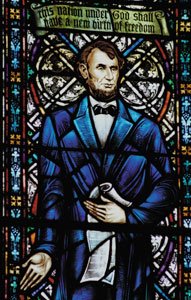 Have been reading the extravagantly titled Lincoln's Wrath: Fierce Mobs, Brilliant Scoundrels and a President's Mission to Destroy the Press. (I think the editors at Sourcebooks who crafted this handle need some time off.)
The book is a wealth of information on Northern newspapers and the war, some of the material from secondary sources, some from primary. I did not know, for instance, that Lincoln had financed the startup of the Illinois Staats-Anzeiger in 1859, nor that he picked its editor. The political dimension of government printing contracts, I had forgotten, and the number of editors Lincoln appointed to diplomatic posts I never knew. For a man with as slender a political career previous to the presidency as Lincoln experienced, Lincoln knew patronage like nobody's business.
Something I found useful appears in Wrath but was originally formulated in The North Reports the Civil War. It's a description of Washington's daily news cycle:
The Baltimore dailies were sold by hundreds of newsboys every morning by six o'clock; these included the American, Sun, and Clipper. The major Washington newspaper, the National Intelligencer and Chronicle, were peddled an hour later at seven. The Philadelphia train arrived at eleven, bringing The Press and the Inquirer. At three in the afternoon, the Washington afternoon papers were on the streets, followed every thirty minutes by later editions, if warranted. The arrival of the New York train at five in the evening brought the day's Herald, Tribune, and New York Times..."Lincoln himself read three papers in the morning, the Daily Morning Chronicle, the National Republican, and the Evening Star. I'd like to read them myself to find out "why these" and to map their editorials against major Lincoln decisions on a timeline.
In addition to reading these papers whole, Lincoln's secretaries, Nicolay and Hay, operated a clipping service for the president, perusing and snipping from a dozen papers each morning.
Thanks to Michael Burlingame, we know that John Hay, in fact, wrote many pro-Administration editorials for various newspapers under pseudonyms. His enthusiasm for anonymous editorializing seems to have dried up after he lost his place in 1864.
The authors of Wrath call Lincoln "the newspaper president." With that there can be little argument. They've done as much as pop historians can reasonably do: excite interest in a subject. The next level of really useful work will be to determine what "newspaper president" means.
(Stained glass image from Boston University's Marsh Chapel.)
3/08/2006
News notes
The York County (PA) historian is going to run Cobb house in Georgia. I'm sorry to see local history posts go down the path(ology) of local newspapers and local schools - to become roosts for wandering bands of rootless "professionals." Let York now recruit a Georgian to tell them about their pasts.
Re-enactors are about to take a big hit from a "satire" called "Shiloh Rules," opening March 24. Description reads more farcical than satiric. Once stigmatized as "those laughable, lovable kooks," the jig may be up for re-enacting. They survived Confederates in the Attic, but how much public scorn is comfortable?
What do you think of when meditating on those great swaths of green at Gettysburg and Antietam? Why, golf, of course! And now you can golf Antietam and Gettysburg, thanks to Golf Digest. "The option for golf is as self-evident as the futility of Pickett's Charge. " Indubitably!
Re-enactors are about to take a big hit from a "satire" called "Shiloh Rules," opening March 24. Description reads more farcical than satiric. Once stigmatized as "those laughable, lovable kooks," the jig may be up for re-enacting. They survived Confederates in the Attic, but how much public scorn is comfortable?
What do you think of when meditating on those great swaths of green at Gettysburg and Antietam? Why, golf, of course! And now you can golf Antietam and Gettysburg, thanks to Golf Digest. "The option for golf is as self-evident as the futility of Pickett's Charge. " Indubitably!
A new turn for the top ten
The annual release of the Civil War Preservation Trust's top 10 list of most endangered battlefields is followed by a predictable media pattern. CWPT's press conference is held, the release issued, and then waves of supportive stories appear nationally, most pieces tying in to local sites on the CWPT list.
This year something new has disturbed the pattern: it's the "why did my site drop off the list?" article. I haven't noticed these before.
The story comes in a benign form:
And it also comes in a critical form:
This year something new has disturbed the pattern: it's the "why did my site drop off the list?" article. I haven't noticed these before.
The story comes in a benign form:
Northeast Mississippi sites may not be on the recently released list of the nation's 10 most endangered Civil War battlefields, but they are no less at risk.
And it also comes in a critical form:
Despite the delisting, [Wilson's Creek] supporters said the battlefield remained threatened."We're very happy we were able to acquire the piece of land," said April McDonough, the foundation's executive director. "But that doesn't mean the battlefield is no longer in danger." She said the housing project is proceeding, and more development is possible in the area.
3/07/2006
Civil War hospital for sale
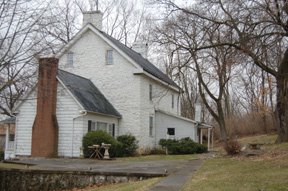 Come March 11, you can own a Civil War hospital that was also a fort during the French and Indian War - Fort Evans. (Its dimensions suggest more of a stronghouse than a fort.)
It's in Berkeley County, WV, where Washington took the waters en route to what became Pittsburgh.
According to Breaking the Backcountry, at the high water mark of Indian success against the Virginia and Pennsylvania frontiers, raiding parties followed the Potomac into Eastern Maryland.
As co-owner of a German stone farmhouse in Loudon County predating the French and Indian War, I sometimes like to picture those war parties moving across the periphery of our property, between the Catoctin and the Potomac.
Breaking the Backcountry describes the successive waves of Indian raids making ever greater inroads against frontier communities until the west is entirely depopulated and Eastern cities like Philadelphia are choked with starving refugees.
I assume this place became a Civil War hospital during Lander's defeat of Stonewall Jackson in 1861, or after Antietam, or even during the Gettysburg retreat. Perhaps all of the above.
It's an auction, so name your own price. Become a neighbor. Plenty of pictures here.
Theatre of the absurd
The Orange County Cemetery District is trying to decide on the best way to implement orders to "clean" 200 ACW headstones.
The stones, in disrepair, were rehabilitated by Air Force veteran Gene Platt on his own time over a period of three years. He cleaned the stones and painted name inscriptions gold.
The stones, in disrepair, were rehabilitated by Air Force veteran Gene Platt on his own time over a period of three years. He cleaned the stones and painted name inscriptions gold.
The clean up could cost between $5,000 and $14,000, district general manager Tim Deutsch wrote in a memo to the board.
3/06/2006
Preservation notes
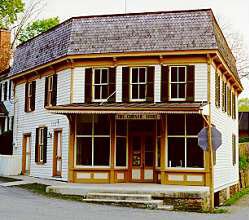 The battle of Franklin in Waterford
Some friends from Marblehead, Mass., recently told us of a landmark 17th Century house we knew of in that town. I couldn't credit the story, it was so absurd: people who wanted to live in Marblehead, a town of mighty strivers and significant incomes, bought this historic house, gutted it and rebuilt the interior to suit themselves, all rather quickly and without interference from city, state, or county.
Reminds me of the stories a Princeton, NJ, realtor used to tell me about what Princetonians did to the insides of their historic homes in the 1980s. But that was the twenty years ago. Who could believe such a story in these days?
Then I saw the most amazing item in the Leesburg paper this weekend. A family called the Franklins had bought a home in Waterford, Va., slightly upstream from me on the Catoctin Creek (picture, right). Waterford - the whole town - has national historic designation. It has been so since the days of FDR.
The Franklins were thwarted by local government from gutting their house and rebuilding it to personal taste and so they have applied to have the entire town of Waterford delisted from the national historic register.
Isn't that the best preservation story ever?
He noticed
Author Tim Reese pointed out to me that South Mountain dropped off Civil War Preservation Trust's ten-most-endangered sites this year. The mountain moved.
History of Gettysburg vandalism
This piece offers a nice recap of recent attacks on Gettysburg monuments. Rewards are upt to $36,000 for the scalps of the latest depradators.
This old house
You buy the Vicksburg old place because you love history.
You start finding old tools lying around. Then Civil War bullets.
Then you find the blood - lots of it.
True story.
You start finding old tools lying around. Then Civil War bullets.
Then you find the blood - lots of it.
True story.
Author remembered
The author of the book, Horse Soldiers, is remembered in this recent piece. The book was about Grierson's raid and became a movie with William Holden and John Wayne.
3/01/2006
The new publishing season
Eric Wittenberg is tring to break some sort of William Davis record: he has two books coming out from one publisher in a single season, Savas Beatie. Interesting that they would concentrate risk this way (on both sides of the deal). He has been good about posting his publishing experiences and I'll be very interested in how this turns out.
Speaking of Russel Beatie, I came across his Army of the Potomac Volume 1 in B&N the other day. Haven't seen it around lately. It had a blue color like the original issue in 2002. Here is that cover as it was issued; there is a flaw in this Amazon picture in that the navy blue color theme does not show well here - too much brown.
Anyway, the edition I picked up had a different picture on the cover than that shown above and it had a different shade of blue on the spine and different typeface. Had they reprinted the volume? Checking the copyright and reprintings info, I saw no, this was the old book in a new cover. Weirder still, when you go to the B&N website a third variant of the cover appears.
Well, the new cover also sports a new price: $60. This is a new marketing technique. Up from $49.98, IIRC. Haven't seen this before.
Nor have I seen the short writing efile model adopted by Amazon, before author Francis Hamit wrote to me about The Shenandoah Spy - Part 1, an Amazon Short. You get almost 10,000 words for under two bits. This business model has to be based on the idea of topic searches on Amazon.
Never thought of Amazon as a place to do topic searches but Mr. Hamit has published a ton of stuff through there in short format.
What an odd publishing season Spring 2006 is turning out to be.
Speaking of Russel Beatie, I came across his Army of the Potomac Volume 1 in B&N the other day. Haven't seen it around lately. It had a blue color like the original issue in 2002. Here is that cover as it was issued; there is a flaw in this Amazon picture in that the navy blue color theme does not show well here - too much brown.
Anyway, the edition I picked up had a different picture on the cover than that shown above and it had a different shade of blue on the spine and different typeface. Had they reprinted the volume? Checking the copyright and reprintings info, I saw no, this was the old book in a new cover. Weirder still, when you go to the B&N website a third variant of the cover appears.
Well, the new cover also sports a new price: $60. This is a new marketing technique. Up from $49.98, IIRC. Haven't seen this before.
Nor have I seen the short writing efile model adopted by Amazon, before author Francis Hamit wrote to me about The Shenandoah Spy - Part 1, an Amazon Short. You get almost 10,000 words for under two bits. This business model has to be based on the idea of topic searches on Amazon.
Never thought of Amazon as a place to do topic searches but Mr. Hamit has published a ton of stuff through there in short format.
What an odd publishing season Spring 2006 is turning out to be.
CWPT issues endangered battlefields list
It's that time of year again. The press release is here. Original reporting is there:
* The AP does a minimal rewrite of the press release.
* Charleston coverage revisits Morris Island.
* The Washington Times keeps it local.
* Medill News Service tries for balance.
* Alabamans survey Ft. Morgan.
* The AP does a minimal rewrite of the press release.
* Charleston coverage revisits Morris Island.
* The Washington Times keeps it local.
* Medill News Service tries for balance.
* Alabamans survey Ft. Morgan.
2/27/2006
My own candidate for the Lincoln Prize
If it's ever reprinted, I would enjoy seeing a certain book submitted to the Lincoln Prize committee. Their reaction to this passage, especially, would be delicious to observe:
The intra-cabinet feuding was beyond Lincoln's power to prevent, but he had let it go on much too long. Further, his willingness to let cabinet officers run their departments almost without supervision, except for the war office, had permitted vexatiously contradictory and independtent policies to go on at the same time. Though Stanton and Seward had learned better, Lincoln's slipshod ways encouraged Chase and Blair to assume viceregal attitudes when it pleased them and their ambitions to do so. As an administrator, Lincoln had a long way to go to excellence [in early 1863] and he never tried very hard to get there.From Thomas and Hyman, Stanton: the Life and Times of Lincoln's Secretary of War (Knopf, 1962). Nice antidote to the Goodwinian nonsense circulating just now.
Coming soon
A têtê-a têtê with Civil War Preservation is shaping up. They seem like very nice people.
Dear Carol Bundy:
Welcome to nonfiction writing! It must be quite a transition from filmmaking to compiling biographies.
You have done very well for yourself, landing a major book contract with a big trade house (FSG), your subject being an obscure Civil War officer who briefly served as McClellan's ADC.
There is no Irvin McDowell biography yet, but we at least have one of Charles Russell Lowell, Jr., thanks to yourself and your publisher. And why not?!
Now, if I could give a few little tips.
As your subject is connected to George B. McClellan, it would be good to know something about General McClellan. For instance, you might want to correct the next edition of your work so that it does not say that Lowell's fellow aide Arthur McClellan was the general's nephew. Arthur was his brother.
You also have to be alert for footnote readers, a sly bunch, quick to argue, quick to find fault. When you make a statement like this, it sends the footnote readers scurrying: "As part of his [McClellan's] efforts to improve morale and to gain publicity, he frequently staged grand reviews, and the army was often paraded through Washington."
The footnote reader is intrigued by the possibility that you have a source for McClellan trying to gain publicity - that would be a fine catch for a researcher. This kind of reader is also challenged by the comment "frequently" set next to grand reviews as well as the assertion "often paraded through Washington."
Your humble and ignorant correspondent is wracking his brain for the exact number of grand reviews and is coming up with two, only one of which was staged in Washington. In despair of his own ignorance, he turns to your endnote for clarification, where he sees, "For more information on General McClellan, see Stephen W. Sears..."
Was that an "appeal to authority" in lieu of data? Hmmm. You know the learned genlemen who accepted your nomination for this year's Lincoln Prize may not approve of that kind of thing.
They may also be surprised, if they ever read your book, to see that Salmon Chase was a senator from Pennsylvania.
I know Goodwin beat you for the prize this year, I hope that Chase thing didn't do it.
I hope, also, that it wasn't your loose, pop-history language that gave the game to Doris. When you say that David Hunter was "an early convert to the use of black troops" it makes it sound as if Hunter bought in to someone else's earlier idea for USCT regiments. I think Hunter could reasonably be called the source of the idea, Carol.
And Carol, note this: Hunter armed slaves - he was not smoking a cigar in his study when he came up with a futuristic concept for USCT regiments. No, Hunter armed runaway slaves for combat operations against the CSA as federal volunteers in the early war. Does that seem like an interesting point to you? You see how that might add a little more juice to your story than He was an early conver to the idea that... ?
No? Oh well, then there's no use trotting out all these other points I've made out.
Carol, you've lost the Lincoln Prize but you are utterly and totally Pulitzer worthy, the Pulitzers being what they are nowadays.
Your pained but faithful reader,
Dimitri
You have done very well for yourself, landing a major book contract with a big trade house (FSG), your subject being an obscure Civil War officer who briefly served as McClellan's ADC.
There is no Irvin McDowell biography yet, but we at least have one of Charles Russell Lowell, Jr., thanks to yourself and your publisher. And why not?!
Now, if I could give a few little tips.
As your subject is connected to George B. McClellan, it would be good to know something about General McClellan. For instance, you might want to correct the next edition of your work so that it does not say that Lowell's fellow aide Arthur McClellan was the general's nephew. Arthur was his brother.
You also have to be alert for footnote readers, a sly bunch, quick to argue, quick to find fault. When you make a statement like this, it sends the footnote readers scurrying: "As part of his [McClellan's] efforts to improve morale and to gain publicity, he frequently staged grand reviews, and the army was often paraded through Washington."
The footnote reader is intrigued by the possibility that you have a source for McClellan trying to gain publicity - that would be a fine catch for a researcher. This kind of reader is also challenged by the comment "frequently" set next to grand reviews as well as the assertion "often paraded through Washington."
Your humble and ignorant correspondent is wracking his brain for the exact number of grand reviews and is coming up with two, only one of which was staged in Washington. In despair of his own ignorance, he turns to your endnote for clarification, where he sees, "For more information on General McClellan, see Stephen W. Sears..."
Was that an "appeal to authority" in lieu of data? Hmmm. You know the learned genlemen who accepted your nomination for this year's Lincoln Prize may not approve of that kind of thing.
They may also be surprised, if they ever read your book, to see that Salmon Chase was a senator from Pennsylvania.
I know Goodwin beat you for the prize this year, I hope that Chase thing didn't do it.
I hope, also, that it wasn't your loose, pop-history language that gave the game to Doris. When you say that David Hunter was "an early convert to the use of black troops" it makes it sound as if Hunter bought in to someone else's earlier idea for USCT regiments. I think Hunter could reasonably be called the source of the idea, Carol.
And Carol, note this: Hunter armed slaves - he was not smoking a cigar in his study when he came up with a futuristic concept for USCT regiments. No, Hunter armed runaway slaves for combat operations against the CSA as federal volunteers in the early war. Does that seem like an interesting point to you? You see how that might add a little more juice to your story than He was an early conver to the idea that... ?
No? Oh well, then there's no use trotting out all these other points I've made out.
Carol, you've lost the Lincoln Prize but you are utterly and totally Pulitzer worthy, the Pulitzers being what they are nowadays.
Your pained but faithful reader,
Dimitri
2/24/2006
Who's the bravest Civil War author of them all?
The one who keeps going back to Iraq to file stories while embedded with units....
Richard F. Miller, author of Harvard's Civil War begins podcasting from the front in a few weeks.
Stay tuned.
Richard F. Miller, author of Harvard's Civil War begins podcasting from the front in a few weeks.
Stay tuned.
2/23/2006
2/21/2006
Civil War Preservation Trust - secrecy and publicity
 As we approach the Feb. 28 date for the release of Civil War Preservation Trust's highly idiosyncratic endangered battlefields list and press conference, it dismays me to say that the essayist and TV personality Ben Stein will be used to spark interest in this year's event. He should know better.
Ben does a money show. I have a little money trick I could teach him. I go to the website of any charity appealing to me for money and I hunt down financials. If there are no financials, I don't consider donating.
Civil War Preservation Trust has never posted its financials but at least up to a couple of years ago, it had a link on its home page to Charity Navigator. By digging around Charity Navigator, you could eventually find links to their tax filings.
I can't find the tax filings in Charity Navigator any more. And CWPT has removed the link to Charity Navigator from its home page. (I notice that Charity Navigator downgraded CWPT to three stars. Coincidence?)
One thing, the Navigator is still good for is charting the disparity between income and outflow. Look at the revenue/expenses trend chart on this page. CWPT is saving more than $3 million a year from its intake; it was sitting on $16 million in assets in 2002 and the savings keep accumulating. My feeling is that the nonprofit is currently clutching $20 mln - $25 mln in unspent donations.
When the government runs a surplus, we define that as overtaxing. How do we define this? As misfeasance? Underperformance? Organizational dysfunction?
For every dollar you donate to CWPT, some 30 cents seems to go into a bank vault. Forever.
On February 28, CWPT will moan and groan about properties it could buy in a heartbeat. After your press conference, go out and buy some land, skinflints.
Tell, 'em how Ben, 'cause they don't have much experience there.
Morris Island - "maritime habitat"
As is their wont, Civil War Preservation Trust has been delighted to turn over the future of Morris Island to non-Civil War interests. The Trust for Public Land will lead in the next phase of the financial transactions designed to "save" that place.
Their Morris Island web site scares the hell out of me: its history page generously refers to the ACW in one of seven paragraphs. I see a bird sanctuary in Morris Island's future.
The Charleston Post and Courier, which knows how to apportion credit correctly, has named Bobby Ginn the hero of this idiotic drama, brought on, I hasten to add, by the unwillingness of CWPT to pay for the land. Not only is Ginn taking a $2 million loss in selling the tract to the Trust for Public Land, he is going to spend an additional $500,000 of his own "to plan and provide for public access." $2.5 million while CWPT sits on a 2004 surplus of $3 million in unspent donations and dues.
Mr. Ginn, if you do not stipulate public access in your sale to the naturalists who run the Trust, the public access facilities you build will be shut down by the new owners. We, in the Civil War community are depending on you to look out for our interests; we have no one else in position to make stipulations in this sale.
The Post and Courier is careful to point out to Charleston that "the island provides valuable maritime habitat in a rapidly developing metropolitan area."
Lovely. Sinking. Feeling.
Their Morris Island web site scares the hell out of me: its history page generously refers to the ACW in one of seven paragraphs. I see a bird sanctuary in Morris Island's future.
The Charleston Post and Courier, which knows how to apportion credit correctly, has named Bobby Ginn the hero of this idiotic drama, brought on, I hasten to add, by the unwillingness of CWPT to pay for the land. Not only is Ginn taking a $2 million loss in selling the tract to the Trust for Public Land, he is going to spend an additional $500,000 of his own "to plan and provide for public access." $2.5 million while CWPT sits on a 2004 surplus of $3 million in unspent donations and dues.
Mr. Ginn, if you do not stipulate public access in your sale to the naturalists who run the Trust, the public access facilities you build will be shut down by the new owners. We, in the Civil War community are depending on you to look out for our interests; we have no one else in position to make stipulations in this sale.
The Post and Courier is careful to point out to Charleston that "the island provides valuable maritime habitat in a rapidly developing metropolitan area."
Lovely. Sinking. Feeling.
My gripes with CWPT
There are some who believe I have a "personal" thing against Civil War Preservation Trust. Let me lay out my problems with the organization, so that I can link to this post the next time the issue arises. CWPT:
Keeps financials offline.
Keeps decisionmaking offline.
Keeps "endanged" site ranking methodology offline.
Avoids owning battlefields.
Defines land as "saved" which no tourist can ever visit.
Enters situations in confrontational mode.
Claims victories in which it has, at best, a supporting role.
Builds assets from dues and donations (should spend money, not build assets).
Avoids buying land; buys cheaper easements with partners opposed to tourism.
Keeps financials offline.
Keeps decisionmaking offline.
Keeps "endanged" site ranking methodology offline.
Avoids owning battlefields.
Defines land as "saved" which no tourist can ever visit.
Enters situations in confrontational mode.
Claims victories in which it has, at best, a supporting role.
Builds assets from dues and donations (should spend money, not build assets).
Avoids buying land; buys cheaper easements with partners opposed to tourism.
2/17/2006
"Mr. Smith goes to Washington"
That is the title of an analysis of Smith's sudden departure from Illinois. Highlights:
* The museum was caught flat footed. They think they'll need six months to find a replacement.
* Smith has no consulting contracts with the Lincoln Library or Museum, the usual sign of an amicable separation.
* He has no job in hand; the George Mason business is a fellowship that pays $30,000 per year; he is leaving behind about $120,000 per year (not $300,000 as the article implies). ["Honey, pack your bags! We're going to live in D.C. on $30,000 per year!"]
Hat tip to the friendly reader who sent in this interesting link.
* The museum was caught flat footed. They think they'll need six months to find a replacement.
* Smith has no consulting contracts with the Lincoln Library or Museum, the usual sign of an amicable separation.
* He has no job in hand; the George Mason business is a fellowship that pays $30,000 per year; he is leaving behind about $120,000 per year (not $300,000 as the article implies). ["Honey, pack your bags! We're going to live in D.C. on $30,000 per year!"]
Hat tip to the friendly reader who sent in this interesting link.
2/16/2006
Smith out
 Grant scholar Brooks Simpson, editor of the Great Campaigns Series, kindly tipped me on a missed story: Richard Norton Smith (right) is on his way out of the Lincoln Library and Museum.
Smith tends not to stay too long in these posts. He is off to George Mason, almost within arm's reach (choking distance?).
I don't think Smith was out front enough - that's very subjective but I don't think if I were the governor, I would consider Smith as having delivered to my project a sufficient number of media darling bonus points. A gut feeling.
Smith goes out with the kind of made-for-the-TV observation that gets under my skin:
Smith said his favorite memory from the museum was the time he watched a black family looking at statues of Sojourner Truth and Frederick Douglass, with the mother telling her children about the famous abolitionists. Inspiring people to talk about history from a personal viewpoint instead of just listening to the experts is exactly what the museum should be doing, he said. "It's not just our history," Smith said. "It's your history."Oh man.
I'm picturing a nightmare scenario: "Hey! Hey you people over there!" [Big, loud, tactless guy plants himself in front of a mother.] "It's not just our history," [thumps chest] "It's your history" [poking woman with index finger; children start to cry].
Cultural facilities can be very attractive as patronage dumps - Smith's job was to be the honest outside face of this Illinois project through launch phase. His job is done. Let the games begin.
2/15/2006
Morris Island - where credit is due
 You stop doing the news feature on a blog like this and the news creeps up on you.
Morris Island has been spared the latest development attempt. The news is here, and some analysis is here.
I have been in many a civic coalition: I'm in a civic struggle right now, as you read this. Civic organizations can expend masses of energy running down the wrong road and then avoid confronting the mistakes of the campaign just concluded. The way to do this is pass out the kudos and share the good feelings.
The Morris Island campaign, seen from this distance, does not encourage me.
The Morris Island Coalition spokesman is full of praise for Civil War Preservation Trust:
I told their board of trustees then that I truly felt that the Morris Island Coalition would not have succeeded in helping to preserve the island had it not been for the role played by the Civil War Preservation Trust. Their star glows brightest of all.Note the apportioning of credit here: the Coalition succeeded and CWPT was key to the Coalition succeeding. And yet the same author makes the interesting observation that
Mayor Riley volunteered to contact Bobby Ginn and ask him to allow the island to be purchased by the preservation community. To his immense credit, Mr. Ginn readily agreed...Get this, my friends: Riley steps in, calls on a friendship, and all this monumental sturm and drang ceases instantly. Riley asks a developer with an option to buy the property to exercise the option and sell the land to preservationists at a discount. The developer agrees! Crisis finished without reference to the Coalition and all its efforts.
And CWPT gets the credit of being key to the Coalition's success. I love it.
May I point out, in all humility, that the sale price of this place, a price that was so onerous as to generate a crisis, could have been paid at the outset, in a trice, by CWPT? Read their financials online; look at their assets. The cost of Morris Island matches hardly a quarter of their assets, which they could have mortgaged and paid off later out of dues or contributions.
We had a Morris Island crisis because of the way CWPT chooses to do the business of preservation.
Let that sink in.
Joe Riley stepped in after endless commotion and found a buyer less parsimonious than CWPT. Ginn will pay $6 million for the land and sell it for $4.5 million. Ginn will take the loss for Civil War buffs. And we now face a hugely complex disposition phase that could keep me and you off the ground.
All because CWPT did not want to lay out the asking price, own the island privately, and welcome tourists on terms friendly to battlefield visitors.
The Morris Island Coalition has done hard work - did it fight the battle in the right places? Did it enlist the right allies? Not if it all came down to Riley. Well, then, any port in a storm. But spare us the back patting.
I think I made it clear in this blog that the very first stop in this controversy should have been Riley's office, not CWPT's. I also lambasted CWPT for antagonizing the seller, just as they outraged the owner of Mullins Farm in Chancellorsville, endangering that site.
If CWPT's participation ultimately mobilized Riley, great. But this deal was done by a seasoned politician doing what seasoned politicians do best: impose on friendships and ask for favors. Simple stuff. Effective.
The real value begins now. Put the champagne away, guys, because saving Morris Island does not just mean saving it from housing it also means saving it for Civil War tourism.
If you can pull that off, I'll name my next child Morris Island Coalition.
(See also my Morris Island: Joe Riley bestirs himself and Morris Island - let's take heart)
2/14/2006
"The Friendly One"
I have the bad habit of picking out an emblematic tendency in some specific writing and then making the author the emblem of that tendency.
This has happened a couple of times with gentlemanly author Michael Aubrecht, who not only runs a conventional website but also a blog (50-50 baseball and Civil War).
I had recently groaned about book review editors letting reviewers run long content descriptions, using one of his reviews as an example. Michael says he was interpreting his editor's guidance correctly. A good rebuttal to my remarks appears here.
It's a new year and I am turning a new leaf; some of you have already noticed it, no doubt. Gratuitous complaints? Insulting insinuations? Out with the old.
When people ask of Civil War blogs, "Which one is Dimitri's," I want the answer to be, "The friendly one!"
p.s. People wanting to complain about my writings have been using the comments section of Eric's and Kevin's blogs to do so (perhaps other people's blogs also). You can complain to me directly at rotobo-x at mailcity dot com.
This has happened a couple of times with gentlemanly author Michael Aubrecht, who not only runs a conventional website but also a blog (50-50 baseball and Civil War).
I had recently groaned about book review editors letting reviewers run long content descriptions, using one of his reviews as an example. Michael says he was interpreting his editor's guidance correctly. A good rebuttal to my remarks appears here.
It's a new year and I am turning a new leaf; some of you have already noticed it, no doubt. Gratuitous complaints? Insulting insinuations? Out with the old.
When people ask of Civil War blogs, "Which one is Dimitri's," I want the answer to be, "The friendly one!"
p.s. People wanting to complain about my writings have been using the comments section of Eric's and Kevin's blogs to do so (perhaps other people's blogs also). You can complain to me directly at rotobo-x at mailcity dot com.
Blind man and the elephant
A minister reviews two pop histories about Lincoln and finds AL to be a "modern man" full of "Bible-based faith."
Oh, the human condition.
Oh, the human condition.
2/13/2006
Doris and me
Some net entrepreneurs have rigged up a site that makes it look like Doris Kearns Goodwin is blogging. And my link is next to her smiling face!
As the Instapundit likes to say, "Heh."
In other DKG news, it seems she has won the 2005 Lincoln Prize ... hat tip to Brian Dirck.
Brian notes:
One of the prizegivers gave me a little heartburn with this: "This is a once-in-a-generation scholarly achievement that has drawn hundreds of thousands of new readers into history's greatest story."
If you read three books in your lifetime, this might be once-in-a-generation stuff.
Gabor Boritt, who is the prime mover behind the prize was more realistic:
Up to a point. If you want masses of fiction readers stomping about your nonfiction area of interest thinking that history is dramaturgy, the prize is designed to help do that. If you want readers impatient with a nuanced description of a controversy, you've got it. If you want publishers flooding our space with copycat stuff even worse than a Goodwin original, this prize is for you.
One does get tired of these talespinners being labeled scholars, however. A real scholar is coughing blood while reading some choice pop history passages.
p.s. Kevin has more on this.
p.p.s. Brian notes that the Spielberg movie based on this book has been placed on indefinite hiatus. Book sales softness, methinks.
As the Instapundit likes to say, "Heh."
In other DKG news, it seems she has won the 2005 Lincoln Prize ... hat tip to Brian Dirck.
Brian notes:
In emails and casual conversation I have heard the opinion repeatedly expressed by my colleagues that Team of Rivals is an overrated disappointment with no original ideas (pretty much my reaction too, I'll admit). The general public, on the other hand, seems to have been much more enthusiastic about Goodwin's achievement, citing the book's storytelling qualities and general entertainment value.Once I go through her sales figures for this book I hope you'll agree with me that the public enthusiasm is not really there. Media enthusiasm, maybe.
One of the prizegivers gave me a little heartburn with this: "This is a once-in-a-generation scholarly achievement that has drawn hundreds of thousands of new readers into history's greatest story."
If you read three books in your lifetime, this might be once-in-a-generation stuff.
Gabor Boritt, who is the prime mover behind the prize was more realistic:
This prestigious award was originally and specifically designed to honor signal accomplishments in the field that are "aimed at the literate general public." This year's striking achievement by Doris Kearns Goodwin gives us the welcome opportunity to highlight this important aspect of the Lincoln Prize.I can endorse Goodwin's award on that basis.
Up to a point. If you want masses of fiction readers stomping about your nonfiction area of interest thinking that history is dramaturgy, the prize is designed to help do that. If you want readers impatient with a nuanced description of a controversy, you've got it. If you want publishers flooding our space with copycat stuff even worse than a Goodwin original, this prize is for you.
One does get tired of these talespinners being labeled scholars, however. A real scholar is coughing blood while reading some choice pop history passages.
p.s. Kevin has more on this.
p.p.s. Brian notes that the Spielberg movie based on this book has been placed on indefinite hiatus. Book sales softness, methinks.
Book sales in 2005
I went through Ingram's 2005 sales figures for a few dozen indicative titles over the weekend. I have to say ACW sales ranged from "subdued" to "miserable." Even Sears and McPherson look spent to me.
Don't know if "the effect" will take hold sooner or later. "The effect" would be sales forces rejecting ACW titles suggested by editors. That translates into higher ms rejection rates. That should translate into more good publishing on demand or digital books, but at this stage in the evolution of ACW publishing doesn't.
So, low sales means fewer titles.
Don't know if "the effect" will take hold sooner or later. "The effect" would be sales forces rejecting ACW titles suggested by editors. That translates into higher ms rejection rates. That should translate into more good publishing on demand or digital books, but at this stage in the evolution of ACW publishing doesn't.
So, low sales means fewer titles.
Illinois launches ACW database
"The revamped research tool, available at www.ilsos.gov/genealogy, replaces large, bulky ledger books that could only be accessed at the state archives building in Springfield."
2/10/2006
2/09/2006
Contingency and Civil War History
 A CONVERSATION WITH SLAVOJ ŽIŽEK
DR: In Civil War history, the author of a narrative allows for some contingency in a work – it spices the narrative – but otherwise strictly rations the stuff. This creates inconsistency – swaths of inevitability are peppered with small spots of opportunity.
SŽ: History can always be read as a process governed by laws; as a meaningful succession of stages; however, insofar as we are its agents, embedded, caught in the process, the situation appears – at least during turning points “when something is happening” – open, undecidable…
DR: You may as well be a Civil War author if your view of history is going to feature an ocean of process and some islands of agency. If contingency is present, it is present in all things at all times. The question seems to me to be how do we narrate that?
SŽ: It is impossible for us to occupy a neutral position of pure metalanguage from which we could overview all "the possible worlds."
DR: But I think derivatives traders and quants try to do that every day – once you get beyond mere stocks and bonds, you enter a world where the metalanguage of mathematics is operated on through advanced contingency modeling – Monte Carlo systems, so-called Historical systems, even Value at Risk. These models are flawed but their users are immersed in myriad alternative worlds and they find ways to verbally describe those shadowy realities.
SŽ: Since what goes on now is the result of radically contingent acts, the only way to define our actual world properly is to include in its definition the negation of the "possible worlds" contained in its position – our lost opportunities are part of what we are …
DR: Of course, and the trader’s end-of-day reflections embrace that negative reality. So why would you to say it is impossible for historians to occupy a neutral position of pure metalanguage from which they could overview all the possible worlds?
SŽ: The point is not that "we will never learn what opportunities we lost," but rather that we will never really know what we have got. Since the position of a neutral observer is not accessible to us, we don’t know which this world is … we cannot ever actually determine the world we live in, we don’t know in which of the "possible worlds" we actually live.
DR: In his dinner reverie, the trader reflects on the world he chose to inhabit, the interplay of events and choices that shaped a world that froze at the closing bell, and he is either celebrating or moping. It seems you have creates a paradox to help yourself, a Leninist, escape the obligations of Leninist historicism – the dialectic, periodism, the other determinisms.
SŽ: This perception of our reality as only one of the possible outcomes of an ‘open’ situation, the notion that other possible outcomes continue to haunt our ‘true’ reality, conferring on it an extreme fragility and contingency, is by no means alien to Marxism. Indeed, the felt urgency of the revolutionary act relies on it.
DR: Then there should be communist "what if" narratives.
SŽ: Why is the flourishing genre of "what if?" histories the preserve of conservative historians?
DR: Because narrative history is a culturally conservative form; because contingency is structurally "right wing" – it is about agency, responsibility, decisions, and individuals; and since all historical outcomes represent "the march of progress" as we conceive it, that makes the what-if writer a challenger to the foundations of outcomes that are, as a minimum, linearly progressive.
SŽ: The conservative sympathies of the "what if?" volumes become clear as soon as you look at their contents pages. The topics tend to concern how much better history would have been if some revolutionary or 'radical' event had been avoided (if Charles I had won the Civil War; if the English had won the war against the American colonies; if the Confederacy had won the American Civil War; if Germany had won the Great War) or, less often, how much worse history would have been if it had taken a more progressive turn.
DR: Progressive speculation, on the other hand, will tend towards historicism. Less "what if" and more "what for." What would be a counter example?
SŽ: Lenin thrown into an OPEN situation. Are we, within our late capitalist closure of the "end of history," still able to experience the shattering impact of such an authentic historical openness?
DR: This "openness" is a literary construct called the "turning point". It does not embrace your "extreme fragility and contingency". It's not historical.
SŽ: There is a much deeper commitment to alternative histories in the radical Marxist view. For a radical Marxist, the actual history that we live is itself the realisation of an alternative history: we have to live in it because, in the past, we failed to seize the moment.
DR: So did Lenin seize a moment, or did Lenin arrive at a point in a cascading stream of contingencies?
SŽ: He had understood that the opportunity was provided by a unique combination of circumstances: if the moment wasn’t seized, the chance would be forfeited, perhaps for decades. Lenin was entertaining an alternative scenario: what if we don’t act now? It was precisely his awareness of the catastrophic consequences of not acting that impelled him to act.
DR: This seems to resolve history into unique "turning points" instead of resolving turning points into moments within cascading historical contingency. It points to a literary, not an historical "what if."
SŽ: The "what if?" dimension goes to the core of the Marxist revolutionary project.
[Žižek quotes from "Lenin Shot at Finland Station," London Review of Books 18 Aug 2005; "All’s Well That Ends Well?" from For they know not what they do; and from "Repeating Lenin" at lacan.com.]
Military reform - still needed
One of the signals of illness in our nation's current military - aside from its Civil War outlook - is in the proliferation of specialist roles and their elaboration not just into permanent functions, but into novel, permanent, and unnecessary organizations.
In a healthy organization, mission focus results in a compact organization with few internal divisions. Specialist units may exist - they tend to be resented and re-evaluated often - but they get infill by detailing people from the organization's core. Army fliers were once assigned from other branches (infantry, artillery, armor). Flying was not "core." And some fliers I recall as being grumpy about separation from from their mealtickets. Focus.
Call the doctor when organizations reach outside their missions or when organizations try to do each others' work.
Well, the Air Force is now forming its own combat infantry units. Not a rejiggering of sentries and base security this, nor another commando outfit ... we're talking about permanent organizations of ordinary light infantry combat units, hundreds of men strong, designed to take the war to enemy ground units, "to close with and destroy the enemy."
The Queen of Battle dons blue.
If history offers a guide, you next aggregate these demi battalions into Luftwaffe field divisions.
This is approaching the medical definition of cancer.
In a healthy organization, mission focus results in a compact organization with few internal divisions. Specialist units may exist - they tend to be resented and re-evaluated often - but they get infill by detailing people from the organization's core. Army fliers were once assigned from other branches (infantry, artillery, armor). Flying was not "core." And some fliers I recall as being grumpy about separation from from their mealtickets. Focus.
Call the doctor when organizations reach outside their missions or when organizations try to do each others' work.
Well, the Air Force is now forming its own combat infantry units. Not a rejiggering of sentries and base security this, nor another commando outfit ... we're talking about permanent organizations of ordinary light infantry combat units, hundreds of men strong, designed to take the war to enemy ground units, "to close with and destroy the enemy."
The Queen of Battle dons blue.
If history offers a guide, you next aggregate these demi battalions into Luftwaffe field divisions.
This is approaching the medical definition of cancer.
Griffith vs. Nosworthy
Mitch Hagmaier has been comparing Nosworthy's Bloody Crucible of Courage to Paddy Griffith's Battle Tactics of the Civil War and is irritated by Griffith.
I read Griffith as I would essays or blogs. It's more about the point of view. For example on Vietnam: "The US forces in Vietnam (contrary to common perceptions) were too few to do the job properly, and often lacked sufficient firepower where it mattered. In jungle terrain light US company-sized units often found themselves isolated, outnumbered and outgunned."
One Griffith factoid I treasure: the density of enemy combatants (people per yard) facing Meade and Grant at Petersburg was nowhere near the density facing McClellan on the Warwick line.
I read Griffith as I would essays or blogs. It's more about the point of view. For example on Vietnam: "The US forces in Vietnam (contrary to common perceptions) were too few to do the job properly, and often lacked sufficient firepower where it mattered. In jungle terrain light US company-sized units often found themselves isolated, outnumbered and outgunned."
One Griffith factoid I treasure: the density of enemy combatants (people per yard) facing Meade and Grant at Petersburg was nowhere near the density facing McClellan on the Warwick line.
Getting into the act
For crying out loud.Instapundit is now recording web interviews with Civil War authors.
Glenn and Helen are no threat to Gerald Prokopowicz, as you'll hear, but they have a good guest in James Swanson who argues the obvious but interesting point that Booth staged Lincoln's assasination as great theatre.
2/08/2006
The Civil War as entertainment
I love Kevin Levin's meme, Civil War as Entertainment. I especially like the sentiment - live the sentiment - We are acting irresponsibly if we turn these men into overly simplistic forms of entertainment.
The problem is in the formulation of the meme: if I resolve to delve deeply into the lives of ACW figures, I am still entertaining myself on some level. It's the quality of the entertainment I suppose. The oft-told tale tends towards a Punch and Judy show.
I tend to disagree with Kevin's idea that "Their lives revolved and were interwoven with larger issues having to do with issues of national identity." I think that's adding a literary layer on top of the historical layer - which is alright but ultimately a higher form of entertainment. Those folks being caught up in patterns we identify after the fact is less interesting to me than the personal drama of life in war; life, with all its difficulties, loves lost and won, birth and death, success and failure, all the strengths and weaknesses of a single personality now heightened to the ultimate degree.
Lately, it's been getting harder and harder to unwrap our wars as an historical exercise. The abundance of open Civil War sources, however, makes it an ideal field for study of this type.
Kevin and I would probably agree that as Civil War readers we obligate ourselves (unlike other Americans) to come to terms personally with the leading figures of that time. Part of that means evaluating their context and their choices. I avoid writing about certain Southern leaders in this blog because I have such difficulty relating to them.
I'm starting to read a big Jefferson Davis biography. This is the beginning of a long road - I will never get a decent grip on Davis as subject - not without years of effort. But I want to learn to sympathize with him on some level more than I do now, and that's something I can effect sooner rather than later. When that happens, I will be able to experience his war as a complex personal drama.
Which is a kind of entertainment, unless it leads to wisdom.
The problem is in the formulation of the meme: if I resolve to delve deeply into the lives of ACW figures, I am still entertaining myself on some level. It's the quality of the entertainment I suppose. The oft-told tale tends towards a Punch and Judy show.
I tend to disagree with Kevin's idea that "Their lives revolved and were interwoven with larger issues having to do with issues of national identity." I think that's adding a literary layer on top of the historical layer - which is alright but ultimately a higher form of entertainment. Those folks being caught up in patterns we identify after the fact is less interesting to me than the personal drama of life in war; life, with all its difficulties, loves lost and won, birth and death, success and failure, all the strengths and weaknesses of a single personality now heightened to the ultimate degree.
Lately, it's been getting harder and harder to unwrap our wars as an historical exercise. The abundance of open Civil War sources, however, makes it an ideal field for study of this type.
Kevin and I would probably agree that as Civil War readers we obligate ourselves (unlike other Americans) to come to terms personally with the leading figures of that time. Part of that means evaluating their context and their choices. I avoid writing about certain Southern leaders in this blog because I have such difficulty relating to them.
I'm starting to read a big Jefferson Davis biography. This is the beginning of a long road - I will never get a decent grip on Davis as subject - not without years of effort. But I want to learn to sympathize with him on some level more than I do now, and that's something I can effect sooner rather than later. When that happens, I will be able to experience his war as a complex personal drama.
Which is a kind of entertainment, unless it leads to wisdom.
Way, way off topic
I have started an arts-related activism blog with Trenton's Tricia Fagan, and others, to try to stop the condo-ization of a downtown art school in Trenton, NJ. If that's your cup of tea, I'll be posting there at least through May. I don't think this blog will suffer.
Comments on the command crisis timeline
Thanks to readers for expressing their enjoyment of the command crisis timeline post, especially Eric Wittenberg and Brian Downey. And Will Keene actually went through the OR - I suspect to check out how selective my items may have been, a good thing to do. (Reminds me of myself.) There's a risk in long posts - they seem unbloglike - so the feedback was helpful.
When you go through the primary material - always start with the timeline as Joe Harsh says - you taste the effect Tom Rowland referred to after he wrote his McClellan book:
If you still have a taste for timelines, I have an old one here to map the period between McClellan's submission of his Urbanna plan to the capture of Yorktown. The thing is long and tries to do too much - it needs to be segmented - and I did not at the time cite each entry. It's interesting reading, I hope, but it needs an overhaul.
When you go through the primary material - always start with the timeline as Joe Harsh says - you taste the effect Tom Rowland referred to after he wrote his McClellan book:
Q: How has your McClellan historiography affected the way you read history in general?I will post briefly on the command crisis next week, exploring what McClellan and Marcy may have meant what they wrote to Pope about your command...
Rowland: Well, it has made me quite humble. I realize just how much effort was expended to understand the historiography of one figure. It makes me aware of just how much study is required to make well informed judgements about issues and persons during the Civil War. It also made me aware of just how reliant I am upon the consensus thinking of most events in virtually all historical writing. That realizaton is both amusing and frightening at the same time.
If you still have a taste for timelines, I have an old one here to map the period between McClellan's submission of his Urbanna plan to the capture of Yorktown. The thing is long and tries to do too much - it needs to be segmented - and I did not at the time cite each entry. It's interesting reading, I hope, but it needs an overhaul.
Maxwell didn't say it
David Woodbury was kind enough to notify me that the crazy quote I attributed to Ron Maxwell is not Maxwell's: "It [Antietam] is the first battle in the Civil War where the South does not beat the North outright." David says, "I think the quote in question is attributed to Bussler, some Fox executive ..."
It does seem unlikely that a buff could make a mistake like that. Thanks, David.
It does seem unlikely that a buff could make a mistake like that. Thanks, David.
2/07/2006
Reviving an old publishing model
 To amuse themselves, back in the early 1980s, the editors of Forbes would run the occasional article on an antiquated business model that had survived into that present age.
One piece dealt with publishers whose catalog consisted of a single title. Or maybe two. This title would be updated every few years and would sell out until the next press run. One example, IIRC, was a legal publisher. Debrett's and Burke's were others. Anyway, the title not only supported the author - where the author, editor or compiler was still alive - it supported an entire business.
I was thinking of this making my way through Pope's information in Eicher and Eicher's massive compendium Civil War High Commands. This book is going to need updating. It also needs lots of notes, of which it has not enough, to become more "transparent" in the finality of its rulings.
That Stanford U. Press is going to pay for revised and updated editions of Civil War High Commands seems preposterous. It's a miracle we have it at all. At the same time, the immense labor invested here must not be lost.
When you think of it, this book is most like Debrett's or Burke's peerages, and it suggests a similar (single publisher) publishing model. Now, this is important: "Burke's Peerage is casting off the shackles of costly print publishing and embracing the brave new world of the internet." That was in 2004.
Like the OR, Civil War High Commands is best when searchable. Like the peerages, it is not for browsing but for look-up. Burke's has figured that out. "Electronic" is the right model for big searchable books. It puts the money in editing and revising, not in production and distribution.
2/04/2006
Comments on Viva Rafuse
Reader Will Keene sent this clip in regarding the command crisis and it's a real find. "Saw something today I thought you might enjoy." LINK:
The Command of the Army of the Potomac. – The Buffalo Commercial Advertiser asserts as a fact that when the rebels threatened Maryland the President asked Gen. Halleck who should be placed in command of our forces to drive them back. The answer was, McClellan, but on being requested to accept the position Gen. McClellanWill has his own take on the crisis chronology and I will yield the floor to him.
positively refused, because he had been so hampered in the past. The command was then offered to Burnside, who declined, saying that Gen. McClellan was the only
man for the place. Gen. Banks next received the offer, but he too declined it for the same reason assigned by Burnside. A second interview with McClellan, in which Halleck told him it was his duty to take the command, resulted in his acceptance on condition that he should not be meddled with. The Washington correspondent of the Chicago Tribune also states that the command of the army was in turn offered to the above named Generals. (Hartford Courant, October 25, 1862)
Some thoughts on your chronology (all my information is from the OR).
If you are going to start with the 8/30/62 message from McClellan to Barnard, I would also include 8/31/62 10:25 p.m. McClellan to Halleck: "I am ready to afford you any assistance in my power, but you will readily perceive how difficult an undefined position, such as I now hold, must be. At what hour in the morning can I see you alone either at your own house or the office?" and that Halleck's aide responded same night "he will see you at any time to-morrow morning that will suit your convenience."
You mentioned that on 9/2/62 McClellan, Halleck, and Lincoln meet. But you do not mention what McClellan stated that meeting resulted in: "I was verbally instructed by the President and the General-in-Chief to assume command of General Pope’s troops (including my own Army of the Potomac) as soon as they approached the vicinity of Washington; to go out and meet them, and to post them as I deemed best to repulse the enemy and insure the safety of the city." [This is from his report "of operations August 14—November 9" written on October 15, 1862 and the same source as the quote in my previous email "honored with the charge of this campaign, I entered at once upon the additional duties imposed upon me.".]
After the phrase "Does McClellan command in chief on this side of the river" in the message of 9/3/62 from Pope to Assistant AG Col. Kelton, you added the parenthetical '[north of the Potomac]'. I think you are mistaken. I think Pope is referring to the south side of the river.
I would have also included 9/3/62 1:40 p.m. Pope to Halleck: "We ought not to lose a moment in pushing forward the fresh troops to confront the enemy. ... Somebody ought to have the supreme command here. Let us not sit down quietly, but push forward again. I give you these suggestions because I believe them very important. ..."
You included Lincoln's order to Halleck to organize a field army. I would also include what comes right after it in the OR -- 9/3/62 (no time noted) Halleck to McClellan: "There is every probability that the enemy, baffled in his intended capture of Washington, will cross the Potomac, and make a raid into Maryland or Pennsylvania. A movable army must be immediately organized to meet him again in the field. You will, therefore, report the approximate force of each corps of the three armies now in the vicinity of Washington, which can be prepared in the next two days to take the field, and have them supplied and ready for that service."
You quoted portions of the message of 9/5/62 (no time noted) from Halleck to McClellan. I would have included the final clause: "so that you may act accordingly in putting forces in the field."
I would also have included 9/5/62 (no time noted) from Halleck to McClellan: "I think there can now be no doubt that the enemy are crossing the Potomac in force, and that you had better dispatch General Sumner and additional forces to follow. If you agree with me, let our troops move immediately."
In your summary of my objections, you state "it cannot negate the underlying evidence that he was not so honored (which unfolds in the timeline I have posted)." Here is what I see unfolding in the timeline (enhanced with the above):
1) On the 2nd, McCllean is given authority over all the troops in the defense of Washington including the Army of Virginia and the Army of the Potomac.
2) On the 3rd Lincolm directs Halleck to have a field army organized and Halleck directs McClellan to ready troops for that purpose.
3) On the 5th Halleck informs McClellan of command and organizational changes "so that you may act accordingly in putting forces in the field." and instructs him to "dispatch General Sumner and additional forces to follow ... move immediately."
Therefore, McClellan was commander of all the troops (see point 1) and under directions to organize a field army (see point 2) and to put that force in motion
(see point 2). Though Lincoln casts around for another commander, no one had been selected. As such, McClellan was by default the commander of the field
army.
Subscribe to:
Posts (Atom)


