11/15/2005
Southern sharpshooters
It continues
11/11/2005
Armistice Day
After the long months of intense strain, of keying themselves up to the daily mortal danger, of thinking always in terms of war and the enemy, the abrupt release from it all was physical and psychological agony. Some suffered a total nervous collapse. Some, of a steadier temperament, began to hope they would someday return to home and the embrace of loved ones. Some could think only of the crude little crosses that marked the graves of their comrades. Some fell into an exhausted sleep. All were bewildered by the sudden meaninglessness of their existence as soldiers - and through their teeming memories paraded that swiftly moving cavalcade of Cantigny, Soissons, St. Mihiel, the Meuse-Argonne and Sedan. What was to come next? They did not know - and hardly cared. Their minds were numbed by the shock of peace. The past consumed their whole consciousness. The present did not exist-and the future was inconceivable."
11/08/2005
Give us the casino
This is one more opportunity to develop something else that gives people a reason to come to Gettysburg and have a different kind of experience.Different from history. Again:
This town folds up in the winter. This might bring in money. There're going to be casinos in Pennsylvania. Why not here?Why not indeed? The question bypasses history to ask: aside from historical considerations, honoring the dead, reverencing a special place, why not multipurpose?
And guess what: the state and federal administrators of battlefields - multipurposing fanatics, every one - should be helpless before this question. Their operating principles have made the casino scenario normal and ethical. They have disarmed the truly preservation-minded for decades. The only logical grounds a state or federal parks administrator can have for objecting to a redlight district, casino, or animal rendering plant at Gettysburg is that of a social calculation: attendance levels and "appropriateness".
Likewise, Civil War Preservation Trust seems confused in condemning the casino, being more than happy to multipurpose battlefields by partnering with suchlike as wildlife groups and farmland preservation outfits to buy an easement on the cheap instead of own the land, an easement that keeps people off the land and out of history's way. CWPT has done so much to hybridize battlefield use that it seems weird they would suddenly get single-purpose religion in Gettysburg. Not that there is a lot of religion in that town:
Gettysburg Borough Council President Ted Streeter said he was neutral on the dispute, but he neatly summed up the concern that everyone shares, regardless of their point of view.Outrage. I know where mine is every time bird-watchers are invited to join CWPT in slapping restrictive covenants on hallowed ground to keep out the relatives of the fallen. The history minded. The reverent. Out. Rage.
Noting that the casino would be outside the boundaries of the battlefield, he said: "How far does the radius of `hallowed ground' extend? If the radius extends that far, it goes through Wal-Mart, Sheetz and the liquor store. Where was our outrage when those started?"
We have set ourselves up for a casino by donating to such as CWPT and applauding their allocation of our funds to multipurposing; we delight in the takeover of private battlefield land by public park administrations for multipurposing.
A casino at Gettysburg is what exactly what we deserve. Not what the dead deserve, no, but what we have earned for them - the most perfect paycheck for our corrupt and incompetent battlefield stewardship. The destruction continues, fueled by our misguided preservation dollars, by ill-conceived preservationist planning, and by that highest of public use principles, multipurposing.
This particular park when founded was an emblem of a certain generation. The casino shall be the emblem of our generation. We will be known for what we really were, not by the lofty names we "preservationists" called ourselves.
[This Bloomberg columnist disagrees and has a few kinder words for CWPT's Gettysburg posture.]
What their friendship was worth
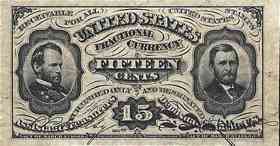
Apparently just 15 cents."Mister, can you break a 15-cent bill?"
"Sorry son, I don't normally carry that much money around."
Historiography is apparently like dropped coffee, splashing all sorts of surfaces in every direction. This bill was canceled for the best of historiographic reasons: its subjects weren't history yet.
11/07/2005
Anybody seen Hagerman around here?
Back in the day when McPherson revived the Centennial interpretation of the ACW, when Sears developed vaudeville characters to broaden sales and garner acclaim, Edward Hagerman "got" the Civil War - at least the military science part of it.
So it seemed to me while ingesting reams of pop culture on my mass transit daily reading back then.
Hagerman laid it out in a 1988 tome, The American Civil War and the Origin of Modern Warfare. I don't want to slight the neat things happening in publishing right now - I want to tell you about some of them this week - but let me indulge my nostalgia for Hagerman just now. Here's a taste:
EH: McClellan, ironically, was dismissed for inactivity ... while leading over 100,000 men in one of the most impressive strategic movements of the war.
DR: McClellan's second Richmond campaign not only has a clever underlying idea - separate the pieces of Lee's army by plugging the gaps in the Shenandoah range - it has good execution with a launch date (as Rafuse points out) keyed to the height of the Potomac waters. Once McClellan starts, Lee - lacking bridging - cannot get behind him, nor can he stop McClellan from isolating Jackson west of the mountains while the AoP bears down on Longstreet who is meandering between the mountains and Richmond. There are accounts of Longstreet, isolated, being shelled as the relief letter is delivered to McClellan - the pitch-perfect anticlimax to Richmond II. Surprising to see people as independent and capable as Jones and Hattaway rotely repeating Lincoln's strategic stuffandpuff about the arc of the chord being the road to Richmond - call that as-the-crow flies strategy. Hagerman got it right, though.
EH: McClellan was the first Union field commander of a mass army to filter this heritage of organizational theory and doctrine through the "fog" of mid-nineteenth century transition from traditional to modern warfare. He was the first to feel the friction of mass armies, industrial technology, and the restructuring of American institutional and intellectual culture complicated by political and geographical factors.
DR: GBM was uniquely qualified for this. As a student of European (especially Russian) military doctrines, as a visitor to the battlefields where European doctrines were applied, McClellan was also an outstanding pupil of military theorist D.H. Mahan; and he was a railroad innovator who developed the country's first transmodal railroad shipping system (between Chicago and New Orleans). As for political and intellectual complications, his whole family deserted the Whigs en masse during the party's radicalization.
There is (sadly) no deep organizational/doctrinal study of the Civil War; these kinds of books tend to be shallow or theoretically underdeveloped and run off the rails into applied tactics at the first opportunity. Hagerman could have done it right but his space is limited and his concerns are much broader.
EH: Yet one must also take into account the internal consistency of his military logic. [...] The failure of others in similar or more favorable circumstances tends to support McClellan's military if not his political judgement. [...] Moving with smaller armies than McClellan, Lee was unable to sustain maneuver or maintain his army in the field, or destroy an army following a tactical victory. [...] The course of early campaigning reinforced what McClellan ... had anticipated from the beginning: maneuver was an organizational monster.
DR: Moving on from Mac...
EH: Lee at least partially overcame the problem of the increased number of wagons needed to forage when he anticipated the organization for foraging that Sherman would develop ... [Lee rejected Longstreet's suggestion at Gettysburg because] the risks of maneuver led Lee to seek what he had come to reject: tactical victory by frontal assault.
If Buell refused to attack him within a very few days, Bragg had no alternative but to seek subsistence. Coming within range of the Confederate Army, Buell entrenched. He refused to rise to Bragg's bait ... His [Buell's] 110-mile march from Nashville had taken only fourteen days, a fairly impressive average of eight miles a day for so large an army foraging with such limite transportation ... Buell was learning the logistical art of extending limited field transportation through the combination of widespread foraging and rapid movement.
[Rosecrans began Tullahoma] with an extraordinary standard that may have exceeded sixty-nine or seventy wagons per 1,000 men. Rosecrans also moved 45,000 animals, the highest proportion of animals to men of any campaign in the war. [...] Rosecrans' success and the speed of his movement make a case for the virtues of careful preparation and an abnormal transportation standard ... Rosecrans' speed of movement was remarkable, considering that he had to cope with torrential rains... This rate exceeds Sherman's average of between 12 and 15 miles per day in his raid to Savannah...
The priority Grant accorded entrenching equipment in the Union supply trains reflected the increased respect for hasty entrenchment... In preparation for the 1864 campaign, Grant ordered one-half the wagons carrying entrenching tools placed at the head of the supply column of the leading division of each corps.
Good stuff. Break's over, Mr. Hagerman, get back to work.
Civil War publishing is ....
Recycling secondary sources at a premium
Is this is a publishing house that thinks there's still plenty of money to be made in that old time (1961-1965) religion? Or is this the fruit of an acquisitions editor who does not know which end is up?
11/06/2005
On Civil War publishing
For someone in my position, even a book that sells poorly still gets me a (usually decent) merit raise in salary. In fact, from a purely financial standpoint that's the main reason for a professor to write books in the first place. The only time a professor is likely to make more money from royalties than raises is when she hits the jackpot on a major college textbook.I would guess that makes for a higher manuscript acceptance hurdle, since the editor reviewing the proposed book has some lingering suspicions in mind.
Mark was reflecting on Eric Wittenberg's comments about University Presses. Let me interleave some comments of my own.
Eric says: The advantage of a university press is that they don’t have to make a profit.
Comment: I think they do: professors used to complain a decade or so ago, that their university presses are more interested in commercially viable stuff than the school's monographs. I think the business model is just different from a trade house. There is a low first press run, keeping expenses down, there is a minimal marketing budget, and there is a hope that the books will become assigned reading - or be embraced by specialists. At a convention of the national organization of political scientists, I heard the director of LSU Press say that Volume I of Eric Voegelin's Order and History (a $45 hardback selling around 1980) had done quite well for them at sales of 1,800 plus copies. (Time frame: middle late nineties. Voegelin publishing is now at University of Missouri Press.)
This sets up explanatory for Eric's main beef:
Eric: ...they can get away with charging absolutely outrageous prices for things.
Comment: It seems to me that there is a cost-per-unit calculation at work in which the low press run is driving up unit prices. This is a hunch: I think in trade presses, some book costs are written off as overhead and in academic houses the full cost is account for in unit pricing. There is also a hope that a limited market of specialists will say "must buy."
Eric: ... although they can charge ridiculous prices, the university presses often cut corners in ways that detract from the overall quality of a book.
Comment: I have been humiliated on the author's behalf reading Oxford University Press offerings in which the author has been compelled to freehand his own battle diagrams using a blunt (damaged) marker.
Eric: ... university presses can take an unreasonably long time to get stuff published. LSU published one of my books in 2002. I submitted the manuscript in 1999. For the record, it took them nearly THREE years to get the book out.
Comment: I'll bet the politics around a university press's release schedule are ferocious. Up to a third of those I monitor will not even have released their catalogs at the start of the season covered by that seasonal catalog!
Eric: Kent State’s marketing efforts are stunningly lame.
Comment: I have never, ever seen a copy of Tom Rowland's George B. McClellan and Civil War History on a bookshelf in any store. I tried to buy the entire press run from them in case they had marked them for pulping or remaindering and the marketing department said, no worries, it may be slightly discounted at worst. At the time, I think they were having a catalog sale and it was 15% off list. So there's an upside: as an author you have years to gin up demand!
I was disconcerted but refreshed by Eric's and Mark's willingness to name names. (Grimsley's criticism of the University Press of Nebraska is here.)
p.s. Don't miss the comments section on both posts.
11/02/2005
The next wave in public history
I see that Civil War Preservation Trust, preparing a story of the Battle of Chancelorsville, has invited National History Inc. to create an "interpretation" of the battlefield.
National History Inc. has resolved "to hear from residents about how to tell the story about what happened along a creek called Lick Run west of Chancellor Elementary School."
Perfect. At this rate even Ken Burns will be out of a job soon.
Obligatory McPherson post
He is sponsored by something called the Vertical Immersion Program - McPherson is all horizontal immersion to me - and where Tennessee native Ayers has lately and publicly been applying purgatives to McPherson fans, the University of Tennessee can still muster a statement like, "James McPherson is the most prominent Civil War scholar of the past 30 years."
Unless I miscounted, that would be the most prominent since 1975. If memory serves, McPherson was an obscure race relations historian in 1975 with little familiarity with the Civil War.
The habit of praising McPherson extravagantly has passed beyond the bounds of reason, record, or history, or even decorum.
Not that I am an expert on decorum. But really.
11/01/2005
Team of Rivals - the reviews roll in
As I pick myself off the floor, Goodwin herself decks me with this roundhouse punch:
After discovering additional passages [in her Fitzgeralds and the Kennedys) that closely paralleled the original sources, Goodwin ordered the book removed from stores and promised a new edition, which has yet to be written. "I just got right back to this (the Lincoln book), which was more important," says Goodwin ...Meanwhile, meanwhile,
Meanwhile, new paperback copies of The Fitzgeralds and the Kennedys [unrevised edition filled with "borrowings"] remain on sale, not through the book's original publisher, Simon & Schuster, but through St. Martin's Press. [...] Goodwin said that she knew nothing about the St. Martin's edition until earlier this month, after The Boston Globe noted its availability. Simon & Schuster also expressed surprise.Surprise, surprise. Would she have been surprised if the royalty checks told the story instead of the Boston media? Get this:
John Murphy, a spokesman for St. Martin's, said Thursday that the publisher was hoping to resolve the matter. "We're looking into the history of it," he said.From beneath his rock.
Oh, but we're here for the reviews. Christian Science Monitor: "Goodwin isn't a prose stylist, and she could have included less play-by-play and more color commentary."
If she's no analyst and not much of a prose stylist, what the dickens is this? New York Daily News:
Goodwin's story of his great, troubled, triumphant life is a star-spangled, high-stepping, hat-waving, bugle-blowing winner.Which is what we want from history, I suppose.