12/30/2005

Morris Island: Joe Riley bestirs himself

Marx envisioned a period after socialism when all needs would be met and the state would wither away. He called it post-scarcity anarchism.

The political psychosis that fogs the mind of your run-of-the mill newsroom and editorial board is something very like a psychology of post scarcity anarchism; local problems are trivial, technical matters; local corruption is a small bother the feds can take care of when they get around to it; vote rigging is something that happens in Central America; the really "important" stuff is chiliastic and national: global warming (whatever happened to acid rain?), international debt forgiveness, presidential elections, and massive financing for paradigmatically skewed pork barrel medical research.

The post-scarcity Carolinian anarchist will wrack his brain over an editorial about perfecting Egypt's political system while bulldozers are ferried to Morris Island. Gaze on this and despair.

My fellow Trentonians who were critics of Trenton's late Mayor Art Holland - cautious in development, respectful of historical treasures - viewed him as an obstructionist. His successor is an enabler. Give me the obstructionist.

Charleston's Mayor Joe Riley delivered a stirring eulogy for Holland in Trenton on the old mayor's death; among other stories, he told of their tug-of-war over posession of the Swamp Angel in Trenton's Cadwallader Park. Riley marched with us in the long procession to the Broad Street Cathedral where the memorial service was held. With Holland dead, he's one of a kind.

Riley has finally weighed in with an editorial against Morris Island development in Charleston Harbor. (I cannot access the editorial.) I don't know why he has to resort to an editorial - maybe it is preparatory to action. Maybe there are jurisdictional issues that prevent his intervention.

Thank heaven the Egyptian political experts let him have a forum on their pages.

Now, responding to Riley's call, the Trust for Public Land has stepped forward to offer its leadership in organizing resistance to the develpoment of Morris Island.

Now, this is a Civil War site. TPL should be on the sidelines and, if I can indulge my own post-scarcity fantasy, Civil War buffs would be working hard to exclude any naturalist participation in this preservation effort.

The gentleman making the offer on behalf of the TPL is (incidentally) a developer himself. Is that sweet?

Of course, given a Civil War preservation leadership scarcity, you thank heaven for the kindness of strangers, be they in sheep's clothing or not. Since we have an abundance of leadership scarcity we have an abundance of developmental anarchism, too.

Coming to a drain near you

Civil War cannon shell tops Roto-Rooter list of weirdest finds in America's drains.

(p.s. Is there an academy journalists could attend to learn the difference between shot and shell?)

12/28/2005

Not ostensible

"I am afraid you will think me ostensible," Emily Dickinson wrote to a gentleman friend,

(Was it Col. Shaw?)

I am not ostensible myself, not yet, and will be back tomorrow.

12/22/2005

Poisoned fruit

Mike Stevens, of the Central Virginia Battlefield Trust, has done Christmas proud in the pages of Fredericksburg's Free-Lance Star.

He has written a generous, humble, praiseful letter thanking certain parties for coming together to save Chancellorsville battlefield:
Anticipation arises out of seeing, once again, a coming together of developers, politicians, and preservationists, willing to balance self-interest with common purpose, willing to listen and learn from one another, willing to share a commitment to get the deal done. The folks of Toll Brothers, of the Spotsylvania Board of Supervisors, and of the Civil War Preservation Trust are meeting in a spirit of comity and compromise, and all of us who understand what this land means to our community and to our country can be hopeful that their efforts will bear fruit.
The lion lying down with the lamb is something that happens after the second coming of Christ, I think. Right now, we are in the period after the first coming of Christ and we need to note the lion's claws and mark our distance from the carnivore. What is happening between Toll Brothers, the county and CWPT can better be summarized in a news snippet:
Toll Brothers Inc. of Horsham, Pa., is poised to sell 75 acres of battleground on State Route 3 to the Civil War Preservation Trust. The sale hinges on the Spotsylvania County Board of Supervisors increasing the number of homes the company can build on about 500 adjacent acres.
Is this "a spirit of comity and compromise?" Or is this a rank business deal with a serious preservation downside?

One could reasonably say that there are no preservationists whatsoever involved in these discussions.

Avoid the Christmas punch, ladies and gents, and remember the true meaning of preservation this year.

Book review riots - let's stage one

There is a new book out on the NYC draft riots which, if I read the review correctly, aims to be definitive.

Can't be sure because the review wastes itself entirely by retelling the underlying events rather than conveying the worth of the tome.

What is wrong with this country's book review editors that they should allow retelling to pass as analysis week after week?
NEWS | Congressman discusses timber sales at Pea Ridge military park * Morris Island finds a buyer - a high-end developer * Davis friend's mansion is reinvented for lodging, dining

12/21/2005

Enough to make a grown man blog

I was reading a nature book and came across a quote by spy novelist John le Carré.

Wait, it gets more convoluted.

On reading it, I immediately thought, “This is about Civil War history.”
There was the boring similarity of technique; the grain of truth carefully reconstructed culled from newspaper reports and bazaar gossip; the follow-up, less carefully done, betraying the deceiver’s contempt for the deceived; and finally, the flight of fancy, the stroke of artistic impertinence which wantonly terminated a relationship already under sentence.
In the original context, le Carré (right) was talking about stories spread by the enemy in war. If we break it down, the tiny engine of pop history appears in all its parts.

There was the boring similarity of technique

… lineal storytelling on a strict timeline in a flat narrative style dolled up with a few old fashioned literary tricks from Jules Verne or Edgar Rice Burroughs.

the grain of truth carefully reconstructed, culled from newspaper reports and bazaar gossip

… some bit from the odd OR report and an anecdote or two that can advance the book's high concept.

the follow-up, less carefully done, betraying the deceiver’s contempt for the deceived

… the next instance of a trend, development, or characterization presented with even less evidence than the previous one.

and finally, the flight of fancy, the stroke of artistic impertinence which wantonly terminated a relationship already under sentence

… the resort to hyperbole in stretching an incompetent generalization beyond error to make it an outrage. Not even Napoleon himself … Never in military history … unprecedented error … unique opportunity ….

The “deceiver’s contempt for the deceived” shuts me down early in most readings. I have to want to suffer to get to that flight of fancy that must terminate my relationship with a book.

What is comical is encountering so many people mouthing flights of fancy as though they were precious insights harvested from some “scholar’s” deepest wisdom.

I have felt the sting of the author's contempt for me, as a reader, so harshly as to want to start three websites in retaliation. And I have. But the sting remains.

12/16/2005

Bringing Civil War history up to date

I used to attend readings of Voegelin Society papers at the American Political Science Association's annual conventions whenever they were held in Washington D.C. In those days, the APSA was in the iron grip of a very grim outfit called The Society for Political Methodology. If not that exact society, its imitators and competitors.

(By the way, attendees would ask me, "What institution do you represent?" and I would answer, "The reading public." The looks were priceless.)

This sort of research flooded the halls of whatever hotel was hosting APSA:

* Practical Issues in Implementing and Understanding Bayesian Ideal Point Estimation *

A quote from that paper: "Item-response and ideal-point models are inherently applied to multilevel structures, with data nested within persons and test items, or judges and decisions, or legislators votes."

Should be "legislators' votes" but these are not wordsmiths, needless to say. And there aren't that many words in these papers anyway. APSA and friends have turned to formulae:

That was an expression of political analysis from a poli-sci paper.
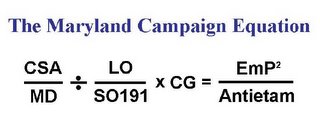
Tim Reese has generously agreed to help our dowdy field catch up with the poli-sci trailblazers. Here is his offering, which I trust you can decode without my help:

We're on our way to methodological excellence!
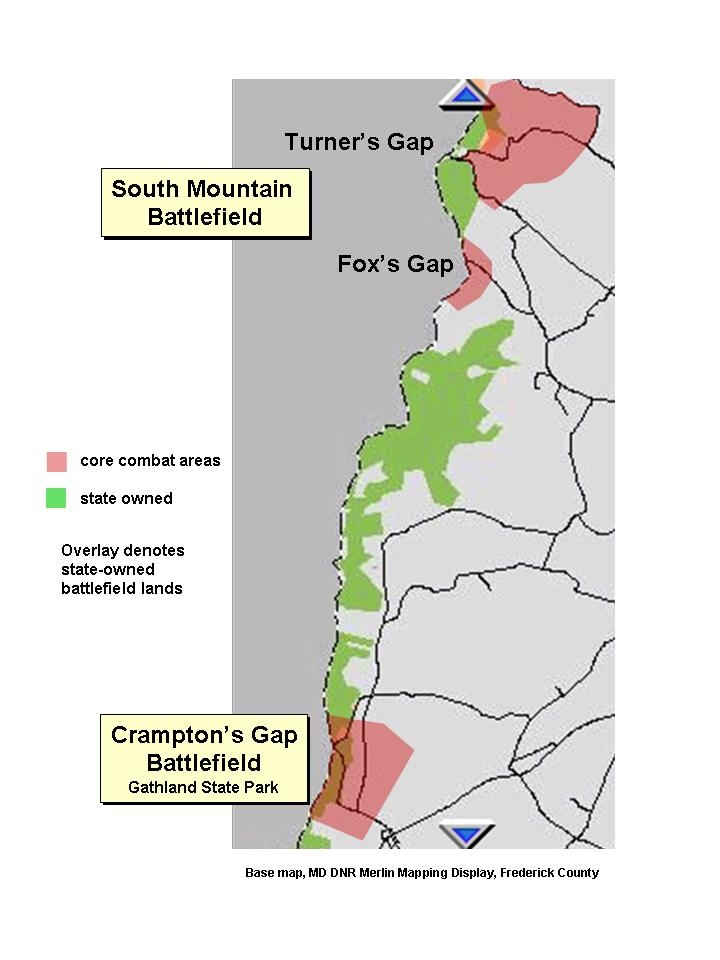
Well, there you have it

The entire preservation story of the Maryland Campaign's gaps is here told in one graphic. Click to enlarge.

If you don't want to click, then peer. Red indicates "core combat areas" and green shows land the state owns.

Thanks to Tim Reese for this.

p.s. The League - on which I posted yesterday - is broadening its focus beyond the Civil War and a number of ACW preservationists have left the group ... which adds a wrinkle to their battlefield land sale.

12/15/2005

The computer is a marvelous thing

I was looking at log files and saw that some searcher way out on the Internet had entered the keyword string "civil war major flaws" and Google brought him to this posting.
 
Wow.
 
This might have done as well, or this series ( 1, 2, 3, 4, 5).
 
You came to the right place. Thank your computer.

Pieces removed from Frankenstein park

The Frankentein-shaped hallucination that passes for South Mountain state battlefield park - a park no one can visit because it is patched together from easements and the odd, isolated fee simple holding - is shifting shape a little, according to a newsletter issued by the Central Maryland Heritage League.

The monster has a notional existence because locals drank the potion offered by some mad scientists who run a famous national preservation trust; they promise eternal life to land placed under easement.

You can reduce the cost of an easement - which already costs less than land - by applying for state highway funds (believe it or not) and/or teaming up with the local birdwatchers or farm conservationists to split the bill ... not the sort of partners you want to have, truth be told, but available and willing.

So, you swing the shiny watch and mutter, "stretch battlefield land budgets, buy several easements instead," and they drink the potion.

I think this is what's happening at the Central Maryland Heritage League:

We are negotiating with State and Federal agencies to see if it is feasible to sell parcels of land on or near South Mountain State Battlefield. Both are protected and their sale would again help us to acquire and protect more land.

This year we have seen battlefield land being "preserved" through sale to developers. We have seen developers called preservationists in the press. Now we have a preservation society selling battlefield land it owns in order to "acquire and protect more land". Will it sell to developers if they are called "preservationists"?

Strike "acquire" from their comments. They want to swap real ownership to buy some hallucinogenic easements. They drank the potion, I think.

However, Tim Reese wonders if the League may be getting off the mountain entirely. Certainly, it may be possible that this sale fixes a financial problem, and that "acquire and protect more land" is a fig leaf.

I wonder, also, if they have put easements on the property they own and want to sell. Since - hypnotized - they may believe easement equals protection, there may be no reason - in their befuddlement - why they should continue to own "protected land" and pay taxes on it. Yes, it is land no one can visit. Yes, it is land that may come under generations of "no trespassing signs" once relinquished.

But by Jove, it is "protected"!

If you think that way, if you believe the nonsense that swirls around Civil War preservation societies today, a perfectly reasonable game plan would be to buy land, put an easement on it, sell the land with the easement in place, buy another piece of land and continue indefinitely. Maybe the League is doing this.It takes a PhD in Kremlinology to understand what our battlefield protectors are saying and doing.

Preserving is developing, buying is paying owners not to sell, and saving something means getting rid of it.

Enjoy your "no trespassing" virtual battlefield, friends. And give generously to save our hallowed ground.

12/14/2005

Even more hats


I hope the code holding this post together does not blow up. I dread to think of how this will compile in your browser. Nevertheless, do send me your favorite hat pictures.

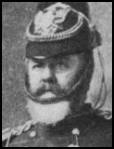
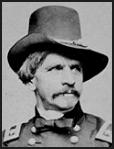
Here we have Scott in a chapeau most of us have seen him wear. He's got some spectacular attachments where Blunt's (see previous posts) is plainer. What do you call this thing?

Check out this variant on General Benham: pure Hornblower. "Hard a'starboard, you laggards!" Banks looks like cover art from a Hawthorne novel - there must be a cape to go with that outfit - and Ward is modeling a Trilby, no less. The locks underneath look fairly lustrous for extended field duty.

That helmet on Jackson's head has to be asynchronous (although we did run a picture in this blog of the Delafield Commission with a spiked helmet on the table nearby).

It's important to be able to spot your general on the field. Very important apparently.

General Mansfield ...

... I like your style.

Everybody in the army puts some spin on regulation headgear.

This interpretive statement takes the prize.

Fussy, continued

A reader writes to say that authors referring to Johnston's Army of the Potomac as the Army of Northern Virginia get his goat.
 
Drew Wagenhoffer also writes to say that "McClellan restored to command" does it for him, McClellan not having been removed from command. Sears, for one, takes a little care here, offering the formula, "McClellan's command was restored to him."
 
I have a different view of this. McClellan was assigned an entirely new command, the defenses of Washington. His adjunct mission, while commander of the defenses of Washington, was to organize a (**A**) field army to intercept Lee. The fact that a field army was organized and later received the old name "Army of the Potomac" is an accident of history ... especially given that it was John Pope who was named commander of this field army (by city defenses commander George McClellan) on September 5, 1862.
 
This is going to be surprising if you have digested the formula "Pope was removed from command and McClellan was restored." That statement is as (un)true for 1862 as is "McDowell was removed from command to be replaced by McClellan" for 1861.
 
You can reach a level of generalization in writing history, where it becomes sludgy.

12/12/2005

How fussy is fussy?

Is it terribly wrong to be irritated when an author refers to McDowell's forces at Bull Run as the Army of the Potomac? Repeatedly in one work?

Any number of authors do this and it freaks me out every time. I stop for awhile. Can't go on. It casts a shadow on all that follows.

Some of you are thinking, "There were no army designations apart from the department then." Partially right. Scott was against divisions and armies. And what was McDowell's department called? The Department of Northeast Virginia.

I see from Eicher and Eicher that McD is department commander from 27 May and that he picks up a title from July 8 on, commander of the Army of Northeast Virginia. I want to know more about that, not less, and calling the Army of Northeast Virginia by another name is giving me less.

Here's another eye-opener that may indicate all is not well in Civil War history. McDowell co-exists as army commander with McClellan when McClellan is called east. McDowell does not relinquish his army command until 15 August; Mansfield does not relinquish his department until August 18. There's a major essay lurking in that.

I know this sort of arcana (names of armies, limits of command) places a terrible burden on history writers but we readers like to know true from false. Humor us.

You don't have to call it "The Army of Northeast Virginia" if that's going to confuse your editors. But don't call it the Army of the Potomac. Please.

Civil War Book News has been updated

 
Hoping to get the rest of the year finished by January 1.
 
That would be cosmic.

"Corrupt Conqueror"

Stamp collectors love those upside-down images and I wonder if this is the ACW reader's equivalent.

The Blunt book I wrote about yesterday is titled General James G. Blunt: Tarnished Glory. I am looking at the cover as I write.

The photo of the cover run in yesterday's post shows a book titled General James G. Blunt: Corrupt Conqueror. Click on the image for a close-up. I got it from the publisher's own website.

Last minute title change or passive resistance from a Missourian in the art department?

12/11/2005

Western publishing

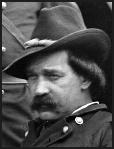
What's with the hat, commodore?

Is there a picture of any other ACW general, aside from Scott and Wool, wearing this headcover?

I picked this book up early in December, pleased to see a Blunt bio and happy that the small publisher, Pelican, had won major chain distribution of the title (I have seen it in three chain outlets so far this year).

This cute and curious passage is from the introduction. It is the very picture of Republican generalhood, I think:
As impressive as these achievements are, they can be overshadowed by Blunt's spectacular failures as a military administrator. He carried on a yearlong feud with one of his superiors. His relations with the first two governors of Kansas were notoriously poor. He did nothing to stem the rampant corruption in the military supply system. Indeed, Blunt took part in some of that corruption. And in one incident ... he bears some of the blame for allowing the massacre to occur.
Ah, Baxter Springs. Rode off leaving his command not just to be massacred but tortured then massacred or tortured while enduring massacre. Something more serious than failed to advance quickly or wrote his wife complaining about Stanton.

Pelican seems to specialize in Western titles; have a look. So does the Camp Pope bookshop, which like Morningside, is both a bookstore and a publisher.

They deserve our patronage.

12/10/2005

Surprises in libraries

There was a talk to be attended in a county branch library new to me today and after the event, I browsed the Civil War book section.

This is always a discouraging prospect and the trash here was heaped deeply on the shelves - I despaired of finding a single useful book when I noticed Richard F. Miller's new Harvard's Civil War mixed in with the dross.

A good sign, one that encouraged me to keep searching. I found a couple of diaries to check out in addition to the Miller book. Gregory Acken, connected with Philadelphia's Civil War Library and Museum, assembled some letters among the holdings in his care into a big tome, Inside the Army of the Potomac, the Civil War Experiences of Capt. Francis Adams Donaldson (of the 118th Penna. USV). McClellan commanding at Gettysburg (again) caught my eye. I also checked out Sears' On Campaign with the Army of the Potoma, the war diaries of LTC Theodore A. Dodge, whom I knew for his Chancellorsville history. Dodge had no McClellan at Gettysburg info.

Dodge and Donaldson were McClellan men through and through. As I started through Donaldson's letters copying out the McClellan material it became overwhelming, there was just so much of it. And it was so emotional.

The general literary and social style of the Civil War involves restraint and distance and understatement and irony. For grown men to wax emotional and poetic about their leader is outside the bounds of accepted personal style. When it happens army-wide, something astonishing is going on. Not astonishing enough to have ever merited a study, however.

Someone needs to collect such primary material - these manliness-be-damned outcries - into a big concentrated sheep dip that we can run historians through before they begin their carping, niggling little AoP annals.

Donaldson: I can say in conclusion that I never saw the army so full of enthusiasm as it now is, everyone anxious to meet the enemy and terminate the war by one grand battle. McClellan seems to have the final termination of the issue well in hand, and when we again meet Gen. Lee's army, they will suffer a defeat that will end their existence. We all feel confident of this, and should I be correct in this forecast of the future, McClellan will be, as he really is today, the greatest military chieftain of the age. (11/5/62)

Dodge: By the way, I may as well tell you how the Army feels about the conduct of this war. Everyone is longing for McClellan [emphasis in original]. "Let us go into action and a few get killed and then the rest retreat." This is just the feeling they have about Burnside, no confidence in his ability at all. But every heart is so turned toward McClellan that his being put in command of the U.S. Army would this moment more than double the force of the troops. They will go anywhere under him, but with reluctance under any other leader; and any day I believe McClellan could lead us up & take those Frederickburg batteries, considered now impregnable.(1/1/63)

And so it goes.

David Woodbury

Hat tip to Eric Wittenberg for pointing to David Woodbury's new Civil War blog. It's quite a feast: start with this post.

Woodbury is a writer who has paid his Civil War dues in a major way - as an editorial collaborator with Ted Savas bringing out innumerable specialist studies and as the patron saint of certain indispensable books, one of which I have failed to say enough about - Eicher and Eicher's Civil War High Commands.

Civil War High Commands originated in John Eicher's dissatisfaction with Civil War historians being unable to master even the most basic units of fact - e.g. who was promoted when and commanded what. As an ACW reader, he found himself keeping notes he could refer to and rely on in lieu of whatever book he might be reading at the time. (Sounds like my gateway into McClellanology.) The result is 1,040 pages of useful almanac-style data (and indirectly, 1,040 pages of commentary on the wretched state of previous ACW research). Shepherding this book through the publishing wilds must have been epic.

My admiration for Woodbury does not stop there. Civil War Regiments, which he co-edited, was an oasis of freethinking during one of the worst periods of consensus we have seen in Civil War publishing, the mid- to late1990s. His reasons for blogging resonate with me: "Let's be frank -- some of those authors didn't work as hard on their books as you did earning the money to buy them. And for that, they must be called out."

But I disagree - I think we're moving past the point where hack authors can still flood the market each publishing season with work struggling to retell the Catton story. New thinking has dominated each new release list for the last four or five seasons. My blog, with its cathartic vitriol, could better serve its readers turning attention to our dramatically new situation. I keep reminding myself, we've turned a corner. There's a new story to tell.

Then McPherson gives an interview and I'm called back to the hunt...

But we need expert readers like David Woodbury to help sort out the new scene. Crappy books will always be with us - it's the publishers' commitment to crap that is crumbling. It is a very talented cohort of writers that is taking advantage of the end of the Centennial ice ages.

Since his is a book blog, I hope Mr. Woodbury notices and takes the same pleasure I do in this new beginning for Civil War history.