9/13/2006

Tidball remembers McDowell

August marked the third anniversary of this blog; it was some time into the second year that Blogger's built-in search feature for this site began breaking down due to the volume of posting. The workaround that held up for the following year was to enter a search string plus cwbn.blogspot.com into the Google search engine home page, and now even that is failing.

I say this not in pride but in frustration in not being able to find material I have posted. For instance I cannot believe that I have not written more about artilleryman John C. Tidball's biography than just this ... a complaint from 2004 that Tidball's bio should be published before McDowell's.

And yet, it's a good biography; I love his stories about General Tim Sherman (but will save them for a future Tim Sherman extravaganza).

Reader Bill Bergen today reminded me of a McDowell pre-war anecdote that Tidball relates. McDowell was fascinated by a mechanical doll he bought for his daughter. Somehow, Tidball and McDowell got onto this topic during an inspection and McDowell became so engrossed in the subject that he forgot his main purpose.

Lost in the woods of his mind.

Tidball was arch enough to share this experience with his peers, who then ensnared McDowell repeatedly into re-enacting the same little lecture with the same results - escape from inspection.

Tidball: "Great minds are often prone to run to bigness in small things, and McDowell was no exception to the rule." His verdict on McDowell: "McDowell - poor man, will come out all right from the absurd accusations of disloyalty, drinking, etc., but nothing will ever make a general of him..."

The econo-lodges of Montgomery Meigs

That "upstart with the power to annoy," Montgomery Meigs, aspired to be an architect and ACW blogger Tom Churchill recently took the trouble to visit one of MM's lodges. Great post - but it seems to me what happened in this particular case was that Meigs' Second Empire style home (very contemporary in his day) was subject to a Dutch Colonial makeover, DC being quite popular in the 1920s.

It would really have been interesting to see Meigs' original Second Empire done in stone in that tiny scale Tom photographed - especially with a Mansard roof per the original design.

Good luck to Tom, Stephen McManus, and Donald Thompson over at Touch the Elbow.

(Don't keep touching your elbow, Gen. Halleck, you'll go blind.)

Case closed on hat and brother

We've got questions, guest blogger Harry Smeltzer has answers...

On McDowell's mystery headgear, he writes: "I found [this] in Detzer [Donnybrook], page 428. He gets the description from Averell’s Ten Years in the Saddle ..."
On the portico [Arlington House] was the solitary figure of a large man sitting on a chair with his arm hanging over the back of his bare head bowed on his breast. His flushed face and stentorian breathing indicated a profound slumber. At his feet lay a soiled helmet that had once been white and the metal lance-head on top of it was broken off.
Harry says, "The question is, Did Averell ever see the spike or is he assuming that it was broken off since he did not see one? It would appear that McDowell still had this or a similar hat one year later at 2nd Bull Run, where Union soldiers claimed he was signaling the enemy with his unusual headgear. ISTR that Hennessy describes the hat as wicker and looking like an inverted canoe. I don’t remember him mentioning a spike."

I'll look up that reference tonight. Could an "inverted canoe" describe a toppee? I don't think so - that description speaks more to some sort of custom headgear, some sort of straw Hornblower chapeau.

Tim Reese has more on America's love affair with the toppee:
Forgot to mention that the basic toppee shape is that which was later adopted by American cops, Keystone and otherwise. Just a blocked gray felt blank with a tin star stuck on the front. Brit Bobbies still wear a nearly identical version of the Army's 1881 Universal Pattern Helmet. Toppee, by the way - is Urdu for "clump of trees". I've been fascinated by this form since childhood. Very attractive to us graphics types. My example is attached, this from the Zulu War of 1879. I used to have half a dozen versions of this before I sold off my collection. Fascinating subject. They were so flimsy you could easily crush one between your hands. That's why so few originals have survived.
On the matter of McDowell's putative brother Col. John A., Harry Smeltzer writes: "I found mention of John McDowell in Wiley Sword’s Shiloh: Bloody April. On page 128 of the revised edition:
Portly Colonel John A. McDowell of the First Brigade [of Sherman’s division, 6th IA, 46th OH, 40th IL, 6th IN Battery] was the younger brother of General Irvin McDowell, leader of the Union army at First Bull Run. Yet John had only served briefly as a captain of an independent militia company about fifteen years earlier, and knew more about railroading than fighting. He held a low opinion of artillery and was fond of asking, "Whoever heard of a dead or wounded artilleryman?"
Harry says Sword's "source for this is a book by A. A. Stuart, Iowa Colonels and Regiments. John McDowell is not listed in Heitman."

Last night my trail converged with Harry's at the doorstep of Simpson and Berliner's book Sherman's Civil War. I put the book down after a little checking, skeptical of finding the brotherly connection. Harry was more patient and produced this recap.
A footnote in “Sherman’s Civil War” says John was Colonel of the 6th Iowa. On page 341 is a letter from WTS to Irvin McDowell; Sherman notes that his brother John “is a good kind hearted Gentleman, full of zeal for our cause”, when he left him in command of a brigade at Oxford. Cump says he urged his name for promotion. A letter dated 3/13/63 “Camp before Vicksburg” says “that McDowell has resigned”, Simpson’s note saying that this was probably John who commanded a brigade in 15th Corps. The index to Sherman’s “Memoirs” (LOA edition) lists references to John under “McDowell, General J. A.”, but the text only refers to him as colonel. Sherman is complimentary of John in all the writings I looked at in these two books and in his report of Shiloh.
Gentlemen, I think this this calls for another cigar.

9/12/2006

Lincoln simulacra

Even for a drug ad, this reaches new heights of obscurity. In case you care, Rozerem ramelteon is sleep medicine.

Baudrillard: In the fourth (and farthest out) order of simulation, that which is symbolized no longer has any relation to reality - it is a simulacra, the simulation of a simulation. Conceptually, it is a free floating radical. It has broken free of any link to meaning.

Col. John A. McDowell - brother to Irvin?

Andrew Wagenhoffer mentioned to me that he recalls some curious information in a work consulted in days gone - that Shiloh Brigade Commander Col. John A. McDowell was brother to Irvin.
I have not seen that (yet) myself and have been stymied by McDowell genealogy generally. Anyone for the brotherhood of John and Irvin?

How about anyone for a McDowell Cigar?

McDowell's hat, revisited

Tim Reese is as intrigued by the McDowell hat mystery as I was. His email is worth quoting at length:

Your closer about McDowell’s ubiquitous “hat” got my wheels to turning ...

The basic shape of the toppee or sun helmet was devised well before the Indian Mutiny of 1857. It was manufactured locally - primarily at Cawnpore - for use by troops of the Honorable East Indian Company’s private army, hence its more common use by HEIC troops rather than Queen’s troops. These were the days of forced concessions to both comfort amid heat and of rudimentary camouflage. Though white cloth was a near standard, varying shades of gray and khaki (i.e., dust) colored-cloth were also used on occasion. One popular pattern dubbed the “pipe helmet” had a tube affixed to the crown to admit fresh air (bottom center), though the “button” style ventilator quickly became universal.

The attached montage illustrates patterns in use during the 1850s and beyond.

The type shown at top center was most common, a basic shell banged out en masse. These were easily and cheaply made, at first of wicker, then universally of cloth-covered sheet cork.

It is conceivable that McDowell picked up one of these shell-pattern helmets while in India. Metallic embellishments on the other hand are suspect. It would be interesting to see if any contemporary sightings of McDowell’s headdress specify use of a spike and badge. Though present on very rare Indian examples, their use was unheard of in British service for decades thereafter.

The brass crown spike with floral base and brass star badge at front are of another era. The popularity of the spiked helmet was spurred by the Franco-Prussian War, 1870-1871, the British then adopting their own cloth helmet circa 1880 (left top) in imitation of the Prussian pickelhaube. The U.S. Army did likewise circa 1881 (right top & bottom). Confusion arises when one fails to perceive that the full-dress cloth helmet and the toppee/sun helmet experienced wholly separate evolutions in all national services, Brits alone retaining theirs for foreign service into the 20th Century.

The crown spike with floral base had different patterns for officers and for enlisted men. Moreover, the use of an eight-pointed radiant star badge [shown in yesterday's post - DR] far exceeds the period in which McDowell supposedly procured his example. The star badge itself - generic, devoid of regimental insignia - is strongly reminiscent of American militia use. Its spike and base more closely resemble those used on the later regulation American pattern cloth helmet.

[...] Imagining the helmet without these trappings might explain in part why it appeared so visually offensive to many viewers.

Sprague in a nutshell

From the site, Mr. Lincoln's White House. Quotes are verbatim with my emphasis added:

* As Governor of Rhode Island (1861-63), he put himself in charge of state militia but refused a regular army commission unless he could be a major general.

* [H]e needed contacts [a wife] that could help keep his nine mills supplied with cotton and supply his need to feel important...

* Sprague's "Texas Adventure" involved a treasonous scheme to sell arms to Confederates in order to buy cotton; publicity about it was suppressed by Secretary of War Edwin Stanton.

* [As senator] Sprague defied his father-in-law [Chase] when he voted for Andrew Johnson's impeachment—a vote which was probably dictated by his vulnerability to legal reprisals from Stanton.

* Sprague financially supported his father-in-law's abortive search for the 1864 presidential nomination ...

You can take a creepy Internet tour of the Sprague mansion here.

9/11/2006

Preamble: Irvin McDowell

Before posting the last of the series on "How to Become a Corps Commander," I thought it best to separate the chaff of my impressions of McDowell from the wheat of analytic comparison that represents this series. This post, then, is summary and informal.

Yet another publishing season has come and gone without any scholar or publisher troubling him/herself with a biography of McDowell. You remain at the mercy of websites like this one. Should you ever wish, in the future, to contest my picture of Civil War publishing as broken, check books-in-print first to see if there is yet a McDowell bio. If not, cut me the break please. This is an ongoing disgrace.

Irvin McDowell was one of those rare high command figures who was on active duty when the war broke out, although he was not a member of the high command at first. He hailed from Ohio and was assistant adjutant general in Washington in April '61.

In the general pattern of patronage, at the war's outbreak the active duty officer was generally holding a mess of pottage. The connections employed to secure West Point appointment were broken by time and change of political fortunes. Consider William Franklin: his appointment to the USMA was arranged by Buchanan when Buck was an MC. His presence in Washington as engineer of the Capitol dome construction had much to do with President Buchanan. Serving officers were, by and large, politicaly orphaned before hostilities commenced.

Not Irvin McDowell. He was cousin to Ohio's sitting Gov. William Dennison, who had replaced ex-Gov. Salmon Chase, the treasury secretary. Chase and Dennison ran the Ohio Republican machine with a little help from political generals like Jacob Cox and a future presidents Garfield and McKinley. McDowell was one of the handful of prewar officers, like Sumner, Keyes, and Heintzelman, who was known as a Republican and an Abolitionist. He had a backer in the Cabinet and a cousin in the governor's mansion.

For reasons ostensibly having to do with overwork in spring and summer of 1861, Simon Cameron delegated large portions of his secretary of war portfolio to Salmon Chase. As Cameron was Seward's creature, and an unhappy one, the delegation of his work to Seward's nemesis Chase is worth studying in a future post.

The prodigious war work performed by Chase earned him the courtesy title "General" and for this work he needed military advice. He recruited capitol engineer William Franklin (ousted from his position by Seward's protege Meigs) and Irvin McDowell. J.G. Randall aptly calls this duo Chase's "military cabinet." One of their more substantial projects was the development - under Chase's direction - of the table of equipment and organization for USV regiments.

The duo of McDowell and Franklin became one of the best known military combinations in Washington, with the pair sitting in Cabinet meetings, drafting operational plans, and acting as a de facto planning group for Chase and even Lincoln. When Scott needed bypassing, the McDowell/Franklin team was there for the civilians. They foreshadowed the use to which McClellan would be put after Bull Run. They were revived, as a team, during McClellan's illness in December of 1861.

As McClellan would be foisted upon an unwilling Scott, so was McDowell. When Chase arranged McDowell's promotion from major to BG, Scott became outraged because he was against
grade inflation and because he had not been consulted on the matter (see Beatie, Vol. 1). Lincoln (and Chase) made McDowell Scott's deputy and then used McDowell and Franklin (again) to plan the advance into Virginia without Scott's involement.

Among McDowell's relatives, we should mention that Gen. John Buford, of cavalry fame, was married to McDowell's cousin; and McDowell met his wife through the old Whig General Wool, whose ADC McDowell had been. Oddly enough, when Chase's man McDowell became damaged, Chase's man McClellan took charge. When McClellan became damaged, Gov. Dennison's relative (by marriage) Napoleon Buford was sought as Mac's replacement (see here and here).

Again, exploring the Chase dimension, note that General Wadsworth, the upstate politician heading the anti-Seward wing of the New York Republican Party (i.e. the Chase wing) rocketed from volunteer ADC to McDowell to brigadier general immediately after Bull Run.

Note also McClellan's decision - under Chase's and Dennison's sponsorship - to keep McDowell on board after Bull Run. After McDowell allows the Radicals to use him in a plot to overthrow McClellan, it is Franklin who intervenes on McDowell's behalf to mend fences with Mac. All this is grist for that future biography.

After second Bull Run, McDowell ends up as as president of the Court for investigating cotton frauds. This is a sensitive post for any friend of Salmon Chase because Chase has married his daughter off to the biggest cotton mill owner in the North, William Sprague, ex-governor of Rhode Island. Sprague manages to get a lot of cotton during McDowell's tenure.

McDowell's brother Malcom, another personal ADC, later became paymaster of the Army of Tennessee. In an 1864 letter to his father, Gen. Frank Blair complains that McDowell's paymaster brother is running Treasury-authorized cotton deals through enemy lines on behalf of Governor Sprague. Irvin was not minding the cotton fraud desk as diligently as he might have.

Finally, on a trivial note, if you read soldiers' accounts of encounters with McD, you tend to find him wearing "that hat." They all seem offended by the hat but none bother to describe it. I once asked Thomas P. Rowland, who was then researching a McDowell bio, what on earth the hat might have been. He thought it a souvenir of McDowell's Indian sojourns, a toppee.

It's as much biography as has emerged, but I'll take what I can get.

(A non-period reproduction of any old toppee is shown at right.)

Digital publishing

Tim Reese is doing some interesting things with digital publishing.
This line looks set to grab a broad audience of non-readers and highly visual readers.

9/08/2006

The Comte de Paris

Mark Grimsley has started a series of posts of his personal translations of passages from the Comte de Paris' unpublished diary  (1861-1862), a very good use for this blogging medium, I think. You can put your new Internet citational habits to work if you quote Mark's translations - and you'll want to.
 
Meanwhile Ted Savas comments that Russel Beatie has been using the same source for his AoP books ... but I wonder if he is referring by mistake to Louis-Phillippe's published history of the Peninsula Camapign.
 

You've been plogged!

Man, this is my kind of post; thank you Brian Downey. Someday mainstream historians will also become interested in the patrons, sponsors, friends, and enemies of military figures.

As long as we are swapping blog identities, let me opine, Brian-like, on his particular topic of digital history.

I logged onto Amazon today and noticed that I had been plogged. I don't know what "plog" stands for except that it seems to be a blog written by an author for Amazon to direct at recent buyers of said author's books. We're connected! Warm and fuzzies and purchases to follow...

The hitch seems to be that these "plogs" are authored specifically for Amazon. The margins of my Amazon page are brimming with clickable images of the covers of Eric Wittenberg's books, but Amazon does not import Eric's blog for feeding into the faces of his book buyers. Ditto for Grimsley-Simpson-Woodworth.

Is this a malfunction or a policy?

9/07/2006

Cossacks in blue: McClellan and Turchin

In the midst of a most improbable family reunion back in November, the name of Union General John Turchin (shown right) came up.

My father's cousin Basil Rotoff, in from Canada, said that Turchin was a member of our Host, the Don Cossacks, and that there was a full biography of the man written in Russian. Uncle Basil put in a few good words for the hard war Turchin practiced, and in a room full of Cossacks, there was ready agreement.

I kept my own McClellanist mouth occupied with champagne and oysters, as it were.

Uncle Basil pointed out that Turchin was the commanding officer of one of the Czar's imperial Don Cossack guards regiments. This would certainly have made him an acquaintance of our own kith and kin, I think, for they served in the same capacity long before his time and after.

Guards officers were members of the court. They were not cavalry militia scraping out a life on the frontier subject to retaliatory passions. This makes Turchin an odd duck, for he was both a revolutionary, Basil told me, and a sexual libertine given to mistresses. Turchin was also - as any Civil War reader knows - a scorched earth general.

Moten tells us that when McClellan was in the Crimea, the French wanted nothing to do with him; the British were congenial but suspicious; but the Russians welcomed him wholeheartedly. This could have engendered that Russophilism Moten notes in GBM.

Taken into the bosom of the Russian army, McClellan concluded that Cossacks were a paradigm for a kind of frontier cavalry that could be repurposed for conventional war. A surmise: he did not get these ideas by associating with line officers, the kind who might have burned Athens, Georgia, in a trice. He spent time with the court's polished Guard Cossacks (right), who would have shown more "soft war" in their French conversation (French being a language of the court and McClellan being a French reader and speaker). The question arises as to whether McClellan might have associated hard war with an American-model Cossack-style cavalry. On the frontier, perhaps, but in conventional war?

I have good reason to suspect that hard war John Turchin met soft war George McClellan in the Crimea, not that either was advocating for a particular policy at that time. Turchin's Don Cossack Guard regiment was there - my own family history tells us so. Also interesting, is this item of information:

In 1856, at the end of the Crimean War, the Turchins immigrated to Chicago, Illinois, where he found work in the engineering department of the Illinois Central Railroad.
The chief engineer in that department was one George B. McClellan. Had McClellan's draft cavalry regulations, submitted to Secretary of War Jefferson Davis as appendices to his Delafield report, owed anything to John Turchin? In other words, did Turchin impose upon a friendship?

Recall also that the railroad's lawyer was one Abraham Lincoln, and Mr. Lincoln's boss was the same George B. McClellan. As often as Lincoln and McClellan toured the Illinois county courthouse circuit together on land cases - a subject Civil War history has yet to show the slightest interest in - the question arises as to whether Turchin might have stood in for his boss McClellan now and again.*

One wonders if a Lincoln connection prompted Illinois' Gov. Yates to give Turchin his state USV colonelcy in 1861. These were highly prized political posts. Most foreign officers with military experience lacked connections; the governors rejected them and they ended up on the staffs of Fremont or McClellan. Turchin got a regiment from Yates. Then he got a brigade from Mac's protege Buell.

There is enough Turchin literature about in English such that we, as readers, might get insight into the Turchin-McClellan-Lincoln connections without waiting for various Pulitzer winners to show us the light.

Notice that...

* The Illinois State Historical Society has some useful articles in print (scroll way down).

* The Army has archived a 100-page plus study of the general.

* There is a new book on the sack of Athens due out next month.

* An older book focuses on Turchin's abolitionism.

Amazon also lists a couple of old books by Turchin himself.

***

P.S. Later, when McClellan moved on to assume the presidency of an Ohio railroad, and when he vacated that presidency to prosecute a war, he was replaced by a certain Nathaniel Banks. But that is another post entirely.
P.P.S. "John Turchin" is an idiosyncratically Americanized name. I find it weird that there could be an actor and a developer of the same name at large today. In fact, there a lot of John Turchins out there.

Citations from all types of Internet sources

A reader had asked how to cite this blog and I posted a link to some style pages describing "how-to."
 
This page is comprehensive, however, and should be bookmarked. (Quibblers will say that blogs are not listed, however I think they come under the heading "Personal site" as shown.) There is never just one way, but these are good ways.
 
Hat-tip to the thoroughness mavens who put this together.


9/06/2006

He read, she read

It was said of Ernest Hemmingway that he tried to broaden the market for novels beyond women.

That was then and this is now, and the divide between men (nonfiction) and women (fiction) is simply a given in publishing today. Cartoonist Tony Millionaire notices the gap widening further and illustrates it with this little dialog:
Her: You should read this great book! It's about these people who -
Him: So, when did this stuff happen?
Her: It didn't happen, it's a novel...
Him: So, it's like telling a dream?

Excess seeking success

In pulling together the raw data for Civil War Book News this year, I noticed a couple of striking anomalies.

First, November Irish madness. The following titles are slated for release in November. What were the odds?

The Harp and the Eagle: Irish Volunteers and the Union Army 1861-1865 (New York University Press)

God Help the Irish!: The History of the Irish Brigade (State House Press)

Irish Confederates: The Civil War's Forgotten Soldiers (State House Press)

Second, Confederate women on parade. The number of these titles is trending upwards annually:

Confederate Heroines: 120 Southern Women Convicted by Union Military Justice (Oct.)

The Widow of the South (Sep.)

First Lady of the Confederacy: Varina Davis's Civil War ( (Sep.)

Blood and Irony: Southern White Women's Narratives of the Civil War, 1861-1937 (Aug.)

Wild Rose: Rose O'Neale Greenhow, Civil War Spy (May)

Confederate Girl's Diary (May)

Defining Moments in the Lives of Mary Todd Lincoln and Varina Howell Davis (April

North Carolina Women of the Confederacy (Mar.)

9/04/2006

Less of a bastard than commonly thought?

Two revisions of Henry Wirz's reputation appear in the same month:

Captain Henry Wirz and Andersonville Prison: A Reappraisal by R. Fred Ruhlman

Andersonville: The Last Depot by William Marvel

Civil War Book News

After a painful hiatus I have resumed updating Civil War Book News. More to come.

9/03/2006

Can you imagine?

Civil War publishing seems to be a big party, complete with lampshades on authors' heads.

Can you imagine having your latest book - and your life's work - being called beer and pretzel fare in a favorable review?

Can you imagine writing a biography of Grant that reflects on Zachary Taylor's capture of Mexico City?

8/31/2006

Coming up...

Trying to get a new routine together in the midst of another schedule change .... sorry not to post more. The material is backing up.

Here's a preview of what may come in the next few days:

* The new CWPT. You can't tell from their website but CWPT is taking some big financial risks. In fact they seem to be finishing the year in risk overdrive...

* Cossacks in blue. An American cavalry system based on the Czar's Cossack regiments? In 1855, McClellan thought Cossacks offered the best paradigm for the U.S. arm. But by 1861, the highest ranking Cossack in Union service would be John Turchin, proving perhaps that you can take the Cossack off the Muslim frontier but you can't take the Muslim frontier out of the Cossack..

* How to be a corps commander: McDowell. His career was fashioned from the whole cloth of political sponsorship. His relationships wih Chase, Scott, and Lincoln prototyped McClellan's own later in the war.

8/30/2006

Sumner, McClellan, Johnston, Davis, and Hardee

Brian Downey is having some fun with the Sumner-Johnston-Mac-Davis post, wondering if my synopsis suggests that Edwin V. Sumner was a knucklehead or a Queeg. If Brian is wondering, certainly other readers are too.

This gives me an opening to return to the content of a very worthwhile study.

The Delafield Commission and the American Military Profession, on which the post was based, stresses repeatedly that Johnston and McClellan were obsessing not about Sumner's intelligence (despite the sharp quotes from JJ) but rather about his theoretical faculties and the potential for what we now call cavalry doctrine. (This is a bit of anachronism - in that day JJ and GBM could only get to the modern concept "doctrine" by referring to a combination of "regulations" plus "method" or "system.")

The fear of Sumner seems to boil down to this 1856 comment from JJ to GBM: "The old infantry notion exists here [in the First U.S. Cavalry Regiment] - that to make a decent appearance on dress parade - is the only object of instruction. [...] Our men have not been taught to use their arms & their best instruction in riding has been in watering their horses." He told McClellan (quite reasonably I think) "Our only chance of reform is in the influence you may have." He says also, "My hopes of U.S. Cavalry are in your efforts - so bestir yourself." In another message he alluded to the need to "compel" commanding officers [Sumner] to attend to the training of the horsemen.

McClellan had indeed bestirred himself - he translated Russian army regulations and a Russian cavalry manual for the U.S. Cavalry. He had additional European cavalry analysis from his European tour. However he and Johnston split on how to manage the matter.

Author Matthew Moten says that Johnston urged McClellan to submit his materials directly to Davis, appealing to Davis's expertise (and vanity?) as an old cavalry commander. Johnston's approach was to get a fiat, an ukase from the SecWar.

McClellan, on the other hand, whether from humility or insecurity, got stuck on the idea of forming an Army Cavalry Board to review and ratify his materials. He opened a correspondence with Davis on the matter. Moten imputes to GBM the aim of making Johnston head of that board. But Johnston warned Mac that such a board, if created, would be stocked with dragoon officers - a very bad turn for a cav doctrine.

Johnston seems to have had a good read on Jeff Davis. Davis rejected the idea of a board - it would be too slow in getting cavalry doctrine off and running. He wanted to see McClellan immediately - and the Russian materials too.

But in fact Davis split the difference on cavalry boards by urging McClellan to consult with the likes of William Hardee, then superintendent of West Point. He wanted Hardee to furnish McClellan with resources for doctrinal cavalry trials at the Military Academy. McClellan balked at the notion of submitting cavalry regulations to such an infantry-minded officer and he made the classic junior officer error of baldly explaining to Davis his objections to cooperating with Hardee, an argument that contested Davis's preferred route forward.

Moten believes in this letter GBM offended Davis. He was summoned for a meeting with Davis and "There is no record of their discussion." A few days later, GBM resigned his commission, delaying its effective date until his Delafield tour report was completed.

Whichever way the cards might have fallen in this matter, it seems Sumner would have been excluded from a ratification of the new doctrines, whether by Johnston's hopes, McClellan's board, or Davis's inclinations. Not because he was stupid, but because he was an old soldier set in his ways.

8/28/2006

Sumner, McClellan, Johnston, and Davis

About five years ago, I stumbled across a self-published biography of E.V. Sumner in the main branch of the Boston library system. It was copyrighted 1968 and the author claimed descent from Sumner. That was two moves ago and I have hope yet of finding my notes on this tome.

The book was fluffy, low on details and high on background information. It contained just one single line that intrigued me, something like "The connection between General Sumner and his cousin Sen. Charles Sumner is much overstated."

Overstated by whom? Where? When? I had not and have never since seen this connection alluded to in print, and yet it is fundamental to any conversation about Lincoln's appointment of the first four commanders of the Army of the Potomac. If the connection is real, every account of the appointment of Sumner is damaged. Every one is compromised.

On my own account, I have research to perform on Sumner and have not even gotten to Bates' diary, which has to be my starting point. Shame on me too.

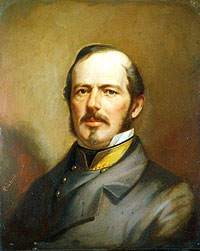
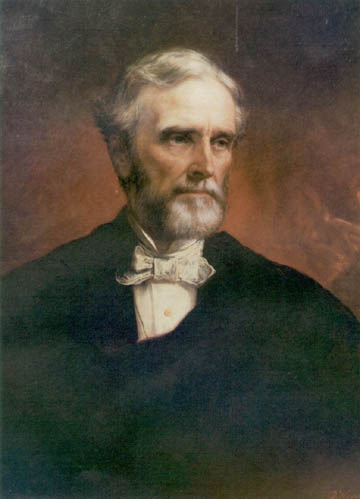
But I have some idea of the relationship of McClellan and Sumner, thanks to The Delafield Commission and the American Military Profession. At the center of that relationship stand McClellan's mentors Joe Johnston (top right in 1861) and Secretary of War Jefferson Davis (bottom right as of 1874).

At the time of the Crimean War, Edwin V. Sumner was the commander of the First U.S. Cavalry Regiment. Joe Johnston was his lieutenant colonel and George McClellan one of his captains (i.e. squadron commanders).

Johnston has left us an aphorism about Sumner. The key to getting along with him, Johnston said, was to assume he knows everything and you know nothing. IIRC, Sears uses this quote to characterize EVS in one of his many Centennial writings.

In Delafield Commission, the author resurrects an even more pungent quote from Johnston's correspondence with McClellan: "This regiment has not begun to be so yet - & can not until we have a system to control its head [Sumner]. You have yet to learn how ignorant a man can keep himself who relies, for knowledge, upon experience, & yet never observes or remembers."

A man who never observes nor remembers.

In a series of letters to Europe, Johnston inveigles McClellan to bring back cavalry doctrine: "The result of your expedition should be put into print as soon as practicable .... & you must of course attend to what pertains to cavalry." McClellan obliged. He left Mordecai and Delafield far behind in the rush to print and - to the apparent irritation of the author of Delafield Commission, McClellan's report from Europe was overwhelmingly concerned with cavalry, especially Russian cavalry doctrine.

The game was (for JJ and GBM, to quote Delafield Commission again) to prevent Sumner having a formative influence on the new cavalry arm. "In Johnston's opinion, senior officers like Sumner would allow the cavalry to wither and die if something was not done to codify professional standards."

Delafield Commission does a good job of recapping Johnston's complaints against Sumner's management of a cavalry regiment and there is more here than I can recap at reasonable posting lengths. The core issue is that Johnston enlisted his young friend McClellan for a doctrinal push against McClellan's most important patron, Jefferson Davis: "So take advantage of your interviews with the Sec. in Washington [Davis] to impress upon him the necessity of something more reliable , for the management of horses and horsemen, than the knowledge and intelligence of superior officers [Sumner], which at present are very unrelieable. We are without cavalry regulations and must have them - or we shall never have cavalry."

McClellan took Johnston's mail to heart. He drafted cavalry doctrine and regs, translated Russian cavalry manuals on the QT (he was, after all, a prodigy whose genius embraced languages) and he sought interviews to present this material to Davis.

Davis, foreshadowing the typology of stubborness that has become an ACW cliche, refused to be moved by McClellan's overtures. Sumner would remain undisturbed by new thinking.

Frustrated in his cavalry dealings with Davis, McClellan quit the army. At least, he seems to have gotten a pall bearer out of the deal (Joe Johnston, as is widely known).

Odd to think that Sumner was, in his way, the root cause of McClellan's resignation. Nor would it be at all interesting except that Sumner was made corps commander under McClellan by Lincoln.

And that, my friends, has as much to tell us about life as it does about Civil War history.

Construction at Harpers Ferry

In Harpers Ferry, some developers last week proceeded with private construction on National Park land. “The developers had neither authority nor the permits necessary to do this.”

Amazing.

8/24/2006

How to become a corps commander: Sumner

In his new book Commanding the Army of the Potomac, Stephen Taaffe breaks with Centennial doctrine – in three out of four cases - to suggest that there was more than date of rank behind Lincoln’s appointment of McClellan’s corps commanders.

I have abstracted all relevant comments on events leading to Sumner's corps appointment from Taaffe. Where I previously compared these to the material in Beatie’s Army of the Potomac I am here adding some general material from Rafuse's McClellan's War, in part because Beatie says little about Sumner in his first two volumes. I have then added material from my own private research as before.

My research into Sumner's political activity is incomplete, so if the material seems paltry regrets, regrets.

Taaffe
Sumner took a "long climb up the military ladder" * "promoted to brigadier general … thanks to his friendship with both Scott and the president" * "basically nonpartisan."

Rafuse
"T. Harry Williams asserts that the split within the Army of the Potomac into rival factions was rooted in partisan politics, with McClellan's Democratic 'pets' clashing with Republican, pro-emancipation senior officers [corps commanders - DR]. [...] As Bruce Tap has pointed out, this distorts the views of McDowell, Sumner, Heintzelman, and Keyes. Although these men enjoyed the support of the Radicals, it was their independence from McClellan and a perception that their resentment toward him could be exploited, rather than a belief that they were sympathetic to emancipation, that attracted the attention of the Radicals."

Myself
Like Scott, Sumner is a Whig: he is also an abolitionist * Sumner writes President-elect Lincoln to inform him, casually, that he and David Hunter will accompany him to Washington; in that letter he gives Lincoln some Rebellion analysis and advice, the tone suggesting this is not their first correspondence (12/17/61, Lincoln Papers) * Sumner writes the president elect to recommend Missouri's E. Bates for the position of Secretary of War - Bates eventually becomes attorney general (1/20/61, Lincoln Papers) * Sumner escorts the president-elect to D.C. (2/19/61-2/19/23) * Arriving in the capital, Sumner stays in the White House to set up security * Within a month of their arrival, Lincoln nominates Sumner to BG rank on 3/12/61 * Sumner was a cousin of Republican Sen. Charles Sumner.

See also:
How to become a corps commander: Taaffe
How to become a corps commander: Heintzelman
How to become a corps commander: Keyes
Future: How to become a corps commander: McDowell

Understanding Keyes and Company
Pinkerton on the corps commanders
Doubleday (on the corps commanders?)

Abner Doubleday (on the corps commanders?)

Doubleday in a letter to Senator Chandler (from Beatie's AOP V2):
When you reflect that there are not more than twenty such Republican officers in the U.S. Army, it is time that those who have been true to their principles under the opposing circumstances surrounding them should be remembered.

8/23/2006

Pinkerton on the corps commanders

From Allan Pinkerton's The Spy of the Rebellion:
The President was besieged by importunate cavillers the burden of whose refrain was the defamation of the hero of West Virginia, and it is not surprising, however much to be regretted, that Mr. Lincoln gradually allowed their clamors to disturb him, and eventually partook of some of the distrust with which they endeavored to impress him.

From a legitimate and wise desire to prevent any untimely divulgence of his plans, General McClellan had, up to this time, kept his ideas and opinions to himself and confined his military discussions to but a few of his immediate officers, and those whom he had known and trusted for years. This manner of proceeding was not to the taste of some of the leading men in high places at that time, who deemed themselves competent to confer with and advise the commanding general, as those he had chosen.

In order to soothe their wounded self-pride, they had recourse to a species of revenge not admirable, to say the least. They plied the ears of the President with comments derogatory to McClellan, and with innumerable suggestions of pet schemes of their own conception, which would, in their opinion, undoubtedly end the war with surprising alacrity.

The result of these onslaughts was that McClellan was required by Mr. Lincoln to unfold his own carefully arranged plans to a council of generals, for their consideration and approval. To this "wicked and ignorant clamor" he was obliged to yield, and it is not to be wondered at, that his proposed movements were betrayed, and that not long afterwards he was subject to the mortification of having his army divided into corps, against his wishes, and their commanders appointed without consulting him, and without his knowledge. Subsequently he was compelled to submit to having the conduct of the war in Virginia placed in charge of inexperienced, irresponsible, and jealous-minded officers, whose antipathy to him was well known as it was unceasing and violent.

8/22/2006

Civil War here and there

IRELAND - Headlines can be deceiving:
Mayor unveils Ireland monument to 'Fighting 69th'
The mayor is Michael Bloomberg of NYC and the American Civil War monument is in Ireland, no less. He does look stern, in his green tie.

Jackie Kennedy had a great comment about Tom Kean before he became governor of NJ (and long before he became head of the 9/11 commission). She called him "a dinky millionaire." Bloomberg's fortune is not dinky but, having been in a few parades, I think the honor guard here is being terribly sporting about entertaining a dinky mayor. And it's not even an election year for NYC...

FINLAND - Back in the day, I had the great pleasure on general staff in Korea of meeting the military correspondent of Helsinki Sanomat, a veteran of both the Winter War and the Continuation War. He had some damn good stories. He has long since retired and Sanomat could use him, if the depth of this little piece on a new history by Mark Tikka is any indication:
Civil War was Finland's first modern war
Where have we seen that meme before?

NICARAGUA - Our friend Ron Maxwell is editing movies he made about the Nicaraguan civil war:
"RESISTENCIA -- The Civil War in Nicaragua" is being edited from more than 16 miles of 16mm film that Maxwell and his documentary film crew exposed in 1987 and 1988 in Nicaragua, Honduras and Costa Rica. Additionally, the film features authentic never-seen-before Contra/Sandinista combat footage from exclusive private sources.
Mr. Maxwell seems to have both feet planted firmly in the pop history potato patch, so if you ask him questions like "why," or "wherefore," you get answers like,
Now, nineteen years later, I am perhaps a little wiser as well, and am grateful to finally have the opportunity to complete this film -- a window into the soul of the Nicaraguan people, and a magnifying glass held up to the seemingly eternal tragedy of fratricide.
The Nicarguans who view this film will remember what they fought and almost died for. The seemingly eternal tragedy of fratricide may not resonate for them as much as it does with foreign film producers.

What was that comic film in which the running gag was the line "Man's inhumanity to man?"

Thank heaven for pre-emptive satire.

8/21/2006

Re-enacting death

From the "Anything is History" heritage tourism department:
Re-enactors revisited a moment in the Civil War, restaging the famous photograph of dead Confederate soldiers in a trench beside the Fredericksburg battlefield's Sunken Road.
Why?
Park Service historians said their goal was to engage the community and allow people to learn about how individuals fit into history's big picture.
They seem to fit in as unburied corpses. And the public is engaged by appealing to a subculture that celebrates death. Ask any re-enactor you happen to see:
"It [the photo] was like seeing war, like being there," he said. "That's really going to bring this war home to those who aren't fighting."
Again, to what end? These characters are acting out personal emotions in costumes under the supervision of park rangers who have a vague idea that they are supposed to enable history of some sort.

Good grief.

8/18/2006

Understanding Keyes and company

Setting aside the more cut and dried resume material I have been presenting about corps commanders, let us explore - tentatively - what the first four corps commanders of the AOP might have represented in different lights.

As noted here previously, our understanding of military careers must be pegged to the rise and fall of individual patronage patterns within the Administration; that patronage must also be plotted on a graph of events that strengthens or weakens sponsorship; and it should be understood that Lincoln personally patronized few generals. This is the essential and inescapable meaning of his famous question to McClellan about being "strong enough" politically even with Lincoln's own help to put his boot on the throats of Sumner, Heintzelman, McDowell, and Keyes.

At the start of McClellan's first Richmond campaign, McClellan had passed out of the orbit of Salmon Chase and into that of Seward (see Welles' diary). Keyes was also Seward's client after joining Seward's Ft. Pickens adventure with Porter and Meigs. Had McClellan failed generally but Keyes kept clear of that failure, Seward could have guided McClellan's command into Keyes' hands.

Seward's second "star pupil," Banks, was also positioned for succession in case of a McClellan stumble. (Seward actually "helped" select Banks' staff and I believe the large number of McClellan's foreign aides represent favors granted to the State Department).

Likewise, Seward controlled the prospects of New York war Democrat John Dix: when Democrat Horatio Seymour won the Empire State's governorship, Weed and Seward developed a plan to take it back by running Dix as a fusion candidate against Seymour. Interestingly enough, it was Dix who ended Keyes career, relieving him on the Peninsula. Keyes, who weakens Seward's client Scott is himself done in by Seward's client Dix: court politics, anyone?

It should be remembered that Seward also sponsored the military bureau chiefs Thomas and Meigs. We find them later being directed by Stanton more than they were run by Cameron and this needs a comment, too.

When Seward's client Cameron left the War Department, Seward's confidant Stanton replaced him, promising his patron that he would be a second Seward within the cabinet. Despite his secret machinations with Chase and the Radicals against Seward, Stanton pretended loyalty to his benefactor into the later parts of 1862. This would have translated into Stanton's directing the military bureaus in a way that was conscious of these chiefs being Seward's "friends."

By the start of the first Richmond campaign, Seward had, through this network, a major influence the war in the East. How that played out is difficult to say and should be a focus in someone's future research. If McClellan had written the "Secret History" he promised after the war, we would know much more about how Seward influenced the war in 1862.

Note the transaprency in the case of Montgomery Blair's correspondence with Butler and Lyons, where we see a cabinet officer personally directing military operations. It is reasonable to believe different sponsors had different kinds of interactions with their military clientele.

Seward's exercise of this influence - if we could see it directly - would clarify some of the motivation behind sponsoring military careers. Of course, politicians are constantly "making friends" for mutual aid and observing politicians interact with Grant during the Johnson Administration, we see different types of proposed "payout" and "payback" schemes based on political "friendship" (and sponsorship).

Certainly Seward seems to have collected he most military chips in the run up to distribution of corps commands. A quick tour of the other hands in play

* Chase's stable included McDowell, McClellan, and Franklin through 1861 and then McDowell and Pope in 1862. In the early war, McDowell and Franklin represented a team styled "Chase's military cabinet."

* Montgomery Blair's clients included Lyons, Fremont, and Butler. Contrary to Centennial history, he does not become a sponsor of McClellan's career in 1862.

* Bates was connected with and may have sponsored Edwin Sumner, Sumner knowing him and having urged him on Lincoln as Secretary of War before the inauguration. Sumner also had the benefit of being a cousin of Senator Charles Sumner, as well as being a Republican and abolitionist.

* Heintzelman was the special project of the Radical Republicans in Congress, as we have seen.

* Stanton's efforts to set up Hitchcock as commander of the AOP and as a major player in Stanton's care failed in March 1862. His efforts to recruit Rosecrans actually backfired that summer, Rosecrans becoming an enemy of the Secretary.

* Grant and Sherman had powerful Congressional backers, though Grant may have had the support of Illinois' Gov. Yates as well.

* Porter's close association with and defense of Gen. Patterson after Bull Run isolated him and he became, like Buell, Lander, Meade, and many others a purely "military dependent" without significant political patronage.

* Hooker talked a brigadiership out of Lincoln we are told, and he seems to stand as a beneficiary of Lincoln's direct patronage. What is never related in ACW histories is that Hooker was well known to Lincoln's great friend Edward Baker and was, in fact, decisive in making Baker a Senator when he (Hooker) split the Oregon Democrats in a close election on war issues.

A complete description of the patterns of patronage has yet to be written, but the astute reader will be surprised at what can already be found in primary materials long available to the public. The deeper problem of how to use those materials to illuminate connections - without falling into the worst tendencies of conspiracy history - is a subject for some other day.

How to become a corps commander: Keyes

In his new book Commanding the Army of the Potomac, Stephen Taaffe breaks with Centennial doctrine – in three out of four cases - to suggest that there was more than date of rank behind Lincoln’s appointment of McClellan’s corps commanders.

I have abstracted all relevant comments on events leading to Keyes' corps appointment from Taafe and compared these to the material in volume one of Beatie’s Army of the Potomac to show the perils of ignoring Beatie (which Taafe has done – see his bibliography). I have then added material from my own private research. Beatie will have more to say on this in his third volume, which covers the period of the appointments.

Taaffe:
Keyes “owed his ascent through the military hierarchy” based on his relationship with Scott * He was a well-known Republican * He corresponded with Chase * He was “more than willing to use his connetions to advance his career” [Taaffe does not delineate those connections]

Beatie:
From V1, AOP: Scott directs Keyes to meet with Seward on the relief of Ft. Pickens * Seward directs Keyes to make a plan with Meigs and present it to Lincoln * Keyes presents his plan to Seward and Lincoln * Lincoln orders Keyes, Meigs, and Porter to relieve Ft. Pickens * Meigs writes Seward to urge that Keyes might lead all of "this great army" being mobilized (4/61) * Keyes is assigned to help NY Gov. Edwin Morgan (4/61); Note: Morgan is the third leg of the Seward-Weed stool and is the financial manager of the national Republican Party from Fremont's candidacy until the later Gilded Age - DR * Keyes is relieved as military secretary by Scott on 4/19/61: immediately afterward, he visits Lincoln, Seward, Cameron, and Chase * Breakfasts with Chase after his relief * Morgan offers Keyes a position and Keyes accepts (4/61) * From V2, AOP: McClellan appointed Keyes to brigade command within the AOP based on his Bull Run performance

Myself:
Keyes is mentioned to Lincoln in connection with a legal matter on 12/9/59 (Lincoln Papers, Library of Congress) * When Washburne warned Lincoln of the inauguration kidnap plot, he
credited the intelligence to a conversation with Keyes (2/3/61, Lincoln Papers) * On 4/1/61, California Republican William Rabe commends Keyes to Lincoln as "a firm Republican." (Lincoln Papers) * A memo on Keyes' service says he "is & has long been a Republican." Lincoln has annotated this with the note that he must check up on Keyes with McDowell. (5/1/61) (Lincoln Papers) Note that Lincoln has already met Keyes several times at this point, starting with the Ft. Pickens relief expedition scheme - so the check up must be for Republican bonafides - DR * Keyes meet privately with Lincoln who invited him to join Meigs and Porter in designing and leading the Fort Pickens relief expedition on 4/3/61 (Lincoln Day by Day) * Meigs and Keyes visit Lincoln privately to discuss Lincoln promoting Keyes and giving him a field command on 6/12/61 (Lincoln Day by Day)

What does it all mean? Additional thoughts here.

See also:
How to become a corps commander: Taaffe
How to become a corps commander: Heintzelman

Future:
How to become a corps commander: Sumner
How to become a corps commander: McDowell

8/16/2006

The headline says it all

Unbelievable.

News flash from Kentucky's heritage tourism bigwigs: "Civil War can unite us in tourism."

What's the big draw going to be? Fort Defiance! Remember that one? I thought not.

Kentucky, a little advice for you. Focus on bourbon and horses. You are way out of your depth here.
NEWS | Celebration to honor female Civil War vet * Civil War stones toppled in Cincy * Brothers charged with stealing Civil War medals, antiques * Indiana memorial gets first face-lift in 15 years

8/14/2006

New paradigm alert

"Lincoln's thinking reflected that he had been a lawyer. He wanted to keep the matter as simple, as controlled as possible." - Detzer, Donnybrook

"Do you think Civil War history should be more objective?"

This question was - incredibly - asked by a journalist of a random collection of people near a Kansas campus. Their answers were staggering. I have to recount them all:
"I think they should look at if from the perspective that all wars are tragic and that it was a tragedy that happened to the people involved, not as victory for the good people and punishment of the bad." Andy Wolff, camp counselor/staff naturalist, Lawrence

"History really shouldn’t be told by people who write the history books or the side that won, but by the individual histories of the people who actually lived through it." Mollie Sultenfuss, teacher, Newton

"If you ask that about the Civil War, then you have to ask the same question of all history. The people who win write the story." — Maura Egan, food service, Lawrence

"I think they oversimplify what happened. People need to learn that it was fought over more than slavery and primarily over sectionalism."— Chris Liverman, Kansas University medical student, Kansas City, Kan.

What to make of this? I'm impressed by the implicit rejection of Unionist histories. Is this a taste of this generation's reaction to the dominant Centennialism? (The respondents all appear to be in their 20s.)

Marx used the pejorative "naive socialism" to refer to the non-scientific variety and I think what we have here is - without any pejorative - naive historiography. It looks certain of itself, fairly sound, and if based on the quotes here, it is robust.

Stop random people in the street and talk historiography with them. What a concept!

Not that the rubber Lincoln brigade will slow its advance, nor will the heritage tourism planners reflect for a moment but there is an historiographic consciousness at large that verges on the rejection of Civil War history as it has been.

... if the answers from a man in the street interview can be believed.

Why the British Don't Remember Their Civil War and Americans Do Remember Theirs

What a beautiful piece of reflective historiography.

8/12/2006

How to become a corps commander: Heintzelman

In his new book Commanding the Army of the Potomac, Stephen Taaffe breaks with Centennial doctrine – in three out of four cases - to suggest that there was more than date of rank behind Lincoln’s appointment of McClellan’s corps commanders. Thank heaven for small favors but we have so much farther to travel.

I have abstracted all relevant comments on corps appointment from Taafe and compared these to the material in volume two of Beatie’s Army of the Potomac to show the perils of ignoring Beatie (which Taafe has done – see his bibliography). I have then added material from my own preliminary private research. Beatie will have more to say on this in his third volume, by the way.

In the one case of Samuel Heintzelman, Taaffe is sticking closely to the Centennial doctrine, as seen below.

Taaffe:
Heintzelman was “promoted beyond his ability” * He was “oblivious to the political machinations around him” * He owed his new position in the AoP “to his seniority more than anything else.” * He was “basically non partisan”.

Beatie:
McClellan chose Heintzelman for division command based on his Bull Run performance * McClellan mentioned his choice of Heintzelman (along with McDowell, Franklin) to become corps commander (11/61) * Heintzelman interacted with Lincoln and Seward after the grand review (11/61), noting that he (H) already knew Seward well but that Lincoln said he could now associate H’s face with the name * Chandler received a note from a radical politician recommending Heintzelman as a witness in the forthcoming hearings of the CCW * H met Chandler at Willard’s for a two hour Q&A session behind locked doors in advance of Chandler’s hearings (12/16/61) * H encountered radical Sen. Henry Wilson on the street (1/62) and they took a long walk reviewing the loyalty of other generals in the AOP * H entertained congressional delegations from Maine and Pennsylvania in his home, where they discuss his future career as commander of the AOP or as independent commander of a 50,000 man detachment from McClellan’s army (in his diary, H demurrs) * Stanton, after taking office, pressed Heintzelman on GBM as a corps commander.

Rotov:
H attracted Radical attention early in the war as "the one general" in the AoP who would not return slaves (Bruce Tap, Over Lincoln's Shoulder: The Committe on the Conduct of the War). * H and his wife were guests of Mrs. Lincoln at the White House for an evening party with "a few friends" of the first family on 9/19/61 (Lincoln Day by Day, Morningside Press) * H and his wife were again guests among 100 invited to a White House party on 11/23/61 (ibid) * Lincoln dropped in on a private meeting between Heintzelman and Sen. Chandler on 12/16/61. Among other business, Heintzelman asked Lincoln for a West Point appointment for his son. Lincoln told H to make the application. * Heintzelman recorded Chandler's idea of an independent command for H 12/24/61 (H’s diary) * Heintzelman met with Sen. Chandler for two hours in a private room at Willard's in preparation for the CCW hearings. Heintzelman wrote in his diary that Chandler asked him to keep the meeting quiet. * "Whenever he was in Washington he hunted up Chandler..." (From Lincoln and the Radicals by T. Harry Williams) * Heintzelman testified before the CCW on 12/24/61 criticizing McClellan and promoting the need for corps organization and councils of war (Report of the Joint Committee on the Conduct of the War, Vol. 1) * Lincoln met with Heintzelman, McDowell and Franklin on 1/10/62 (Bruce Tap) * Heintzelman met with Stanton twice to talk about the need for corps organization – on 2/61 and again 3/8/61 (From Lincoln and the Radicals by T. Harry Williams).

***

In a discipline that tolerates evaluations of Heintzelman as "nonpartisan" and "oblivious" to politics, it should not take one blogger to point out that something stinks to high heavens.

See also:
How to become a corps commander: Taaffe

Future:
How to become a corps commander: Keyes
How to become a corps commander: Sumner
How to become a corps commander: McDowell

8/10/2006

How to become a corps commander: Taaffe

There is good coming out of Stephen R. Taaffe's Commanding the Army of the Potomac. Although faithful to the major themes and literary conventions of Civil War history as developed at American Heritage during the Centennial, the book is fundamentally about the power of personal relations in Civil War military careers. This central idea violates the meritocratic and apolitical treatments of ACW history in Centennial narratives. That Centennial tendency is beautifully encapsulated in the old saw that McClellan's corps commanders were appointed by the president based on seniority.

This contrary meme may be why the Taaffe has attracted attention (and blurbs) from interesting mavericks like Brooks Simpson and Steven Woodworth.

In his very first chapter Taaffe drops what to conventional readers must seem like four bombshells by sketching the ACW careers of McClellan's four corps commanders. While repeating the (circular) argument that they ranked other generals (Lincoln personally ensured they ranked other generals in the way they were commissioned) he does portray them as - if not polluted - at least compromised.

But it is a stumble as much as a step because the thumbnails Taaffe sketches are woefully incomplete. It occurred to me to present a abstract of Taaffe's sketches, listing the main points, then supplementing them with my own (dark) biographical material. I may also include Beatie's sketches as a third point of comparison. No major contradictions here - just issues of fullness laid out for you in some blog-length postmortems.

Going a commander at a time, you can match my sourced material against theirs. You are encouraged to compare that to whatever accounts you can find in whatever tomes you have at hand. You'll have a very interesting view of how to achieve seniority in 1861 sufficient for a "natural" appointment to corps command.

Projected parts:
How to become a corps commander: Taaffe (this post)
How to become a corps commander: Keyes
How to become a corps commander: Heintzelman
How to become a corps commander: Sumner
How to become a corps commander: McDowell

Possible supplements:
How to become a corps commander: Franklin
How to become a corps commander: Porter

Millions of violations?

Eric Wittenberg has been death on this project, from a copyright point of view. Now the news gets worse: Google, UC Ink Pact to Digitize Books .
 
This is the part that is amazing: "and though UC has not specified which books will be digitized, it has said millions of volumes will be scanned under the initiative, according to The Daily Californian." Is that because UC has secured millions of rights to do so? Or do they have millions of copyright-expired tomes on hand ready to scan?
 
Have they even read those copyright disclaimers they themsleves tape onto Xerox machines within their library?
 
And why did Google partner with UC? Because it was the cheapest bidder on the job or because it was the most ethically relaxed university system with a library attached to it?
 
Inquiring minds want to know.

8/09/2006

Pyrrhus envy

As a reader, I know I am in deep trouble when paragraph one of chapter one of my summer reading tells me: "If the Bull Run debacle proved anything, it proved that the army needed new leadership, so McDowell had to go." (In the background: Sound of slamming doors up and down a long hallway.) Ah, joy. Another my-way-or-the-highway author speaks his piece.

Never mind that at the time of Bull Run, McDowell was new leadership. Never mind the wild notion that events prove just one thing. We are in Stephen R. Taaffe’s Commanding the Army of the Potomac, where the future is always with us as we stumble through retellings of a past. Thus, with a glance forward to Appomattox Courthouse, Taaffe tells us that McClellan, "could not bring himself to launch the ferocious all-out attacks necessary to grind down the opposing Confederate Army." Unlike our ferocious ACW historians, I would add.

Whenever I encounter this stock sentiment, I wonder what people think Antietam was? What were the attacks on the gaps if not winner-take-all assaults? More often, I think of Patton’s formula of making the other poor dumb bastard die for his country because ferocious all-out attacks is how the attacker is himself ground down ... as Hattaway and Jones have pointed out in their many Civil War works.

Odd that Pyrrhus is not a name seen much in Civil War histories.

The defender conserves his strength in exchange for loss of the initiative. That is the bargain made between attacker and defender.

McClellan’s game was to place his army into a situation where the enemy would have to spend the initiative on ferocious all-out attacks on good positions. Consider Hancock’s captured redoubts at Williamsburg; the position at Beaver Creek Dam, personally selected by GBM; Malvern Hill, ditto; and not least, his second Richmond campaign where he successfully interposed between Jackson and Longstreet to create a "fight your way back to Richmond" situation for the Rebels. (Burnside opted out of this battle, in favor of a ferocious all-out assault at Fredericksburg.)

McClellan’s careful analysis of the disproportionate power between attacker and defender quickly became a truth to live by, considering how widely it was adapted outside the AoP.

Taaffe lists Archer Jones and Herman Hattaway in his bibliography but has not absorbed their material, which presents McClellan's methods to a general readership.

The analysis of McClellan’s "offensive/defensive" tactics in Hagerman do not seem to be anything Taaffe has read at all, judging by Hagerman’s absence from Taaffe's extensive list of secondary sources. Also missing from that list is Rowena Reed’s seminal Combined Operations in the Civil War which explains how well McClellan’s offensive/defensive was served by naval projection. Harsh’s analysis of McClellan as a tactician are absent from the bibliography. And who else is missing here? Let’s see, Ethan Rafuse and Russel Beatie!

So one recognizes a stacked deck but reads on anyway.

Setting aside the matter of exactly how Rebels are to be attritted, note that for Taafe to grind down the opposing side is a given and he forebears any argument in favor of so obvious a point. Taaffe regards it as such a natural fact that he expects the men on the scene, like McClellan, to understand this instinctively. Failure to act as Pyrrhus casts a pall on Taafe's historical figures, despite the many competing contemporary views on how to end the war. Funny thing about history and about assumptions and about proving just one thing.

Well, I haven’t gotten to the third page of the first chapter and I am worn out. Some summer reading.

8/08/2006

Pioneering the new heritage tourism

If we think of Army museums at all, we think of them as passive institutions taking whatever visits come their way.

For some reason, the museum at Ft. Belvoir craves visitors and is about to decamp to a spot where private enterprise can build hotels an attractions around it. On federal land. Producing no benefit to the local economy.

It's a concept of heritage tourism that has broken free of the underlying economic drivers. In a cosmic twist, the local community actively opposes the plan.

Heritage tourism with no utility. The military as pure entertainment.

Heritage tourism as an idea has gained so much momentum, it has now broken through to hyper-reality. A represenation of heritage tourism has displaced functional heritage tourism.

Lincoln trails and highway trash signs

You know those trash signs posted on highways? They read something like, "This section of road picked up by Don's Auto Body." Well, get this:
Looking for Lincoln chairman Paul Beaver has presented a solution for the signage project the committee has carried on its "wish list" for several years. [... ] The group is seeking local sponsors, who would be recognized on the signs.
Great idea. I imagine the sponsors would want to come out and be photographed under their Lincoln signs, increasing heritage tourism to boot...
NEWS | Quilters creation to raise funds for Civil War memorial * Study concludes dirt mine won’t impact historic site * Builder joins in effort to save Slaughter Pen

8/07/2006

Garlands for Detzer

A positive review for Detzer's Dissonance in Pittsburgh. Unfortunately, the reviewer falls into the trap of assuming we want history to read like novels.

Drew has a slightly different take: "The writing style, with all its descriptive power and boldness, is a prime example of accessible historical writing." And I will always be open to authors describing "Lincoln's early blundering."

Monsters and Critics say: "He critically analyzes the persistent legend that Lee, then a mere colonel, was offered command of the Union forces before casting his lot with his native state." Sounds like my cup of tea.

This utterly incompetent review from the consistently disappointing William C. Davis arouses even more interest in Dissonance. Classic Davis:
No one really wanted the war that lay ahead, but in those 100 days they all found themselves in a box from which there turned out to be no way of escape except to fight their way out.
And I seem to be in a box in which I have to read my way out.

Germinating

My killer commute has been great for ACW reading but death on blogging.

Bear with me, please.

Longstreet's widow

She worked at an aircraft factory in WWII and died in 1962.
NEWS Goldsborough Bridge Battlefield Association formed * UDC frets that development willsurround Pelham monument * Rebel Delawareans will be honored

8/04/2006

Brevet rank

I just received a communication from someone styling herself "Interim Assistant Vice President for Alumni Relations."
 
The brevet system lives on!
 
If she were the "Acting Interim Assistant Vice President for Alumni Relations," would that signify she had been brevetted twice?

Indicting the heritage tourist

 
And it's all first hand.

8/02/2006

Wilmott is winning the ACW in UK

Kevin Wilmott is getting a lot of press in Britain with the release of "Confederate States of America" over there - more than he got here, I think. Some interesting points from an interview:

* PBS seeded the project, then ran away.
* The History Channel said "no thanks" to a broadcast of the film.
* Wilmott's film is reacting to battle books and - if I read him right - Centennial history.

As early as age 12, a young Unionist (myself) was repelled by the dual standard in Centennial history - its willingness to take sides in the war on moral grounds (Union side) while adulating Rebel leaders on a technocratic and plot-driven basis (go underdogs!). The modern reader enjoying these old Unionist authors is as burdened with ethical and moral issues as certain die-hard Southrons. Nor are the Wilmotts free and clear, as long as they require acknowledgement of the supremacy of slavery as a driver of that war while avoiding the core experience of massive white rebellion.

Myself, I'm free and clear of moral and ethical burdens. (Regular readers will agree that it goes without saying.)

Wilmott's turn:
... the discussions we've had have just been incredible. People have made all kinds of different connections to the film. It just opens people up to a whole host of issues and ideas.

... those people that watch the History Channel, a lot of them are those battlefield memory people. They watch those documentaries about the Civil War and they don't want to talk about the causes because that's no fun.

... you can't look at Gone with the Wind and just get caught up in the romance.

I didn't want to give a battlefield kind of history of all this, about Generals and how that would have turned out. I think that's actually part of the problem with the Civil War in America, that people love to talk about the battles but they hate talking about slavery. But slavery is the thing that still defines us today in America. It defines our understanding of race still in America. We still understand each other based in a lot of weird concepts left over from slavery.

... if you honestly look at history, and you read books outside of battlefield books, you quickly find out that it was all about slavery. So that's really the chief reason I wanted to make the film, to finally give the history of America from this other point of view.
That he needed to finally give the history of America from this other point of view is another stain on the failure that has been Civil War history. The proposition that this other point of view might trump all comers, however is a conceit.

This courtesy your expert on conceits...

An Oregonian wonders...

... what is the point of a Civil War fort in the Northwest? The answer given is, I think, ahistorical.

Maryland Historical Society: pork barrel?

You know you're a geezer when you gawk dumbstruck at newsprint referring to salaried staff at an historical society.

When did this evil social development happen? The Maryland Historical Society has 60 of these exotic creatures haunting its hallways, according to this story. Call the Baltimore Zoo immediately!

The new director was recruited from South Carolina - another jawdropper for me. Are these people like education administrators, "Have Gun - Will Travel?" South Carolina, Maryland, hey: history is history. "Where" is just a state of mind...

Anyway, let me salue the new director for bluntness:
Emerson, who arrived on the job July 1, had been taking a hard look at the $1.2 million budget deficit reported in the society's most recent financial statement, from May, and realized that he was facing a sea of red ink.

"I had never seen anything like it," says Emerson, who came to Baltimore after four years as head of the South Carolina Historical Society. "Every year I was director there, we ended up in the black."
I remember black ink. Still use it occasionally. But what ever happened to the retirees puttering around musty archives in their spare time?
NEWS | Ely Parker loses his medals * SC celebrates Civil War blacks * Port Republic battlefield deal covers 220 acres

8/01/2006

Exhaustive

John P. Marquand (right) was a remarkable writer. His Pulitzer-winning novel The Late George Apley is 354 pages of Boston Brahmin send-up with wads of dry humor packed densely, amazingly densely for a form rendered so sparingly in daily life.

There's a wonderful extended joke about Apley's prep school cohort, one member of whom "is now known for his exhaustive study 'The Massachusetts Fishing Fleet Before the Civil War.'"

I'd read that. By the way, what ever happened to exhaustive studies? Seen one lately?

The character George Apley is born in 1866. I especially enjoyed this rendering of his father's wartime service and present it in full as a fine specimen of Marquandish mischief. Apley is here writing to his son.
As a young husband who was about to become a father, and as the head of an important business enterprise, upon which hundreds depended for their daily bread, my father, although as staunch a Unionist as anyone in Boston, when the fatal die was cast could not fight in the Civil War. At the time of the Draft Act he was obliged, much to his own regret, to hire a substitute. Clarence Corcoran, the head gardener of his country place at Hillcrest, took your grandfather's place in the ranks, receiving the usual bounty and with it the promise that his little family should b cared for comfortably in case of any accident. I once saw some letters that my father wrote to Clarence at the time of the Wilderness Campaign; letters of affection and good cheer, each with a financial enclosure.

It is gratifying to add that Clarence came back safely and that a friendship existed between him and my father which endured even after Clarence was obliged to leave Hillcrest, on account of drunkenness and an unfortunate infatuation for your grandmother's maid. Clarence and the Corcorans have been pensioners of the family ever since, even down to his grandson, John Apley Corcoran, whose tuition I paid myself in Boston University and later in the Suffolk Law School.
If I could pack that much meaning (and innuendo) into two nonfiction paragraphs I'd very quickly become exhaustive myself.

Dinner time is Civil War time

... at least it is in Louisville, where a winery has engaged a theatre troupe to perform:
A Kentucky Civil War tale with mystery, intrigue, and a love story that pulls at your heartstrings ... retold as a dinner drama called “Restless Spirits: the Murder Mystery of 1864.”
Are we not straying dangerously close to an adult version of Chuck E. Cheese's Pizza Time Theatre?
NEWS | Williamsburg seeks comments on Civil War park * Man finds ACW sword in barn * Minnesotan honored in memorial service