A surprising number of ACW bloggers had books out this summer.
Eric Wittenberg's Like a Meteor Burning Brightly: The Short but Controversial Life of Colonel Ulric Dahlgren was scheduled for release June 11 (by Amazon's reckoning) but was still in production as recently as July 10. I'm really looking forward to the accounts of political intrigue in this one.
I missed the release of Scott Mingus's book in March, Flames Beyond Gettysburg: The Gordon Expedition, June 1863. Hmm: Confederate general training militia on the march during and for an invasion of the North. Narrative history doesn't get much better than that. (Hat tip to Eric W for mentioning this.)
Brooks Simpson has put out his Civil War in the East 1861-1865: A Strategic Assessment. The publisher says, "At a time when the telling and retelling of the military narrative approaches Norse saga, Brooks avers that it is essential to question conventional wisdom, especially when it is questionable wisdom, without giving way to pure contrarianism."
J. David Petruzzi and mapmaker Steven Stanley saw their Complete Gettysburg Guide released by Savas-Beatie last month. This is a full-color production on slick paper with maps of the same quality as CWPT distributes in its mailings.
Back in April, Steven Woodworth issued a collection, The Shiloh Campaign, which included a piece by his co-blogger Brooks Simpson as well as Savas-Beatie author Timothy Smith.
Larry Tagg's Unpopular Mr. Lincoln was reviewed here Friday - please read that post.
Apologies to fellow bloggers for mere mentions. Will delve into content in future posts.
7/20/2009
7/17/2009
Lincoln's odium
 The Unpopular Mr. Lincoln is a bold and difficult idea for a book.
In our circles (dear reader), everyone knows Lincoln was unpopular but his unpopularity is one of many bromides ("McClellan was a great organizer," "the ACW was the first modern war") on which no one wastes curiosity.
 In fact, these bromides are designed as prophylaxis against subject development. "We all agree, let's move on." Put another way, lazy writers use these thought tokens so often as EZPass badges that readers are taught to accept them as the legal tender of scholarship.
Over the years, in my mind, I have thoroughly organized my own version of an Unpopular Mr. Lincoln. It is a book that would turn the firehose of contemporary Lincoln criticism into the face of thoughtless Lincoln-loving. Its vast number of chapters would be organized topically - by category of criticism, very heavy on quotes, progressing from the most substantive and credible complaints to the grumbles of partisans. The back of the book would be an examination of the best, sharpest criticism. An extended appendix would ask to what extent Civil War history has been organized to defend Lincoln's decisions, all of which we are currently told, were correct or the best under the circumstances; a second appendix would trace the phrases, ideas and memes of current historians back to their origins in the Republican newspaper editorials of the period. This imaginary book of mine would be the cure for "everyone knows Lincoln was unpopular but..."
Hearing of The Unpopular Mr. Lincoln, I oddly assumed Larry Tagg had written a book plotted out in my own mind.
Actually, The Unpopular Mr. Lincoln starts from an opposite premise: it seeks to correct the idea of Lincoln being popular, "the idol of the common people," presumably the view held beyond our ACW readership. Its organization has to be different because if someone's stock of Lincolniana is so miserably low that he thinks Lincoln was popular, then the author is going to have to take that reader by the hand and lead him along a timeline landscaped with deep context and summary information.
The Unpopular Mr. Lincoln, then, takes the form of a book of essays, each devoted to a phase of the Lincoln presidency and the controversies and criticism in that phase.
This approach is not to my taste; I expected to be bored and disappointed. Actually the essays are so well done, afer the first three I became so excited, I had to get up and walk around to calm down. The summaries of the presidency and the party system pre-Lincoln were superb - and I say this even in full rejection of Tagg's interpretation of Whiggery and the birth of the two-party system.
This brilliance may defeat the marketing ends intended. These are more like treats for advanced ACW readers than digestible foods for general nonfiction readers - unless I'm underrating the latter. I mean, think of the Larry Tagg "brand." What was Generals of Gettysburg? It had the outward form of a reference book but its content was that of delightfully pungent commentary by an entertaining and informed author for a knowing reader. Welcome dummies, welcome cognescenti! Myself straddling the dummy/cognescenti divide (at least re: Gettysburg) I read that non-narrative cover to cover, entry by entry when it came out and enjoyed it immensely.
Tagg here takes the insight and writing skill shown in his tiny biographical gems (in Gettysburg) and dispenses more, better in a much larger medium demanding of him much wider reading and much deeper thought. This is a tour de force demonstration of writing, reading, and thinking.
If old hands have a problem with this book it will be in Tagg's matter-of-fact treatment of Lincoln's mistakes; not that he dwells on them, rather the opposite. He relates an action or decision then goes to the public reaction without the usual elaborate rationalizations and justifications. (I sometimes think authors are terrified to leave the reader unchaperoned in a room with Lincoln.)
Personally, I think this book wasted on general nonfiction readers. We, however, are free to enjoy it and should do so in the knowledge that a work of this quality can rarely come out of an authorial pool as small as that of the ACW and Lincolnology. Bravo.
(Topside: Lincoln's Comedy of Death, a privately circulated cartoon scanned from the book; it's typical of the author's original research and good eye.)


Inspiring
Ted Savas knows what to do with interns - make 'em blog! And boy, does Parul Guliani blog. Let's see if I can get my summer-soaked attitude adjusted and inspired...
7/15/2009
Back to blogging
After a lazy hiatus, this blog will be looking like Drew's for awhile as I plunge into the pile of books accumulated in the last weeks.
Kenneth Stampp has died
It's amazing to hear of people with big mid-century reputations dying now. Think of Stampp's peer group among Civil War historians...
7/06/2009
Celebrating Lincoln, 7/4/09
 Perhaps they were waiting for better weather, but a surprising number of venues postponed their Bicentennial observances from February to July 4. The weather was fine in some places, worse in others:
Rain didn’t prevent Abraham Lincoln from making a Fourth of July visit to downtown Springfield. Lincoln impersonator Michael Krebs was one of a large group of entertainers who performed Saturday as part of the Capital City Bicentennial Celebration ... Because of the wet weather, many entertainers had their performances moved ...Notice how the writer conflates the performance of a vaudeville bit with an actual visit by the historic Abraham Lincoln. I guess history is the big winner when (similarly) an eight-year-old in Philly mistakes a re-enactor for an historical person:
"Awesome," Joey said, nodding. "I thought that Abe Lincoln was just a spirit, but he's right here."There was not enough bad vaudeville availble to Sparta, Indiana, so Kiwanis there decided that "Children who dress-up like Abe or his wife, Mary Todd will be admitted to the park for free." This will help them get past the image of the man to penetrate his historical meaning, perhaps.
In Philadelphia, the art club Dumpster Divers strewed trash across damaged plywood on Independence Mall to "honor Abraham Lincoln's 200th birthday." Sensing the kitsch imperative behind every Lincoln project, a spokesman said "Originally I wanted to make it look like Abe Lincoln's hat" but gave up for technical reasons. He was careful to use the word "whimsical" instead of "kitschy" but of course the "trash" content of the exhibit is immutable.
Another artist, Wisconsin cheese artist Troy Landwehr (top photo), sculpted a Lincoln form out of a 1,000-lb block of cheddar with the full weight of the task in mind: "I think it's a big honor to carve Lincoln." He did not take this honor lightly: "It's a lot of research."
When the figure was moved to Washington, hot weather and jostling caused the cheese head to roll off:
Landwehr couldn't salvage the stovepipe hat. "But we saved his face," the sculptor said. "He's OK. He's back to standing tall."He, not "it." For you see, Joey, Lincoln has become a spirit that inhabits trash, kitsch, bad lectures, and vaudeville schtick.
6/30/2009
"Comfort reads"
As someone who reads books only once (very, very slowly) I had never heard of "comfort reads" before this. I suspected there were people who read a book twice due to memory failure but this is wild stuff...
6/29/2009
Sesquicentennial kick off
 Virginia could not wait another moment and kicked off its Sesquicentennial program in Winchester this weekend with some 1859 re-enactors (!) in attendance (shown right).
I don't want to be too hard on "Bud" Robertson because I am relying on a third party - a reporter - to translate what he said into one and two syllable words for a mass audience. If, however, you read the linked story carefully you'll get a full measure of the kind of damage public history can do to the public and history.
This is the subject for a symposium, not a truism to be handed out to newspaper readers:
...the Shenandoah Valley proved to be crucial in the outcome of the war...It gets worse:
Winchester alone changed hands between the Union and Confederacy more than 70 times, making it focal point of the war, he said.We should rename it "The Winchester War" I suppose. Look at the phrasing in this whopper:
“The Shenandoah Valley was important because of location. It was the western flank of all military operations.”All military operations. And does he know what a flank is?
Is it Robertson's own interest - as a specialist - in the Valley that skews his thinking this badly? Or is there more to it, something out of the public historian's public usefulness (emphasis added):
Robertson said the celebration of the war should be a time for enjoying history, building on visits by citizens to boost the economy of various towns and counties throughout Virginia.Eventually every town in Virginia will be declared "crucial to the outcome of the war/tourist industry." Meanwhile, enjoy your celebration of war.
"For diligence in genealogical research..."
West Virginia has 4,000 unclaimed ACW medals awaiting an owner.
They found an angle
The New York Times ran a re-enactment story, believe it or not. Seems to have a Mason vs. Mason angle...
6/23/2009
John Brown's Raid
John Brown will have died in vain if his end cannot be made to serve heritage tourism:
Speaking of which, this freshman dorm argument was inevitable:
Harpers Ferry officials claim they have serious standing in the national celebration because the Civil War actually began when Brown and his men raided the arsenal that saw the first shot fired in the “War Between the States.”Freshman dorm arguments apparently make good history (for some).
They maintain Brown’s raid is the real jumping-off point for the 150th anniversary of the Civil War and not the shot that was fired by the infant Confederacy on Fort Sumter in Charleston, S.C., in April 1861.
Speaking of which, this freshman dorm argument was inevitable:

"John Brown was, in effect, a terrorist. Whether you agree that what he was doing was right or not," says Gerry Gaumer, spokesman for the Park Service in Washington, D.C. "There are people in the Taliban who believe what they're doing is right. Can you separate John Brown from what's going on in Iraq or Iran or Pakistan or Afghanistan? "They fervently believe what they're doing is right," he says. "But is there a better way?"Can we get some historians into the National Park Service and over to Harpers Ferry? The freshmen are running the seminar.
Professor demands Republicans apologize for slavery
Your children are in good hands at Vanderbilt:
Also interesting how some modern administrations are more responsible for events 150 years ago than others.
Intriguing, too, this legal scholar's idea that a (legal) party without (legal) standing can "shed" crimes committed by other (legal) parties through the simple issue of a legislative resolution by this or that political party.
Dr. Swain is a breakthrough thinker who offers us a whole bag full of historiographic bones to chew on.
Carol M. Swain, a professor of political science and law at Vanderbilt University who had pushed for the Bush administration to issue an apology [for slavery], called the Democratic-controlled Senate's resolution "meaningless" since the party and federal government are led by a black president and black voters are closely aligned with the Democratic party.Republicans = slavery?
"The Republican Party needed to do it," Swain said. "It would have shed that racist scab on the party."
Also interesting how some modern administrations are more responsible for events 150 years ago than others.
Intriguing, too, this legal scholar's idea that a (legal) party without (legal) standing can "shed" crimes committed by other (legal) parties through the simple issue of a legislative resolution by this or that political party.
Dr. Swain is a breakthrough thinker who offers us a whole bag full of historiographic bones to chew on.
6/18/2009
Touring Wheatland
You would think that the "inevitability of war" doctrine would work in favor of Buchanan's reputation:
I asked Patrick Clarke, director of James Buchanan's Wheatland, what he thought of Buchanan's being on the worst-president list. Clarke said that nobody elected in 1856 could have averted the war.Despite the iron grip of the inevitables on Civil War historiography, Buchanan reaps no gain.
U.S. Senate considers slavery apology
At last, I can be reconciled to my fellow man, thanks to a Senate resolution:
... a formal apology to African-Americans will help bind the wounds of the Nation that are rooted in slavery and can speed racial healing and reconciliation...
6/16/2009
ACW publishing: trending up
After an astonishingly weak first quarter, the number of Civil War titles released in April-May-June has exploded.
You've just been insulted
From Publishers Weekly:
...one wishes for more rigorous, subtle analysis ... Still, McGinty's engaging account ... will delight history buffs.
6/11/2009
Battle Hymns
A new choral/dance work, "Battle Hymns," will use Civil War texts and premier in a working armory. Pulitzer-winning composer David Lang says,
"The Civil War was different from the Revolutionary War, which was so clearly 'us versus them.' There's something inherently introspective about the Civil War, because it's about us."
6/09/2009
Ayers kicks off Sesquicentennial in Virginia
 Interesting account of the Sesquicentennial kickoff in the Chronicle of Higher Education by a slavery historian from Yale.
For a motif in his article, David Blight (right), despite his pedigree, sophomorically grabs onto so-c
 alled "Lost Cause history" and tells how he would like to stamp out this imaginary school of thought and re-educate its purported proponents. Deleriously waving this red herring, handed to him by respected Centennialists, he completely misses the up-to-date, historiographic struggle occurring under his very nose in realtime.
Agitating against "Lost Cause" historiography invites one into a fantasy struggle against a pretend school of thought invented out of scraps of writing and speech and then built into a menace. Centennialism dresses up as Don Quixote to tilt against this windmill while its real foes line up for hard jousting.
Edward Ayers' symposium, "America on the Eve of the Civil War," did something dramatic to grab the attention of the Centennialist's inevitability-of-war advocates.
Ayers immersed attendees in his system of "deep contingency" analysis, then he enforced that system throughout the event (apparently with rigor). The "inevitables" - if any attended - had to evaluate and discuss events as contingent in origin with multiple possible outcomes. Can you imagine the discomfort of the "inevitables" at this event?
Inevitablility vs. Contingency. How do you split that difference? How do you pretend the difference does not exist?
Blight's solution was to paper over the stark differences "deep contingency" bares: let's all unite to attack the French in Mexico - er, "Lost Cause History."
Nothing to see here folks. Keep moving.
6/05/2009
Prepare to overreach

Prepare to exhibit!
Pretentious pseudo-biblical title ready?
Check, "Illinois Stories: 'How Vast and Varied a Field' ... The Agricultural Vision of Abraham Lincoln."
Tangential and irrelevant artifacts ready?
Check, ox yoke and John Deere tractor prepared for show.
Rationale ready to explain how a farmer who abandons the land remains an agronomist?
Check, all Whigs are actually agronomists:
He recognized how technological and industrial advancements could improve agricultural productivity; how improved roads and canals and new rail lines could tie outlying markets to burgeoning cities; how national banks and a new currency system could help both farmers and businessmen.
6/01/2009

5/26/2009
President honors Confederate war dead
He did not lay a wreath on the tomb of the authors of the Rebellion but on their victims' graves.
Odd that pundits struggle with such distinctions, easy as they seem to us. (Link)
Odd that pundits struggle with such distinctions, easy as they seem to us. (Link)
5/22/2009
They're learning how to communicate
...or they're reading this blog. Either way, it's impressive to see journalists learn how to use the right words:
Civil War Projectile Discovered in St. Mary's Landfill
Vintage Find in Landfill: A Civil War Projectile
I don't think they've mastered the difference between shot and shell yet but this is a cautious step along that monstrously steep learning curve.
Civil War Projectile Discovered in St. Mary's Landfill
Vintage Find in Landfill: A Civil War Projectile
I don't think they've mastered the difference between shot and shell yet but this is a cautious step along that monstrously steep learning curve.
5/19/2009
Lincoln, the movie
 Spielberg's movie "Lincoln" appears to be in pre-production, with full production planned for autumn; this suggests a late 2010 release date. This project crept back into the news this month with NY Senator Schumer's public request that it shoot scenes at Seward's home in Auburn.
A student newspaper says the film will be based on Goodwin's Team of Rivals, but this information is probably based on stale newspaper clippings. All stories reporting on Tony Kushner's involvement simply say he is writing the script without mentioning adaptation.
In February, it looked as though a December 2009 release was planned, then that the film was dead, then Spielberg missed a President's Day announcement deadline, then news emerged that Disney would probably make it. So this is progress.
BTW, what proportion of projects make it out of pre-production?
5/15/2009
5/12/2009
Juneteenth, Roy Harris, and bicentennials new and old
 Fascinating news: Roy Harris's Bicentennial symphony is being dusted off by a pick-up band for performance at a Juneteenth celebration that is endorsed by the Lincoln Bicentennial Committee.
In other words, we have a convergence of 1809, 1976, and 1865 over the bones of the eternally neglected Harris (right).
That's historical.
5/08/2009
The ACW overseas
If you like seeing historical patterns drawn, here's one that may be overdrawn: the Pakistani "civil war" vs the US Civil War.
5/01/2009
The Sesquicentennial Tower of Babel
 A couple of interesting quotes from a story about planning for the Sesquicentennial in Georgia:
 the chance to make money on touristsactually appears in black and white and is followed by
"We're certainly not celebrating the Civil War anniversary," said Edward DuBose, the president of the State Conference of the National Association for the Advancement of Colored People. "We see the Civil War and the Confederate States here as a dark spot on the history of Georgia."Note the linkeage of the Civil War to slavery, as part of slavery not as liberation.
Confusion and ambiguity about the meaning of the observance is not resolved by the false certainty of "making money on tourists." Without firm statements of purpose coming out of state commissions, all sorts of vocal, public, personal statements interpreting the events will drown out the stated purposes of observance.
The Centennial planners failed to "grasp the nettle" - address and resolve questions of meaning. This generation of planners is repeating the mistakes made in 1959.
4/30/2009
"The general was ill-prepared to run the country"
I once seriously annoyed my mother-in-law by arguing Americans are all monarchists, without exception, judging by their national political rhetoric.
Here's a columnist who wants Grant taken off the $50 bill and replaced with Frederick Douglass. "The general was ill-prepared to run the country" you see. Presumably Douglass would have made a more effective Gilded Age imperator. This guy is a history reader, BTW.
Perhaps this is pop culture interpreting, in its own light, the Lincoln Administration and then using it as a standard...
(Hat tip to Russell Bonds who says he hasn't seen a fifty lately.)
Here's a columnist who wants Grant taken off the $50 bill and replaced with Frederick Douglass. "The general was ill-prepared to run the country" you see. Presumably Douglass would have made a more effective Gilded Age imperator. This guy is a history reader, BTW.
Perhaps this is pop culture interpreting, in its own light, the Lincoln Administration and then using it as a standard...
(Hat tip to Russell Bonds who says he hasn't seen a fifty lately.)
4/27/2009
Johnston's surrender site: big yawn
 The local press dug into Jay Winik's 1865 to try to figure out how there could be surrendering in North Carolina after Appomattox.
They did a decent job of half-understanding what they tried to read. The reference to Winik as an historian, e.g., is cute (a civil servant, he wrote 1865 only, and that is merely an historical essay) but Johnston's surrender did not remove the spectre of continued war, as implied here. Nor can that conclusion be drawn from Winik. The Confederate government, led by Breckinridge, continued moving south and west after Davis's capture.
Lack of interest in Johnston's surrender site is not just about Appomattox blindness among ACW readers, it's also about the ambiguous end-of-war date. It's a discussion that needs to be aired.
Journalism's cannonball crisis continues
Flash from the professional wordsmiths among us: "Civil War-era 'cannonball' may be just a ball."
How do you mock a headline that stupid? Answer: you read down into the story where it begins to mock itself:
How do you mock a headline that stupid? Answer: you read down into the story where it begins to mock itself:
An iron ball that a gardener dug up from his yard is apparently just a solid-iron ball, perhaps intended to ornament the top of a wrought-iron fence post, and not a Civil War-era cannonball, a bomb-squad official says.There's just no way a Civil War cannonball would be solid! Thank goodness for the bomb squad.
4/22/2009
The return of an ACW meme
A proposal is made to close service academies (he forgot the Coast Guard, though). The only thing missing is the obligatory reference to "native American genius."
On a more serious note, the locus of the modern military's "professionalism" is indeed not the service academy; professionalism would not take a hit in that decision. The author's second point, about the deficiencies of advanced military education, were already explored by Martin Van Creveld at length.
The "professionalism" imbuing the services today is a business-influenced pop culture credo that the West Pointer of 1861 would never recognize.
On a more serious note, the locus of the modern military's "professionalism" is indeed not the service academy; professionalism would not take a hit in that decision. The author's second point, about the deficiencies of advanced military education, were already explored by Martin Van Creveld at length.
The "professionalism" imbuing the services today is a business-influenced pop culture credo that the West Pointer of 1861 would never recognize.

Clash of Extremes
 Have begun Clash of Extremes and am quite impressed. The book opens with a broad rejection of James M. McPherson's work in the inevitability-of-war school. At the same time, it does not take an exclusively economic view of events nor does it take any heed of the world made by Lew Rockwell and Thomas DiLorenzo.
Tom Rowland referred to McPherson and Co. as "Unionists," representatives of (I would say ardent partisans for) a particular historiography. This grouping of like-minded friends into a school was a signal contribution of George B. McClellan and Civil War History. My own "Centennialist" is a little more specific in referring to Unionists united by connection to American Heritage and closely associated with the commercial success of Centennial-era historiography (which McPherson repackaged in Battle Cry).
In Clash of Extremes, Marc Egnal refers to McPherson and ilk as "idealists" representing an idealist school of history. This is broader than "Unionist" but still very useful in accurately depicting the kind of historian that takes a normative interest in past events.
I might argue that idealists can't do history at all, but that's for a future post. Back to Egnal for now.
Informed minds want to know
Has anyone ever heard of a museum display exploding? Anywhere? Anybody ever heard of routine police checks made on weapons displayed in a museum? This Chicago is a remarkable place. Some say "shakedowns" are conducted there.
At least the cops know shot from bomb although they call bombs "grenades" for some reason.
At least the cops know shot from bomb although they call bombs "grenades" for some reason.
4/19/2009
Maryland's Sesquicentennial
Maryland is considering whether to think about a Sesquicentennial commission maybe sometime uh in the future perhaps.
Just in time for the Sesquicentennial
Philadelphia's mothballed ACW museum loses funding for relocation.
Baltimore's President Street Station ACW museum was abandoned in 2007 and now the building itself (not an historical structure!) needs saving.
Meanwhile, get ready for another Lincoln museum.
Baltimore's President Street Station ACW museum was abandoned in 2007 and now the building itself (not an historical structure!) needs saving.
Meanwhile, get ready for another Lincoln museum.
4/16/2009
The fuse went out
I searched for "bicentennial" news today and received one hit for a Lincoln's birthday event on the first page. That item was outnumbered three-to-one by 1812 bicentennial preparation stories.
Fizzle.
Fizzle.
4/14/2009
We hold these truths to be entertaining
 Nothing speaks to the significance of Abraham Lincoln more than a dozen stovepipe hats: "cartoonish," "whimsically decorated," "fun," "really fun," "really colorful and fun," and did we mention "fun"?
Nothing speaks to the significance of Abraham Lincoln more than fun.
Or to take a meme from Kevin Levin, Nothing speaks to the significance of Abraham Lincoln more than entertainment.
Plus a dozen 300-pound blocks of concrete.
Tennessee's slavery apology
No state re-integrated into the Union on the basis of Reconstruction needs to own any pre-war history. There is no political continuity - the link is broken.
To see states like Tennessee prepare apologies for slavery is to see a modern polity voluntarily associate itself with an historical curiosity - as if Sarkozy were to apologize for the actions of Petain.
Further, it puts the government in the position of making a claim against the lives of Tennessee residents, the majority of whom are transients or descendants of non-Tennessee ancestors. It takes the fallacious idea of universal blood guilt and twists the principle around to produce an even more absurd "geographic guilt".
If some legislators seek to own the actions of a discredited and violently deposed slave government, surely there must be some punishment we can mete out to them without embroiling the entire population in political fantasy.
Meanwhile, as the apology law moves through state deliberations, the Republicans are opposing it on the basis that it might cost money down the road. Incredible.
To see states like Tennessee prepare apologies for slavery is to see a modern polity voluntarily associate itself with an historical curiosity - as if Sarkozy were to apologize for the actions of Petain.
Further, it puts the government in the position of making a claim against the lives of Tennessee residents, the majority of whom are transients or descendants of non-Tennessee ancestors. It takes the fallacious idea of universal blood guilt and twists the principle around to produce an even more absurd "geographic guilt".
If some legislators seek to own the actions of a discredited and violently deposed slave government, surely there must be some punishment we can mete out to them without embroiling the entire population in political fantasy.
Meanwhile, as the apology law moves through state deliberations, the Republicans are opposing it on the basis that it might cost money down the road. Incredible.
4/13/2009
Testing Lincoln's "Shroud of Turin"
The museum holding the pillowcase with Lincoln's blood and brains on it faces a request for DNA material.
Was the 16th president dying of cancer at the time of the assassination?Apparently cancer detection by photograph has not of itself progressed enough.
John Sotos, a cardiologist, an author, and a consultant for the television series House, wants to test the artifact to confirm what eyewitness accounts and 130 period images already tell him: Lincoln had a rare genetic cancer syndrome called multiple endocrine neoplasia type 2B (MEN2B).
More Confederate money than...
South Carolina is auctioning off "40 cubic feet of banknotes issued by the Bank of South Carolina during the Civil War ... on eBay." They should auction it off in bales not in onesies and twosies.
4/10/2009
Kindling my interest (cont.)
Harry Smeltzer had been mulling over Kindle issues in late February, it turns out, and he pointed out to me that Renee's Civil War blog went into Kindle deeply the same week. Harry comments on my post: "I think the real attraction of the device to CW bibliophiles is for the downloading of free, public domain pdf books." Renee is also enchanted by free ACW books.
But here are my reservations as a potential buyer.
(1) In the file types supported that Renee lists, pdf is not there.
(2) There does not seem to be a print-out capability.
(3) I would need inherent Zotero capability in a device and high levels of interoperability with Wintel computers for the cutting and pasting of passages I need in my writing.
(4) I read in the bathtub where electronics dare not go.
(5) I read on the patio where computer screens are unreadable.
(6) I read at lunch every day in restaurants where I may leave the table for the buffet or restroom.
I think one of Ted's examples paints a picture of perfect use: a frequent traveler reads her favorite periodicals indoors in waiting rooms and on planes. I think Renee and Harry have hit on another strength - reading for pleasure.
Consider me "still thinking."
But here are my reservations as a potential buyer.
(1) In the file types supported that Renee lists, pdf is not there.
(2) There does not seem to be a print-out capability.
(3) I would need inherent Zotero capability in a device and high levels of interoperability with Wintel computers for the cutting and pasting of passages I need in my writing.
(4) I read in the bathtub where electronics dare not go.
(5) I read on the patio where computer screens are unreadable.
(6) I read at lunch every day in restaurants where I may leave the table for the buffet or restroom.
I think one of Ted's examples paints a picture of perfect use: a frequent traveler reads her favorite periodicals indoors in waiting rooms and on planes. I think Renee and Harry have hit on another strength - reading for pleasure.
Consider me "still thinking."
4/09/2009
Kindling my interest
Publisher Theodore Savas and his son Demetrius were in Arlington yesterday and we met for dinner, some trade talk and a few laughs. Ted is as wise as he is genial and I would urge authors to jump on the chance of working with him.
He caught me offguard with his interest in the Kindle reading machine promoted by Amazon. When you say "Kindle" I picture a curly wire sticking out of a taped-together shipping box stuck at the bottom of a closet - a closet filled with early adopter toys that never worked out.
 I had seen the competitors' stuff and was not impressed. In fact earlier in the day, I had looked at an 8" USB-enabled $49 digital picture frame that could serve as a computer monitor in a pinch. I thought, "If the book pages were image files, this could also be a reading device." Then I thought, "This is stupid, I'm re-inventing the tablet computer."
Ted has seen people with Kindles in public places. He has talked to them about the thing and is impressed by its potential and the way people use it. He met a woman who gets her newspapers and magazines delivered to the system; he has seen travelers in airports and trains reading it; he remarked on its lightness and legibility.
He also mentioned an Amazon feature I had not noticed in my browsing. While looking at book information, Amazon enables the sending of a pestering email to the publisher asking for a Kindle edition of the work. What startled me is that as a publisher Ted gets such emails.
It seems Kindle has an active fan base. I am wiping off my Kindle spectacles for a fresh look.
He caught me offguard with his interest in the Kindle reading machine promoted by Amazon. When you say "Kindle" I picture a curly wire sticking out of a taped-together shipping box stuck at the bottom of a closet - a closet filled with early adopter toys that never worked out.
 I had seen the competitors' stuff and was not impressed. In fact earlier in the day, I had looked at an 8" USB-enabled $49 digital picture frame that could serve as a computer monitor in a pinch. I thought, "If the book pages were image files, this could also be a reading device." Then I thought, "This is stupid, I'm re-inventing the tablet computer."
Ted has seen people with Kindles in public places. He has talked to them about the thing and is impressed by its potential and the way people use it. He met a woman who gets her newspapers and magazines delivered to the system; he has seen travelers in airports and trains reading it; he remarked on its lightness and legibility.
He also mentioned an Amazon feature I had not noticed in my browsing. While looking at book information, Amazon enables the sending of a pestering email to the publisher asking for a Kindle edition of the work. What startled me is that as a publisher Ted gets such emails.
It seems Kindle has an active fan base. I am wiping off my Kindle spectacles for a fresh look.
4/08/2009
Monocacy battlefield - your input needed
The NPS is seeking your input on the future of Monocacy National Battlefield. Story here, government website here.
Bull Run in the repertoire
 Opera's sweetheart Renee Fleming has been scoring her biggest emotional gains in programs featuring John Kander's "A Letter from Sullivan Ballou," a Union officer killed at Bull Run.
There is a fine YouTube presentation of same by Fleming available here (marred by some slapstick coughing). The letter itself is transcribed incompletely in some places on the web, however this version seems full.
(Note: Although Kander is a Broadway composer, the music will strike listeners ill disposed to opera as uncomfortably operatic. But if you like what you hear, listen to Paul Hindemith's and Walt Whitman's When Lilacs last in the Dooryard Bloom'd, music that should actually be the theme for the Bicentennial.)
Shot, shell, whatever
 There is work called "journalism" which was a trade when I learned it but which has become a "profession." The journalist now "professes" his desire to improve the world; this places reporting tradecraft at the bottom of a long list of more urgent priorities.
For us, this means reading endless stories that refer to Civil War shells or bombs as "cannonballs" and vice versa. Here, have another: "Civil War-era cannonball safely detonated." Note that "It turns out the cannonball was filled with gunpowder." Full of tricks, those cannonballs.
In a different kind of balls, Private Eye collects this kind of nonsense in a weekly column called "Colemanballs," named after an incompetent sports broadcaster. We need columns like that in this country, if shaming can still do any good.
4/07/2009
Publishing: the digital editions pricing scandal
Authors are upset with publishers who are pricing digitial (e.g. Kindle) editions of their work near hardcopy levels.
It gets worse: Amazon users, availing themselves of that website's "tagging" feature tag overpriced digital editions with the word "BOYCOTT."
And so, some blameless authors (using Amazon's tag search feature) find their work at the top of Amazon's boycott list.
Have a look at this post, including the comments.
It gets worse: Amazon users, availing themselves of that website's "tagging" feature tag overpriced digital editions with the word "BOYCOTT."
And so, some blameless authors (using Amazon's tag search feature) find their work at the top of Amazon's boycott list.
Have a look at this post, including the comments.
Hoofbeats in the distance
J.D. Petruzzi has moved his url to Blogger and posts a debut piece featuring meet-ups with Ted Savas and Duane Siskey, among others.
4/06/2009
Bob Dylan: "Elvis must have felt it too"
 From the Times:
 Q: When you think back to the Civil War, one thing you forget is that no battles, except Gettysburg, were fought in the North.
Bob Dylan: Yeah. That’s what probably makes the Southern part of the country so different.
Q: There is a certain sensibility, but I’m not sure how that connects?
BD: It must be the Southern air. It’s filled with rambling ghosts and disturbed spirits. They’re all screaming and forlorning. It’s like they are caught in some weird web - some purgatory between heaven and hell and they can’t rest. They can’t live, and they can’t die. It’s like they were cut off in their prime, wanting to tell somebody something. It’s all over the place. There are war fields everywhere … a lot of times even in people’s backyards.
Q: Have you felt them?
BD: Oh sure. You’d be surprised. I was in Elvis’s hometown – Tupelo. And I was trying to feel what Elvis would have felt back when he was growing up.
Q: Did you feel all the music Elvis must have heard?
BD: No, but I’ll tell you what I did feel. I felt the ghosts from the bloody battle that Sherman fought against Forrest and drove him out. There’s an eeriness to the town. A sadness that lingers. Elvis must have felt it too.
4/03/2009
A Bicentennial essay worth reading
 It takes an Air Force captain to look at the Lincoln loving and ask What exactly is going on here?
 ...the inevitable corollary to this Lincoln love-fest in the capital is a good bit of self-aggrandizement served up by those who see themselves as the rightful political heirs to his legacy. Praising oneself while appearing to praise someone else, especially someone beloved and dead, is an invaluable political skill...Take care that your Lincoln love does not become a public display of self love.
...a slew of recent Lincoln “scholarship” seems less concerned with historical study than with self-justification. A clinically depressed biographer concluded that Lincoln was clinically depressed; a gay rights proponent discovered that Lincoln was gay; former New York Gov. Mario Cuomo ... assert[ed] that Lincoln was at heart a Northeastern Democrat in the late 20th/early 21st century mold. In 1992, former President Ronald Reagan misquoted Lincoln to show that he was a staunch fiscal conservative. In 2007, former Vice President Al Gore misquoted Lincoln to show that he was a staunch fiscal progressive.
... Given Lincoln’s postmortem celebrity, understanding the extent of his unpopularity while governing and breathing is all the more important, and can’t help in the end but deepen our appreciation for him.
... Memorializing Lincoln, and especially rededicating a monument that has served as a backdrop for so many different political movements, requires us to walk a fine line. We pay tribute to him by distilling the lessons of his life, but risk being manipulative if we claim his legacy for ourselves.
4/01/2009
New books
Some notes.
Jomini
While batting around emails with Drew Wagenhoffer on Jomini editions, I happened to notice the same translation is being endlessly repackaged with a floor price of about $15 and up.
Then, looking up Halleck's Art of War (based on Jomini), I see pricing of reprints starts at $76, steps up to $103 and rises from there. What recession?
Meanwhile, Halleck's translation of Jomini's Napoleon remains out of print and deserves a reprise (priced right).
Publishing
The big news however, seems to me to be something like a collapse in Civil War publishing. In 12 years of compiling Civil War Book News, I have never seen a weaker month of releases than February 2009
- and that includes the bump provided by Lincoln Bicentennial releases. March has been better but so far publishers seem to have decided to downplay the ACW list.
Clash of Extremes
There is a new, scholarly study (Clash of Extremes) about what might be called the economic origins of the ACW from Marc Egnal. It seems, from reading the release information, that the author develops a picture of a changing national economy that lowers the cost of political extremism.
Jack Hinson
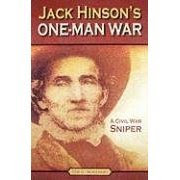 On a visceral level, another new book of interest is Jack Hinson's One-Man War. Hinson was a prosperous Kentucky planter who became a bushwacker after finding his sons heads placed on stakes by Union forces.
The author makes Hinson a former friend of Grant who ambushes and kills over 100 men; he credits Hinson also with the destruction of an entire Union supply train as well. Reading the description, one gets the psycho-killer vibe that pervades ACW non-fiction treatments of irregular warfare.
The number of titles issued may be down but material of interest is still coming out.
Jomini
While batting around emails with Drew Wagenhoffer on Jomini editions, I happened to notice the same translation is being endlessly repackaged with a floor price of about $15 and up.
Then, looking up Halleck's Art of War (based on Jomini), I see pricing of reprints starts at $76, steps up to $103 and rises from there. What recession?
Meanwhile, Halleck's translation of Jomini's Napoleon remains out of print and deserves a reprise (priced right).
Publishing
The big news however, seems to me to be something like a collapse in Civil War publishing. In 12 years of compiling Civil War Book News, I have never seen a weaker month of releases than February 2009
- and that includes the bump provided by Lincoln Bicentennial releases. March has been better but so far publishers seem to have decided to downplay the ACW list.
Clash of Extremes
There is a new, scholarly study (Clash of Extremes) about what might be called the economic origins of the ACW from Marc Egnal. It seems, from reading the release information, that the author develops a picture of a changing national economy that lowers the cost of political extremism.
Drawing on a wealth of primary and secondary sources, Egnal shows that betweenNote that it seems some of these themes might play on either side of the historiographic fence, blundering generation or inevitability-of-war. Will have to read to find out.1820 and 1850, patterns of trade and production drew the North and South together and allowed sectional leaders to broker a series of compromises. After midcentury, however, all that changed as the rise of the Great Lakes economy reoriented Northern trade along east-west lines.
Meanwhile, in the South, soil exhaustion, concerns about the country’s westward expansion, and growing ties between the Upper South and the free states led many cotton planters to contemplate secession.

Jack Hinson
 On a visceral level, another new book of interest is Jack Hinson's One-Man War. Hinson was a prosperous Kentucky planter who became a bushwacker after finding his sons heads placed on stakes by Union forces.
The author makes Hinson a former friend of Grant who ambushes and kills over 100 men; he credits Hinson also with the destruction of an entire Union supply train as well. Reading the description, one gets the psycho-killer vibe that pervades ACW non-fiction treatments of irregular warfare.
The number of titles issued may be down but material of interest is still coming out.
3/31/2009
Jomini's objectives
Speaking of Jomini, here is a passage from the US 1862 edition of his Art of War. I cite this in the hope we can be rid of the procrustean nostrum Make the enemy your objective:
There are two classes of objective points,—objective points of maneuver, and geographical objective points. A geographical objective point may be an important fortress, the line of a river, a front of operations which affords good lines of defense or good points of support for ulterior enterprises. Objective points of maneuver, in contradistinction to geographical objectives, derive their importance from, and their positions depend upon, the situation of the hostile masses.More, with reference to risk:
In strategy, the object of the campaign determines the objective point. If this aim be offensive, the point will be the possession of the hostile capital, or that of a province whose loss would compel the enemy to make peace. In a war of invasion the capital is, ordinarily, the objective point.
As to the choice of objective points, every thing will generally depend upon the aim of the war and the character which political or other circumstances may give it, and, finally, upon the military facilities of the two parties.Did the Union ever have the political capacity to incur "great dangers"? Demanding great results without incurring great danger is exactly what we would expect of politicians.
In cases where there are powerful reasons for avoiding all risk, it may be prudent to aim only at the acquisition of partial advantages,—such as the capture of a few towns or the possession of adjacent territory. In other cases, where a party has the means of achieving a great success by incurring great dangers, he may attempt the destruction of the hostile army, as did Napoleon.
There is another class of decisive points to be mentioned, which are determined more from political than from strategic considerations: they play a great part in most coalitions, and influence the operations and plans of cabinets. They may be called political objective points. [...] This subject is so extensive and so complicated that it would be absurd to attempt to reduce it to a few rules. The only one which can be given has just been alluded to, and is, that either the political objective points should be selected according to the principles of strategy, or their consideration should be postponed till after the decisive events of the campaign.Emphasis added. Have a look.
Jomini 2009
 A new article from the Small Wars Journal applies Jominian analysis to a critique of modern US counterinsurgency doctrine. The brief review of Jomini, by way of Maguire, will evoke many Civil War campaigns in the mind of the reader.
Interesting general note on theory vs practice from the piece:
What the US Army and Marine Corps seem to have done in their counterinsurgent doctrine is to turn despair of finding enemy’s lines of communication into a doctrinal escape from the [Jominian] principles that focus on those lines. The new doctrine displays a sort of psychological displacement behavior in the face of failure. For instance, because the lines are hard to find, descriptions of the type of combat begin to include the expression ‘non-linear.’ Once accepted that a war is non-linear by nature, any need to look for the lines collapses, and any principles constructed on the basis of their existence are rendered inapplicable.By the way, the DEA (unlike the Army) views clandestine networks differently and attacks them through their lines of communication and support (as this article shows, starting on page 21).
Jomini and the Civil War remain with us.
3/30/2009
Maryland's Sesquicentennial
Maryland takes its first step towards a Sesquicentennial program. I'm expecting a pure tourism play.
3/25/2009
McPherson's "Abraham Lincoln" (part 2 of 2)
 Totaling 65 tiny leaves of narrative, each larded generously with white space, we can easily see how reviewers might be stumped by McPherson's new book Abraham Lincoln. Was this a stillborn embryo of a biography? An example of failing faculties? Reviewers stayed away in droves.
In my view, Abraham Lincoln is intended as a powerful display of the author at the peak of his powers.
The whole issue comes down to, what are those powers. As I have said for more than a decade, McPherson is patently a synthesizer of secondary sources while his admirers imagine that he is an original researcher/scholar whose popular writings offer glimpses of original insights.
If you believe the latter, the book Abraham Lincoln can make no sense, for there is no McPherson reader so new to this corner of nonfiction that most of the content of Abraham Lincoln will not be familiar, warmed over, even tired. Put another way, no one's stock of Lincolniana is so low and so poor that McPherson's biography is going to surprise and delight them with fresh facts and observations. In that way his ardent admirers at last arrive at the place where the deep readers of Civil War source material have been all along – face to face with pedestrian recapitulations of well known secondary material.
For the purveyors of the myth "Greatest Living Civil War Historian," the game is up. In fact, McPherson has given them up himself. He never bought into the image that was foisted on him. Abraham Lincoln would not be possible if he had.
As much misguided praise as McPherson drinks up, he still knows much better than his adoring public who he really is and what he really does. And so the author (I contend) intended here a virtuoso performance of summation – a real knuckle buster (to borrow pianist slang) – within his beloved "public history" sphere.
To make this very public demonstration, the artist has to make choices on the lines of What is virtuosity in synthesis?
Go back to Battle Cry of Freedom where we have a comparatively long book. Take a complex issue, such as the commander's intent in Lee's Maryland Campaign; McPherson's treatment of it is to select one single secondary source that he regards as the best for this issue (D.S. Freeman) – without making a case for its excellence, BTW - then to summarize a substantive evaluation made by Freeman in a single paragraph.
So, we can derive a value system at work here. Go through Battle Cry and you'll see it continuously. McPherson's art in those early days was to choose (to his own personal satisfaction) the best secondary explanation of means, motive, and action on a single matter and then "boil it down" to essentials that could be expressed in a few sentences or less. His attributions were reasonably transparent as he saw no shame then in crediting the sources of his recapped insights.
If you view the Civil War as a series of decisions and incidents, each one of which has some controversy attached to it, each analysis of which requires a discussion of evidence, McPherson was never for you. He did not even recap his secondary sources' own travels through primary sources. For instance, Freeman might have quite a substantial review of the sources to justify his views, but these would not make it to Battle Cry's front- or back-matter. Only Freeman's conclusions would survive in truncated form.
But we don't want to get too deep in the technique here, just far enough to identify the secret sauce this artist is serving. It is the most concise single account of what McPherson deems the best thinking on an issue. He connects the issues by stringing the accounts together in a narrative. One issue or incident demands just one interpretation, one explanation. The weakness in historical method and technique are offset by a confidence in tone and faster narrative pacing.
If we compare Battle Cry with Lincoln, we are first struck by scaling issues. Battle Cry, so much bigger, can be viewed in terms of the art of compression not being perfected, as being clumsier.
The individual summaries within Lincoln are briefer than in Battle Cry. In Lincoln, paragraphs have given way to sentences.
This is not the only change in technique. Like Goodwin in Team of Rivals, McPherson wipes the slate clean of secondary sources in his new writing. He seems embarrassed to have ever been associated with secondary sources.
He has 67 footnotes for his 65 pages, only three of which contain secondary sources cited for their own value (a few more are cited specifically to extract a particular Lincoln quote only). McPherson now uses citations exclusively to document quotes. He has jettisoned the Battle Cry system of making his influences transparent, no doubt deciding that this is a luxury his readers don't need. In the case of his fanbase, I would say it is a luxury they never made use of anyway.
Needless to say, this shortens the book considerably.
Finally, McPherson includes a bibliography in which he delivers one-liners (more compression!) about this or that source or secondary study. He never divulges which author influenced him or which set the course of a particular school of thought. Imagine just four tiny pages of annotated bibliography of all the Lincoln literature, manuscript and published. This is not happenstance, this is showing off.
The question is, do we get it? Some of us have gotten it from Battle Cry onward.
Now it's time for the rest of his readership. Let them pick Abraham Lincoln up and read it in the way he intended them to. Take McPherson at his own measure for once.
He's been putting on a show - and you've completely missed the show with your scholar nonsense - now go and enjoy the show.
3/24/2009
Tea for Varina Davis
By the time she gets her tea party for the Sesquicentennial there will have been time enough to learn how to spell her name.
Sometimes I think the persons, places, and things of history are mere placeholders for the heritage tourism industry.
Sometimes I think the persons, places, and things of history are mere placeholders for the heritage tourism industry.
3/23/2009
CWPT Battlefield Report
The Civil War Preservation Trust has released its annual endangered battlefield report. Press release here and report here.
3/18/2009
When activists take an interest in history
Got to shed light on slaveholder insurance policies. The need is urgent. Must compile report and send to governor immediately. I repeat, the need is urgent. Pass a law to force disclosures. Hurry. This is a priority. What are we waiting for? Pass the law now.
The hearty handshake school of heritage tourism
 Brunswick, MD, wants to leverage its Civil War history (it was "Berlin" then) to qualify for inclusion in the Preserve America program. The program, if you haven't heard of it, is comical in a W.C. Fields sort of way:
 "The benefits are not monetary," Jones said. But participating communities get a certificate of recognition, a Preserve America welcome sign, and inclusion in press releases about the historical value of the region."Allow me to give you another hearty handshake" says the bank president after the bank dick foils a robbery.
3/13/2009
An affront to Old Baldy
 Philadelphia is down to its last Civil War museum (due to budget issues) and would you believe they are not displaying Meade's horse's head!
 Mr. Waskie would like to see the head of Old Baldy taken out of storage and reunited with the reins on Gen. Meade’s horse, currently on display.Let their labors not be in vain.
“The head of Old Baldy was obtained by two members of the Grand Army. They had it preserved and then put the skin over a plaster mold and framed on a wooden fence,” Mr. Waskie said.
Why they fought the Civil War: for peace
The Union fought for peace. Peace was Lincoln's objective. To be specific: "a just and lasting peace." The kind that takes four years and a mountain of dead to achieve. That kind of peace.
Peace is good and Lincoln is good. Connect the dots.
Peace is good and Lincoln is good. Connect the dots.
3/11/2009
The Mystery of Oktibbeha County (cont.)
 How did the Grant Society's Grant Papers end up at Mississippi State? We have a new clue: Mrs. Marszalek is a political powerhouse in the state. If her husband, an emeritus, wanted the archive nearer home, she had tremendous wherewithal to prepare a warm reception for them:
She has played a major role in Mississippi politics. She began her career as secretary of the Oktibbeha County Democratic Executive Committee from 1989-1992, also becoming a member of the Mississippi State Democratic Executive Committee (1989-2000). She was the founder and first president of the Oktibbeha County Federation of Democratic Women (1990-1992) and has held a variety of offices in the Mississippi State Federation of Democratic Women (1990- ). In 1992 and 1996, she was elected a delegate to the Democratic National Conventions and subsequently played leadership roles in the two local Bill Clinton presidential campaigns. From 1994 to 2002, she wrote a regular column in the quarterly newsletter, the Oktibbeha Democrat. From 1993-1996, she was co-chair of the Starkville Race Relations Team. She was awarded the Unity in the Community Award from the Oktibbeha County NAACP (1996) and the Democrat of the Year Award from the Oktibbeha County Democratic Executive Committee (1998). In 2003, the Mississippi State University College Democrats named her "Honorary Life Member."Mrs. Marszalek rates her own page on the MSU website without having been employed by the school or published by its press. Her relationship with MSU is strictly that of patron:
She and her husband have established endowed library funds at Mississippi State University and Canisius College. Her papers, gathered in the course of her political career, are deposited in the Mitchell Memorial Library, Mississippi State University.Her own papers! So students can study her life and career!
Sorry, I'm getting distracted. The bullseye is that "She and her husband have established endowed library funds" at MSU.
The closely guarded secrets surrounding this transfer are starting to come unraveled. We'll get to the bottom of this. Keep watching and if you have a clue, send it in.
p.s. I have stopped referring to this archive in shorthand as THE Grant papers in deference to the important point made by Brooks Simpson that they are not THE Grant papers, but rather the papers of the Grant Society. "... just as so much of this story has been confusing." Amen
Grant Papers: SIU feels the sting
SIU has weighed in on the Grant Papers removal with a resounding "no comment."
This story, however, puts the Simon controversy in a larger context, a year in which "a couple of administrators have left under bizarre or suspicious circumstances." It reports also that one administrator was busted for false military service claims. The funniest SIU scandal of 2008 had to have been when the college's new plagiarism policy was discovered to have been plagiarized.
Current administrators have assured the reporter it's all no big deal.
(Hey, good college press, though.)
This story, however, puts the Simon controversy in a larger context, a year in which "a couple of administrators have left under bizarre or suspicious circumstances." It reports also that one administrator was busted for false military service claims. The funniest SIU scandal of 2008 had to have been when the college's new plagiarism policy was discovered to have been plagiarized.
Current administrators have assured the reporter it's all no big deal.
(Hey, good college press, though.)
Lincoln's watch
You leave it for repair and they're messing with your watch. Is this like cooks spitting in your soup?
BTW, why would the Smithsonian only occasionally put this item in their Lincoln display if it is the one item he carried with him night and day? Now that its secret is exposed will it get more exhibition time?
(Thanks to Ted Savas for the pointer.)
BTW, why would the Smithsonian only occasionally put this item in their Lincoln display if it is the one item he carried with him night and day? Now that its secret is exposed will it get more exhibition time?
(Thanks to Ted Savas for the pointer.)
3/10/2009

The ALPLM in the Bicentennial
 I think that I shall never see...
It's been over 20 days since the Abraham Lincoln Presidential Library and Museum appeared in any news item in this Bicentennial year.
We go to the ALPLM website and click on EVENTS for a surprise. The big February to May event is an art show featuring Don Pollack (whose painting is featured topside). Don's exhibition is offering "a conversation with painting, photography, history, and art history and includes painted landscapes, portraits, maps, and documents." Not very Lincoln-sounding.
Concurrently, a master of sticky pads will work his magic putting the Emancipator at the center of his efforts: "Using thousands of colored Post it notes, Mr. Killham will work with local volunteers to build larger than life portraits of Mr. Lincoln: one in each side of windows on the bridge that spans Jefferson Street."
Am I sensing trivialization here? Or just disorder, exhaustion, and ingnorance?
The ALPLM calendar then descends from these two artistic high points into a sparse listing of laughable trivia (tea ladies?).
For relief, you could try looking at Bicentennial Commission events. These include events such as performances of Shakespeare's Macbeth.
If these folks are not going to celebrate Lincoln, we can all safely take a pass.
Lincoln authors and scholars: you missed a great opportunity. The Bicentennial is over. Kudos, though, on maintaining excellent collegiality throughout.
3/09/2009
Using the ACW to corrupt Boy Scouts
These Boy Scouts have a pretty neat agenda for their "Boy Scout Day At Mayfield Earthwork Fort." This is all stuff I would want to do if I were a child: "Participants will learn to drill and fire wooden muskets, fire artillery and learn how to send messages using signal flags."
The part that made me laugh was "Scouts will also learn how to prepare camp food and formulate military strategy." You see, boys, military strategy is a lot like beans and franks...
Actually this is like an old comedy bit mocking children's shows: "And tune in next week when we'll show you how to cure diseases and end world hunger!"
After their half-hour strategy session, these kids will be fully equipped to denigrate any Civil War general they may read about.
The part that made me laugh was "Scouts will also learn how to prepare camp food and formulate military strategy." You see, boys, military strategy is a lot like beans and franks...
Actually this is like an old comedy bit mocking children's shows: "And tune in next week when we'll show you how to cure diseases and end world hunger!"
After their half-hour strategy session, these kids will be fully equipped to denigrate any Civil War general they may read about.
Is this the stupidest Bicentennial event?
How childish would you have to be to ask serious questions of a Lincoln actor and a Darwin actor? What sense of history imagines them sharing tea on the same stage and chatting about this and that? And how low will we have to go before the year ends to find the stupidest-ever Bicentennial event?
"Our ancestors, the Gauls"
 A bill supporting Sesquicentennial activity in Kentucky has made it out of committee and now lumbers on to the next milestone.
These sorts of stories are interesting places to gather clues about who is driving these bills and why. As a general (maybe shaky) observation, it seems to me that Civil War readers are absent and that in our circles there has been no discussion about what a Sesquicentennial is for and what it should do.
A state senator promoting the Sesquicentennial had this to say:
It is important that we educate those who do not realize our state’s significance in this historic era and recognize our ancestors for their roles in the war and its aftermath.The question, "Why is it important" is left on the table.
His remark seems to divide Kentucky into two classes of inhabitant: "our ancestors" and "those who do not realize," i.e. the transients who make up the majority of the population of any state nowadays. The motivation, then, seems to be one of integration.
I don't think it will work. That part of the transient national labor pool that finds itself in Kentucky is amply served by all sorts of non-local culture. It also imagines itself "national" in character - witness the abysmal turnouts in local elections.
If the sesquicentennial is a cultural rearguard action designed to drag "those who do not realize" along the path of state history I think it will fail.
In fact a specific image of futility comes to mind: those thousands of colonial African schoolrooms where the children began their very first French lesson with the words, "Our ancestors, the Gauls..."
3/05/2009
The Mystery of Oktibbeha County (cont.)
Russell Bonds writes to say, if you want to understand why the Grant papers were moved to Mississippi State University, look to the bulldog motif:
Got a theory? Pass it along.My 2¢: Could it be the mascot?
Compare:
and (Currier & Ives):
See also Lincoln to Grant, Aug. 17, 1864 ("Hold on with a bulldog grip, and chew and choke as much as possible"), OR Vol. 42 pt. 2 p. 243; F.B. Carpenter, Six Months at the White House with Abraham Lincoln (New York: Hurd & Houghton, 1867), p. 283 ("I asked the President, during the progress of the battles of the Wilderness, how General Grant personally impressed him as compared with other officers of the army, and especially those who had been in command. . . 'The great thing about Grant,' said he, 'I take it, is his perfect coolness and persistency of purpose. I judge he is not easily excited, — which is a great element in an officer, — and he has the grit of a bull-dog! Once let him get his 'teeth' in, and nothing can shake him off.'").
And (bonus!!) see also Harold Holzer, "The Return of the Peacemakers," American Heritage (Feb./March 1996) (describing "Gen. Ulysses S. Grant, famed for bulldog ruthlessness in battle...").
Behold the power of Internet Archive and Google Book Search. : )


3/04/2009
The Mystery of Oktibbeha County
 If you are joining us late, we are working on the Mystery of Oktibbeha County. It's like a Lovejoy mystery involving valuable artifacts, shady doings, an academic setting, and skullduggery behind a facade of propriety. In this whodunnit, a collection of historic papers mysteriously appears at a Mississippi college where no one can explain how it got there.
How did the Grant papers end up at Mississippi State? The collection, assembled and owned by the shadowy Ulysses S. Grant Association, was recently in the care of the deceased John Y. Simon (a bona fide Grant scholar). The Association's new director, Sherman buff and psycho-history pop author John Marszalek, moved them out of Southern Illinois University after difficulties with the current administration. So we do have motive for relocation.
Reporters, however, failed to report how MSU came to be selected as a new home. Whenever asked directly, Marszalek, as we have seen in previous posts here, diverted the question or made useless noises. As the director of the nonprofit that owns the papers, Marszalek could have said anything: "I am professor emeritus and like the place"; or, "They're giving us a nice building"; or, "The truck took a wrong turn and delivered its load here by mistake and we figured, what the hell."
One interview with local press is typical. Marszalek was asked flat out, "Why was Mississippi State's Mitchell Memorial Library chosen as the repository of President Grant's papers?" He answers with irrelevant general background data culminating in
Through the hard work of Mississippi State University Library Dean Frances Coleman, interim MSU presidents Vance Watson and Roy Ruby and the enthusiastic support of MSU President Mark Keenum, we were able to convince the [Grant] Association board of directors that the Mitchell Memorial Library at MSU was the appropriate place to house these significant materials.In other words he answers the "why" question, "because we were able to convince our board." Was the board faced with one lousy offer?
Marszalek could say anything but he assiduously says nothing.
Hat tip to the gentleman who pointed out today's new clue. It is a university press release which hints as to the membership of the cabal behind the move.
Rhode Island Chief Justice Frank J. Williams, winner of MSU's 2006 MSU Distinguished Jurist Award, is [Grant] association president. A former commissioner of the U.S. Internal Revenue Service and a New York Metropolitan Museum of Art vice president, as well as two direct Grant descendants, are other officers."(More on this momentarily.)
Williams, calling in to MSU for the dedication ceremony, laid more fog over the question of MSU's selection. Get this:
The transfer of Grant’s papers to MSU, Williams said, will enhance efforts to understand his legacy as president and as commanding general of the Union forces during the Civil War.We would have had no chance of understanding Grant's legacy if these papers had gone anywhere else...
The same report covering the dedication contained an inadvertent disclosure by Marszalek:
When Chief Justice Williams, Dean Coleman and I [were] readying for the papers’ arrival, I told them that once the papers were inside the doors of the library, I was going to let out the loudest scream ever heard in Oktibbeha County.Marszalek is alluding here to difficult negotiations, not difficult logistics. The dean would not be involved in bills of lading, delivery, and unpacking issues.
So the silence of Marszalek punctuated by screams of joy points to haggling over terms and conditions for the housing of the papers. Is the Association going to pay rent? Is it going to get grants? The deal is so secret, even the existence of a deal must be concealed.
Before we leave the dedication reporting, we should note this ominous, mystery-novel element. Marszalek appears to be the only officer present. Williams phones it in. The recalcitrant board members are not mentioned nor are any other officers. The whole point of the Grant Association is the papers and nobody shows up for the momentous event of relocating them.
Cue the dramatic music.
Now what is this Ulysses S. Grant Association? It was formed in 1962 by the Centennial's brain trust as we see in this contemporary snippet from volume 72 of Ohio History:
ONE OF THE BETTER results of the effort to recognize the centennial of the Civil War has been the establishment of a project to collect and publish the correspondence and other papers of Ulysses S. Grant, supreme commander of theUnion armies and eighteenth president of the United States. To accomplish this end the Ulysses S. Grant Association was created through the efforts of the Civil War centennial commissions of Ohio (where Grant was born and lived his early years), Illinois (which gave him his first command in the war), and New York (where he spent his last years). The association has been chartered as a non-profit corporation by the state of Illinois. Its offices are located in the Ohio State Museum, Columbus, the headquarters of the Ohio Historical Society. Officers of the association are: Ralph G. Newman, Chicago, president; Bruce Catton of the American Heritage, David C. Mearns of the Library of Congress, and T. Harry Williams of Louisiana State University, vice presidents; Erwin C. Zepp of the Ohio Historical Society, secretary; Clyde C. Walton of the Illinois State Historical Society, treasurer; and Allan Nevins of the Huntington Library, chairman of the editorial board. Dr. John Y. Simon of the department of history of Ohio State University is executive director and managing editor.Note the Illinois charter. Info about the Association, which lacks a website or any other public-facing organ, can be found in the Illinois Secretary of State's portfolio. Its 2008 address was given as the library at SIU which housed the collection: "605 Agriculture Dr, Carbondale, IL 62901-4310." It had "Estimated annual sales" of $138,536.
Now, from our informant's link, we see what may be a board of six people. The identities "exposed" thus far:
** Marszalek, director
** Williams, president
** Grant relative #1, "officer"
** Grant relative #2, "officer"
** "A former commissioner of the U.S. Internal Revenue Service," "officer"
** "and a New York Metropolitan Museum of Art vice president," "officer."
I split the last clause into two because the story is written in AP style. AP's treatment of commas tells us this is written about two people not one ex-IRS art guy.
The Museum VP is Harold Holzer.
The former commissioner of the IRS is harder to figure but must certainly be Sheldon Cohen, "current Abraham Lincoln Association Board Member."*
So the leadership consists of Williams, who won an award from MSU and may have connections there; Marszalek, professor emeritus of MSU; Holzer; Sheldon Cohen; and two Grant relatives. Notice there are no Grant authors or scholars whatever in this organization.
If we were investigating a drug cartel, we would now begin mapping our network. Let's see what we can do on the QT:
Lincoln Bicentennial Commission: Holzer, Williams.
Lincoln Bicentennial Advisory Committee: Marszalek, Cohen.
Lincoln Forum: Holzer, Williams, John Y. Simon.
So, the Grant papers are firmly in the hands of the mobbed-up branch office of a shadowy offshore enterprise we can call "Amalgamated Lincoln Enterprises Inc."
We have our suspects and a trail of dissimulation but the mystery remains. Why MSU?
(Got clues? Send them in.)
* Despite this "credential" Cohen does not actually appear on the ALS website list as a board member. In fact, the board roster excludes all members of the rival Amalgamated Lincoln Enterprises cartel. See here.
3/02/2009
Quite an anachronism
Montgomery Meigs quotes Brooks Simpson.
(Well, not that Meigs, but nevertheless. Scroll to end notes.)
(Well, not that Meigs, but nevertheless. Scroll to end notes.)
Subscribe to:
Posts (Atom)


