6/11/2013

Mary Lincoln's mental health

Mary Lincoln's Insanity Case: A Documentary History does well to offer a superset of what was previously available in contemporary documentation. But author Jason Emerson does no favors to Mark Neely and R. Gerald McMurtry. He mentions their 1993 work The Insanity File: The Case of Mary Todd Lincoln (still available) as representing a subset of his own document collection.

This is typical. There's not much more of a literature review here than the occasional mention of previous works.

But Emerson also does well to drain the partisanship out of his editing and lay his material out for readers to decide. The Neely/McMurty book was painted by marketing with an anti-Robert Lincoln brush. It took the serendipity of document discovery into the dark alleys of advocacy.

Emerson's was a surprisingly good read. I came to it with the thought that there was controversy around Mary's insanity. The early parts of the book (and its repetitive news articles) presented a slam dunk for "crazy." Where's the controversy, I wanted to ask. But this changed with reading.

Not to recount the whole case, here are a few ideas of my own gleaned from reading Emerson.

(1) Robert Lincoln had lower tolerance for his mother's eccentricities than did others.
(2) Robert mixed up defense of his mother's reputation with defense of his own.
(3) Robert made a bad decision when he allowed the court to appoint him his mother's (financial) conservator. A third party would have kept him clear of his mother's wrath.
(4) Mary's deep suspicions of Robert's financial motivations are well worth examining and here are given very short shrift.
(5) Mary was odd enough to convince clinicians of her madness yet functional enough to get along in the world for decades after her release from Batavia.
(6) None of the predictions about her self-destructiveness or future embarrassment came true after her release.
(7) Mary's involuntary commitment was an overreaction that humiliated her and the Lincoln name.
(8) Mary's involuntary commitment, and the related sensation, smoothed her way in the world after release. It reduced the novelty of her eccentricities.
(9) Mary medicated herself in ad hoc ways with stuff including narcotics.
(10) Mary's dress-buying habit would compare favorably to my book-buying habit.

Mary's early discharge from commitment and her high functioning in the real world to the end of her life remind me of the de-institutionalization movement in mental health in the 1970s. Released to the care of her family, she represents the success the psychiatrists of that era strove for.

The books are piling up

Better start reviewing.

3/25/2013

Sherman by Uhl

Went to the Army and Navy Club last week to buy the redesigned club tie, eat a good lunch, and take some decent digital pictures of Civil War generals' portraits. Collected a bunch of trash instead, by virtue of having used a camera phone and shaky hand. Will return with a proper digital camera for a redo. The image above is one of the "better" ones (but I must retake it).

My sense is that these celebs were members who sat for portraits, which is why they are hanging on the Club's walls. That would explain their ages as the Club was founded in 1885.

The portrait you're viewing, in all its awful reporduction is listed by the National Gallery as an Uhl sitting. I have never seen this image in any other context than the painting itself, which I hope makes it special for you too.

Break's over

Odd to get 509 hits in one day after no new post in weeks. Well, here we are again.

3/11/2013

Another plagiarism scandal ...

Another research assistant is blamed. Suggestion: write your own stuff or hire a better quality of research assistant.

(A reader tip: thanks!)

3/06/2013

Alternative paradigm

Speaking of 1862 in the East, Eric T. Dean writes:
...there was not yet an alternative paradigm such as Grant's method of fighting a series of inconclusive battles... - "We live under a government of men and morning newspapers," The Virginia Magazine of History and Biography 103.1 (Jan 1995)
Neither is there any sense among historians of the cost paid to get a largely Republican newspaper readership to accept the "alternative paradigm" as sufficient and acceptable.

Unconscious paradigm substitution (as an enabler of harsh moral judgements) is another signal failing of Civil War history. We might think of it as a late war/early war double standard, but double standards are simpler things than paradigm substitutions.

2/24/2013

OT: Back soon

Last week of school, then comprehensive exam; can return to posting in about eight days.

p.s. Try wrapping your head around reverse synthetic aperture radar followed by some ACW blogging. Doesn't work.

2/15/2013

The blight on nonfiction

Had lunch with a fellow whose intense interest is outside of Civil War history. In his own field of interest, he's writing a book to bring a whole new perspective on a famous episode in U.S. history. In the meantime, he's publishing reviews of other people's books on his favored subject. These other books are making him crazy.

As I shared with him the typical sins of the Civil War writer, he matched me story for story, sin for sin. I was a little surprised but not a lot.

He had an author's work in hand that almost reached ACW levels of malpractice. I said, call her out.

(1) She belongs to a specific school of history and interpretation and she failed to disclose that to the reader.

(2) Her citations are selectively derived from that school of thought's truncated bibliography.

(3) That makes her own bibliography woefully incomplete.

(4) Her work is entirely derivative but she fails to acknowledge her inspirations.

(5) I bet money she has phrases, sentences, maybe paragraphs lifted from her readings.

(6) Publish tables showing her "borrowings."

(7) Point out all the new research, evidence, and analysis that has been excluded from her work.

(8) Point out all the arguments that counter hers that she fails to address or acknowledge.

(9) Suggest that she has entered a field of controversy while pretending controversy does not exist and contested issues are "settled science."

(10) Suggest that a fresh approach, such as in your forthcoming book, is the approach that is needed.

If you set number 10 aside, how many of these points apply to any of your recent ACW readings? Too many, probably.

2/14/2013

And now a word from our sponsor

The historian who speaks of cause, and not of causes, should be fired immediately.

To write honestly for the rest, one must write fundamentally for oneself.

Every strict classification of an historical event distorts it.

Educating the individual consists in teaching him to distrust the ideas that occur to him.

It is not to increasing our knowledge to which we may aspire, but to documenting our ignorance.

When the dust raised by the great events of modern history settles, the mediocrity of the protagonists leaves the historian dumbfounded.

History clearly demonstrates that governing is a task that exceeds man’s ability.

Reason, truth, justice, tend not to be man’s goals, but the names he gives to his goals.

History shows that man’s good ideas are accidental and his mistakes methodical.

Contemporary man admires only hysterical texts.

The peddlers of cultural objects would not be annoying if they did not sell them with the rhetoric of an apostle.

The fragments of the past that survive embarrass the modern landscape in which they stand out.

Only the defeated come to possess sound ideas about the nature of things.

Museums are the tourist’s punishment.

No writer has ever been born who did not write too much.
- Nicolás Gómez Dávila

Digitizing medieval books

All 25,000 of them.

Amateur medievalists may someday enjoy the kind of source-rich world the ACW reader currently inhabits.

OT: You can buy an historic German church on eBay

No kidding. More than one, actually.

2/10/2013

That's entertainment (OT)

Seen this evening on "Are You Smarter than a Fifth Grader?" A fascinating show if you can hack it.

Host: For $25,000, Budapest is the capital of which European country?

Contestant: This may sound stupid but I thought Europe was a country.

Host: No, (repeats question).

Contestant: Wait a minute, I know they speak French there. But isn't France a country?

Host: (Tries to be helpful)

(Lots of back and forth)

Host: And the answer is, HUNGARY!

Contestant: Hungry? I never heard of Hungry! I've heard of Turkey.

Note: Private Eye used to round up game show contestant answers in a column called "Dumb Britain." Would be worth doing that stateside. Here are some choice selections from the column read in a revue of six minutes.

And from issue 1333:

Perfection, BBC1
Nick Knowles: Tennessee Williams wrote Death of a Salesman. True or false?
Contestant: False. I have a lot of his records, but I can’t remember him singing that one.

The Chase, ITV
Bradley Walsh: In the Bible, Noah’s three sons are called Japheth, Shem and… what? Ham, Lamb or Spam?
Contestant: Lamb.
Walsh: The correct answer is Ham.
Contestant: Who’d call their son Ham?

BBC Radio Merseyside
Presenter: Name an instrument which can be found hanging on the wall in many households.
Caller: A piano.

Revoking McPherson's Pulitzer - not so easy

Yes, we do take questions here and... revoking McPherson's 1989 Pulitzer would appear to be a long shot.

Philip Nobile raised this revocation matter in connection with three other of the most egregious history plagiarists in 2002 and came up with answers from the Committee that amounted to "We don't look back."

The Committee's decision on the Duranty reporting case is also instructive.

Whatever you may hear, bureaucratic inertia provides a measure of safety to even the worst of the winners. McPherson is likely safe.

2/09/2013

Proclamation porter

Brewer's Alley in Frederick has issued its Proclamation Porter, available in stores hereabouts. An interesting collaboration with the Museum of Civil War Medicine, to be sure.

Wainwright says porter (along with ale, cider and wine) was always available at Burnside's headquarters during Grant's Richmond campaign.

This one is balanced, a little sweet but nicely offset by the right measure of hops. I can imagine drinking it in the heat of early summer, in the shade of Burnside's tent, as my heavy woolens soak up sweat and the dull itch of a thousand insect bites gives way to the pleasure of the moment.

"So Burn, tell me, where do you get stuff this good?"

Shiloh battlefield, also a baseball field


An interesting survivor of the battle...

"The Curse of History"

Hey, if it weren't for "distorted and monolithic" interpretations, the ACW would have very few interpretations at all.

Black's paradigm has been out there for four years but I see little of it in ACW "memory" writing.

The Harrisons as hipsters

President William Henry Harrison had a grandson whom we know as President Benjamin Harrison. He was the last Civil War general elected president and he was, of course, a Republican. His attempt at a second term was frustrated by the great (I am tempted to say very great or all time greatest Democrat) Grover Cleveland.

It was my pleasure to work in an exotic locale with a friend named Benjamin Harrison III. His father had been an army general of the same name (but II) and it intrigued me that this distinguished presidential family did not harken back to their more ancient and eminent predecessor William Henry in naming conventions.

Ben and I had a friendship based on hard laughter. Our employer provided the material and it was up to us to come up with the punchlines. We were pretty good at crafting the required boffo.

Somehow, the Harrisons had become Texans and Ben II, before he became a MG acted as the first ever manager for Mose Allison. I would list that above major general on my resume.

After Ben III married a beautiful Irish stewardess, he visited me stateside. We were on our way from Philly to New York on some roads located under overpasses in the city of brotherly love. Remember the French Connection chase scene and you'll have the idea. This was the early 1980s.

Our one-way street was blocked off with primitive barricades manned by children. The children were armed with toy guns. They challenged us and wanted baksheesh to allow passage.

Ben's comment was "Druze militia." Indeed. We knew what to do - we went into action mode, high speed backup, squealing tires, escaping turnoff, lots of laughs. Take that Walid Jumblatt. Through negligence or incompetence the children failed to kill us.

I hate when that happens.

Ran into some videos on YouTube of the band Benjamin Harrison III and I were on our way to see way back when. This appears to be the show we saw. Perk up if they pan the audience. If it's not to your taste, I would just say that the memories of old age can become a nuisance.

And you never know where presidential progeny may end up.

2/08/2013

The answer is yes - but it's not a good answer

Our friends at the Washington Examiner ask if Lincoln would have droned Robert E. Lee. If they read their Eric Wittenberg, they would know that yes, of course, because Lincoln droned Davis. He droned the bejeezus out of Davis!

Lincoln was not a boundaries sort of guy. He was not afraid of the odd precedent. His trailblazing made him a victim of some sic semper tyrranis. In other words, he got droned himself and Davis successfully disavowed any knowledge.

Perhaps you've heard the phrase "disavowed any knowledge?" It seems to have entered popular jargon in 1966.

Kushner lays out the meaning of "artistic license"

If you missed it, this is worth reading.

The movie "Lincoln" changed the 13th Amendment votes of Connecticut congressmen. Screenwriter Tony Kushner says no big deal and lays out the rules for artistic license over historical material.

2/07/2013

Hugh Trevor-Roper, Whig historian

Also, forensic historian in a field full of storytellers.

But man do I loathe Whig historians.

In my dream, I was ruined

This is true: I dreamt that my pen name was Chester Hearn and that I wrote these terrible Civil War books for a fast buck.

I dreamt that the readers of this blog discovered my secret identity and exposed me as being Chester Hearn. It was a scandal on the Web. The ridicule was painful.

Fortunately, it was just a dream.

2/06/2013

How to start over

We need to start over in Civil War history.

What does that mean?

Take all the new research and analysis since the Centennial together with the complete record of source material and build anew.

Some authors are doing that; it's happening topic by topic. But it's not happening broadly enough. And the old guard is shouting "stop the madness." The old guard is bypassing new research and new analysis to reconstruct history from selected old source material to reach conclusions our granparents would be familiar with.

In doing so, they can present old, incomplete source material as representing the best thinking of today when it was the best thinking of 60-80 years ago.

As readers, it's our job stop this. It's job one for us.

When an author cites no secondary sources but goes back to the OR to write an account of this or that, when the OR cited is selective and dishonest, when the author claims no influence from major recent books (or if that influence is not visible in the work), put that author's book down, ignore it, and mark the author as unworthy of further reading.

Mark the author no matter how big the name, how impressive the prizes.

You may not want to shame them but you can certainly ignore them.

2/04/2013

Study the losers

Under the right strategy, losers might be gainers.

2/03/2013

The uninformed reader

The uninformed reader is as much a menace as the uninformed voter. His bad choices drive a market to endlessly satisfy a low information state.

2/02/2013

Analysis is doing

Without analysis, history can do nothing. The storyteller borrows his analysis in order to pretend to do something.

2/01/2013

"New writing" from James McPherson (cont.)

From the current issue of the New York Review of Books. (This is from the print edition, which is behind the website paywall.) Some authors can really turn a phrase. The same phrase.

Henry Clay, a three-time loser as a presidential candidate...
- James McPherson, New York Review of Books, February 7, 2013

Henry Clay a 3 time loser for the Presidency...
- 2012 comment posted on David S. Heidler's Henry Clay, the Essential American

As a three-time loser in presidential contests, however, Clay ...
- James McPherson, Battle Cry of Freedom, 2003

Asserting that three-time loser Clay could not win...
- David S. Heidler, Jeanne T. Heidler, Favid Coles, 2002, Encyclopedia of the American Civil War

... his [Clay's] record as a three-time loser ...
- Michael Holt, 2003, The Rise and Fall of the American Whig Party

... another three-time loser for the presidency, Henry Clay.
- Aubrey Sher, 2008, Presidential Hopefuls (1788-2008)

... Henry Clay, a three-time presidential candidate (if a three-time loser)...
- Stephen Berry, 2009, House of Abraham: Lincoln and the Todds, a Family Divided by War

... Henry Clay, three-time presidential candidate (if a three-time loser).
- Frank J. Williams, Michael Burkhimer, 2012, The Mary Lincoln Enigma

Political generals

What if every single Civil War general was a political general?

1/31/2013

"New writing" from James McPherson (cont.)

Again, from his latest writing in the New York Review of Books. The man is psychic!

Although the Mexican Congress repudiated this treaty, the Texans managed to maintain their independence for almost a decade … - James M. McPherson, New York Review of Books, Feb. 7, 2013

Although the Mexican Congress repudiated the treaty, the Republic of Texas maintained its independence. – "A Concise History of the U.S. – Mexican War" (website), August 7, 2004

Silas Jerome Uhl

I had posted a lousy digital snap of a George Thomas painting taken in the Army & Navy Club, artist unknown. The Club has recently moved blocking objects away from the frame and I can now see the artist's mini-plaque. He was Silas Jerome Uhl (1842-1916).

Uhl is collected at a decent valuation. An indifferent still life (vase and flowers) recently sold for $2,000. His obit in the NYT says he was popular in the salons of Paris in the 1880s.

The A&N Club has a number of portraits of ACW personalities done in his style, probably by him. As with Thomas, they all appear late in their lives, which suggests to me a sitting. The portraits of interest I have seen on the walls at the Club include Thomas, Sherman, Meade, DD Porter, and perhaps another swabbie. (Assume they were ANC members.) They are very well done in terms of character and detail and I have never seen any in print.

The imagery available from Uhl on the Web is far inferior to the quality of these portraits. Thomas, Sherman and Porter are superb: Meade looks a little vacant and is for that reason a notch below. Will try snapping better cameraphone images and posting them here as opportunity permits.

College professors

Could it be that college professors are merely support systems for college administrators?

1/30/2013

"New writing" from James McPherson (cont.)

The man has chops, you have to admit it.
... the new government offered American settlers large land grants to move into its sparsely populated northern province of Tejas. - James McPherson, New York Review of Books, February 7, 2013
"Mexico welcomed foreign settlers to sparsely populated Texas" - Source

"Tejas was sparsely populated" - Source

"Since the province of Texas was very sparsely populated..." - Source

"[Texas] was a sparsely populated area in northern Mexico..." - Source

"... note that the province of Tejas—Texas ... was a sparsely populated area in northern Mexico." - Source

"Mexico welcomed foreign settlers to sparsely populated Texas." - Source

"American settlers who had made their homes in this sparsely populated land..." - Source

And on it goes.

The inevitability of the war

The inevitability of the war portends the inevitability of select anecdotes, the inevitability of sophistry, and the inevitability of awards bestowed by your inevitable friends.

1/29/2013

"New writing" from James McPherson

In the very latest New York Review of Books, James McPherson reviews A Wicked War by Amy Greenberg. As with all of his reviews, he spends 95% of his ink recounting events, in this case the Mexican War.

His historical insights and literary techniques seem as sharp as ever:
... the issue of slavery in this new American territory [Texas] set in motion a series of events ...
- James McPherson, NYRB, February 7, 2013
... but the annexation of Texas set in motion of series of events ...
- Michael Kazin, Rebecca Edwards, Adam Rothman, 2011, The Concise Princeton Encyclopedia of American Political History- Page 490
... it resulted in the greatest land acquisitions in American history and set in motion the chain of events leading directly to the Civil War.
- Historian magazine, blurbed review of The Presidency of James K. Polk, 1987
... the process leading to the annexation of Texas and the state joining the Union set in motion a train of events causing the Civil War.
- Joseph G. Dawson in The Journal of Military History, 2007

Civil War movies

The appeal of movies like Lincoln to Civil War authors lies in that they are storytellers first and regard film as a higher form of storytelling than history books.

1/28/2013

Battlefield monuments

Battlefields dense with monuments alter the tour into something entirely different.

1/27/2013

Idea for a battlefield tour

Let every battlefield visitor load and fire a period weapon. Let them move under heavy loads and a hot sun. Let them stand opposite opposing tourists for long spells wearing woolen clothing. Let them elect their guides. Let them wait interminable periods for directions from their guides.

1/26/2013

Walter Mitty fought the Civil War

Everyone is (at best) George Thomas in their daily lives while everyone imagines himself to be a mythical version of Stonewall Jackson.

1/25/2013

Literary ideals

Because his book cites some scholarship, the storyteller claims scholarly validation for his literary ideals.

The Jackson alternative

Where is the historian who presents Jackson as slow, unresponsive, unpopular, harsh, double-dealing, generally confused, and usually unprepared?

1/24/2013

What if ...

What if the Civil War was not a modern war?

1/23/2013

Battlefield guides

Battlefield guides ask us to visualize too much.

1/22/2013

What if ...

The ACW was not inevitable?

1/21/2013

I was a teenaged Civil War soldier

Ran into a fraternity brother last week - hadn't seen him in 39 years. I went Infantry and he went Armor. He told me some things about the Army I left that blew my mind. The key thing - and this is current doctrine that I read up on afterward - is that everything must go through the network and reside on the network.

Thou shalt have no knowledge except that it reside on network.

When he and I were young, we moved companies, battalions and brigades using innacurate maps, compasses, ridiculously crappy radios, code books, and verbose orders. I was proud of my map reading and marksmanship. I was lousy at radio and encryption/decryption. I could give a good order. I enjoyed entrenching and laying down fields of fire. Looking back, I recall we avoided radio communication as inherently insecure. Take away the radios and we infantry were a Civil War army in terms of skills. We had to know stuff. Couldn't outsource that to machines.

In Korea, the mortar section of my weapons platoon resorted to an archaic artifact printed in a thick book - firing tables. Firing tables told us how much charge (gunpowder) we needed to put the round a certain distance downrange. Robust and yet delightfully primitive, I'm sure our ACW predecessors had the same for direct fire cannons.

My predecessor in C-1/17 did not read his firing tables correctly and put rounds on Republic of Korea troops at one point. But his boss, an accomplished schmoozer (and another fraternity brother of mine) got himself awarded a Korean medal after the fact anyway. No network could have produced that outcome.

The point is all that info needed for warfighting now resides on the blessed network. If the network is down, then...

- No maneuver. Online maps not available; GPS kaput
- No coordinated fires on enemy targets
- No lateral communication - lost the IM and email
- No upward communication - lost PowerPoint
- No downward commo - email and IM out
- No resupply - online forms not accessible.

I have a sense that the radio persists in some form or other. So let me be wrong about the network, spectacularly wrong. Write me and cuss me out. But if this is true, then my fraternity brother and I are in a continuum with the armies of the ACW. The modern soldier is something else altogether.

My fraternity brother says that today's junior officer is helpless in calling on indirect fires without a GPS or a laser. That would be amazing except for the story from Benghazi, where an ex-Seal was killed painting a mortar crew with laser (at immense risk to himself) instead of radioing in their coordinates (at no risk to himself).

Whoever gave primacy to the network, lasers, GPS, databased firing tables and other shortcuts has and will have an immense amount of blood on his hands. One wonders how today's army could survive in a non-networked war.

1/14/2013

Finishing a degree

Regular posting to resume soon. Meanwhile, don't burn your books.

1/09/2013

Costumes and storylines

Too many writers see the Civil War as a costume drama.

1/08/2013

History hoax on Wikipedia

Some of the ACW material on Wikipedia is not much better than this.

Historical truth

Historical truth is the best substitute for absolute truth that we can manage.

1/07/2013

New book blogs

Our friends at Savas Beatie advised us of three new book blogs:

James A. Morgan III offers A Little Short of Boats. Morgan wrote this very good book of the same name about Balls Bluff for Eric Wittenberg's press way back. This is a revised edition which suggests new and improved. Not sure what could have been improved other than the author's attitude towards GBM. Oh wait - maybe the author's attitude toward "Cap" Beatie! (But that's not in the book.) A good author meets up with a good publisher - what's not to like? Morgan has opinions and I hope he airs them. that's what blogs are for.

Bill Morgan blogs on ACW sites in NYC. The random stroller with Gotham experience will attest that the number of NYC ACW sites and monuments are such that it is inevitable that the low-information walker will eventually be confronted by a monument that evokes a loud "huh"?

Lance Herdegen has cranked up an Iron Brigade blog, which topic has the makings of "forever."

I think the risk in author blogs is that by the time they take up their HTML toolkits, they are exhausted (topic-wise) and in poor condition to pursue the book's subject.

That's not a fact, just a concern.

12/29/2012

Literary sense

To save themselves the trouble of applying military science to Civil War history, many authors resort to a substitute, what they think is "common sense." But it's not. It's "literary sense."

Literary sense has its own structure and logic. When applied to history, it clears the path for a literary climax by setting fire to the undergrowth of common sense, military science, military theory, and especially historical truth.

When you see an historical writer blurbed as a "master storyteller," it means this is one who applies literary sense relentlessly, to everything.

12/28/2012

Schwerpunkt und Schweinerei, Jomini und Clausewitz

For a rough idea of the hold Clausewitz has on the modern U.S. Army, look at this essay collection, Addressing the Fog of COG. "COG" refers to the theoretical concept "center of gravity" which is the misleading American rendition of Clausewitz's "Schwerpunkt."
[It] not only [has] become a constraint to the individual and collective thinking and acting of the United States military as an organization; but, because of slavish adherence to using it as a central construct in the theoretical approach to operational warfare, it also has become detrimental to the further development of innovative concepts.
On the spectrum of German "big picture" words, Schwerpunkt straddles both the specific types (e.g. Zeitgeist) and the general types (e.g. Gestalt). It means many different things in many different contexts and is flexible enough that Clausewitz could it assign it his own meaning - a very specific one.

Check out especially Christopher R. Paparone and William J. Davis, Jr. in the collection cited.
Based in his [Clausewitz's] obvious aversion to making war theory a Jominian mathematical science, his selection of the Center of Gravity metaphor seems not of isolatable value to the gestalt of his treatise.
Try saying that quickly 10 times. It points to Clausewitz choosing NOT to use "terminology to prescribe an 'objectively' definable phenomenon."

This is important in our ongoing review of Civil War Jominianism, making Jomini the "scientist" and Clausewitz the "philosopher." In this sense, one could say that Civil War officers started the war as scientists and ended as philosophers.

Paparone and Davis make a general critique of modern Army theorizing but the thrust of their piece deals with the migration (and corruption) of meaning from Schwerpunkt into the Army's "Center of Gravity." The late Jean Baudrillard would have been made very happy with this:
"...words can eventually become extended to the point the original meaning becomes removed from any connection to the now dead metaphor..."
Do look at their essay, "Exploring Outside the Tropics of Clausewitz:Our Slavish Anchoring to an Archaic Metaphor."

Meanwhile, considering the meandering course of the ACW, can we not say that the labyrinth is the more apt military metaphor rather than Schwerpunkt?

12/20/2012

Lincoln vs. Lincoln

Interesting!

Lincoln
Domestic Total as of Dec. 19, 2012: $110,253,963
Foreign Gross: N/A
Production Budget: $65 million

Abraham Lincoln: Vampire Hunter
Domestic Total Gross: $37,519,139
Foreign Gross: $78,489,268
Production Budget: $69 million

"Touristification"

Taleb...
... believes that universities propagate "touristification," another term he coined, a phenomenon that occurs when what should be an exciting exploration turns into a programmatic exercise. It's better to be an adventurer than a tourist.
I think this idea can apply to a certain kind of Civil War history writing. It hits the main points of interest in a certain order, recounts events rotely, and for a set price.*

When something big breaks, like Ken Burns's "Civil War," a flood of books comes out searching for those readers who are first-time ACW literary tourists.

The sad thing is when those kinds of books persist.

* No offense to those of our park ranger friends who are passionate and do so much more.

12/19/2012

The history taught in Britain

"Most members of the public are unaware of how debased the teaching of history has become."

Interesting.

12/12/2012

Academia discovers geospatial intelligence

You have to give them a couple of decades but eventually they'll catch up:
Looking at the Battle of Gettysburg Through Robert E. Lee’s Eyes.

This blog has gone through Quincy Gillmore's eyes, Gary Gilmore's eyes, and now Robert E. Lee's eyes, all in a week. But I ask the Gettysburg readers, did we need geospatial for this?
The sight lines show Lee couldn’t see what Longstreet was doing. Nor did he have a clear view of Union maneuvers. Longstreet, meanwhile, saw what Lee couldn’t: Union troops massed in clear sight of open terrain he’d been ordered to march across.

Rather than expose his men, Longstreet led them on a much longer but more shielded march before launching the planned assault. By the time he did, late on July 2, Union officers—who, as Knowles’ mapping shows, had a much better view of the field from elevated ground—had positioned their troops to fend off the Confederate advance.
One would think the authors had this "mapped out" long ago ...

Blog afterlife

It's odd to get a dozen hits in one day from a blog that ceased publication a year ago. Shilo Nick, however, left as his legacy a continually updating ACW blog news aggregator.

Wonder how he did that.

12/11/2012

Woodworth and Reed

Historian Steven Woodworth is into the late, great Rowena Reed. How totally impressive.

Scalable risk and culmination

We see so little military science in our Civil War battle books, I want to share with you a mil sci paper, The Civil War Experiences of General Quincy Adams Gillmore: The Challenges of Transitioning from the Tactical to the Operational Level of Command. Link here.

This paper is going to be a slog for the general ACW reader but hopefully not the reader of this blog.

An interesting idea: "He [Gillmore] did not grasp how risk varies in scale between the tactical and operational levels of command." This has been stated differently elsewhere but I like this formulation best.

McClellan understood this very well and that is why we hate his guts. Risk aversion! The captain who wouldn't dare! Hood understood it less well. And we get to mock him for losing an army. The armchair critic can't lose.

An entire book has been written on a subject very close to this: Newell's Lee vs. McClellan: The First Campiagn in which he argues that Lee, the tactician, was out of his depth trying to cope with McClellan the stateside inventor of the operational art. This is less about risk scaling than military management scaling to a level where Lee could no longer cope.

(Again, a book not at all suited for story lovers.)

Back to Gillmore: author Adam Lewis, in his paper, credits Gillmore's non-scalable risk with a decision that squandered just enough force such that his Charleston mission "culminated."

Lewis:
Current United States Military Doctrine defines [the] culminating point as “the point at which a force no longer has the capability to continue its form of operations, offense or defense.” It is the responsibility of the operational level commander to identify points in the campaign where his force could culminate.
What do you think about culmination? Is it a useful analytic in Civil War history? Where else would it apply?

Does any Grant campaign culminate? Any Lee campaign? Any McClellan campaign? Worth a thought.

And on a lighter note, how about Gillmore's eyes? Reminds me of a bad song.

12/08/2012

This is the hot search topic today

I don't know why.

One gets the oddest surges.

Just back from Vegas (company trip) - blogging to resume shortly.

12/03/2012

Flashman on the ACW

Not a fan of the Flashman novels, but always interested in novelists doing history. Here's a Flashman rant on the ACW.

Any Canadian should endorse the closing statement, I would think.

12/02/2012

Will Ferrell's "Lincoln"

With all the excitement about Spielberg's "Lincoln," we tend to forget about the Will Ferrell - Zooey Deschanel - Don Cheadle production.

If just one young fratboy becomes motivated to read books by Doris Kearns Goodwin as a result of this film, it will have been worth it.

12/01/2012

Bloggers on Spielberg's "Lincoln" with notes on DKG

Not a lot of blogosphere comment on "Lincoln," the movie, but Al Mackey has the best roundup of links to "scholarly" comment.

RC Ocean endured talk, talk. The Amendment's inevitability also struck him as working against the story arc and its pretend urgency.

Rea Andrew Redd points us towards an HNN essay testing the truthiness of Lincoln.

The author, David O. Stewart, is a pop historian and novelist who says things like "For a Hollywood production, the movie’s version is more true than not." Helpful.

He presents points of scholarship in an entertaining, non-threatening way so that the unstable, easily intimidated readers of HNN will not be overly stressed. (Nothing personal, Mr. Stewart, everyone factors in an aversion to scholarship when writing for HNN readers.)

The single interesting point, for me, is about Team of Rivals. This was the book, the rights of which were bought by Spielberg for a future film before Goodwin finished a first draft. After the first round of scriptwriters were fired, Tony Kushner took over on a tack that involved a lot of personal research and years of writing. When "Lincoln" came out, Spielberg said Goodwin's book had been too big for a movie script, a kindly rationale for what had happened to her and her text.

The HNN piece asks the question, how much of Team of Rivals was used? Certainly we have all noticed bookstores now pushing DKG's doorstop as a movie artifact.

From HNN:
... it’s a long book that devotes about nine pages to the episodes in the movie. That’s 9 out of 754 pages. Goodwin’s treatment does not include quite a lot covered in the movie (for example, Seward’s merry band of fixers), nor does it definitively link the House vote on the 13th Amendment to the peace negotiations.
In other words, it's hard to say what tiny particle of connection the book has with the movie.

For the earnest cultural middlebrows who have made her wealthy, Goodwin is a scholar, just as Spielberg is an artist, laugh as we might at that. Spielberg bought a book to serve as protection against scholars when his film came out, IMHO. Not knowing scholarship and being a middlebrow himself, he thought Goodwin an eminent enough historian for this purpose. In the bargain, he got a publicity hound with a wide following to act as his shill.

Goodwin's association with this project has now been revived and highlighted (and her content contribution grossly misrepresented). In the publicity tours she milks her "star power" to present a seal of scholarship approval for the film. She is introduced on shows as "presidential scholar" DKG.

However, as the Foner (et al) scholarly criticisms of "Lincoln" mount, the question is whether she will be rolled out to battle the film's history critics. It's about that time, isn't it? And won't that be amusing?

Stewart remarks on the film that "It presents a range of Conversations That Never Happened.."

Will a Goodwin-Foner conversation happen?

(Above, right, a DDL-DKG chat at the ALPML.)

11/30/2012

From my forthcoming book...

Suppressed Lincoln Photographs with Notes and Commentary.
You can see why this one was suppressed. The UFO-shaped lights are not imagery artifacts. See my other book, Lincoln and the UFOs.

Thanks, readers

And my dear Moldavians, what are you up to?

11/29/2012

Foner strikes again

Eric Foner returns to his criticism of Lincoln (the film) in a letter to the editor of the New York Times.

The letter below his, by a Williams College student is also worth a look.

Meanwhile, you'll be delighted to know Harold Holzer ("Lincoln scholar"!) is preparing a "companion book" to the film.

11/28/2012

Hey scholars! Get off Spielberg's back!

So says Kevin Levin in the Atlantic.

Nice to see a blogger make good but he must now use his superpowers to battle evil. That's the deal, IIRC.

If scholars are on Spielberg's back, it's to get a better bum kissing angle.

11/27/2012

Guelzo's "joy" over Spielberg's Lincoln

We have come to expect from Lincoln scholars a slobbering, insensate endorsement of every piece of craptastic pop culture touching upon AL.

As I have noted before, these people are trapped in a Gommorah Syndrome where they argue as if with God that the [whatever] be spared [our criticism] if even one little child is eventually led to a future enjoyment of [what they imagine to be] history.

Now, Allen Guelzo has written a movie review that is a study in equivocation that allows him to conclude his review with a reaction of [qualified] "joy."

Perhaps Lincoln scholars are so used to patting each other on the back that they lack the chops to lower the boom on bad product.

Take a look at this, by Guelzo, and again, compare it to Foner's succinct criticism of the project.

And while you're at it, amuse yourselves with this.

In publishing Guelzo's review, the Daily Beast only had to get two facts right: his name and his occupation. But somehow, they made him out to be a "Civil War historian."

Please don't compare Lincoln scholars to Civil War historians. They don't rate nearly that high. As blighted as our little corner of the nonfiction world may be...

p.s. After you tire of Guelzo's studied ambiguity, may I recommend a Nation of Islam review of the movie?
Spielberg is the master of American propaganda, and there is no one since the notorious director D.W. Griffith who has more successfully exported to the world a utopian vision of America as a Caucasian paradise.
The baristas call that "robusto."

11/26/2012

McClellan at Antietam - a vigorous defense

Gene Thorp, cartographer, defends McClellan on all points on an NPR talk show. The callers are what you would expect, however.

He was apparently invited on based on this WaPo piece.

11/22/2012

Huffpo can't find its quote marks

Lynn Parramore is a "cultural theorist" and writer for the Huffington Post. She recently wrote an article about Lincoln being a railroad lawyer.

The first red flag was highlighting as history a famously fakelore quote attributed to Lincoln and naively publicized by Al Gore (who had been taken in by the hoax). This is "I see in the near future a crisis approaching ..." - "a bold, unblushing forgery..."

The rest of the article contains the occasional quote mark, which is proof that Parramore is familiar with these exotic markings. It also includes the footnote, "For more on Lincoln’s railroad advocacy, see James W. Ely Jr.’s 'Abraham Lincoln as a Railroad Attorney.'" Ely is also mentioned in the body of the article.

To show what happens next, I will now link to Ely, which Huffpo neglected to do.

The Parramore text given below does not appear in quote marks, nor is it indented or boxed or otherwise set apart from her exposition.

Ely:
During the late 1850s Lincoln received more in fees from that carrier than from any other single client, and he was closely associated with the Illinois Central until his election to the presidency.
Parramore:
During the late 1850s, Lincoln collected more fees from Illinois Central Railroad than from any other single client, and he was closely associated with Illinois Central until his election to the presidency.
Ely:
Lincoln first appeared for the Illinois Central Railroad, probably the largest business corporation in the state in May 1853.
Parramore:
Lincoln first appeared for the Illinois Central Railroad, probably the largest business corporation in the state, in May 1853.
Ely:
In 1851, in his first major railroad case, Lincoln represented the Alton & Sangamon Railroad before the Illinois Supreme Court in a case against a defaulting stock subscriber.
Parramore:
In 1851, Lincoln tried his first major railroad case, representing the Alton & Sangamon Railroad before the Illinois Supreme Court.
Memo to HuffPo: if the author mentions a source, go look at it. Compare and contrast. Take an interest in whatever it is you're publishing. Some of your readers might and that could prove embarassing.

p.s. A real "cultural theorist" would over-use quote marks if anything, don't you think?

11/21/2012

After Foner, the usual suspects

Eric Foner used the 15-30 seconds given him by CNN to substantively criticize the basis of the film "Lincoln" and to identify its central historical error. He made a compelling and interesting point in under a minute.

Meanwhile, a blogger at WaPo has collected other comments from authors attending the Lincoln Forum.

Harold Holzer: "I loved it."
However, he said, the way the vote for the 13th Amendment was depicted in the House of Representatives was wrong. The roll call was, and is, always done alphabetically and not by state.
Catherine Clinton: "... completely mesmerized by the film’s ability to capture Mary’s complexity."
She pointed to one inaccuracy in the movie, the scene where Lincoln slapped his son Robert. It never happened, she said.
John Marszalek:
“[Grant] wasn’t that tall,” the forum speaker said. “His hair was too red and he wasn’t that aggressive. He was also too talkative. He would never have talked that much.” However, he still thought the movie excellent and said he planned to see it again.
Speaks volumes, doesn't it?

11/19/2012

Foner vs. Spielberg & Co.

I have to tip my hat to Eric Foner for again stepping up to shoot down pop culture Lincoln artifacts. (Guelzo has bestirred himself once or twice but the rest of the Lincoln authors seem utterly useless.)

In a short CNN segment, Foner forcefully lays out the central historical error that invalidates the story arc in Lincoln-the-movie by Kushner/Spielberg/Goodwin. Kushner's rebuttal is hollow (as he hides behind Goodwin's skirts).*

Have a look. Link fixed 11/20.

(H/T to Simpson)

* Now that it's promo time, the utility of Goodwin in advancing this film seems worth the money Spielberg paid for the rights. She's everywhere.

11/18/2012

Petraeus called "phony hero" (O/T)

Truscott IV is lashing out blindly, I think, but I like this part very much:
I spent part of the fall of 2003 with General Petraeus and the 101st Airborne Division in and around Mosul, Iraq. One of the first questions I asked him was what his orders had been. Was he ordered to “take Mosul,” I asked. No answer. How about “Find Mosul and report back”? No answer. Finally I asked him if his orders were something along the lines of “Go to Mosul!” He gave me an almost imperceptible nod. It must have been the first time an American combat infantry division had been ordered into battle so casually.
IIRC Petraeus himself noted he had no orders whatsoever. But that is modern generalship, of which Petraeus is but a small part.

One does get the distinct impression from Tell Me How This Ends that Petraeus was overwhelmed and unequal to the tasks he set himself in Iraq.

Rebuttal here.

More interesting is two seniormost officers going to a Tampa socialite for help suppressing free speech on a shock jock's radio show. Time weighs heavily on the hands of any four star, for sure.

Those colonels McClellan purged from the Army with special boards? They're running the show nowadays. In fact, they're running riot with stars on their shoulders.

11/16/2012

Lincoln reviews

Reviews are in.

Montreal Gazette: Six score and 12 minutes ago, we went into the movie theatre to see Lincoln, a biography of the 16th president of the United States that was conceived in reverence and dedicated to the proposition that Steven Spielberg should get another Oscar, and Daniel Day-Lewis along with him.

NY1: It's a bit long, close to two-and-a-half-hours, there's a hokey contrived scene early on, and if you don't like history, you might find it a bit tedious.

St. Louis Today: While some people might find 1800s legislative sausage-making to be drier than a C-SPAN marathon, for me it only grounds Lincoln firmer in reality.

Las Vegas CityLife: The early excessive exposition is necessary to set up the rest of the film, as well as for Spielberg to fully impart his appreciation for Lincoln’s dilemma.

Box Office Prophets: This take on Lincoln is undoubtedly an entertainment, rather than a history; while that will not impress those in search of the facts, it is ultimately to the film’s credit.

East Valley (AZ) Tribune: If you have no interest in how our laws were created or the people who made them, then you will probably be bored silly by this movie, because the bulk of this dialogue heavy picture is spent on the strategery ... behind getting the 13th amendment passed.

Salt Lake Tribune: The legislative thriller is a genre that’s seldom seen in the age of C-Span, but Spielberg creates one as riveting as the classic of the form, Otto Preminger’s "Advise and Consent."

WorthPlaying: If you've been turned off by the trailer, please ignore it and watch "Lincoln" anyway.

Lincoln's filmmakers speak

Spielberg says,
We didn't want it to be a movie of Abraham Lincoln's greatest hits ... what Lincoln and the lobbyists did to get this passed was not illegal. It was murky. To make a movie about a squeaky clean person whose moral principles hold them beyond mortal man or woman would not be interesting to me.
I wonder how the legion of Lincoln authors will respond to that.

Meanwhile, I speculated a break between filmmakers and the infamous Doris Kearns Goodwin and I was wrong. Screewriter Kushner consulted her much:
I had known Doris' work. I'd read everything else she'd written and I've always thought she's an extraordinary writer and shaper of narrative...
"Shaper of narrative!" I'll be using that.
“Doris' sense of who Lincoln was and how he did what he did became really the guiding spirit for the film,” the screenwriter said. I think it's the Kearns Goodwinian Lincoln that we follow. I talked to Doris two or three times a month, the whole time I was working on the script, and with great joy.
The many Lincolns of Abraham Lincoln seems to work against the whole point of history, doesn't it? BTW, is this kiss kiss makeup w/DKG? FYI.

The cost of a modern major general (O/T)

... appears to be $400,000 apiece.
But Mr. Coburn said the problems went beyond bad program funding choices.

He said the military now has more generals and admirals per troop than it did at the height of the Cold War. He recommended cutting 200 generals and admirals, which he said would also cut 800 support personnel, for a savings of $800 million over the next decade.
We seem to have 698 of these types knocking around, doing a little physical training, giving each other briefings, signing new orders. When not sending voluminous emails to female admirers, some of them clearly do not have enough to do:
On Jan. 16, two days after a killer earthquake hit Haiti, a team of senior military officers from the U.S. Central Command (responsible for overseeing American security interests in the Middle East), arrived at the Pentagon to brief Joint Chiefs of Staff Chairman Adm. Michael Mullen on the Israeli-Palestinian conflict. The team had been dispatched by CENTCOM commander Gen. David Petraeus to underline his growing worries at the lack of progress in resolving the issue.
[...]
The January Mullen briefing was unprecedented. No previous CENTCOM commander had ever expressed himself on what is essentially a political issue; which is why the briefers were careful to tell Mullen that their conclusions followed from a December 2009 tour of the region where, on Petraeus's instructions, they spoke to senior Arab leaders. "Everywhere they went, the message was pretty humbling," a Pentagon officer familiar with the briefing says. "America was not only viewed as weak, but its military posture in the region was eroding." But Petraeus wasn't finished: two days after the Mullen briefing, Petraeus sent a paper to the White House requesting that the West Bank and Gaza (which, with Israel, is a part of the European Command -- or EUCOM), be made a part of his area of operations.
Good to see elements of Congress interested in oversight. If you haven't served, you haven't experienced the depth of this problem and will tend to give the benefit of the doubt. Feel free to doubt and doubt big.

11/14/2012

Listen to Drew

On Beatie's Army of the Potomac, Drew says it well. I too am eager for the next volume. It's been way too long.

As for the glut of Gettysburg books in preparation, I'd save two fingers, not one. Simpson's volume will be interesting and Petruzzi's authoritative.

11/13/2012

Memorable history

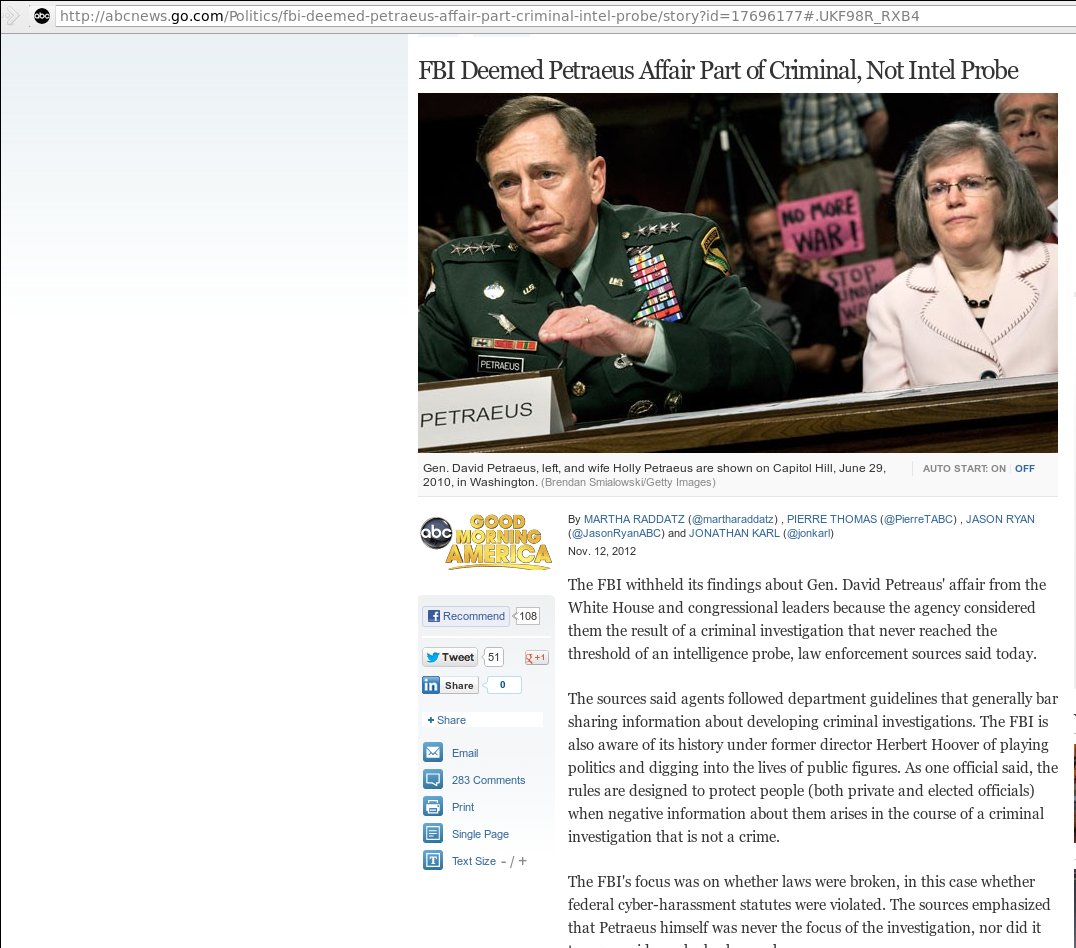
ABC News reminds its audience about the days when Herbert Hoover ran the FBI. See line 3, paragraph 2.

Meanwhile, IIRC, wasn't J. Edgar Hoover president when the stock market crashed in '29? Or was that FDR?

You make mistakes like this when history is not memorable. The authors of 1066 And All That well understood this principle:
During the Wars of the Roses the Kings became less and less memorable (sometimes even getting in the wrong order) until at last one of them was nothing but some little princes smothered in the Tower, and another, finding that his name was Clarence, had himself drowned in a spot of Malmsey wine; while the last of all even attempted to give his Kingdom to a horse. It was therefore decided, since the Stuarts were not ready yet, to have some Welsh Kings called Tudors ... who, it was hoped, would be more memorable.
Now, that's memorable history.

11/12/2012

The ACW wants you!

The president has a process for handling future secessions. Bet you didn't know that.
“If a [secession] petition gets enough support, White House staff will review it, ensure it’s sent to the appropriate policy experts, and issue an official response,” explains the [White House] website.
Big priority! And then some genius put the petition signature requirement at 25,000.

If you want to get a trash collection measure on your state ballot, do you think the threshold will be set at a mere 25,000 signatures? Is this Buchanansism or Machiavellianism? Perhaps the "policy experts" receiving the petitions work at DHS and the FBI?

White House website + do-it-yourself secession instructions = here we are in 2012. Modern nullifiers might be pleased.

The ACW remains pervasive. Let's modify Trotsky's famous saying. Tell your friends: You may not be interest in the American Civil War, but the American Civil War is very interested in you.

---

Update: petitions from 47 states have been filed at this point.

Seward by Stahr - quick notes

Stopped at Bridge Street Books in Georgetown at lunch. Found newly translated novels by Celine and Cendrars there, which made me very happy, magnifying the effect of our Indian summer warmth and sunshine.

There was also present a large new biography of Seward, something I’ve been waiting for over a long time. I picked it up and noticed the dust jacket blurbed by all the wrong people: two plagiarists (Goodwin and McPherson) and a dialectical materialist (Foner). As if further red flags were needed, the praise was about readability – as if the previous works on Seward are unusable because they are unreadable. (The dust jacket could not hold all the praise craptastic authors had for this book, so check out Amazon if you want to see storytellers and recapitulators lavishly praise one of their own.)

I put the index through my McClellan test. There were a grand total of 13 references to GBM in 717 pages. They were appallingly ignorant. In addition to relying on the usual, imaginary “letters to his wife,” author Walter Stahr showed no inkling that Lincoln had been McClellan’s employee pre-war. In discussing the Scott-McClellan relationship, he shows no awareness of the McClellan-Scott family connections described by Rafuse, nor does he have any inkling of the Scott-Seward-McClellan patronage ecology, described in part by Gideon Welles in his diary. Stahr paints McClellan and Scott one-dimensionally as enemies. He does the same with McClellan-Seward, relying on a few snippets from Sears. Seward’s early patronage takeover (from Chase) of GBM is missing, as much as it annoyed Chase, and Seward’s other military clients are also missing from this book, if my quick skim can be relied on.

It’s likely I could find a few interesting points of departure for further research in these pages, but a biographer this tone-deaf and blinkered appears more of a menace than a help to readers.

You could hitch up your pants, grit your teeth, clothespin your nose shut and start reading, but what kind of fun would that be?

11/11/2012

"A lack of critical analysis"

A friend writes about Brands' Grant book:
Don’t want to beat a dead horse, but I’m sensing a theme.

Bonds, WSJ: “. . . the book provides little analysis of Grant’s generalship. Battles are described but not dissected, and Mr. Brands presents no new sources or revelations.”

Foner, WaPo: “What Brands does not do, however, is present new interpretive insights on questions that have engaged generations of historians. . . .”

Sears(!), MHQ: “There is . . . a lack of critical analysis, especially in Grant's often complex relationship with the Lincoln administration, and little explication of just what Grant possessed that was so lacking in other Civil War generals.”
Civil War book reviews are rare - it's unusual to get three high profile such. When they do appear, as in this case, they can end up addressing a book of no merit.

BTW, Sears needs new authors to stress that special something that validates Grant and invalidates his predecessors or his storylines fall apart. The complexity-relationship comment, meanwhile, is a nod to Brooks Simpson.

A lack of critical analysis? Hallmark of pop history.

Web weirdness (O/T)

In one day (Friday), 1300 hits from Googlers searching for Petraeus. Is the web so lacking in Petraeus data that searchers have to come here?

Dear searchers: refine your searches.

Thank you!

11/10/2012

Generals who faint (cont.)

We don't do political news except as it harkens back to ACW controversies, nevertheless, the scalps were called in this blog 15 days ago, although Ham's was already taken. Let us now mark them all for the Smithsonian:

* Rear Adm. Charles M. Gaouette ("inappropriate leadership judgment") mid-east carrier strike force.

* Carter Ham, commander AFRICOM, who proposed to defy SecDef (10/18/12?).

* The general who faints, David Petraeus. Rumors are flying. Was he pro-intervention? (11/09/12)

The first two seem to be victims of Panetta's growing Stantonism.

It amazes me that Panetta could hold a press conference after Benghazi, tell everyone publicly that he ordered the military not to respond to the attack and there still is confusion over what happened.

(1) Attack is underway, DoD tells soldiers no go.

(2) Attack is underway, CIA mounts confused, delayed, inadequate response.

The Civil War reader revels in civilian control of the military and hisses theatrically, like a vaudeville theatre-goer, at the mere hint of a Harrison Bar letter. And here we are.

Civil War controversies keep repeating. It will continue so until we stop shrouding the controversies in narrative and engage them as living issues of principle.

p.s. CIA chiefs with undeclared girlfriends - as big deals go, they don't get any bigger.

11/07/2012

The Civil War wines of James River Cellars

See here.

Promotional text says: "Our graphic artist, Adam Rodriguez, has depicted 'Lee’s Last Stand' with Lee mounted on Traveller defending his case of wine."

Don't recall if Lee drank wine. But shouldn't this label be showing a victorious FJ Porter?

11/05/2012

Book blurt (cont.)

The last post listed new books. This post plays “catch up” with older titles that were comp’d or bought.

The Civil War in the East: Struggle, Stalemate, and Victory
Brooks D. Simpson

... fills a gap in Civil War literature on the strategies employed by the Union and Confederacy in the East, offering a more integrated interpretation of military operations that shows how politics, public perception, geography, and logistics shaped the course of military operations in the East.

Comment: At about 176 pages, this is what a short history is meant to be: erudite, pungent, interesting, integrative, analytical, and engaging for deep readers already familiar with the material. I cannot think of another short history that lives up this purpose, although publishers keep issuing them. A great many controversies and issues are compressed throughout and that requires reader trust. It’s a lot to ask for from strangers. Myself, having seen Simpson handle evidence on a great many issues on USENET years ago, I’ll vouch for him, if that nudges you towards a good read. His justice to the record tends towards exceptional, although it is not transparent in this brief format. Some of his characterizations may irritate, but consider that the tax you pay for a top notch essay written for sophisticates like yourselves. It's a nice concentrate of the whole Simpsonian gestalt. This is a major author in a field generally bereft of major authors and Simpson is always worth your time.

The Peninsula Campaign and the Necessity of Emancipation: African Americans and the Fight for Freedom
Glenn David Brasher

... the campaign saw something new in the war - the participation of African Americans in ways that were critical to the Union offensive. Ultimately that participation influenced Lincoln’s decision to issue the Emancipation proclamation...

Comment: This book is more about black participation than Lincoln’s cogitations. It contains lots of new research and the perspective is fresh and multidimensional, putting the military and political in tandem in a way few Civil War tomes do. I felt sorry for Brasher being directed by his park superiors to make social history for his battlefield interpretations but he has done a really fine piece of history, despite its luridly multicult overtones. It’s a delight to read a substantial ACW account where almost everything is new. The political analysis is deeper than the promotional copy implies and if the book suffers a fault it may be the narrowness of the focus here. But that is also a strength and will make this a source for future writing. This is an interesting young historian.

Sing Not War: The Lives of Union and Confederate Veterans in Gilded Age America
James Marten

... explains how the 19th Century’s “Greatest Generation” attempted to blend back into society and how their experiences were treated by non-veterans.

Comment: Marten is a prolific Civil War author you may have missed - he concentrates on social history and his books have the flavor of collections of anecdotes with fairly dry, short, spare bridges of his own text between Dickensian primary material. His taste is for the darker stuff - especially the grotesque inadequacies of 19th Century social services - and so despite the upbeat title here, when I saw “by James Marten” I knew my buzz would be harshed. Further, Marten’s technique is to transition between anecdotes by forcing a synthesis on literary terms, not analytically or conceptually. “Like many men, George Crosby had come to ...” “Despite loved ones’ resistance, veterans usually ...” “Dunn exemplifies the veteran who ...” These transitions build discontent in the reader as they seem expedients to tie the material together without leading to a general insight or argument. This all spells more ennui as readers plod through one misery after another expecting Marten to unveil a moral, an agenda, a cause. You think, “I feel I’m reading an IWW account of U.S. history but the author won’t own up.” It all just hangs there in a dark cloud. And Marten’s has been the strangest career in Civil War nonfiction.

A Savage Conflict: The Decisive Role of Guerrillas in the American Civil War
Daniel E. Sutherland

A Savage Conflict is the first work to treat guerrilla warfare as critical to understanding the course and outcome of the Civil War. Daniel Sutherland argues that irregular warfare took a large toll on the Confederate war effort by weakening support for state and national governments and diminishing the trust citizens had in their officials to protect them.

Comment: This is a hard argument to prove and I am not sure the author succeeds. The shine in this book lies in its research. I feel that Sutherland trusts the immense weight of anecdotes to close the deal for him in lieu of deep analysis. However, the many primary sources are fresh, making the stories especially compelling and with 74 pages of discursive end notes and a 63 page bibliography, what’s not to like? Amazonians give it 4.5 stars.

Masters and Savages (Novel)
James Dawsey

A saint who despises slavery yet traffics in people. A Southern hero, but also a coward. A runaway aching for home. Civil War survivor Witfield Stone totters on the brink of insanity. Entrusted with transporting contract laborers from Africa to Brazil where his father and members of the Southern Land and Immigration Society plan to reconstruct their lost fortunes, Witfield takes special interest in the fate of eleven-year-old Fatima.

Comment: Dawsey was co-author of the nonfiction Civil War publishing sensation Confederados and here tries fiction writing. This book begins as a kind of psychological study with exotic overtones and becomes a sea dog action tale as disease, a misfit sea captain, and anti-slaver patrols put the ocean-going Confederados in grave peril. I should add that it helps to think of this in terms of 1950s Catholic novels, if you were ever into that scene. Also rated at 4.5 stars by Amazon reviewers.

Lincoln and McClellan at War
Chester Hearn
Lincoln, the Cabinet, and the Generals
Chester Hearn

Comment: I’ll review these two together in a posting of their own in the near future.

The soldier vote crisis of 1864 rolls on

Republican senators write, “We are perplexed as to why DoD did not do everything in its power to modernize the system" for soldier voting.

Politics is perplexing. So is Civil War history.

11/04/2012

Brian Jordan's "Unholy Sabbath"

Unholy Sabbath is a book by a young author with a theme interesting enough to intrigue an adventurous publisher: that the Maryland battles preceding Antietam were decisive victories.

Many, perhaps most, deep readers would shrug at this.

It is the 21st Century now; this would have been hot stuff in the Centennial-dominated eighties or nineties. But the problem is that in large swaths of Civil War readership, it is still the "golden age" of ancient interpretation, and a backward readership needs to be tempted out of its caves and into the sunlight of new research and new thinking by shiny trifles that do not completely threaten all of the bad reading they have ever done.

I see this effect again and again. An author offers a breakthrough concept to a hidebound audience taking immense care not to upset them with too much novelty. There would be an insight in the center of the work and it would be surrounded by mounds of the same old same old. Newton's Joseph E. Johnston and the Defense of Richmond comes to mind. Massively revisionist in terms of Johnston, the author kowtows to every single cliche about every other general and incident. Revisionism was reserved for Johnston only.

Unholy Sabbath is exactly that kind of book. It reinforces everything that the low-information reader already "knows" while proposing a tweak to just one part of the consensus history. And maybe, politically, that's how you do it, without goring too many oxen and overturning too many apple carts.

But we're doing history here and history is our best attempt at the truth.

Here the malignant bungler McClellan accidentally achieves an outcome of import, through no virtue of his own. That is the sugar coating on the bitter pill of worthy victories.

RC Ocean gives books the "Young Napoleon" test. The higher the count of this usage in an ACW work, the less chance he will buy it. This book would fail his test.

Consider also these gems:
[1] Beyond a gross overestimation of enemy strength around Manassas, incessant carping, and criticism of the Administration, however, most of what McClellan offered was more bragadoccio.[13]

[2] With his right turned, McClellan ordered a retreat to the James River... [15]

[3] McClellan conveyed the news to his wife Ellen in his usual vainglorious style... [30]

[4} ... McClellan's caustic and predictable personality. [74]

[5] ... McClellan quickly began another round of of grousing ... [75]

[6] The general's acidic comments about McDowell and Pope continued, only inflating his already bloated ego. [75]

[7] ... Franklin proved to be as indolent and slothful as his sponsor George McClellan. [78]

[8]... McClellan refused to recognize the extent to which Lee and his men were at *his* mercy. The Army of Northern Virginia fielded at most forty thousand men [upon crossing into Maryland]. [88]
The Ocean test is fundamentally about polemics. Is the author a polemicist caught up in an emotional relationship with his material? If so, this is not history.

Brian Matthew Jordan, in my view, set out to write a battle book. This is a narrative that seeks to fill a gap in publishing rolls where there should be a South Mountain campaign. Instead of being devoted to scholarly argument around the meaning and import of those battles, this is a story about marching and shooting. In Reese's Sealed with their Lives and in Harsh's books, the shooting and marching were constantly brought back to the commander's intent. The commander's intent is missing throughout here, the commander being an vainglorious imbecile. And so, "Stamp's conspicuous death sent a shiver of panic rippling through the men of the 76th New York..." Spare me.

In the parts where people are not shooting or marching, there is page upon page of generals' bios.

Jordan did not consult Beatie, Rafuse, or Harsh's Taken at the Flood (which last is unforgivable in a volume like this). He mentions Sounding the Shallows without resorting to its data tables. He gives lip service to Clemens' Carman without referring to Carman (did I miss a reference here?), and although a citation shows he has read everything Tim Reese published on Crampton's Gap, he completely fails to understand Reese's analysis of GBM's order to Franklin, Reese's analysis of the commander's intent for all the battles along the mountain, and Reese's case for the separation of Crampton's Gap from the South Mountain action.

Not that citations here are thin. There are a lot of them but they don't advance the cause. The working sources provide quotes and anecdotes; the rest seem to be window dressing.

Ultimately, the entire case for the unique value of the battles is made in one chapter running 18 pages filled with quotes and excerpts. It's as if the publisher asked for this addition. There is almost no analysis in that chapter; the "evidence" for the importance of these battles comes from the mouths of participants and contemporaries.

Jordan has virtues as a storyteller and will do well with his next book if he can limit the snide remarks, the emotional outbursts, and the big-picture stuff. He needs to really engage with the secondary sources, the controversies, and the implications of higher analysis.

On some level, this is an okay shoot-em-up, but who among advanced readers needs that?

---
Notes on the excerpts quoted above:

[1] I know of no first hand accounts of McClellan's carping, criticism, or bragadoccio. None. There should be some somewhere, but everyone who dealt with him found him to be kindly, courteous, attentive, and I would add concise, energetic, and at times, fun. Carping, etc. may be the author's readings of some notes found in the McClellan papers as rendered by Sears. They do not correlate to any wartime remembrances. Regarding strength around Manassas, McClellan passed through raw intelligence which he labeled as pass-through information. The Civil War author generally does not know the difference between intelligence and analysis, analysis being what produces an estimate.

[2] The sequence is wrong. It would have been a retreat if this sequence was correct. A change of base started before the battle began.

[3],[4],[5],[6] This stream of vituperation seems to be based on Sears' renderings of notes found in the archives and do not correspond to any observed behavior of McClellan during the war.

[7] Franklin's sponsors were many starting with Salmon Chase, then Irvin McDowell, then McClellan, Banks, ultimately even Grant who tried to get him a command after the Red River campaign.

[8] That Lee crossed into Maryland with 40,000 men is not sourced. It is a remarkable contention worth its own book. The author has taken pains to avoid Fox, Livermore, Longstreet's writing on the subject, and Harsh's tabulations. He likewise avoids the testimony on enemy strength given Lincoln by the US corps commanders after the battle.

11/02/2012